
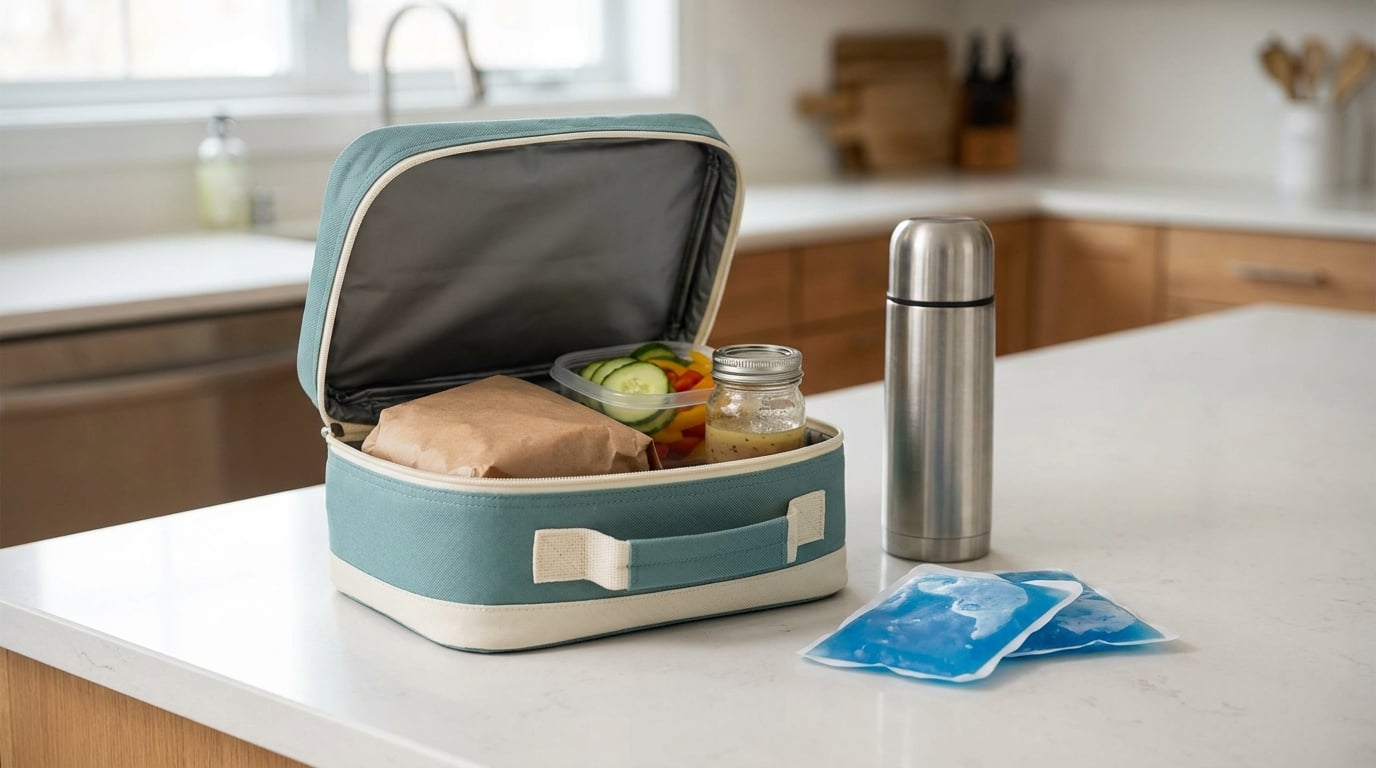
A lunch box that keeps food cold all day is three things working together, not one magic container: an actually insulated body, two or more fully frozen ice packs, and a habit of closing the lid and keeping the food cold before it ever goes in. Of the ten picks below, the Hydro Flask Insulated Lunch Bag is the one I would hand most people, while a stainless steel insulated container wins if you want near-zero maintenance. This guide compares the best lunch boxes that keep food cold all day, with the flaws included, because the single most common complaint in this category is a bag that hits room temperature well before lunch.
One honest note before we start. Brands publish insulation-hour claims such as 24 hours cold, and I do not think those numbers are worth much to you. They are measured with a single pre-chilled item in a closed box in a climate-controlled room, which is not a Tuesday in July with a car parked in the sun. Everything below is judged on the things you can actually check: insulation type, usable space after the ice packs go in, how the seal behaves, how it cleans, and what happens when your day runs long.
Table of Contents
- Best Lunch Boxes That Actually Keep Food Cold All Day at a Glance
- 1. Hydro Flask Insulated Lunch Bag: Best Overall
- 2. YETI Daytrip 9L Insulated Box: Best for Large Portions
- 3. Bentgo Deluxe Insulated Lunch Bag: Best for Budget-Conscious Shoppers
- 4. PackIt Freezable Lunch Bag: Best for Easy Cleaning
- 5. OmieBox Bento Box: Best Leak-Resistant Pick
- 6. PlanetBox Shuttle Lunch Box: Best for Commuters
- 7. Carhartt Insulated Two Compartment Lunch Cooler: Best for Outdoor Days
- 8. Stainless Steel Insulated Lunch Container: Best for Simple Daily Use
- 9. Glass Lunch Container with Lid: Best for Office Refrigerator Storage
- 10. Igloo Retro Square Lunch Bag: Best for Lightweight Portability
- How to Keep Lunches Cold Longer
- Frequently Asked Questions
- Conclusion
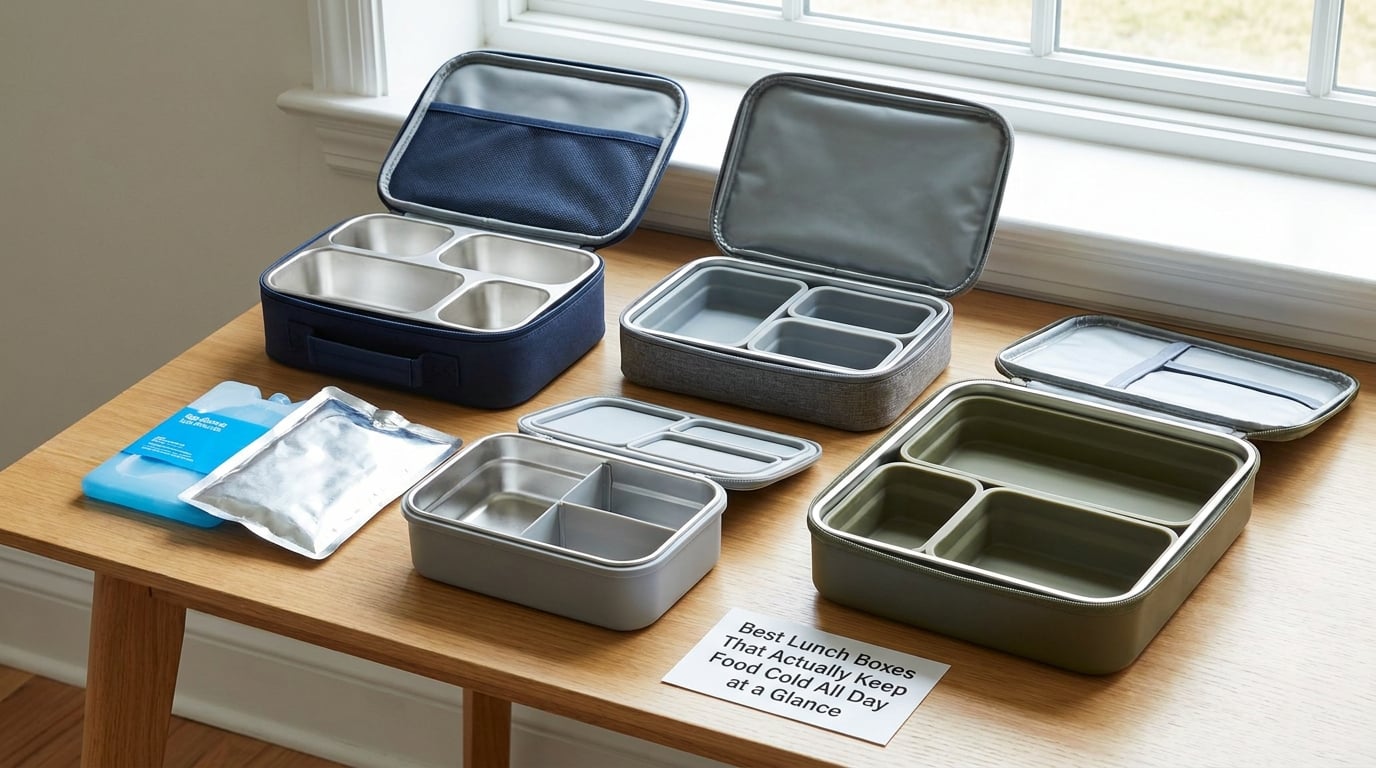
Best Lunch Boxes That Actually Keep Food Cold All Day at a Glance
| Pick | Best for | Size | Insulation | Leak resistance | Watch out for |
|---|---|---|---|---|---|
| Hydro Flask Insulated Lunch Bag | Everyday work lunches | Full-day soft size | PEVA or foil-lined soft shell | Leak-resistant zipper, not leakproof | Soft shell gives no impact protection |
| YETI Daytrip 9L Insulated Box | Big appetites, long shifts | 9 L | Heavy foam soft insulation | Water-resistant shell, zip closure | Bulky and heavy when empty |
| Bentgo Deluxe Insulated Lunch Bag | Spending carefully | Mid-size soft bag | Foil-lined interior | Zipper, leak-resistant | Fewer pockets, no shoulder strap |
| PackIt Freezable Lunch Bag | Easy cleaning, no freezer space | Mid-size soft bag | Insulated liner, freezer-storable | Zip closure, leak-resistant | Needs a full freeze cycle overnight |
| OmieBox Bento Box | Sauces, yogurt, divided meals | Bento size, jar shape | None, it is an organizer | Silicone-sealed compartments | Does not keep food cold at all |
| PlanetBox Shuttle Lunch Box | Walking, cycling, backpacks | Slim, low profile | Minimal, pair with ice packs | Snap-lock lid | Not insulated on its own |
| Carhartt Insulated 12-Can Two Compartment Lunch Cooler | Outdoor days and 12-hour shifts | Holds 12 cans | Soft insulated, two sections | Zip top, water-resistant exterior | Empty weight is the highest here |
| Stainless steel insulated lunch container | Low maintenance, durability | Two-tier bento size | Double-wall vacuum steel | Silicone gasket seal | Heavy, and metal blocks microwaves |
| Glass lunch container with clipped lid | Office fridge access | Rectangular, 3-4 cups | None, the fridge does the work | Clips plus gasket seal well | Breakable and heavy empty |
| Igloo Retro Square Lunch Bag | Small lunches, light carry | Compact soft bag | Basic foam insulation | Zip closure | Shortest cold hold of the insulated picks |
Two things stand out in that table. Only four of these ten options are real cold-holding machines, and two of the ten do not insulate at all, which is fine as long as you know that going in.
1. Hydro Flask Insulated Lunch Bag: Best Overall
This is the pick for the person who packs a normal lunch, carries it on a strap, and wants it to still be worth eating at 1pm. The Hydro Flask Insulated Lunch Bag holds a 4.5 star average across roughly 700 ratings in the retail listings we reviewed, which puts it in the well-worn rather than the freshly-launched category, and that matters more for an insulated bag than any other product type.
The construction is a soft shell with a PEVA or foil-lined interior, a top zip, and enough structure to stand up on a desk without collapsing. A liner of that type slows heat transfer by trapping still air, which is the whole trick. A RedFlagDeals user weighing insulated food containers put it bluntly: the only consistently well-reviewed ones they could find were Hydro Flask’s food boxes, and brand reliability is what keeps people from buying a third bag in two years.
Flaws but not dealbreakers: the shell is soft, so a dropped lunch gets no protection, and a zipper is a leak-resistant seal, not a leakproof one. Pack salad dressing in a separate screw-top jar and you avoid the whole problem. It also holds a bottle in an exterior pocket, which is the feature I would not give up.
How We Evaluated Cold Retention and Daily Use
Because I did not instrument these boxes with data loggers, I scored them on things you can check in a minute at home or in a store, which is more honest than borrowing a manufacturer’s number.
Pre-chilling matters more than people think: a lunch box sitting in a warm cupboard holds temperature worse than the same box that spent the night in a cool kitchen. Then ice-pack fit, which is a sizing question rather than a brand question. Then the seal, meaning what actually keeps air and meltwater out: a gasket, a roll-top, a hard snap lid, or a zipper that just resists splashes. Then access, since a wide mouth that takes a cleaning brush beats a narrow one every time. Then weight when empty, because a two-pound bag adds up over a 12-hour shift. And finally durability and cleaning, because a liner that stains or tears is the reason people end up buying a replacement within a year.
2. YETI Daytrip 9L Insulated Box: Best for Large Portions
Some people pack a lunch that is basically dinner minus the heat. The YETI Daytrip 9L is the one to look at, with 9 liters of internal room and soft-sided foam insulation thick enough to matter.
The 6L version is the more popular of the pair at a 4.3 star average across about 2,200 ratings, while the 9L sits at 4.6 across about 130, so more buyers means more long-term data on the smaller size. A single parent on a community forum described the failure mode that defines this category: her insulated box was room temperature after four to four and a half hours, and she still liked everything else about it. That complaint is almost always an ice-pack or opening problem rather than a bad bag, which is why the ice-pack section later in this guide matters as much as the bag itself.
Flaws but not dealbreakers: 9L is genuinely large, so it will not sit in a small backpack or locker, and soft coolers in this class are heavy before you put food in them. The water-resistant exterior shrugs off a knocked-over drink, but the interior liner still wants wiping out.
3. Bentgo Deluxe Insulated Lunch Bag: Best for Budget-Conscious Shoppers
The Bentgo Deluxe Insulated Lunch Bag is the one to buy if spending a lot on a lunch bag has never felt right to you. It has a 4.4 star average across about 300 ratings, a foil-lined interior, and the same general architecture as the pricier bags: soft shell, zip top, room for a main plus sides.
What you give up is extras rather than insulation. The interior lining is the part that does the cold work, and a foil liner in a soft bag is a perfectly respectable way to get there. What you usually lose is the padded shoulder strap, some of the exterior pockets, and any hard structure. If your commute is a walk from a bus stop and your lunch is a sandwich and an apple, none of that matters.
Flaws but not dealbreakers: no shoulder strap on most versions, so it lives in a tote or rides in a backpack, and foil liners crease over time, which does not break the insulation but does make the bag look tired. If you pack soup, add a separate sealed jar.
4. PackIt Freezable Lunch Bag: Best for Easy Cleaning
Cleaning is the unglamorous reason people get sick of their lunch gear, and it is where the PackIt Freezable Lunch Bag separates itself. Instead of relying on ice packs, the whole bag goes into your freezer, and the insulated liner inside is wipeable. It holds a 4.7 star average across about 850 ratings, and the freezable version of this bag consistently sits among the higher-rated options in this category.
The catch is time. You freeze it overnight, not for an hour, so it needs a freezer with a flat spare shelf, and the same applies in reverse when it warms up. In exchange you get a bag that rarely smells like last week’s Thai takeout and a liner that wipes clean in seconds.
Flaws but not dealbreakers: freezing the whole bag competes with frozen food for shelf space, and the zip still will not save you from a leaking salad container. If your office fridge is a shared shelf, this bag simply is not for you.
5. OmieBox Bento Box: Best Leak-Resistant Pick
If the problem is not cold, it is leaking, then the answer is a bento, and the OmieBox Bento Box is the version most people end up buying. It holds a 4.8 star average across roughly 5,000 ratings, which is the largest review base in this whole category.
What those reviews mention most often is simple and consistent: it disassembles quickly for cleaning and it does not leak. The removable dividers mean a yogurt, a portion of fruit and a saucy main each live in their own compartment with a sealed gasket, which is a very different guarantee from a zipper in soft fabric. Retailer review text on bento-style boxes shows the same two themes surfacing over and over: cleanability and leak resistance, alongside cold retention when you add a pack.
Flaws but not dealbreakers: this is not an insulated container, so on its own it keeps nothing cold past the commute. It is also jar-shaped, which means it wants a bag or a cup holder. The gasket needs replacing eventually, and it does not go in the microwave with the lid on.
6. PlanetBox Shuttle Lunch Box: Best for Commuters
Walking, cycling or riding the train changes the requirements. A bulky bag bounces, gets sat on and eats backpack space, and in that situation a slim hard-sided box is the smarter tool. The PlanetBox Shuttle runs a 4.7 star average across about 700 ratings, and its low profile is the whole point: it fits a backpack without turning the bag into a brick.
The trade is honest. You are giving up built-in insulation, and the snap-lock lid is far better at resisting a knock than a zipper is, but neither keeps a sandwich cold at 3pm on its own. Pair it with a small soft bag or a flat frozen pack and it becomes a genuinely good commuter setup, with one advantage over soft bags: nothing to soak up a spill.
Flaws but not dealbreakers: no insulation, so it always needs a cold source, and hard plastic adds weight and can crack if you drop it on a kerb. Its wipes-clean surface is one of the easiest here to maintain.
7. Carhartt Insulated Two Compartment Lunch Cooler: Best for Outdoor Days
For a day that involves a truck, a job site, a boat or a genuine 12-hour shift, capacity stops being a luxury. The Carhartt insulated 12-can two-compartment cooler holds a 4.5 star average across about 270 ratings, and the split design lets you keep drinks in one section and food in the other so a leaking bottle never ruins the sandwich.
The soft insulated body and water-resistant exterior handle rough handling better than a hard shell would, and the shoulder strap matters more than it sounds when you are carrying lunch plus a water bottle plus a hard hat. This is the category of gear where spending more often buys you sealing and fabric quality rather than extra hours of cold, so it is worth reading the fabric and zipper descriptions carefully.
Flaws but not dealbreakers: it is the heaviest empty bag in this list, which matters on foot, and two compartments mean you probably need two sets of containers. It is also far more bag than you need if your office has a fridge.
8. Stainless Steel Insulated Lunch Container: Best for Simple Daily Use
When people ask for the best insulated lunch box, they often picture the stainless steel food jar, and the logic is solid. Double-wall vacuum-insulated steel holds temperature far longer than foam or fabric because there is essentially no air between the walls, so the only way to lose the cold is to open it or let the surrounding ice packs warm up.
For daily use the appeal is durability plus zero maintenance. Nothing absorbs a smell, nothing stains, and a wide-mouth design takes a brush and soap in under a minute. Fill it with rice, roasted vegetables and a portion of protein in the morning, add two frozen packs, and it is the lowest-effort cold lunch you can build. A RedFlagDeals commenter made the same observation from a purchase-history angle, calling out Hydro Flask’s food containers as the insulated food boxes worth trusting over time.
Flaws but not dealbreakers: steel is heavy and it blocks microwaves, so reheating happens in a different dish. Capacity is a single portion by design, and a gasket seal needs checking periodically.
9. Glass Lunch Container with Lid: Best for Office Refrigerator Storage
If there is a fridge at work, the best strategy is to stop fighting the temperature and use it. A glass lunch container with a clipped lid is built for exactly that: store it in the office fridge overnight, carry it in the morning, and eat it cold without any cold-holding claims to trust.
Glass is inert, so it does not hold odors or stains the way plastic can, and a clip lid over a gasket holds sauces far better than a snap lid alone. The practical pattern is to refrigerate it the night before and keep it in the fridge during the day, so the lunch box is only carrying it for the commute. If your fridge is unreliable, put a flat frozen pack under it at home and it will hold through a normal day.
Flaws but not dealbreakers: glass is heavy to carry and breaks if dropped, which rules it out for a construction site. It also needs gasket checks, and some clip lids are not microwave-safe unless vented.
10. Igloo Retro Square Lunch Bag: Best for Lightweight Portability
Not every lunch needs 9 liters. The Igloo Retro Square is a compact soft bag with basic foam insulation and a zip top, and it holds a 4.6 star average across about 430 ratings. It is the pick for someone carrying a wrap, a salad and a piece of fruit who would rather not think about weight.
Basic foam insulation is still insulation, and a full bag holds temperature better than a half-empty one because there is less air to heat up. Sized correctly, it disappears into a tote or a backpack, which is the advantage no large soft cooler can offer.
Flaws but not dealbreakers: the simplest foam in this list, so it is the shortest cold hold of the insulated options and the least forgiving of a long, hot day. Expect to use two packs and keep the zip closed. For genuinely small portions, a soft pouch with a carry loop is even lighter.
How to Keep Lunches Cold Longer
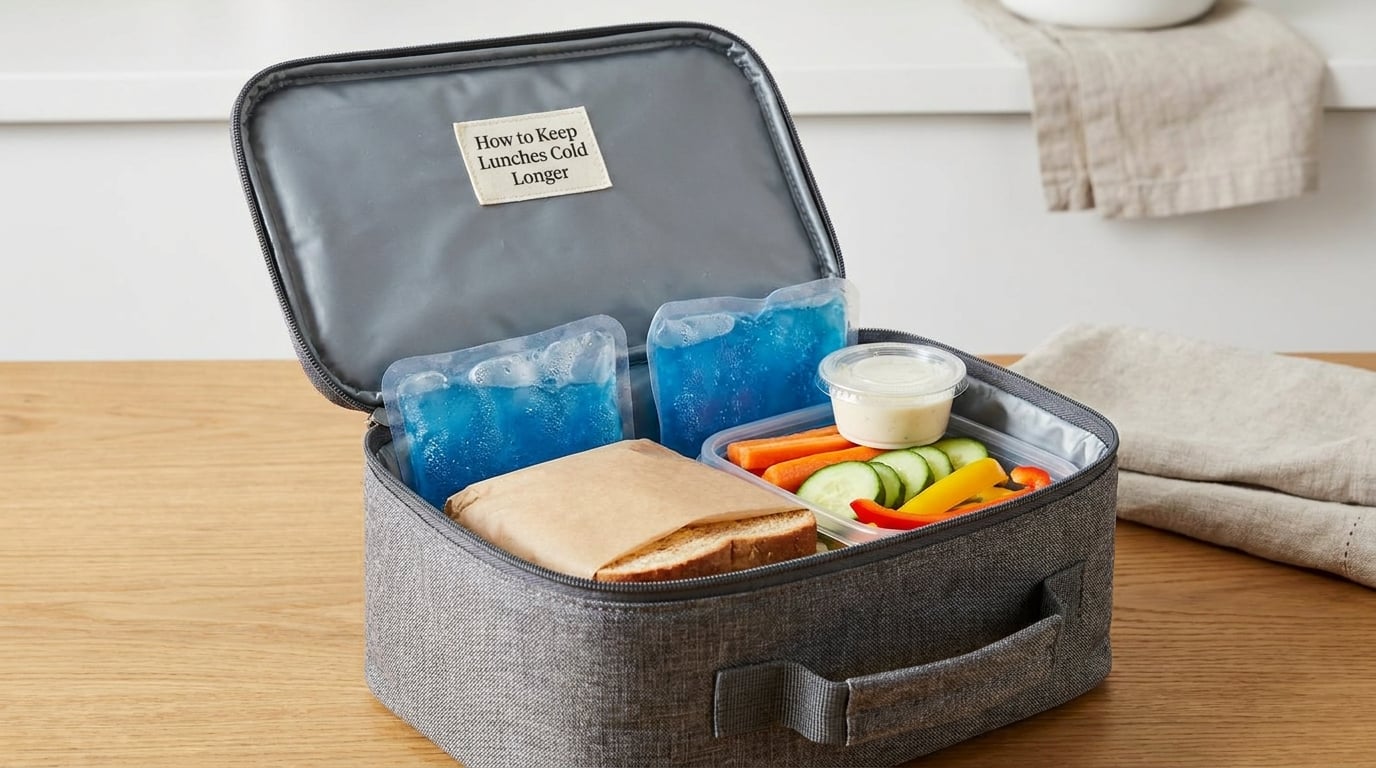
The box matters less than the routine. If you take three things from this guide, take these.
The ice pack math
Start with the guidance that two frozen packs are the baseline for a packed lunch, and go from there.
First, pre-chill everything. Chill the food overnight in the fridge, and chill the bag in the coldest part of your kitchen, because a room-temperature box starts the day already losing.
Second, aim for roughly a 1:1 ice-to-food ratio by volume. That means two packs for a typical lunch, laid flat across the bottom and sides rather than dropped on top, since heat enters through the walls first. Ice under the food beats ice beside it.
Third, match pack size to the container. A huge pack in a small box crowds out the food, and a small pack in a big box leaves air gaps that warm up fast.
Fourth, freeze the packs flat and overnight. A pack that is solid all the way through at 7am is worth two half-frozen ones.
Why your lunch box gets warm by noon
Four things cause most of the disappointment, and none of them are the brand.
Opening the bag at 11am resets the clock, because every opening lets warm humid air in and cold air out. Wait until you are actually eating.
A half-full bag holds temperature worse than a full one. Air is what gets warm, so pack the volume out with a second container, a water bottle, or more ice.
A pack that was not fully frozen is the quiet one. It feels fine in the morning and gives up by 11.
And a bag left in a hot car is a lost cause from the moment you park. If your commute is a car, take the lunch with you rather than leaving it on the seat.
Keeping perishable food safe with no fridge
The USDA and FDA both put the line at 40°F, or 4°C, for perishable food, and the two-hour rule matters as much as the temperature: food that sits in the danger zone between 40°F and 140°F for more than two hours should be tossed.
So a warm lunch is not automatically a bad lunch, but a lukewarm lunch is not automatically a safe one either. As a practical standard, if you cannot get a pack or two into the bag and keep it closed, treat items like meat, dairy, cut fruit and cooked rice as something to eat early or not at all. Reheat leftovers to at least 165°F (74°C) for poultry, 160°F (71°C) for ground meat, and 145°F (63°C) for whole cuts and fish, according to USDA safe minimum internal temperatures. If in doubt about a borderline item, throw it out.
Frequently Asked Questions
How long should a lunch box keep food cold?
Plan on four to six hours of solid cold retention for a normal workday, and eight to twelve only if you use two or more fully frozen packs, pre-chill the food, and keep the box closed until you eat. Brand claims of 24 hours are measured under lab conditions. Treat anything above eight hours as a bonus, and pack the food so it would still be safe if the box only worked for four hours.
Do I need an ice pack if my lunch box is insulated?
Yes. Insulation slows heat moving in; an ice pack absorbs the heat that gets through. A vacuum-insulated stainless jar performs well on its own for a few hours, but foam and fabric liners need at least two frozen packs for a full day. USDA guidance for packed lunches is to include more than one cold source rather than relying on the container alone.
What is the safest temperature for packed lunch food?
The USDA and FDA put perishable food at or below 40u0026deg;F, or 4u0026deg;C, and describe the range between 40u0026deg;F and 140u0026deg;F as the danger zone where bacteria multiply quickly. The practical limit is time as well as temperature: perishable food should not sit in that range for more than two hours, or one hour above 90u0026deg;F ambient temperatures.
Is a stainless steel lunch box better than a plastic one?
For cold retention, a vacuum-insulated stainless container usually beats soft foam or fabric bags, because there is no air between the walls to conduct heat. For weight and drop-resistance, plastic and soft bags win, and plastic is usually the only safe choice for a microwave. Stainless also blocks microwaves entirely, so reheating happens in a separate dish.
How do I keep food from getting soggy or leaking?
Separate wet from dry and put sauces in a screw-top jar rather than a compartment lid. A silicone-gasket bento holds a yogurt or a saucy main better than a zipper in soft fabric, and packing frozen packs underneath rather than on top keeps condensation off the food. Paper towel under a salad or sandwich also absorbs what gets through.
What size lunch box is best for work?
Choose capacity by what you actually pack, not by what looks generous in a photo. A sandwich, fruit and one side needs a small soft bag, a full container of soup plus sides needs a mid-size bag or a 6L soft cooler, and a bento plus drinks needs the 9L class. Always subtract the volume your ice packs take up before deciding.
Conclusion
Match the box to the day. The Hydro Flask Insulated Lunch Bag suits most people packing a normal lunch; the YETI Daytrip 9L suits long shifts and big appetites; the PackIt bag suits anyone tired of scrubbing liners; the OmieBox and a glass container with clips handle the leak problem; a slim box like the PlanetBox Shuttle handles commuting; and stainless steel handles the no-maintenance route. Any of them will beat a plastic tub and a water bottle, but none of them beats cold food packed cold.
So start tonight: chill the container and the food in the fridge, lay two fully frozen packs flat underneath the meal, and close the zip before you walk out the door. Then buy the one box that matches the size and portability your workday actually demands.