
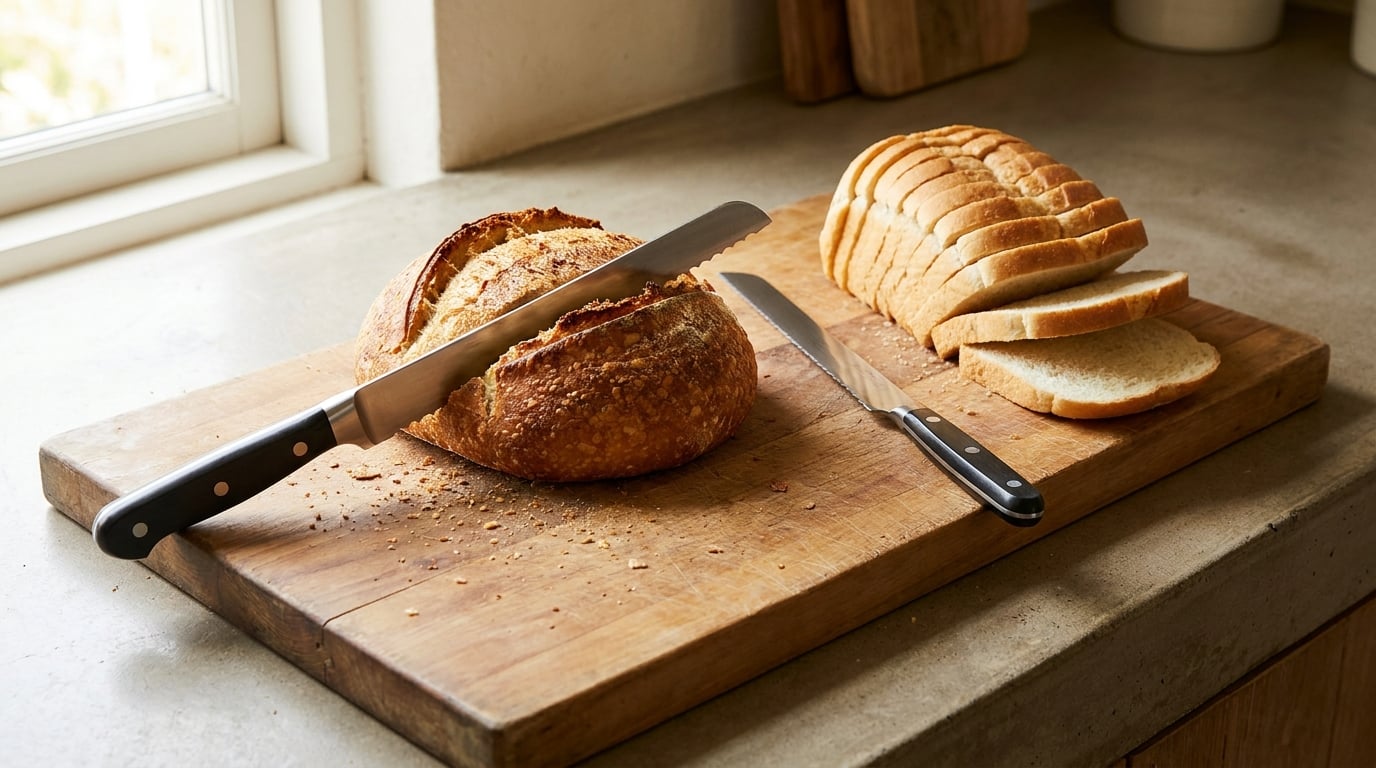
The best bread knives for crusty loaves and soft sandwich bread come down to blade geometry, not brand. A long serrated blade with moderately deep teeth bites into a hard sourdough crust, and a thin blade with a straight or gently scalloped edge slides through white sandwich bread without squashing the crumb. Most kitchens only ever need one, and the deciding factor is the tooth.
There is a second reason geometry outranks prestige here. A serrated edge cannot be sharpened at home, so how sharp it arrives and what steel sits behind it matter far more for a bread knife than for a chef’s knife you can correct on a Sunday morning. Buy a dull premium knife and you have simply paid more to keep a dull knife.
One thing to name up front, because it is where most buyers get confused: the big outlets do not agree on a single winner. Wirecutter and The Perfect Loaf both put the Mercer Culinary Millennia Wavy Edge M23210 at the top, Bon Appetit named the MAC Superior 10.5 inch its best overall after testing 36 blades, and Serious Eats went with the Tojiro F-737 235mm. They tested different things, mostly crust, cake and tomatoes, and prices move constantly. Everything below reflects their published verdicts plus what bakers report on The Fresh Loaf and r/BuyItForLife, not a test lab of my own.
Table of Contents
- Best Bread Knives for Crusty Loaves and Soft Sandwich Bread at a Glance
- Serrated Bread Knives for Crusty Loaves
- Straight-Edged Bread Knives for Soft Sandwich Bread
- Which Bread Knife Should You Choose?
- Frequently Asked Questions
- Is a serrated bread knife better for soft sandwich bread?
- What type of knife cuts a crusty sourdough loaf without crushing it?
- Do I need a separate knife for soft bread and crusty loaves?
- Are serrated bread knives harder to sharpen than straight-edged ones?
- What bread knife length works best for baguettes and sandwich loaves?
- Can I put a bread knife in the dishwasher?
- Bottom Line
Best Bread Knives for Crusty Loaves and Soft Sandwich Bread at a Glance
Two blade shapes, two cutting actions, and one row each. The quickest way to see the whole argument is to compare them on the seven things that actually change your slices.
| Criterion | Serrated bread knife | Straight-edged bread knife |
|---|---|---|
| Blade type | Long, usually curved, with individually sharpened teeth set below the surface | Long blade with a smooth non-serrated edge, sharpened on one or both sides |
| Best bread types | Sourdough miche and boule, batard, rustic rye, seeded loaves, baguettes, bagels | White sandwich bread, milk bread, pain de mie, enriched loaves, burger buns |
| Cutting action | Slow back-and-forth sawing with almost no downward force | One long smooth pull, with steady downward pressure |
| Crumb control | Excellent on firm crumb, can tear very soft crumb | Excellent on soft crumb, compresses hard crust |
| Maintenance | Hand wash, dry immediately, effectively unsharpenable at home | Hand wash, dry immediately, can be honed on a stone |
| Typical price tier | Entry level through premium | Entry level through mid-range |
| Clearest use case | Crust-forward loaves, plus tomatoes, watermelon and cake | Delicate soft bread, ripe produce and deli meat |
One row deserves emphasis. Notice that neither column wins on maintenance: both want hand washing and immediate drying, and both end up in a block or on a strip. The difference is that a straight edge can be rescued after a bad week and a serrated one cannot.
Serrated Bread Knives for Crusty Loaves
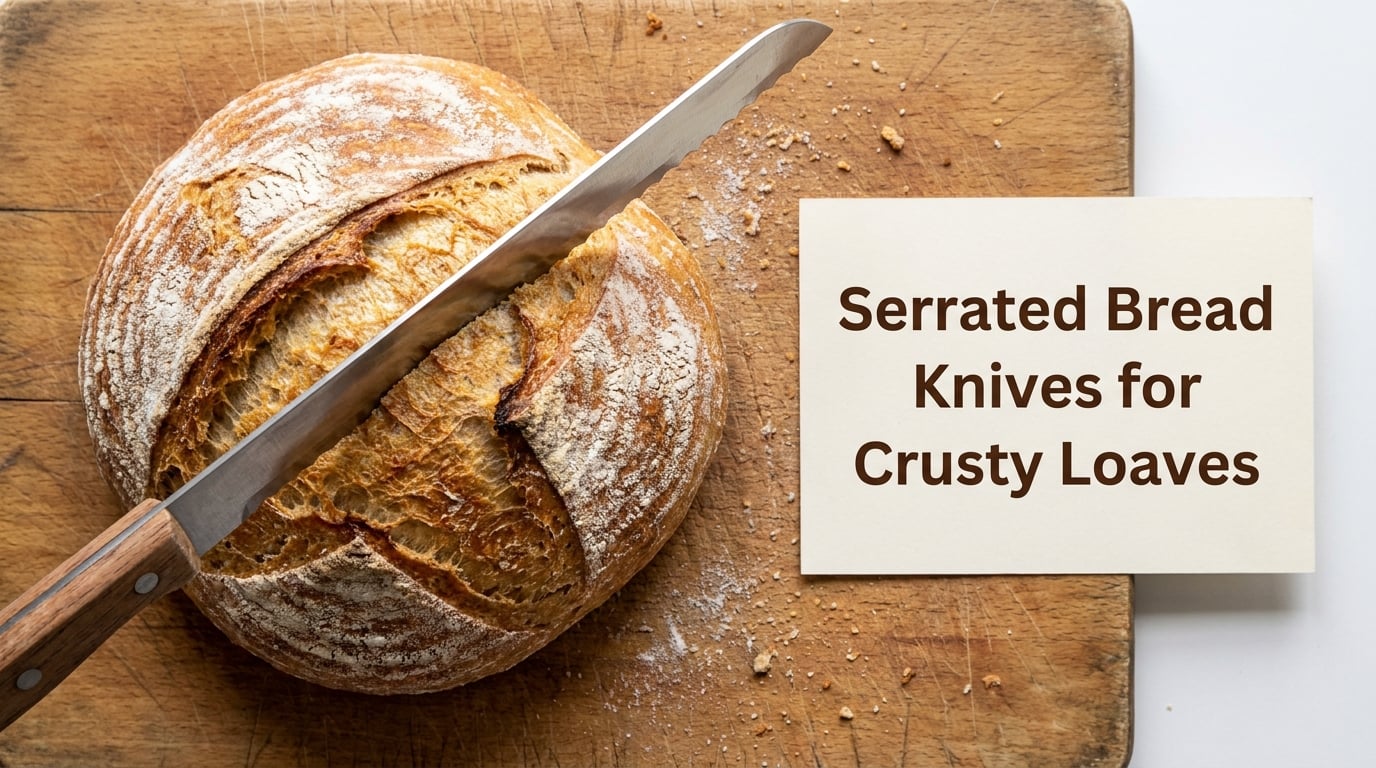
A serrated bread knife cuts with two parts working together, and understanding them explains everything else. Each tooth is a small point, sharpened on both sides and set below the flat of the blade. Below and between the teeth sit scalloped recesses, concave scoops that sit almost at the level of the blade’s spine. The tooth grips the crust on contact; the recess shears the crumb behind it.
That split is why serrated blades handle sourdough, batards, rye, seeded loaves, baguettes and bagels so well. The outer skin offers something to grab, and once the teeth have a hold, the sawing motion does the rest with almost no downward force. The crumb never has to be pushed through.
The Mercer Culinary M23210 is the clearest example on the value shelf: a 10 inch blade of high-carbon stainless steel, about 6 ounces, with pointed serrations that are moderately sized and well spaced, a textured handle, and no full tang. Wirecutter reports four years of heavy sourdough cutting on one with a blade still pretty much as new. The MAC Superior 10.5 inch runs longer, at roughly 15.38 inches overall with a 10.75 inch blade and rounded teeth, and its curved belly extends about half an inch past the handle for leverage on a wide boule.
Where serrations lose is very soft bread. A pointed tooth that can chew through a 2mm crust will happily catch the top of a fresh white sandwich loaf, lift a flap of surface, and leave the middle compressed underneath. That torn-top-plus-squashed-middle combination is the single most repeated complaint from bakers, and it is a tooth problem, not a technique problem alone.
Serrated vs. Straight: How Each Blade Handles the Loaf
Five variables separate the two edges in the hand, and once you can name them, the choice stops being a matter of taste.
Tooth direction. Serrations cut on both the pull and the push, which is why they can back out of a crust without tearing it. A straight edge only cuts cleanly on the direction its bevel allows, so the whole stroke has to be planned before the blade lands.
Tooth depth. Too deep and the edge gives a hacking action that crushes what it lands on. Too shallow and it skates off a crusty loaf without ever finding purchase, which is exactly the complaint buyers attach to cheap knives that arrive blunt: the blade refuses to find a groove to grab.
Pressure. This is the big one. A serrated blade needs nearly no downward force, because the teeth convert horizontal motion into cutting. A straight blade has no teeth to do that work, so the hand adds downward pressure, and downward pressure is precisely what compresses bread into a dense, unappealing slab.
Stroke speed. Serrations reward a slow, even cadence, roughly one stroke per centimetre. Straight edges reward a single committed motion; going back and forth on a straight edge just drags the face across the crumb.
Crumb compression. The scalloped recess lifts away crumb as it passes. A flat face in contact with crumb has nowhere to go but down, so it smears instead of cutting. This is the mechanical reason soft bread and serrated teeth sit in tension, and why technique can narrow that gap considerably.
Straight-Edged Bread Knives for Soft Sandwich Bread
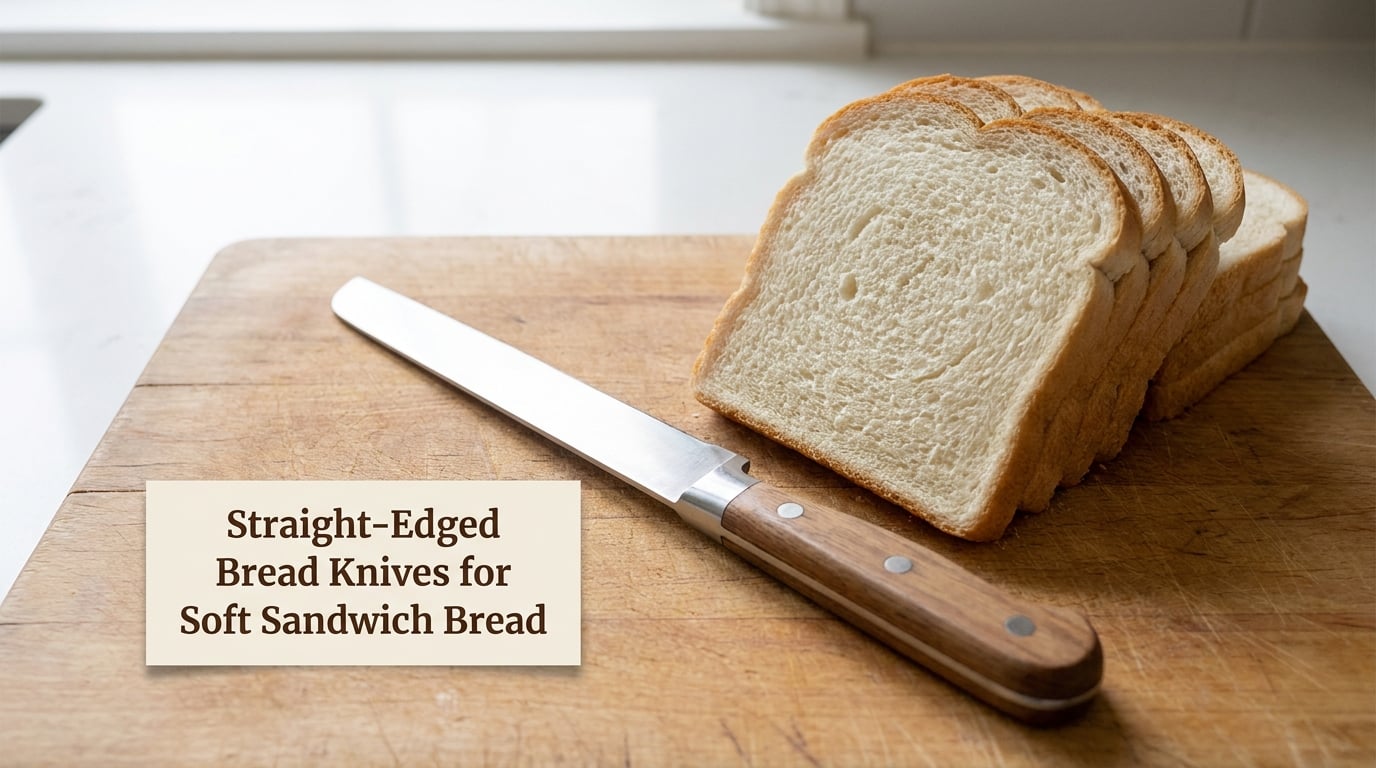
A straight or shallow-scalloped edge gives the flattest, cleanest slice of white sandwich bread you can get, because the edge removes material cleanly without catching and lifting the surface. On packaged sandwich loaf, milk bread, pain de mie and enriched loaves, that is the difference between a slice you can butter and a slice you press back together to reassemble.
Soft bread compresses for three reasons, and only the first is about the knife. Too much downward force is the big one. Aggressive pointed teeth are the second, since they grab and tear a surface that has no resistance. A thick blade is the third, because more steel riding on the loaf means more of the loaf is being pushed aside instead of removed.
The clearest demonstration on record is the Shun Premier 9 inch, whose Damascus steel VG-MAX core and full tang were shown slicing soft pain de mie without distortion, backed by free lifetime honing from the maker. The Wusthof Classic 9 inch double serrated takes a different route, nesting small teeth inside the larger scallops so each point wears less and stays effective longer on waxy surfaces. And the forums contain a useful counterpoint: a commenter on a sharpening thread reported that a recently sharpened ordinary kitchen knife cut bread with no squishing at all, which reframes the real requirement as sharp enough today rather than premium serrations.
The honest limit is hard crust. On a sourdough boule a straight edge skids on the first contact, then rides down and compresses the whole slice. If crusty loaves are half your baking, a straight-edged knife is a specialist tool, not a replacement.
What to look for in a bread knife for soft sandwich bread
Measure your widest loaf first, because that single check eliminates most returns. Then look for a blade at least 9 inches, preferably thin, with a rounded tip so it can travel into a bag without spearing it, and a full tang so the blade does not twist when you press. Handles with a bolster or a decent palm swell resist a wet, floury hand better than smooth plastic. Shallow scallops are a fair middle ground if you want one edge that leans soft while still catching a crust now and then.
Which Bread Knife Should You Choose?
If you bake crusty bread, buy serrated, and buy long. Nine inches covers most loaves, while 10 inches or more earns its place the moment you start making miche or wide boules, because a blade shorter than the loaf means turning the loaf constantly. Pointed or moderately deep teeth, a curved blade for knuckle clearance, and a full tang are the specs that matter.
If you mostly slice packaged bread, buy thin. A 9 inch straight or shallow-scalloped knife, plus a damp towel under the board or a bread slicing guide, will do more for your sandwiches than any amount of spending on teeth. The user who reported finally being able to cut a sandwich with an America’s Test Kitchen-recommended Tojiro was describing exactly this problem.
If you want one knife for both jobs, the honest answer is a compromise tooth: a 9.5 to 10 inch serrated blade with moderate tooth depth and generous scalloped gaps, and the technique below. The Mercer M23210 is the working example of that compromise at a price nobody can argue with. Owning both knives only makes sense if you genuinely bake weekly and slice packaged bread most days, and even then the second knife belongs in a drawer, not on the counter.
Before buying anything, diagnose what you already have. Press the edge onto a ripe tomato: if it skids instead of biting, the teeth are too rounded to matter. Lay the blade across your widest loaf: if it does not span it, the answer is to halve the loaf, not to shop. Cut a slice of soft bread and look at the top surface: a torn flap means the teeth are too aggressive, while a dense, flat slice means the cut needed less pressure than you gave it. Only when the knife fails on all three counts is replacing it the rational move.
How to slice a loaf without squishing it
- Lay a damp towel under the board. It stops the loaf sliding and the board walking, which is most of what people call a squashed slice.
- Halve the loaf first, then stand the half cut-side down on the board. Several bakers on Reddit recommended this independently, and it is the single most effective fix there is.
- Hold the loaf with fingertips flat on the far side, knuckles well clear of the blade line.
- Rest the blade on the crust and make a shallow groove with a gentle back-and-forth motion before you gain any forward travel. A blade that has not found its groove yet will skid and tear the top.
- Saw with no downward pressure at all. If you feel your forearm pushing down, stop and restart at step four.
- Slice from the middle outward, so the most representative slice comes first and the crumbs land at the end rather than on your best pieces.
Frequently Asked Questions
Is a serrated bread knife better for soft sandwich bread?
Not automatically. A serrated knife with deep pointed teeth will catch the top of a very soft loaf and tear it while compressing the middle. A thin straight-edged knife, or one with shallow scallops, gives the flatter slice. If a serrated knife is all you own, the fix is technique rather than a new purchase: rest the blade, find a groove, and saw with no downward pressure.
What type of knife cuts a crusty sourdough loaf without crushing it?
A long serrated bread knife, 9 to 10.5 inches, with pointed or moderately deep serrations and a curved blade. The teeth bite the crust while the scalloped recesses between them shear the crumb, so you saw rather than push. Halve the loaf first and stand it cut-side down, and use almost no downward force on the stroke.
Do I need a separate knife for soft bread and crusty loaves?
Usually not. A 9.5 to 10 inch serrated knife with moderate tooth depth and generous scalloped gaps handles both jobs, which is why most bakers keep exactly one. Consider a second, straight-edged knife only if you slice packaged sandwich bread most days and the pointed teeth keep catching the soft surface. Owning two is a luxury rather than a requirement.
Are serrated bread knives harder to sharpen than straight-edged ones?
Yes, considerably. Every tooth is sharpened separately, usually with a ceramic rod or a triangular sharpening system matched to the tooth geometry, and mistakes cannot be undone. A straight-edged blade can be honed on a stone in about a minute. Because of that, buy a bread knife that starts sharp, since a dull serrated knife rarely improves at home.
What bread knife length works best for baguettes and sandwich loaves?
Nine inches handles a standard sandwich loaf and most baguettes with room to spare. Ten inches or more pays off if you bake miche or large boules, since many home bakers make 10 to 11 inch loaves that an 8 inch blade cannot cross in one stroke. Measure your widest loaf before buying, because a short blade means turning the loaf constantly.
Can I put a bread knife in the dishwasher?
No. Heat, detergent and the rattling of other items work on serrated teeth and degrade plastic or pakkawood handles. Wash it by hand in warm soapy water, rinse, and dry it straight away including the tip. A knife dried immediately will outlast the same knife put through a cycle in the rack many times over.
Bottom Line
Start by deciding which loaf annoys you more. If it is the crusty one, buy a long serrated knife, 10 inches if you bake large loaves, with moderate pointed teeth and a curved blade. If it is the soft white sandwich loaf, buy a thin 9 inch knife with a straight or shallow-scalloped edge, and keep a damp towel under the board.
For most kitchens the sensible single purchase is a 9.5 to 10 inch serrated blade with a compromise tooth, worked with the halve-it-first method above. Add a second knife only when both bread types are a daily part of your life.