
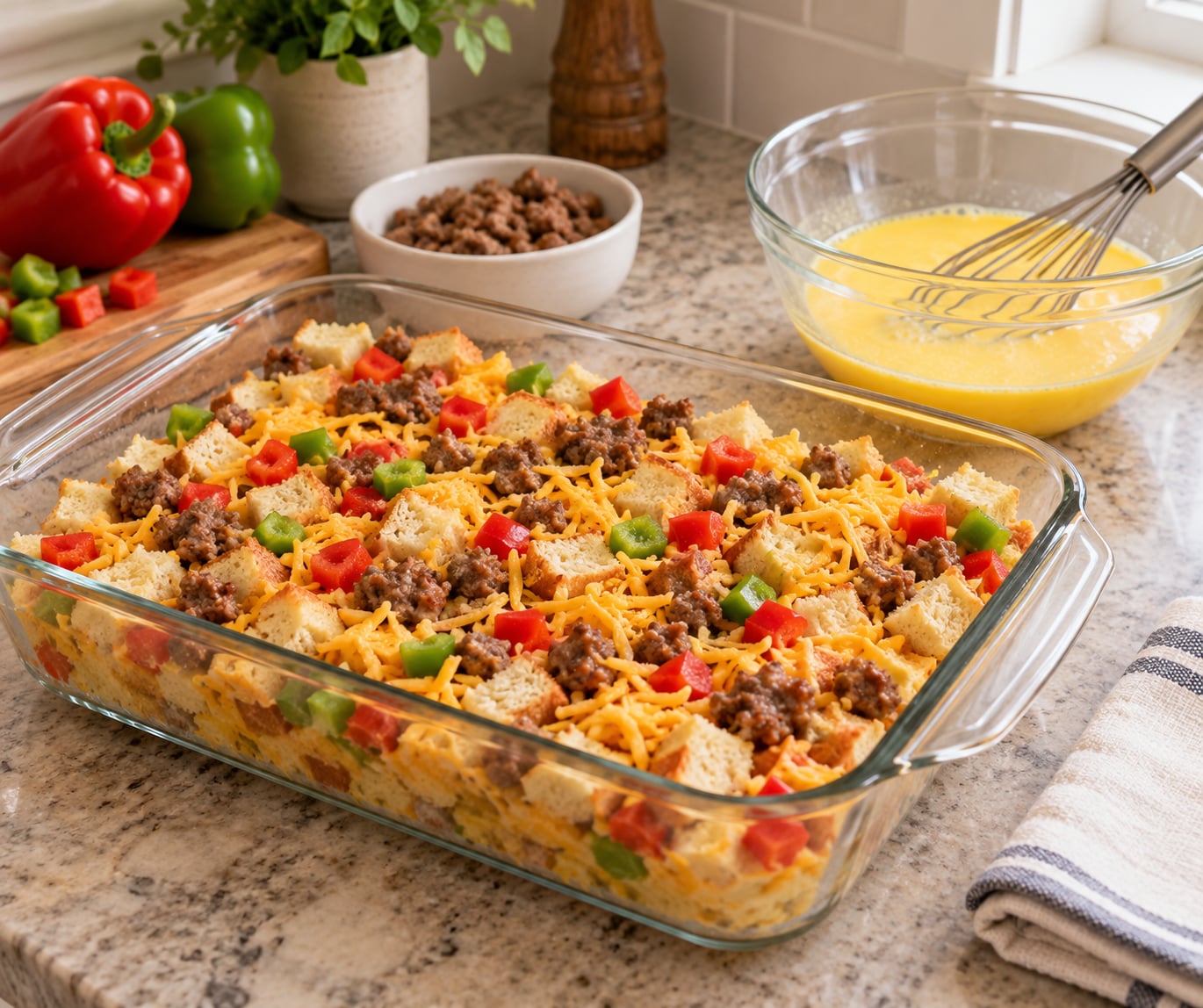
The short answer: assemble the whole dish the night before, cover it, and keep it in the refrigerator at 40°F (4°C) or below for up to 24 hours. In the morning you take off the covering, let the dish sit while the oven heats, and bake it until the center is set.
That’s it. About 20 minutes of work at night turns a 45-minute morning cook into a 10-minute oven job. It is the difference between standing in the kitchen while coffee brews and sitting down with everyone else.
Learning how to make a breakfast casserole the night before also improves the texture. The bread or hash browns sit in the egg custard for hours, so they soak it up instead of floating in it. The finished casserole sets as one slice you can lift with a spatula instead of a pile of separate ingredients.
Table of Contents
- What You Need
- Step-by-Step
- Frequently Asked Questions
- Can I assemble a breakfast casserole the night before?
- How long should I bake a breakfast casserole that was refrigerated overnight?
- Can you leave a casserole with raw egg in the fridge overnight?
- How do I keep the bread from getting soggy overnight?
- What ingredients can I put in a make-ahead breakfast casserole?
- How long does a cooked breakfast casserole last in the refrigerator?
- Conclusion: How to Make a Breakfast Casserole the Night Before
What You Need
Equipment is short. You need a 9-by-13-inch baking dish, a large mixing bowl, a whisk or fork, a cutting board, measuring cups, a wooden spoon or spatula, and oven mitts for the morning. A sharp knife and a griddle or skillet for the sausage round it out.
Grease the dish before it goes in the refrigerator. Butter, oil, or a quick wipe of cooking spray all work, and it matters more than it sounds like it should: an egg custard that has soaked for twelve hours will stick to anything it can grip.
For the base, pick one of these:
- Stale bread cubes — French bread, sourdough, or a loaf that has sat out a day. Day-old bread holds structure through a long soak. Fresh bread compresses into a dense bottom layer.
- Shredded hash browns — fresh or frozen, thawed and squeezed dry. Hash browns hold more water than bread, so pat them well.
- Torn croissant or crescent dough — lighter and flakier, and it needs less baking time.
- No starch at all — skip the base and double the meat and vegetables. This is the version that works when you want something closer to a baked egg frittata.
The add-ins are where you make it yours. Cooked breakfast sausage and bacon are the usual anchors, but cooked chorizo, leftover roast chicken, or browned ground beef work just as well. Add vegetables that release water slowly — bell pepper, onion, spinach, mushrooms, or zucchini — and shred about 2 cups of cheddar per 9-by-13-inch dish.
The custard is the part people overthink. For a standard 9-by-13-inch dish, whisk together 10 to 12 eggs, 2 cups of whole milk or half-and-half, a pinch of salt, black pepper, and whatever seasoning you like — paprika, garlic powder, fresh thyme, or a spoon of Dijon. That ratio sets firm without turning rubbery. If you want to plan ahead, our guide to breakfast sandwiches you can make ahead and freeze covers the same kind of Sunday-night batch cooking from a different angle.
Step-by-Step
Step 1: Choose and Prep the Ingredients
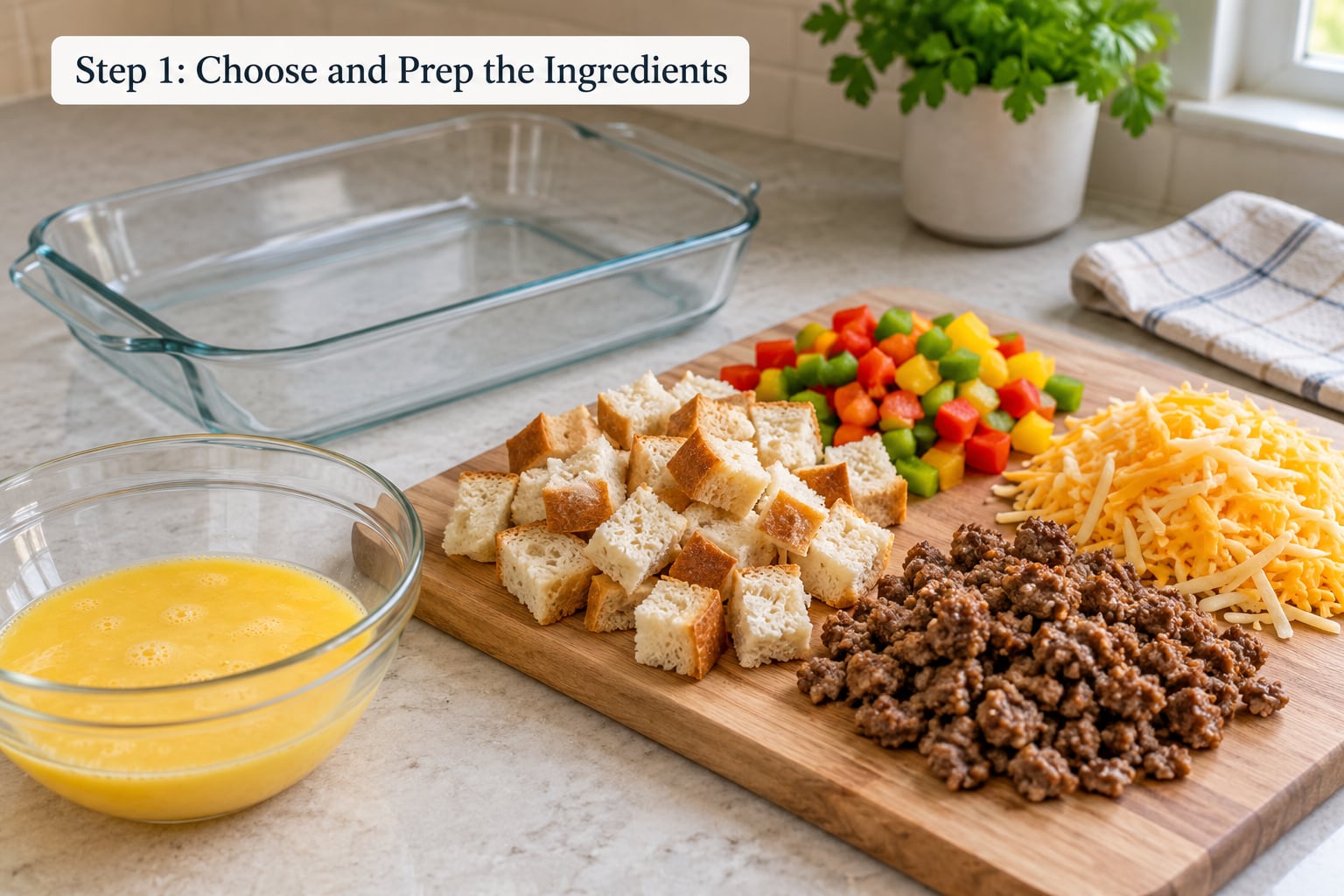
Cook any raw sausage or ground meat first, and do it before assembly, not after. Brown it in a skillet, break it up, and drain the fat. Ground meat must reach 160°F (71°C) and poultry 165°F (74°C) before it goes anywhere near the egg mixture.
Dice the bread into chunks roughly the size of a walnut, chop the vegetables, and shred the cheese by hand or in the food processor. Cooking the meat first is the step people skip, and it is the step that keeps a night-before casserole from tasting raw in the middle.
Let everything cool to room temperature before it touches the dish. Warm sausage straight from the skillet starts cooking the eggs on contact, and the result is a set ring around raw custard in the middle.
Step 2: Build the Layers
Grease the dish, then spread half of your bread or hash browns across the bottom in an even layer. Half the egg mixture goes over that, then half the cheese and half the meat and vegetables. Repeat with the remaining ingredients on top.
Two layers beat one big layer every time. A single thick layer leaves dry bread at the corners and a dense, custard-heavy center, because the custard cannot reach the bottom of the pile. Even layers cook at the same rate all the way through.
Pour the last of the custard across the top and press it down gently so everything sits submerged. If the bread is not covered, the exposed corners turn dry and chewy in the oven.
Step 3: Cover and Chill the Casserole
Cover the dish tightly with plastic wrap, foil, or a fitted lid, and refrigerate it right away. The safe window is 8 to 24 hours; 24 is the ceiling, not the target.
You can leave the dish loosely covered, but tight is better here. Loose wrap lets the bread steam less evenly and lets the dish pick up refrigerator odors overnight, which is exactly what nobody wants in a Saturday morning brunch.
Keep the casserole at 40°F (4°C) or below the whole time, and never leave it on the counter overnight. Raw egg dishes follow the two-hour rule: more than two hours at room temperature and the uncooked egg mixture is no longer safe to eat. Overnight on a counter is twelve hours. That is not a risk worth taking for a dish that only takes twenty minutes to assemble.
One more reason to keep it under 24 hours: the bread keeps drinking the custard. Past about a day it goes from creamy to spongy, and you get the texture people describe as wet.
Step 4: Bake from the Chilled State
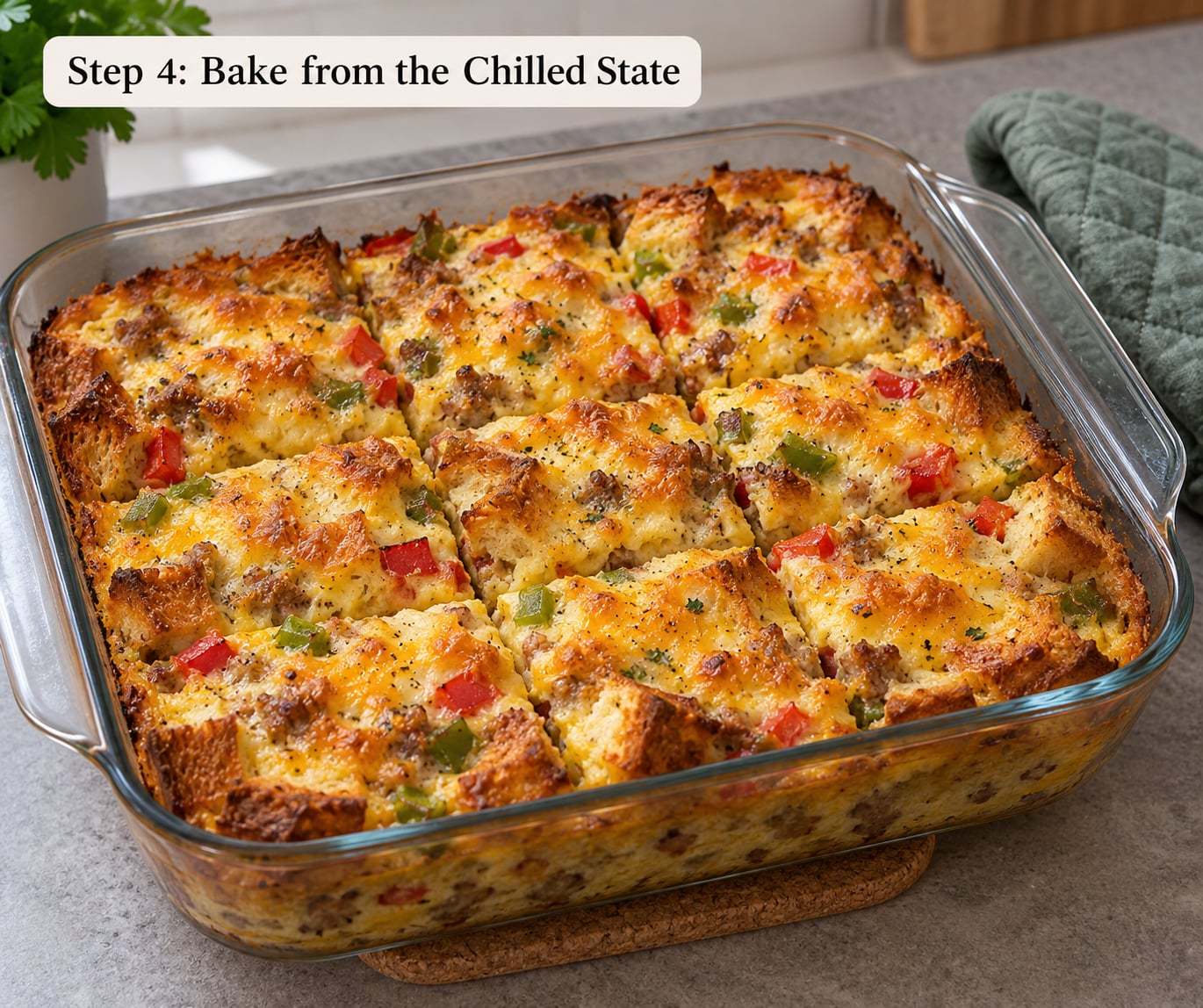
Heat the oven to 350°F (177°C) for a bread base or 375°F (190°C) for a hash brown or no-starch version. Take the dish out of the refrigerator and remove the foil or wrap. A cold dish straight from the fridge bakes unevenly and takes longer, so let it sit on the counter for 20 to 30 minutes while the oven heats.
Bake uncovered so the top can set and brown. Expect 45 to 55 minutes for a chilled bread-based dish and 35 to 45 for a hash brown version.
Check early rather than trusting the clock. A casserole that soaked a full twelve hours needs several extra minutes compared with one assembled just before baking, because the custard is already partly absorbed. Pull it when the edges look set and the center still has a slight wobble, then give it the temperature test.
If the top browns before the middle sets, lay a piece of foil loosely over the dish and continue baking. The center still needs those extra minutes, it just does not need the heat hitting the surface.
Step 5: Check That It Is Fully Cooked
Egg casseroles are done when the center reaches 160°F (71°C), measured in the middle of the dish away from the edge. Insert a clean thermometer, push it through the crust into the center, and read it before you pull it out. Poultry inside the casserole needs to have hit 165°F (74°C) as well, which is why you cook it first.
Visual cues help but do not replace the thermometer. The top should be set and lightly golden, the edges will pull away from the dish, and a knife inserted near the center comes out clean rather than wet. A browned top on its own tells you nothing about the middle, which is where an under-set center hides.
Step 6: Rest, Slice, and Store Extra Servings
Let the casserole stand 10 to 15 minutes after it leaves the oven. The eggs are still setting as they cool, and a ten-minute rest means your first slice holds together instead of collapsing onto the plate.
Cut with a sharp knife dipped briefly in hot water, and wipe it clean between cuts. Cut all the way through rather than scooping, so the leftovers keep their shape when they reheat.
Refrigerate cooked leftovers within two hours and use them within three to four days. Reheat a slice in the microwave for 60 to 90 seconds, or in a 350°F (177°C) oven for about 15 minutes. A spoonful of milk stirred in before microwaving keeps the eggs from turning rubbery. The same casserole works for breakfast-for-dinner, which is the other half of why people make a big one.
Common Mistakes When Making a Breakfast Casserole the Night Before
These five problems come up again and again, and every one of them has a fix you can apply before you assemble the dish.
Soggy bread or mushy hash browns. The base soaked longer than it needed to, or held too much water to begin with. Fix it by pressing shredded potatoes dry in a towel, using day-old bread rather than fresh, and capping the chill at 24 hours. If you already have soggy potatoes, drain them through a colander for ten minutes and reassemble.
Watery or weeping eggs. Too little milk relative to the eggs, or vegetables that released their water into the dish. Fix it by sticking to roughly 10 to 12 eggs and 2 cups of liquid, and by salting watery vegetables like zucchini and mushrooms before you cook them. If the finished casserole weeps in the baking dish, most of the liquid is from the vegetables, not the eggs.
Rubbery eggs. Too many eggs and not enough milk, or a bake that ran long at high heat. Fix it with the ratio above and by pulling the dish the moment the center hits 160°F (71°C).
Uneven cooking. One thick layer, an unstirred custard, or a cold dish going straight into a hot oven. Fix it by layering in halves and resting the dish 20 to 30 minutes before baking.
Overcooked top, raw middle. The dish was uncovered and baked without checking. Fix it with foil over the top once the edges are set, plus the thermometer test.
Two habits prevent most of this. Keep your layers even, and choose add-ins that hold their shape. Peppers, onions, spinach, and pre-cooked meats all survive a long soak. Fresh tomatoes, watermelon, and uncooked spinach release enough water to leave you with a puddle in the bottom of the dish.
If you want more make-ahead breakfast cooking that freezes well, these sandwiches to make ahead for the whole week follow the same batch-then-reheat logic.
Frequently Asked Questions
Can I assemble a breakfast casserole the night before?
Yes, and it is the intended method. Cook any raw sausage or ground meat first, layer the bread or hash browns, egg mixture, cheese, and meat in a greased 9-by-13-inch dish, then cover it tightly and refrigerate. Keep the dish at 40F (4C) or below and bake it in the morning.
How long should I bake a breakfast casserole that was refrigerated overnight?
Bake a chilled, assembled casserole for 45 to 55 minutes at 350F (177C), or 35 to 45 minutes at 375F (190C) for a hash brown version. Let the dish sit out 20 to 30 minutes while the oven heats, bake uncovered, and confirm the center reaches 160F (71C) before serving.
Can you leave a casserole with raw egg in the fridge overnight?
Yes, if you refrigerate it promptly and keep it at 40F (4C) or below. Raw egg mixtures can be safely chilled for up to 24 hours before cooking. Never leave an uncooked egg casserole on the counter overnight, and use the dish within two hours of taking it out of the refrigerator.
How do I keep the bread from getting soggy overnight?
Use day-old bread rather than fresh, use two even layers instead of one thick pile, and keep the chill to 24 hours or less. Press shredded hash browns dry before assembling. If you want a firmer texture, cover the top with cheese so the surface dries out and browns in the oven.
What ingredients can I put in a make-ahead breakfast casserole?
Most combinations work as long as everything that needs cooking is cooked first. Good choices include breakfast sausage, bacon, chorizo, browned ground beef, cooked chicken, bell pepper, onion, spinach, mushrooms, and shredded cheddar. Skip watery raw vegetables like fresh tomatoes and uncooked spinach, which release liquid and thin the custard.
How long does a cooked breakfast casserole last in the refrigerator?
A cooked egg casserole keeps for three to four days in the refrigerator, refrigerated within two hours of baking. Cover the dish or transfer slices to a sealed container. Reheat in the microwave for 60 to 90 seconds or in a 350F (177C) oven for about 15 minutes, adding a splash of milk to keep the eggs tender.
Want to keep the whole morning simple? That idea applies beyond casseroles. Building a sandwich that still tastes fresh at lunch is the same principle: prep ahead, seal it well, and buy back your morning.
Conclusion: How to Make a Breakfast Casserole the Night Before
Start tonight with twenty minutes of assembly. Cook the sausage, dice the bread and peppers, whisk the eggs and milk, layer it all in a greased 9-by-13-inch dish, cover it tight, and put it in the refrigerator within the hour.
In the morning, pull it out, let it rest while the oven heats, bake it uncovered until the center hits 160°F (71°C), and let it sit ten minutes before you cut. That is the whole method, and it works every time 2026.