
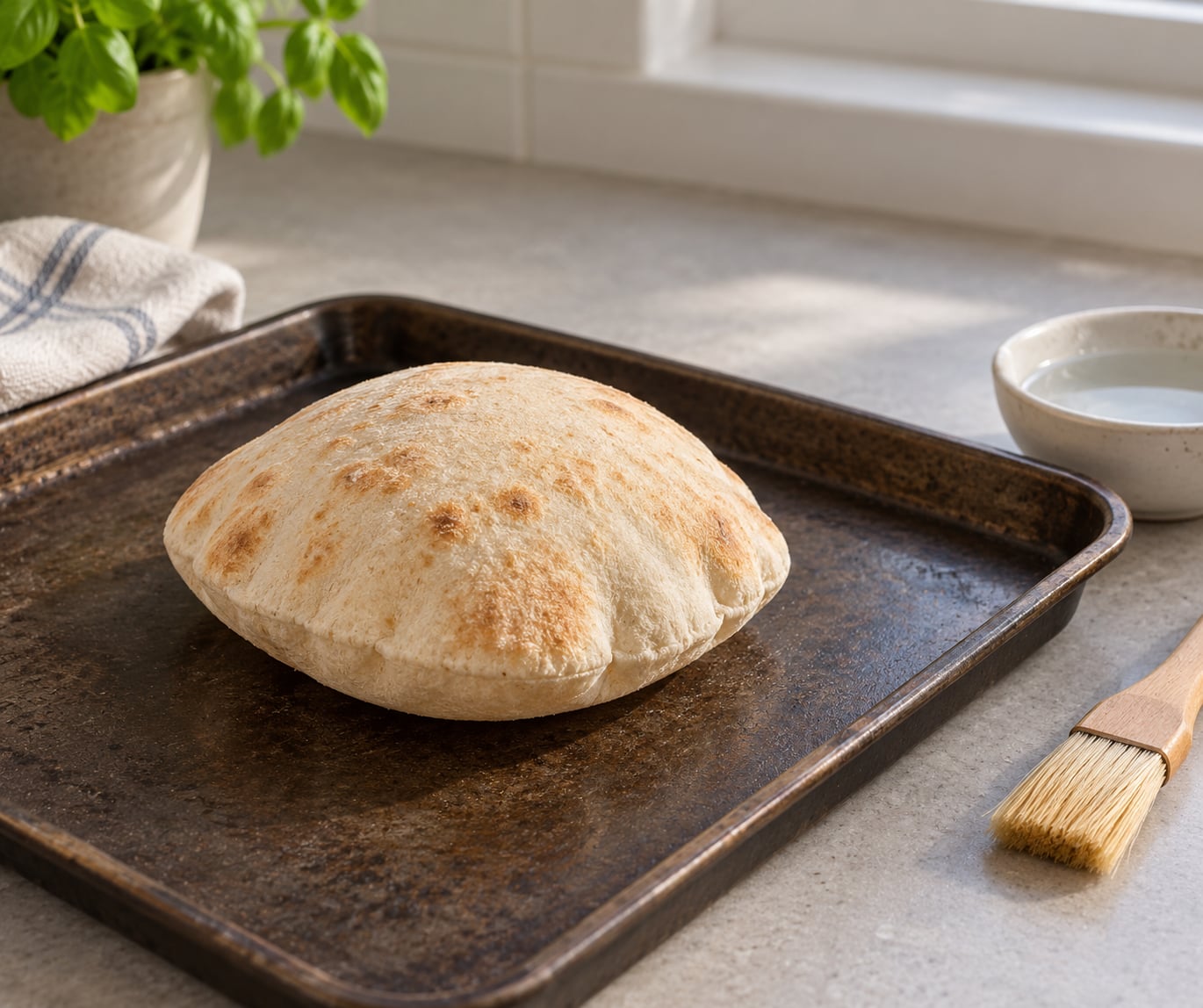
To make pita bread puff up, you need one thing above everything else: a hot surface and moisture inside the dough. Bake at 450 to 500 degrees F on a preheated sheet, stone, or steel, and the water in the dough flashes to steam that forces the top and bottom layers apart into a pocket. If your pita comes out flat, the heat was too low, the dough was too dry or too thick, or a tear let the steam escape.
A pita without a pocket is just a thick tortilla. The round balloon is what lets you stuff it with gyro meat, falafel, or hummus without the filling sliding out, and most home ovens can do this in about two minutes per pita once they are fully preheated.
Table of Contents
What You Need
The ingredient list is short. You need pita rounds, either store-bought ones you want to revive or dough you rolled yourself, and very little else.
- Pita bread rounds or rolled dough balls
- A preheated baking sheet, pizza stone, baking steel, or cast iron skillet
- A pastry brush or a mister with a few tablespoons of water
- A cooling rack or a plate for resting the finished pocket
Optional but useful: a light drizzle of olive oil, a small bowl of flour for dusting your work surface, and parchment paper if your steel or stone is older and you do not want to stick anything to it.
If you are shopping for bread rather than baking it, I keep coming back to our guide on the best pita and flatbreads for stuffed sandwiches, since a thicker store-bought pita holds up better once it puffs.
Step-by-Step: How to Make Pita Bread Puff Up
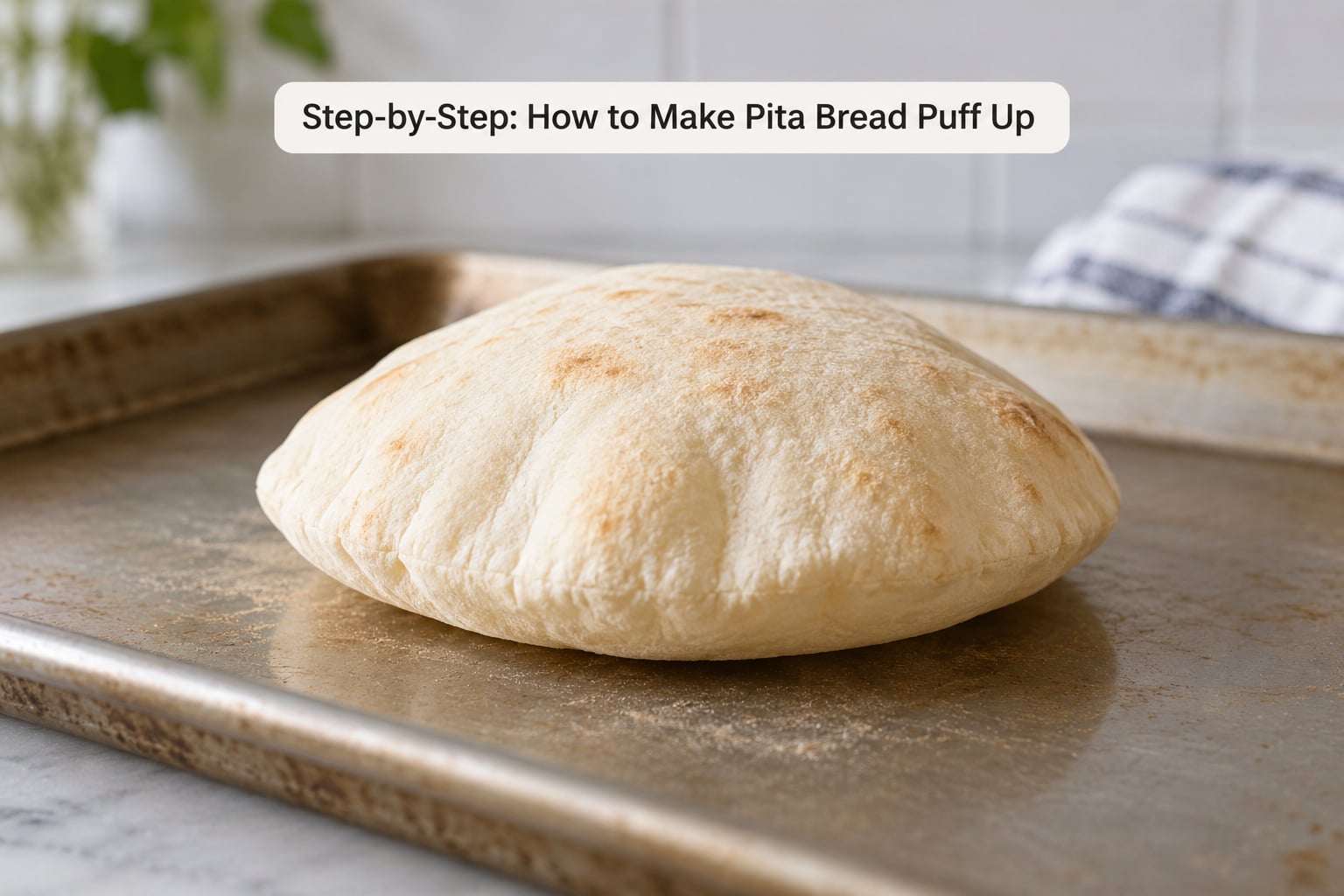
Set your oven to 450 degrees F and put the baking surface inside while it heats. Give it a full 30 to 45 minutes, longer if you are using a thick steel. A surface that is only warm when the dough lands will never produce a pocket.
Heat the Pita Until the Edges Blister
Lay the pita on the hot surface and leave it alone for 60 to 90 seconds. You are looking for the edges to tighten, dry, and darken slightly, and for faint bubbles to appear across the top. This first blast of heat sets the outside of the dough so the structure can hold air.
Do not walk away during this stage. A pita that goes from pale to burnt in about fifteen seconds has been on a too-hot or too-thin surface, and it will blister on top while staying dense in the middle.
Add Moisture and Let the Pocket Separate
Brush or mist both sides of the pita with water, then return it to the hot surface for another 45 to 60 seconds. That is when the pocket forms: surface water turns to steam instantly, steam expands the space between the two layers, and the round swells like a balloon.
Thick store-bought rounds often need a longer second stage than thin homemade ones. Give it another 30 seconds if the dough is more than a quarter inch thick, because more water in the round means more time to convert.
Check the Pocket and Cool Before Filling
Press the dome gently with one finger. A properly puffed pita feels springy and hollow, and you can hear a faint shift of trapped air when you squeeze it. Flat, dense dough leaves no give and no sound.
Move the pita to a cooling rack and wait about a minute before cutting. Pita is full of steam, and cutting it straight out of the oven gives you a gummy interior and a filling that soaks the crumb. If you like the contrast of crisp outside and soft inside, a short blast under the broiler for the last 20 seconds does that without drying the whole round out.
Stovetop Method for Pita Bread That Will Not Puff
Cast iron is the reliable stovetop path, and it is also the one most home cooks already own. Heat the skillet over medium-high until it is smoking faintly, about 3 to 4 minutes, and lay the pita in dry first, pressing it flat with a spatula so every point touches the pan.
Cook for 60 to 90 seconds, until the surface looks dry and pale gold, then flip and cook for another 30 to 60 seconds. Drizzle or brush with a little water just before the flip, and keep the spatula moving around the edge so the round inflates evenly.
Watch this one the whole time. Skillet pitas go from perfect to burnt fast, and a nonstick pan is not the tool for this job since the high heat builds up nothing useful without cast iron’s thermal mass.
Common Mistakes and Quick Fixes
Almost every flat pita traces back to one of a handful of causes. Match what you see in the tray to the likely reason and change that one thing on the next batch.
| What you see | What caused it | What to change |
|---|---|---|
| Flat round, no pocket, soft texture | Surface was not hot enough | Preheat 30 to 45 minutes, and push the oven to 500 degrees F if it will hold that |
| Puffed in spots only | Dry, unevenly rolled dough or a damp spot | Hydrate more evenly and roll to an even quarter inch |
| Hard as a rock, no air | Underhydrated dough measured by volume | Weigh the flour with a kitchen scale and add water until the dough feels soft |
| Split open at the seam, balloon collapsed | Steam escaped through a tear or the dough dried out during shaping | Seal the edges firmly and dust the counter lightly instead of adding more flour |
| Puffs, then goes flat again | Over-baked, so the shell scorched and collapsed | Pull it as soon as the dome forms, usually under 3 minutes |
| Soggy or gummy center | Cut straight from the oven | Rest on a rack for a full minute before slicing |
| No pocket no matter what | The round is too thick or the top cooked before steam built | Roll thinner and keep the first stage short |
A few extras that come up often. If your baking sheet is rated only to about 446 or 450 degrees F, that is a real ceiling on the puff, and the workaround is to preheat the sheet for the full time and use a thin round so the top surface still cooks at pace. If your dough keeps tearing while rolling, it needs 15 to 30 minutes of rest under a cloth before you start, since that is when the gluten relaxes and stops pulling back.
Stale store-bought pita usually needs moisture, not more heat. A short stint in a damp paper towel, or a dampened round in a hot pan, will bring back enough water to create steam. And for the same reason, it helps to think about whether toasting a sandwich bread helps or hurts before you apply the same approach to a filled pocket. When the pita is finally open and stuffed, our piece on how to keep an overstuffed sandwich together is the next read.
Frequently Asked Questions
Why does my pita bread stay flat?
Flat pita usually means one of four things: the surface was not hot enough, the dough was dry, the round was too thick, or a tear let the steam escape. Preheat the baking surface for 30 to 45 minutes, keep the dough soft and slightly moist, roll to about a quarter inch, and seal the edge seam firmly. If only some pitas in a batch puff, thickness and hydration are almost always the reason.
Can store-bought packaged pita bread puff up?
Yes, and the skillet is the best tool for it. Preheat cast iron over medium-high, lay the flat pita in dry for 60 to 90 seconds, then dampen both sides and flip for another 30 to 60 seconds. A short microwave burst with a damp paper towel first softens a stale round and gives it more water to work with. Store-bought rounds thicker than a quarter inch take longer than homemade dough.
What temperature do you bake pita bread at?
450 degrees F is the floor, and 500 degrees F is better if your oven and your baking surface can handle it. The cooking itself is fast, roughly 2 to 3 minutes per pita. What matters more than the dial is the preheat: give a sheet, stone, or steel a full 30 to 45 minutes so the surface itself is hot, since dough landing on a merely warm pan will not puff.
How do you store and reheat pita so it stays soft?
Store pita in a sealed bag or airtight container at room temperature and use it within a day or two; the pocket stays softer because the trapped moisture is protected. For longer storage, wrap rounds individually and freeze them. Reheat directly from frozen in a covered skillet for about a minute per side, or wrap in a damp paper towel and microwave in short bursts. A dry, brittle round means it has lost the moisture it needs to puff again.
Is pita bread the same as naan?
They are close relatives but not the same bread. Pita is leaner, usually baked on a hot stone or steel, and puffs into a hollow pocket designed for stuffing. Naan is richer, brushed with oil or ghee, softer and chewy, and bakes or tandoors flat without a pocket. Lavash is thinner and crisper. For a sandwich pocket, pita is the one you want; for a soft, buttery side bread, naan is the better pick.
Conclusion
Start with the heat: preheat the surface for 30 to 45 minutes at 450 to 500 degrees F, then give the pita a short first stage before you add moisture. The water you brush or mist on turns to steam, and that steam is what separates the layers into a pocket. Let it rest on a rack for a minute before cutting, and your pita will puff up every time.