
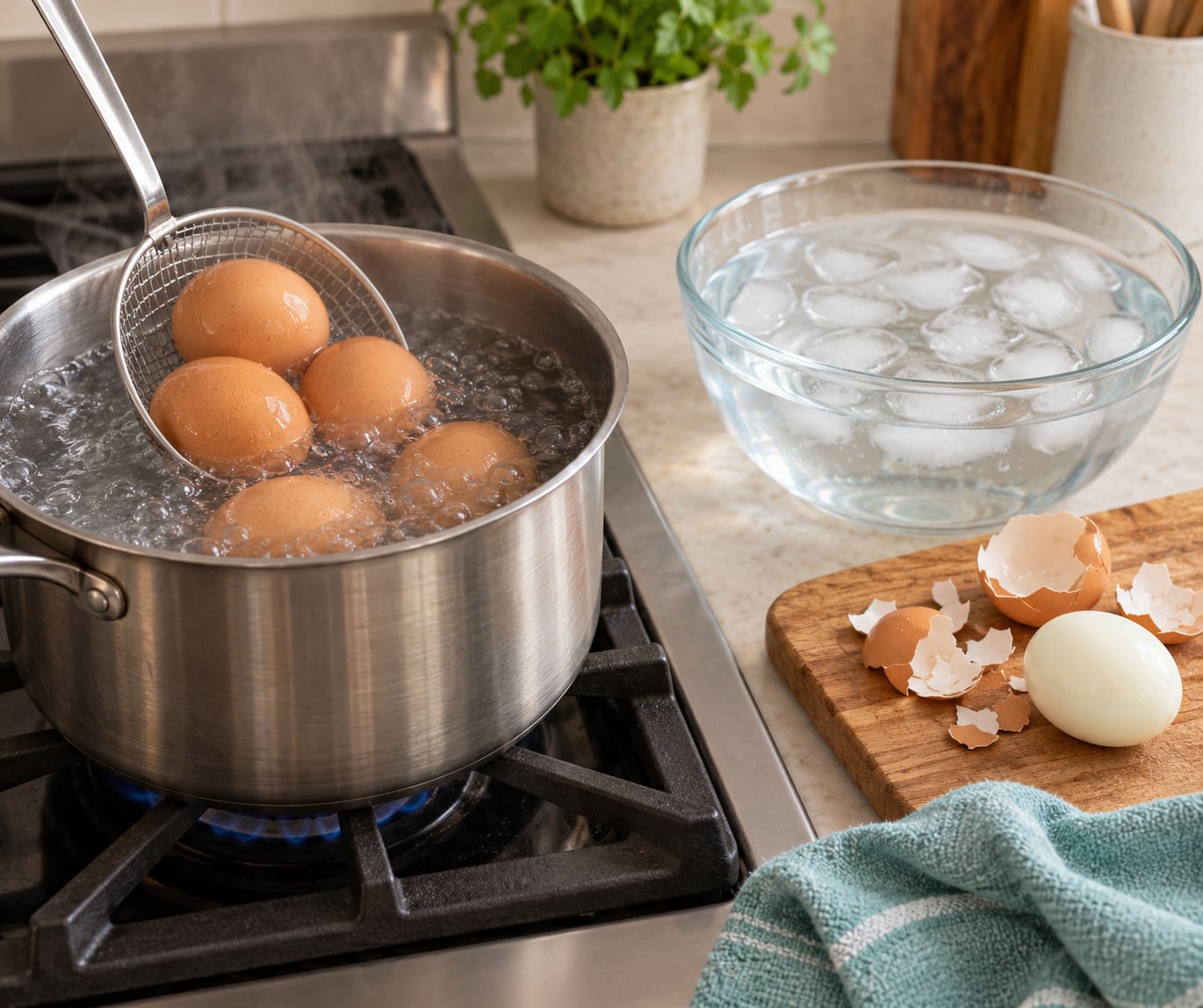
To make hard boiled eggs easy to peel, lower your eggs into already-boiling water, time the cook by size and yolk doneness, then drop them straight into ice water for 10 to 15 minutes. Crack the shell all over, roll the egg gently, and peel from the wide end where the air pocket sits. Total time is about 25 minutes, most of it unattended.
Shell tearing is the most common complaint I hear about boiled eggs, and it usually comes down to two things: eggs that went in cold, and eggs that got peeled while still warm. Both are fixable in about five minutes of extra attention.
There is also a factor you cannot control at the stove. Egg age matters more than any additive you can dissolve in the water, which surprises people who assume a fresh carton should peel best.
Table of Contents
- What You Need
- Step-by-Step: How to Make Hard Boiled Eggs Easy to Peel
- Common Mistakes
- Frequently Asked Questions
- Why are my hard-boiled eggs hard to peel?
- Do older eggs peel more easily than fresh eggs?
- Should I put hard-boiled eggs in ice water before peeling?
- How long should I boil an egg for a hard-boiled result?
- Can I peel hard-boiled eggs before refrigerating them?
- How should I store hard-boiled eggs in the refrigerator?
- Conclusion
What You Need
You need very little: a saucepan that holds your eggs in one layer with water to cover them by an inch, a bowl of ice water, a slotted spoon, and a timer you can actually hear from another room.
- Eggs: whatever size you have. Large eggs are the default for timing; jumbo and extra-large need a few minutes more.
- Saucepan: room for the eggs in a single layer. Crowding drops the water temperature and gives you uneven results.
- Water: enough to cover the eggs by about an inch once they are in.
- Ice and a bowl: a genuine ice bath, not just cold tap water. Cold tap water slows the cooling, which slows the shrink.
- Slotted spoon: lets you lift several eggs at once without dropping them.
- Timer: the single cheapest tool that fixes most boiled egg complaints.
On the egg itself, aim for eggs that are not freshly laid. Cooks on r/Cooking and r/BackYardChickens both point at age as the biggest lever, and the reason is chemistry rather than folklore.
Step-by-Step: How to Make Hard Boiled Eggs Easy to Peel
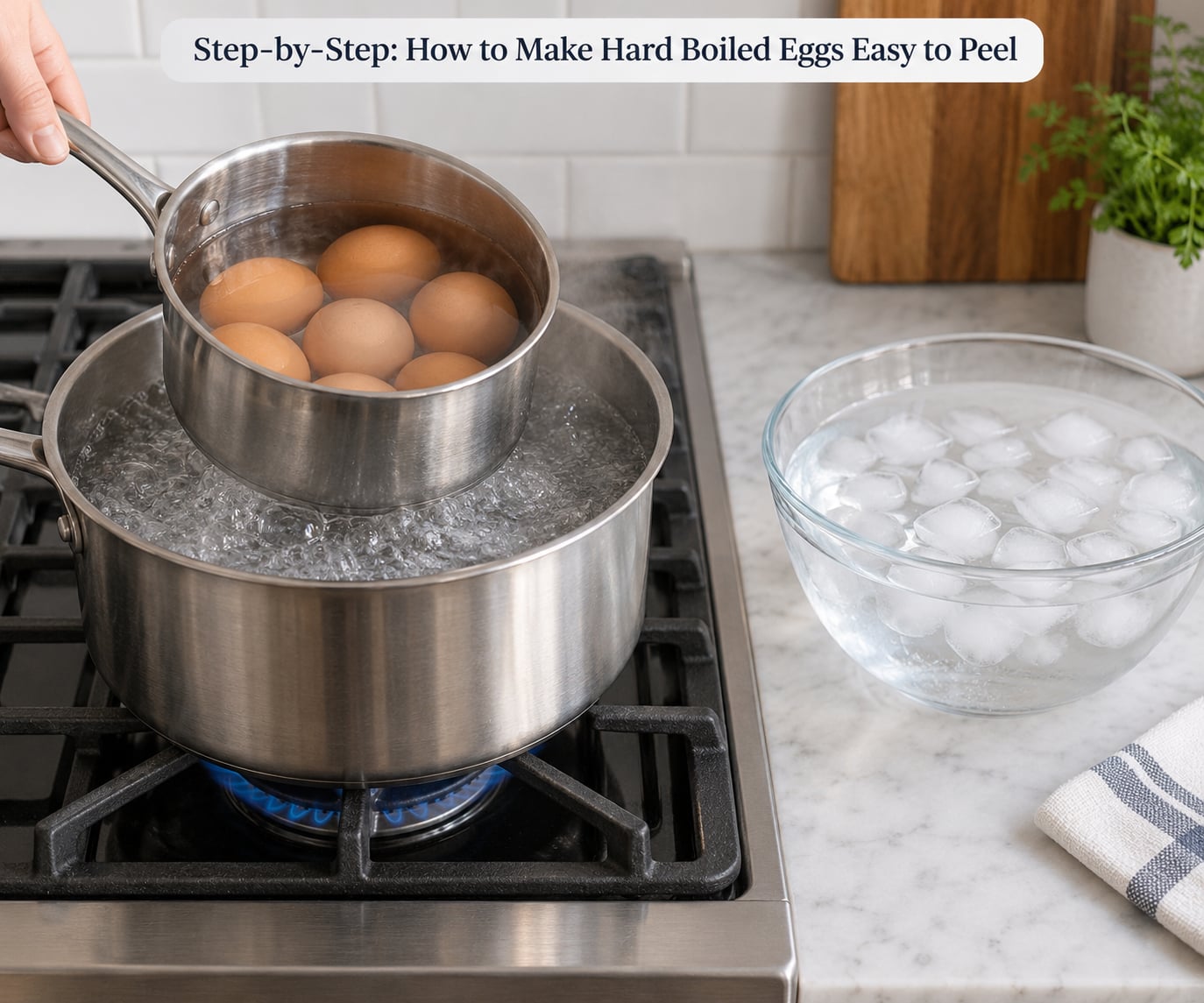
Step 1: Choose and Prepare the Eggs
Eggs that have sat in the refrigerator for a week or two peel better than eggs collected yesterday. As an egg ages, carbon dioxide and moisture leak out through the tiny pores in the shell, the air cell at the wide end grows, and the pH of the white rises from about 7.6 toward 9. That shift is what loosens the cooked white from the inner membrane.
Starting temperature matters less than people think, but room temperature eggs are more forgiving. A fridge-cold egg takes longer to heat through, so the white near the shell sets before the center does. You do not need to leave eggs on the counter for an hour; 20 minutes out of the fridge is plenty.
Place the eggs in the pot by hand or with a slotted spoon. Do not drop them in, and do not crack them. A dropped egg gets a hairline crack, and then the white seeps out and welds itself to the shell in exactly the way you are trying to avoid.
Step 2: Boil the Eggs
Bring the water to a full rolling boil first, then lower the eggs in, stir them gently for about 10 seconds so none of them sit against the pot, and start the timer the moment they go in. Cookers on r/cookingforbeginners call the hot start the biggest factor in easy peeling, and they are right.
Here are the timings that work from boiling water. Pick the row that matches the yolk you want.
| Egg size | Soft set | Jammy set | Fully hard |
|---|---|---|---|
| Large (about 2 inch) | 6 to 7 minutes | 8 to 9 minutes | 10 to 12 minutes |
| Jumbo | 7 to 8 minutes | 9 to 10 minutes | 12 to 13 minutes |
| Extra-large | 8 to 9 minutes | 10 to 11 minutes | 14 to 15 minutes |
How do you know the white is set without cutting one open? Lift an egg out at the end of the cook and spin it gently on the counter. If it spins smoothly and fast with no wobble, the white has set all the way through. A soft or watery white gives a visibly slower, wobblier spin.
Step 3: Stop the Cooking and Shock the Eggs
Move the eggs directly into the ice bath with your slotted spoon. Leave them for 10 to 15 minutes; that is long enough to cool the center and short enough that you are not wasting your evening.
Two things are happening. First, the shock stops carryover cooking, so the yolk does not keep firming up after you pull the eggs out. Second, the cold contracts the cooked white slightly so it pulls away from the shell and membrane instead of gripping them. That is the whole reason the ice bath exists, and it is why r/LifeProTips users who skip it usually come back to the same complaint.
If you have no ice, running cold water over the eggs in a colander works better than nothing. Just know that a room full of ice does the job in half the time.
Step 4: How to Make Hard Boiled Eggs Easy to Peel by Hand
Tap the egg hard on the counter all over, not just at the top. You want a spiderweb of cracks across the whole shell, because that is what lets water get between the shell and the inner membrane. Then roll the egg between your palms or against the counter with light pressure until most of the shell is loose.
Start peeling at the wide end, where the air pocket is. Peel with your thumbs, not a knife or a spoon sharp enough to gouge the white. If a strip of membrane drags the white with it, stop, dip the egg back under water, and work the membrane loose with your fingernail before continuing.
The mason jar method popular on TikTok and in r/cookingforbeginners works too: put one egg in a jar with an inch of water, cap it, and shake for 10 to 15 seconds. The shell slides off because the water gets underneath the cracked shell. It is fast and it works, but it makes a mess and it is harder to control than tapping.
My order of preference: tap and roll under a thin stream of water first, mason jar second if you are doing a dozen or more. Running water keeps the membrane wet and slippery, which helps more than any trick people sell you.
Step 5: Store the Finished Eggs
Unpeeled hard-boiled eggs keep in the refrigerator for up to 7 days in their shell. Store them in a carton or a sealed container on a middle shelf, not in the door, where the temperature swings every time it opens.
You can peel before refrigerating and still have 7 days, but I would not. Peel at least a day or two ahead for egg salad or breakfast sandwiches that need to stay fresh until lunch, cover the eggs tightly, and expect a slightly drier white than a same-day peel.
Keep peeled eggs in an airtight container with a damp paper towel and a plate of nothing but onions out of the fridge. Nobody wants onion-flavored egg salad at 7 in the morning.
Common Mistakes
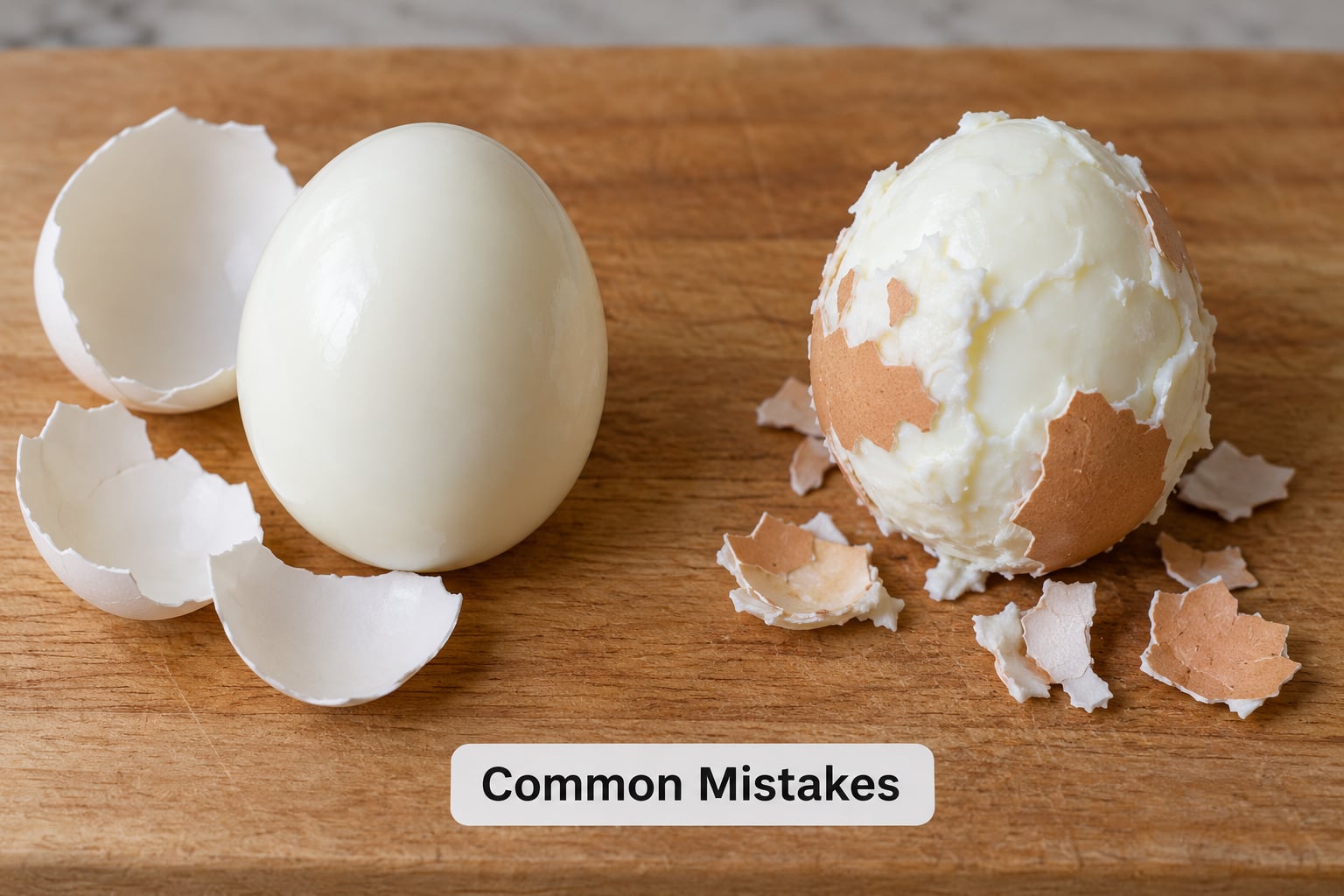
Starting eggs in cold water. This is the mistake most people make, and it is why some batches peel fine and others do not. Cold water heats the egg slowly, so the white has time to bond with the membrane before it sets. Bring the pot to a rolling boil first.
Boiling straight from the fridge with no timing. Eggs straight from the cold center take longer to cook than eggs that sat out, so a habit of twelve minutes can mean overcooked on the outside and undercooked in the middle. Twenty minutes on the counter closes the gap.
Overcooking. Past about 14 minutes the white turns rubbery and a grey-green ring forms where iron from the yolk reacts with sulfur in the white. It is harmless, but the texture is not. Watch the spin test and pull the eggs on the earlier side of the range.
Skipping the ice bath. Warm eggs peel worse and keep cooking after you drain them. Ten minutes in real ice water is the cheapest fix in this whole article.
Peeling warm eggs. Straight from the ice bath is right; room temperature for a few hours is fine too. Warm is the problem. Warm whites are soft and tear instead of lifting away.
Using eggs straight from the farm. Very fresh eggs peel terribly. If you buy direct, hold them for a week or two first.
Adding baking soda and expecting miracles. A teaspoon of baking soda raises the pH of the water, which does make the white less sticky and helps a stubborn batch. It also makes the shells rougher and can give the egg a faint soapy taste if you use a lot. It is a reasonable backup, not a fix for cold-start eggs or skipped ice baths.
Adding vinegar. Vinegar does not help peeling. Its only real job is to neutralize if a shell cracks and the white starts setting in sour water.
Adding salt. Salt mostly raises the boiling point slightly and seasons the white if a shell cracks. It is not doing meaningful work for peelability. Skip it unless you like salted egg whites.
One more option worth knowing, since people search for it: steam works. Eggs steamed over an inch of boiling water for 13 minutes, as cooks on r/cookingforbeginners and r/loseit describe, then cooled and peeled, come out clean and with very tender whites. It is a good fallback if you have no ice.
Frequently Asked Questions
Why are my hard-boiled eggs hard to peel?
Three things cause it most often: eggs went into cold water, they boiled too long, or they were peeled while still warm. Egg age matters too, and very fresh eggs peel worse than week-old ones. Fix it with a boiling-water start, a timed cook by size, and an immediate 10 to 15 minute ice bath before peeling.
Do older eggs peel more easily than fresh eggs?
Yes. As an egg ages, carbon dioxide and moisture escape through the pores in the shell and the white’s pH rises, which loosens it from the inner membrane. The air cell at the wide end also grows, giving you an easy place to start peeling. Eggs held for a week or two peel noticeably better than eggs collected the same day.
Should I put hard-boiled eggs in ice water before peeling?
Yes, and this is the step people skip most often. An ice bath stops the egg from cooking further in the warm center, and the cold contracts the cooked white so it pulls away from the shell and membrane instead of clinging. Ten to 15 minutes is enough. Cold tap water works in a pinch, but it takes longer and works less evenly.
How long should I boil an egg for a hard-boiled result?
From boiling water, large eggs need 10 to 12 minutes for a fully set yolk, 8 to 9 minutes for a jammy center, and 6 to 7 minutes for a soft set. Jumbo eggs need about 2 minutes more, extra-large about 3 to 4 minutes more. Cooking from cold water adds several minutes, so always start with a timer.
Can I peel hard-boiled eggs before refrigerating them?
You can, and they will keep for up to 7 days either way. Peeled eggs lose a little moisture in the refrigerator, so the white is slightly drier than one peeled the same day. For egg salad or sandwich filling, peeling a day ahead is worth the tradeoff. Store peeled eggs in an airtight container so they do not pick up refrigerator odors.
How should I store hard-boiled eggs in the refrigerator?
Keep them unpeeled in their shell inside a carton or sealed container on a middle shelf, away from the door where temperatures swing. Boiled eggs in the shell last up to 7 days. Cold or hot spots are the enemy, so leave room for air to circulate around the eggs rather than stacking them in a sealed bag.
Conclusion
Start here if you do one thing differently: use eggs that are not freshly laid, bring the water to a rolling boil before the eggs go in, and drop them into real ice water the moment the timer ends.
Everything else is refinement. Crack the shell all over so water can get underneath, start peeling at the wide end, and take the eggs out a minute on the early side of the time range. That combination is what turns egg salad, a deli platter, or a tray of make-ahead breakfast sandwiches into something that looks like you meant it.