
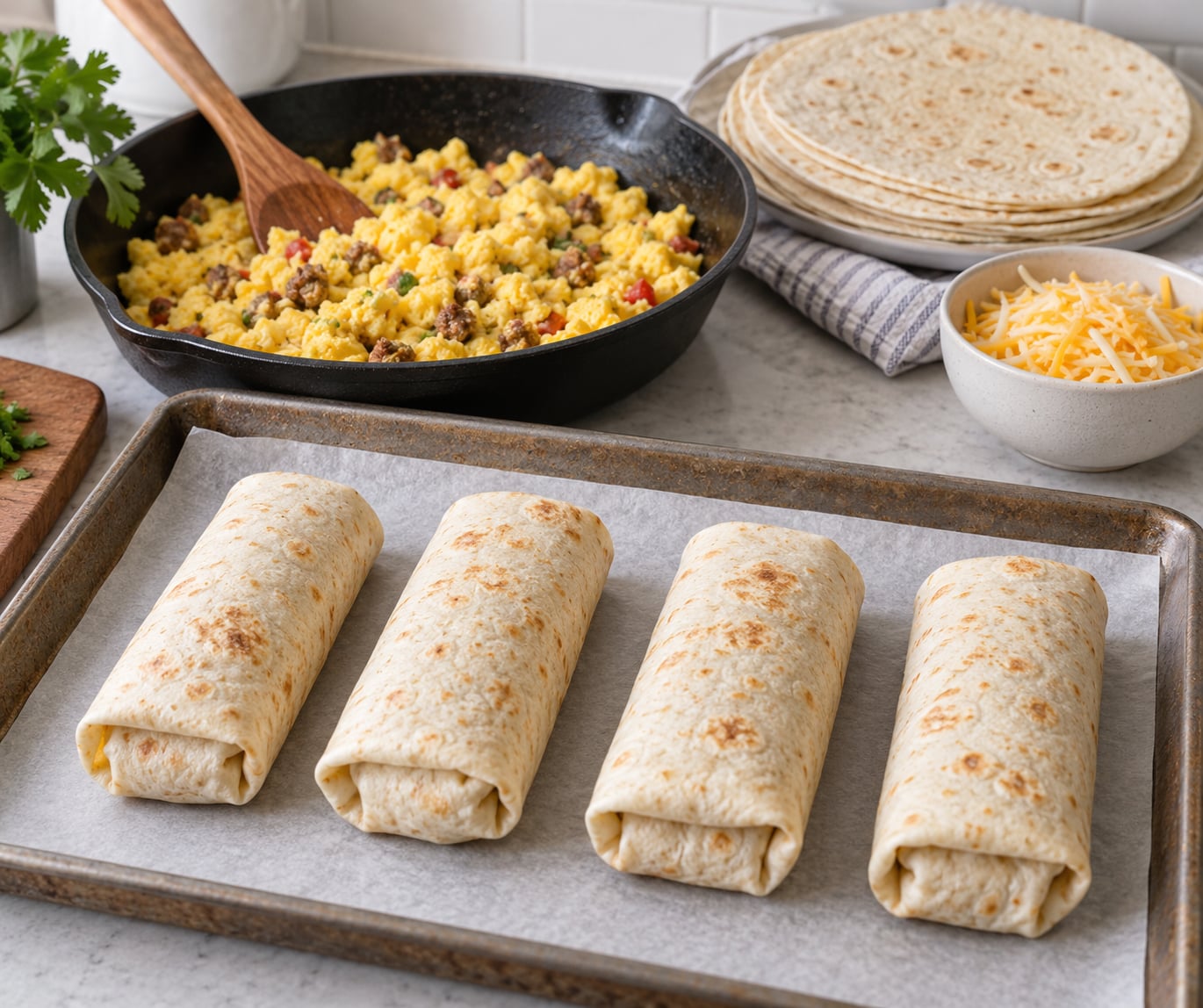
How to make breakfast burritos to freeze is mostly a matter of temperature discipline: cook the fillings, cool them until no steam comes off, roll them in large flour tortillas, wrap each one in parchment or film, and freeze for up to 3 to 4 months. A full batch takes about an hour for 12 burritos, most of it hands-off while things cool.
The whole method rests on one rule that home cooks learn the hard way: never wrap a warm burrito. Warm filling traps steam inside the wrap, that steam turns into condensation, and the tortilla comes out soft and split when you thaw it. Everything below follows from there.
Freezer breakfast burritos also solve a weekday problem that sandwiches and pancakes just cannot. You eat them one-handed on the way out the door, they reheat in two minutes, and one cooking session covers most of a month. If you want the same idea built from bread rather than tortillas, breakfast sandwiches made ahead and frozen work on the same schedule.
Table of Contents
- What You Need
- Step-by-Step: How to Make Breakfast Burritos to Freeze
- Common Mistakes
- Frequently Asked Questions
- How long can breakfast burritos stay in the freezer?
- Can I freeze breakfast burritos with scrambled eggs?
- What ingredients should I avoid freezing in breakfast burritos?
- How do I thaw frozen breakfast burritos without soggy tortillas?
- Is it better to reheat breakfast burritos in a microwave, skillet, or oven?
- Conclusion
What You Need
You do not need special equipment. You need a rimmed baking sheet, a skillet, a spatula, and something to wrap finished burritos in. Everything else is a filling you can swap.
- Large flour tortillas. Eight- or ten-inch, not the small street-taco size. Flour tortillas stay pliable through freezing and reheating, and corn tortillas tend to crack along the fold lines.
- A protein. Cooked breakfast sausage, bacon, diced ham, chorizo, or a plant-based version. One pound of meat covers roughly a dozen burritos.
- Eggs. Eight to twelve eggs scrambled just firm. Eggs give the burrito structure and they bind the filling so it does not migrate during rolling.
- Cheese. One and a half to two cups of shredded cheddar, Monterey Jack, or Pepper Jack. Cheese works as a moisture barrier, which is exactly why you should not skip it.
- Vegetables. One diced bell pepper and onion, sauteed until soft and drained. Raw or undrained vegetables add the exact water you are trying to avoid.
- Potatoes, optional. Cooked hash browns or tater tots, cooled and patted dry.
- Sauce, used sparingly. A thin layer of salsa or hot sauce freezes fine. Sour cream, guacamole, and avocado go on after reheating.
- Parchment paper or freezer-safe film plus a resealable freezer bag or airtight container.
- A rimmed baking sheet for cooling the assembled burritos and for reheating them in the oven.
Step-by-Step: How to Make Breakfast Burritos to Freeze
1. Cook Every Filling Safely
Scramble the eggs until they are just set, then cook the meat the same way you would for any meal. USDA guidance puts eggs and ground meat at 160°F (71°C) and poultry-based sausage at 165°F (74°C), and a food thermometer is the only way to know for sure.
Cook each component separately and spread it across the baking sheet in a single layer. A wide, thin layer cools in minutes; a pile stays warm in the middle long after the edges feel cool to the touch.
2. Warm the Tortillas and Set Up the Filling
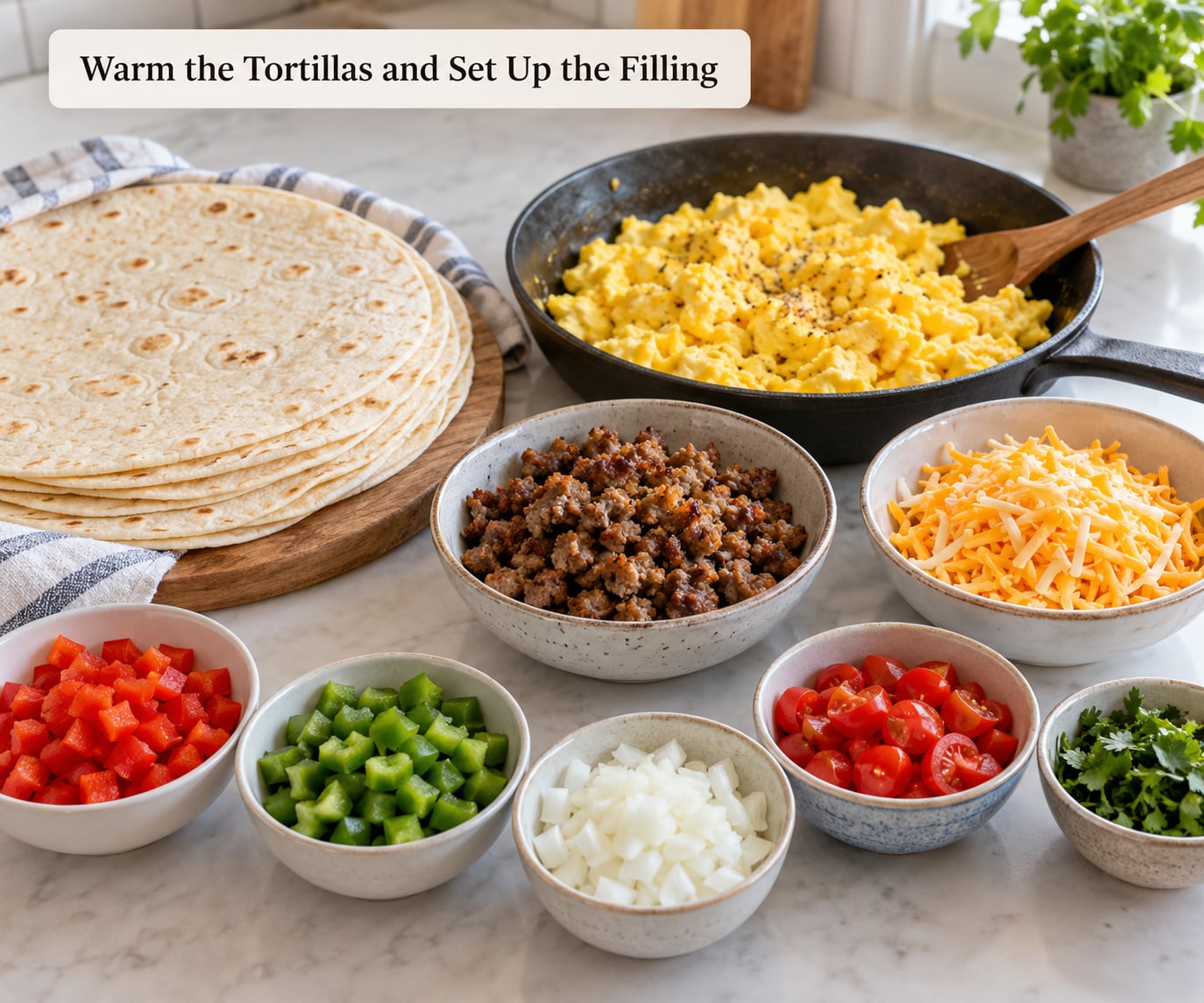
Warm the tortillas for 20 to 30 seconds in a dry skillet or in the microwave before you start filling them. A warm tortilla bends without tearing, and cold tortillas split the moment you fold the sides in.
Then line everything up in the order you will use it: tortilla, protein, eggs, cheese, vegetables. Working from one side to the other turns 12 burritos into a five-minute assembly instead of a twenty-minute one. Drain any wet vegetables in a colander first and blot them dry.
3. Add Filling and Fold Each Burrito Tightly
Fill each tortilla with about two-thirds of a cup of filling, keeping it in a band across the center third. Overfilling is the number one reason a burrito tears, and frozen filling expands slightly as ice crystals form.
Fold the two sides in until they meet over the filling, then fold the bottom edge up over them. Roll the rest of the way, pulling gently and keeping tension as you go. You will know the roll is tight when the seam sits flat and no filling peeks near the open edge.
4. Cool and Arrange the Burritos
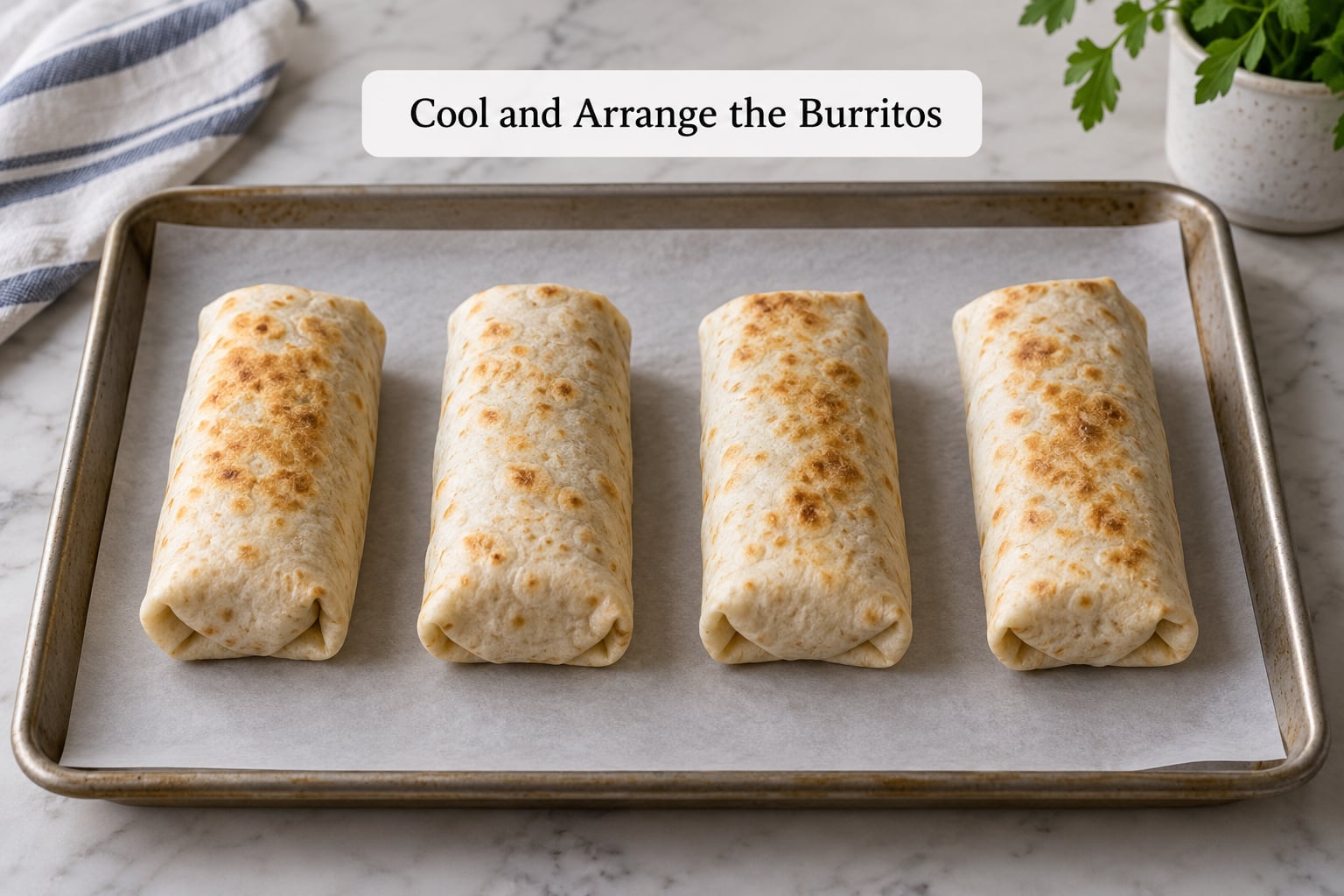
Lay the finished burritos seam-side down on a clean, dry baking sheet, not touching each other, and let them sit uncovered until no steam rises and the tortilla feels room temperature all the way through. On a warm day this takes 20 to 30 minutes.
Keep that window short. USDA guidance is to refrigerate or freeze food within two hours of cooking, and a burrito cools faster in a single layer than in a stack. If you are making 20 or more and cannot cool them all at once, spread them across sheet pans and rotate the pans into the freezer as each group is cool.
5. Wrap, Label, and Freeze
Wrap each cooled burrito in parchment paper or freezer-safe film, then place them seam-side down in a resealable freezer bag or airtight container. Freeze flat in a single layer for the first two hours, then stack if you need to save space.
Label the bag with the filling type and the date. Six unlabeled burritos that all look identical become a guessing game by week three, and most of them get skipped.
Freeze for up to 3 to 4 months for the best texture. Quality slides after that, and safety guidance for frozen cooked food tops out around four months.
6. Reheat from Frozen
Take the bag out of the freezer and remove the outer bag or film. Parchment can stay on for oven and air fryer reheating. You do not need to thaw first unless you want the skillet method to work evenly.
| Method | Time and setting | Result |
|---|---|---|
| Microwave | 2 to 3 minutes at 50% power, then 1 minute at full power, wrapped in a damp paper towel | Fastest, soft tortilla |
| Oven | 375°F (190°C) for 20 to 25 minutes on a baking sheet | Even heat, lightly crisp shell |
| Skillet | 2 to 3 minutes per side in a dry or lightly buttered skillet over medium heat | Crispest tortilla |
| Air fryer | 375°F (190°C) for 8 to 10 minutes, seam-side down | Crisp without a long preheat |
For any burrito containing meat, reheating leftovers means reaching 165°F (74°C) in the center. Use a food thermometer if the burrito is packed thick, especially straight from frozen.
The microwave keeps the filling moist and the tortilla soft, which is fine. If you want a crisp shell, add 2 minutes in a dry skillet afterward. The damp paper towel trick is what stops the microwave from turning the tortilla rubbery, and half power on the first cycle stops the edges from drying out before the center heats.
Common Mistakes
Almost every disappointing freezer burrito traces back to one of five problems. Diagnose which one you have before you change the recipe.
| What went wrong | Cause | Fix |
|---|---|---|
| Tortilla is wet or falls apart | Wrapped before the filling cooled, so steam turned into condensation | Cool uncovered until no steam rises, then wrap |
| Burrito unrolled in the freezer | Loose roll or too much filling | Fill only the center third and roll with steady tension |
| Filling is watery and mushy | Undrained vegetables, wet hash browns, or too much salsa | Pat vegetables dry and keep sauce under a tablespoon |
| Eggs turn rubbery | Overcooked eggs, or reheated at full power too long | Take eggs out while they still look slightly underdone, then start reheating at 50% power |
| Dry, pale exterior or freezer burn | Thin wrapping, or air got into the container | Wrap each burrito, press out the air, and label with a date |
One fix that does not work is broiling frozen burritos. The outside browns or burns long before the filling is hot through, which is also how people end up with a burrito that is safe to eat in the middle and dry at the edges.
For batching, 12 burritos is a realistic first session at about an hour. Going to 20 or 25 is doable, but budget closer to two and a half to three hours for the extra rolling and cooling, and use two sheet pans so nothing sits waiting.
Portion before you freeze if burritos run large after thawing. Large, overstuffed burritos often sit uneaten in the back of the freezer, which defeats the purpose of cooking once.
If texture matters more to you than convenience, there is a better method: freeze only the cooked filling in flat bags, then roll a fresh tortilla at eat time. You trade a few minutes on a busy morning for a tortilla that never went through a freezer at all.
Planning the rest of your week? The best sandwiches to make ahead for the whole week follow the same cool-first logic, and if your mornings are the problem rather than your lunches, building a sandwich that stays fresh until lunch is worth a look too.
Frequently Asked Questions
How long can breakfast burritos stay in the freezer?
Frozen breakfast burritos keep their best texture for 3 to 4 months when each one is wrapped in parchment or film and stored in an airtight bag or container. Past four months the filling still freezes safely, but the tortilla gets drier and the eggs turn more rubbery. If a batch will not be eaten inside that window, label the date so you use the oldest ones first.
Can I freeze breakfast burritos with scrambled eggs?
Yes. Scrambled eggs freeze well, and cooked eggs in a burrito stay safe as long as the burrito was cooled before wrapping and kept frozen. The texture is better if you pull the eggs off the heat while they still look slightly underdone, then let them cool completely. Fully cooked eggs tend to come back chewy, so that small step matters.
What ingredients should I avoid freezing in breakfast burritos?
Skip anything with high water content or fresh dairy: avocado, guacamole, sour cream, fresh lettuce, and raw vegetables. Salsa is okay in a thin layer, but too much turns the tortilla to mush. Add those items fresh after reheating, along with anything crisp like tortilla chips or crunchy toppings, which turn soft in the freezer.
How do I thaw frozen breakfast burritos without soggy tortillas?
You do not have to thaw them at all. Most reheat methods work from frozen, and going straight from freezer to microwave or oven keeps the tortilla from sitting in moisture. If you prefer a thawed burrito, move one to the refrigerator the night before and leave it wrapped, then crisp it in a dry skillet for 2 to 3 minutes per side before eating.
Is it better to reheat breakfast burritos in a microwave, skillet, or oven?
Microwave is fastest and keeps the filling moist but softens the tortilla. A dry skillet over medium heat gives you the crispest shell in 2 to 3 minutes per side. An oven at 375u0026deg;F (190u0026deg;C) for 20 to 25 minutes reheats a whole batch evenly, which is the practical choice on a weekend morning.
Conclusion
Start by getting the temperature right, not the recipe. Cool the cooked fillings completely with no steam rising, roll each burrito tight enough that nothing peeks near the seam, and freeze them in a dated airtight container. That single session gives you a hot breakfast in minutes for the next month.