
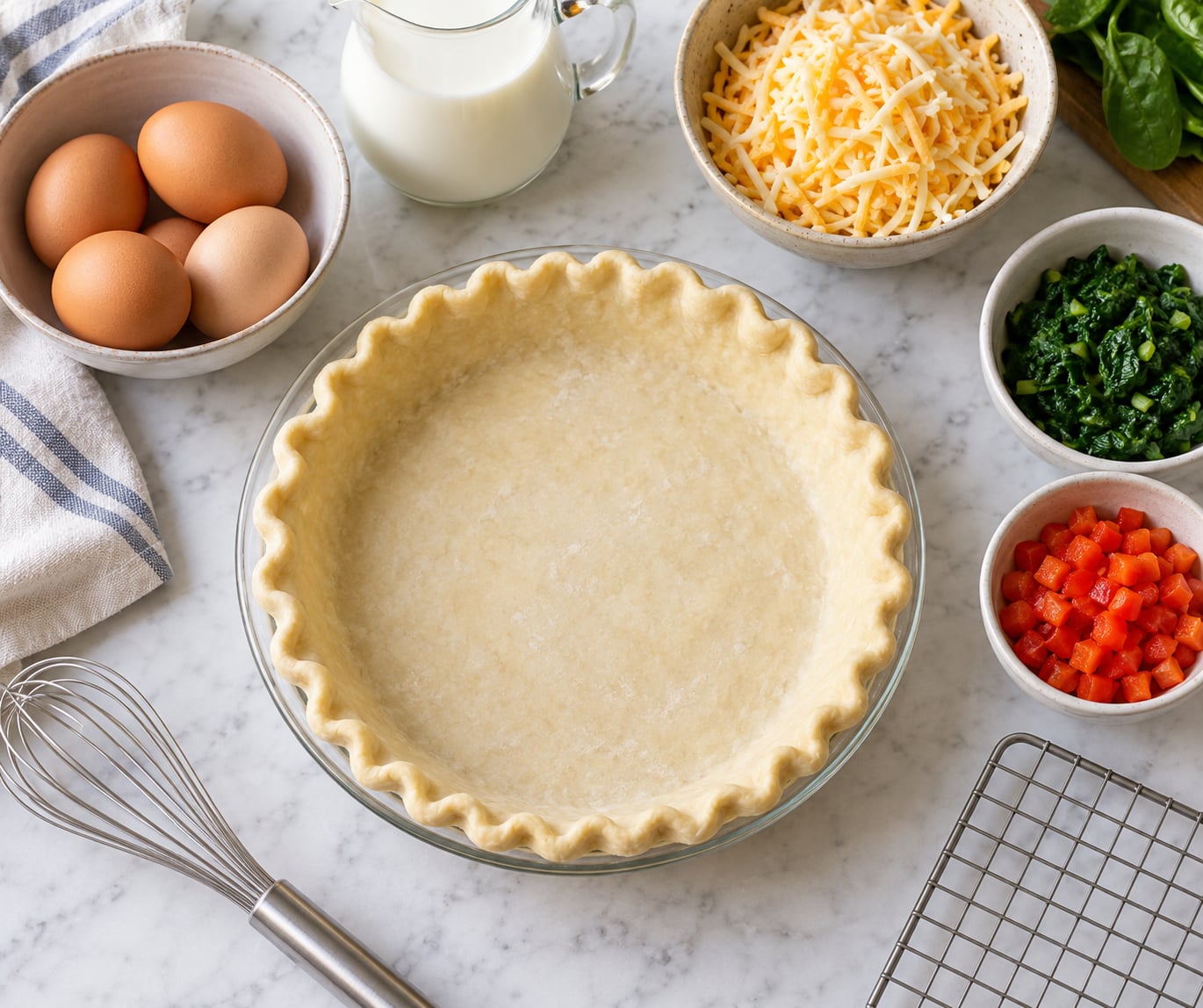
Anyone learning how to make quiche with a store-bought crust should start here: yes, pre-bake it. Dock the bottom with a fork, line it with parchment and pie weights, and bake it at 350°F for about 15 to 20 minutes before you add anything else. That one extra step is what keeps the base crisp instead of chewy, and it is the whole reason premade crust quiche works so well.
A premade 9-inch shell gives you the same result as scratch pastry with about half the work, and quiche is a forgiving dish to learn on. Total time is about an hour, most of it in the oven. You do not have to make dough, roll anything, or own a tart pan.
Table of Contents
What You Need
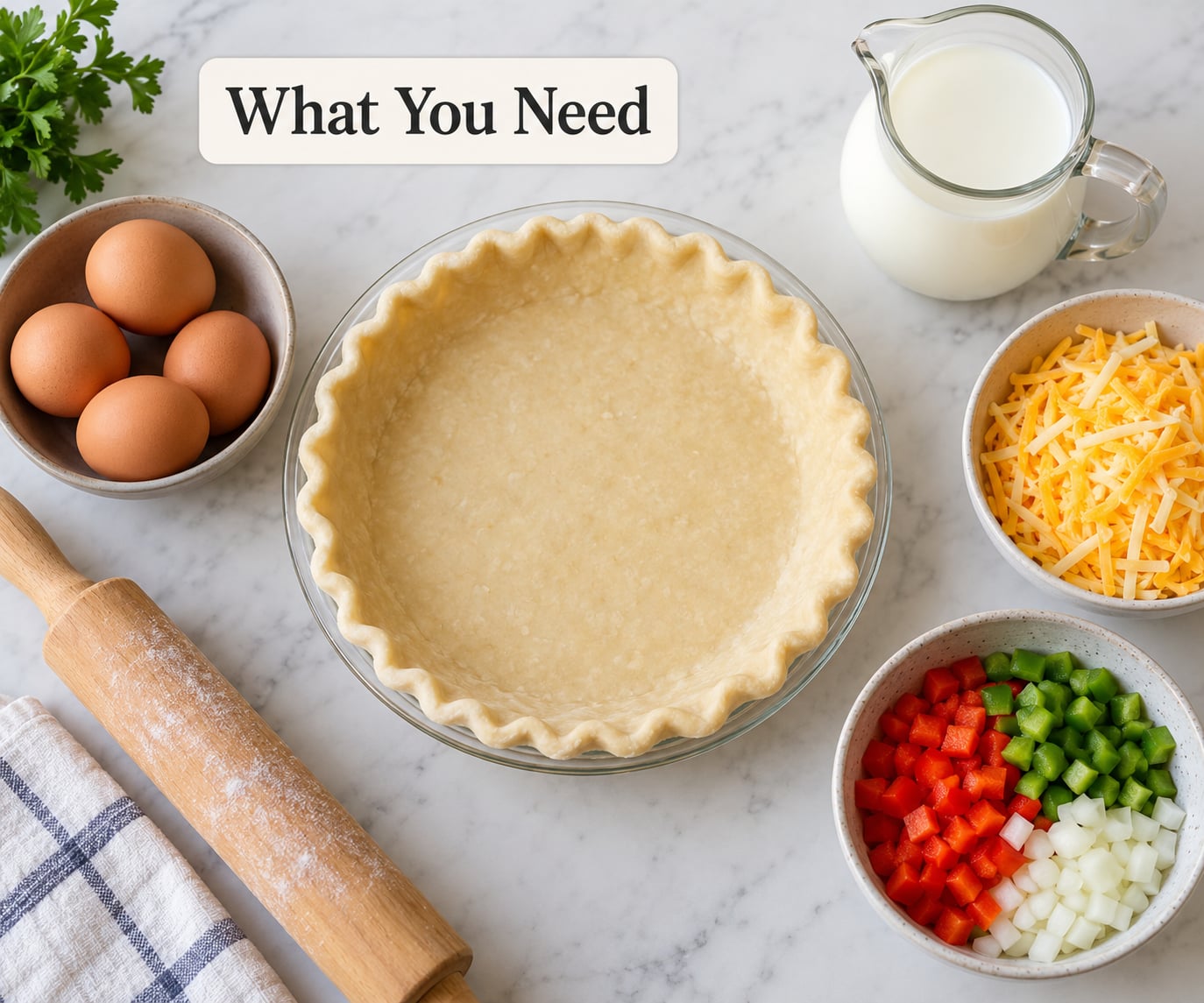
The base recipe below fills one standard 9-inch quiche. Working from the ratio rather than a fixed ingredient list means you can swap the cheese and vegetables without reworking the math.
Equipment
- A 9-inch glass or metal pie plate
- A mixing bowl and a whisk, fork, or immersion blender
- A pie crust brush or a clean pastry brush
- Parchment paper and pie weights, or dried beans if you have no weights
- Sheet pan to catch drips, plus a cooling rack
- An instant-read thermometer for the filling center
- A narrow spatula or knife for cutting clean slices
- Optional: a second bowl and a small sieve
Ingredients
Crust: one unbaked 9-inch refrigerated or frozen pie crust. Skip frozen pastry cups and mini tart shells here, they are sized for a single bite and dry out before the custard sets.
Eggs: 4 large eggs, room temperature.
Dairy: 1.5 cups total. Use heavy cream for the richest result, half-and-half for a lighter one, or whole milk for the least dairy weight. Milk sets quiche a little softer, cream sets it firmer and richer.
Cheese: 1 cup shredded. Gruyere and Swiss give the classic flavor, sharp cheddar brings more bite, and a blend of two works fine. Grate it yourself if you can, pre-shredded cheese carries anti-caking powder that dulls the sauce.
Fillings: 1 cup, cooked and drained where noted. Good combinations are sauteed spinach with feta, roasted red pepper with mozzarella, or cooked ham with Gruyere.
Seasonings: 1/2 teaspoon salt, 1/4 teaspoon black pepper, 1/2 teaspoon Dijon mustard, 1/4 teaspoon ground nutmeg or cumin, and a pinch of cayenne if you like heat. An egg yolk for brushing the rim.
Optional: 2 tablespoons chopped herbs such as chives, thyme, or basil, and a teaspoon of vanilla in a sweet variation.
Which store-bought crust to use
Refrigerated crusts are the more forgiving option. They arrive soft and pliable, so they press into a pan without cracking, and they hold their shape better through the second bake. Frozen crusts are cheaper per pie and taste a little flakier, but they need a short tempering period or they will crack when you press them in.
Thaw a frozen crust at room temperature for 10 to 15 minutes, which is enough to take the chill off without warming the dough. If it still cracks when you press it into the plate, give it another five minutes. If it starts sticking to your fingers, put it back in the fridge for ten minutes. Keep the dough cold until it goes into the oven, because warm dough shrinks as it bakes.
Step-by-Step: How to Make Quiche With a Store-Bought Crust
1. Preheat the oven and prepare the crust
Heat the oven to 350°F and put the empty pie plate in there while it heats. A hot plate is the difference between a bottom that sets and one that stays pale and soft. Line the bottom of the plate with a baking sheet if you are nervous about drips.
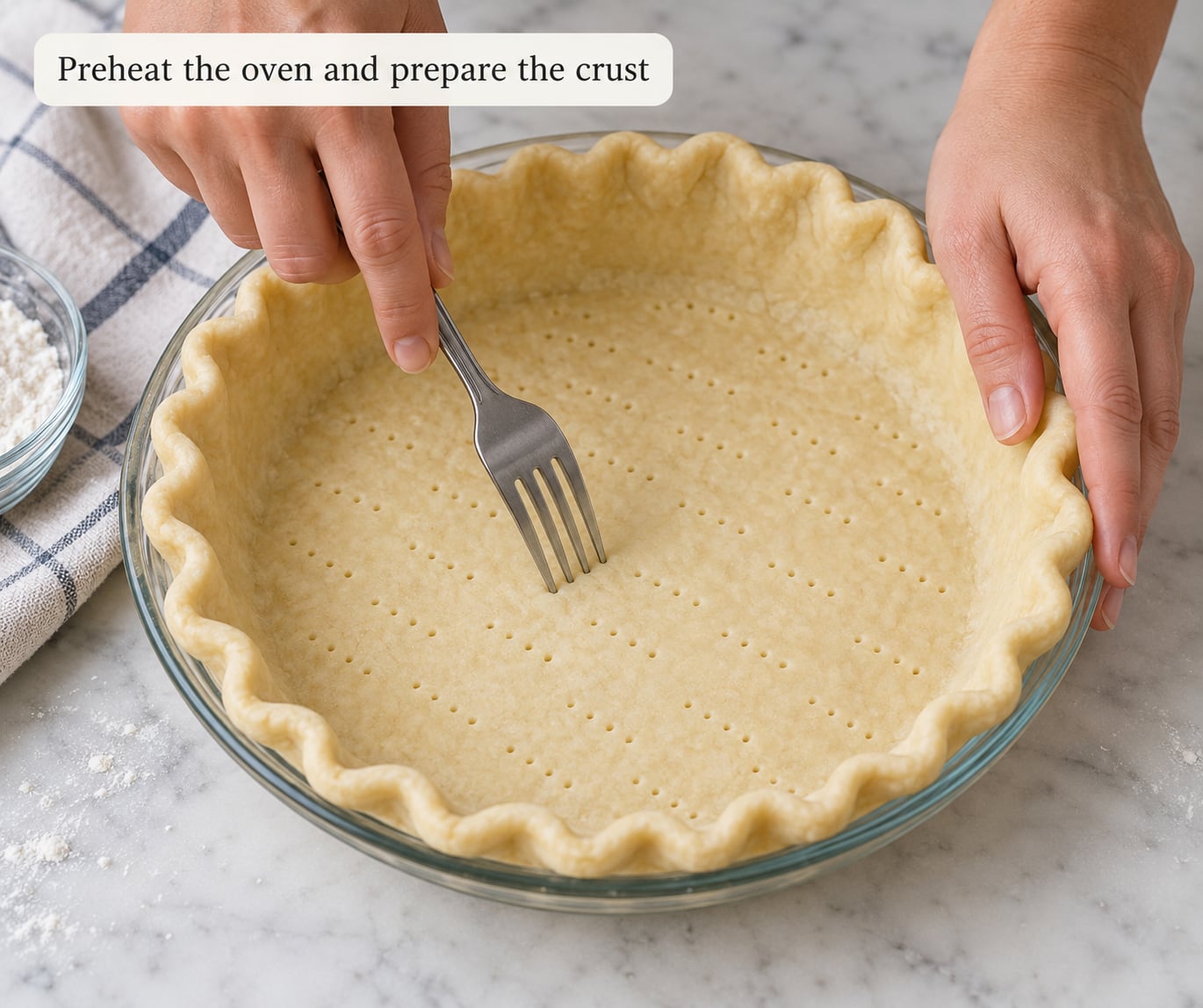
Take the dough straight from the package, unwrap it, and press it into the cold plate. Ease it down with your fingertips rather than draping and stretching it. Stretched dough shrinks during baking, and that is the reason a store-bought crust pulls away from the sides and leaves a gap. Push the dough up the walls with your knuckles instead of stretching it, then crimp or fold the overhang over the rim.
If the crust has no crimped top edge of its own, fold the overhang under and press it around the lip with your fingertips so the top edge sits about a quarter inch below the rim. That recess gives the custard room without spilling.
Dock the bottom with a fork, poking straight down every half inch. Those holes vent steam so the base does not balloon. Dock the sides too if your crust came without a crimped edge. Press down any cracks with a fingertip to seal them.
2. Blind-bake the crust if the recipe calls for it
For a reliable crisp base, blind-bake it. Line the shell with parchment paper, leave the sides exposed, and fill it with pie weights, dried beans, or raw rice until the paper is covered.
Bake at 350°F for 15 to 20 minutes until the weights look dry to the touch and the edges of the dough have lost their raw translucence. Pull the pan out, lift off the weights carefully, and return the crust to the oven for 5 to 8 more minutes so the exposed bottom can dry out. You want pale gold, not brown.
Skipping the weights is fine for quiche, and it is the faster compromise most home cooks use. Just dock the bottom and bake the empty shell for 15 minutes at 350°F until the base looks dry and no longer translucent when you lift a corner. Do not go longer than that, a par-baked crust has to survive a second 35 to 40 minutes of heat.
3. Prepare the vegetables and cheese
Water is what ruins a quiche filling, so treat every high-moisture vegetable before it goes in. Spinach, broccoli, mushrooms, zucchini, and tomatoes all release liquid as they bake. Cook them briefly with a little oil, then drain in a colander or a sieve and press out the excess with the back of a spoon.
Skip the cooking for fillings that hold their water well, such as raw bell pepper, green onions, or pre-cooked bacon and ham. Sautéing mushrooms until they release and reabsorb their liquid, about four or five minutes, does more than draining them later.
Grate the cheese and let it come to room temperature along with the eggs. Cold cheese hits the hot custard in clumps and leaves streaks instead of melting evenly through the filling.
4. Mix the quiche filling without overmixing
The dependable ratio for a 9-inch shell is 4 eggs to 1.5 cups dairy to 1 cup cheese to 1 cup filling. Whisk the eggs first, then pour in the dairy while whisking gently. Add the mustard, salt, pepper, and nutmeg next, and stir in the cheese last.
Stop when the mixture looks evenly combined with a few streaks of white still visible. A little graininess is fine, it settles as it bakes. Beaten into a foam, the eggs trap air and the top of the quiche comes out spongy and cracked, and it can rise above the crust rim.
Now fold in your drained filling and fold it in rather than stirring. Layering works too: cheese on the bottom, filling in the middle, a scatter of cheese on top for color and browning.
5. Pour and bake until just set
Pull the par-baked crust out of the oven and let it sit for two or three minutes so it stops being screaming hot. Pour the filling in slowly, starting at the edge, and stop about a quarter inch below the rim. Overfilling causes the top to dome, brown, and crack.
Cut two or three small slits in the top with a knife so steam can escape. If the rim is already turning golden, fold a strip of foil over the edge and crimp it snugly, leaving the center uncovered. The rim is thin dough and browns long before the middle of the custard is anywhere near set.
Bake at 350°F for 35 to 45 minutes until the edges are set and barely jiggle, the center wobbles just slightly when you shake the pan, and the top has gone from wet to satin with a few pale golden patches. Check the temperature in the center with a thermometer, and aim for 160°F.
That last wobble is the part most people get wrong. Pull the quiche while the center still trembles and the carryover heat finishes the job. Wait until it is completely firm in the oven and you will get a dry, rubbery surface. If the center is still liquid and sloshing after the full time, the filling volume is too large or the oven is running cool, and 5 more minutes is usually the fix.
6. Cool before slicing and store leftovers safely
Let the quiche sit on a rack for 15 to 20 minutes. The filling is still setting as it cools, and cutting it straight out of the oven gives you a runny slice. Once it barely moves when you nudge the pan, it is ready to cut with a long knife wiped clean between slices.
Refrigerate leftovers in a covered container at 40°F or below for up to three to four days. Quiche built with meat, bacon, or a lot of cheese needs the fridge within two hours of coming out of the oven.
Reheat slices at 325°F for 10 to 15 minutes, or microwave in short bursts with a damp paper towel over the top. A light sprinkle of water before reheating keeps the custard from turning rubbery, which is the usual reason people decide they do not like leftover quiche.
Freezing works too. Cool the quiche completely, wrap it tightly, and freeze for up to two months. Thaw it overnight in the refrigerator rather than on the counter, and reheat at 350°F for 25 to 30 minutes. If you are planning a make-ahead brunch, [10 best breakfast sandwiches to make ahead and freeze](https://www.hillcrestsandwich.com/best-breakfast-sandwiches-to-make-ahead-and-freeze/) follows the same logic of cooking once on a weekend instead of twice during the week.
Common Mistakes and How to Fix Them
| Symptom | Likely cause | Fix |
|---|---|---|
| Chewy or soggy bottom | Custard soaked into unbaked dough | Par-bake the shell 15 to 20 minutes at 350°F before filling |
| Center still liquid | Filling pulled out too early, or too much liquid | Bake 5 more minutes and recheck with a thermometer for 160°F |
| Rim browned long before the center set | Thin crust edge exposed to direct heat | Fold a foil strip over the edge, or lower the oven to 325°F |
| Cracked or shrunken sides | Dough was stretched, or warmed too much | Press dough up the walls with knuckles and keep it cold until baking |
| Watery filling | Uncooked vegetables released liquid | Cook and drain spinach, broccoli, mushrooms, or tomatoes first |
| Lumpy cheese with white streaks | Cold cheese and pre-shredded anti-caking powder | Grate fresh cheese and bring it to room temperature |
| Taste is too salty | Recipe salt did not allow for cured meat or cheese | Cut the added salt roughly in half when using ham, bacon, or feta |
| Dough cracked while unrolling | Frozen crust was too cold or too warm | Let it temper 10 to 15 minutes, then press with your knuckles |
Two habits fix most of the table. Baking on a wire rack set over a sheet pan circulates heat under the crust instead of trapping steam, and a metal pie plate transfers heat better than glass, which is why a quiche in a thin glass dish tends to bake paler underneath.
If you want to scale up, a 10-inch shell needs about 5 eggs and 2 cups of dairy, and a deep-dish shell usually takes 6 eggs and 2.25 cups. Making two separate 9-inch quiches beats one 9×13 pan, because the edges of a rectangular pan set and brown long before the middle firms up. Deep-dish shells also hold more filling than you expect, so fill them about two-thirds rather than to the rim.
For a gluten-free version, skip the crust entirely. Butter a pie plate, pour in the same filling, and bake until the edges just set with a center wobble, roughly 35 minutes at 350°F. If you would rather make it the night before and eat it fast, [a sandwich built in the morning that still tastes good at lunch](https://www.hillcrestsandwich.com/how-to-make-a-sandwich-in-the-morning-that-still-tastes-fresh-at-lunch/) covers the same make-ahead ground.
Frequently Asked Questions
Do I need to blind-bake a store-bought pie crust for quiche?
Yes, and it is the single step that decides whether your base is crisp or chewy. A quiche custard is mostly water, and unbaked pastry dough drinks it up as it bakes. Bake the empty shell at 350°F for 15 minutes with pie weights, or 15 minutes docked with no weights, until the bottom looks dry and no longer translucent. Fill it while it is still warm.
Should I thaw a frozen pie crust before making quiche?
You need to temper it, not fully thaw it. Let the frozen crust sit at room temperature for 10 to 15 minutes so it is pliable but still cold. That is enough to press it into a pie plate without cracking. If it cracks, wait five more minutes; if it sticks to your fingers, chill it for ten. Warm dough shrinks, and cold dough snaps.
How do I keep vegetables from making quiche watery?
Cook and drain anything watery. Spinach, broccoli, mushrooms, zucchini, and tomatoes all give up liquid in the oven. Sauté them in a little oil, drain in a sieve, and press out the moisture with a spoon before they go into the eggs. Bell peppers, green onions, and pre-cooked bacon need no cooking, since they hold very little water of their own.
How do I know when a quiche is fully cooked without overbaking it?
Look for two things. The edges should be set and the center should still wobble very slightly when you shake the pan, and an instant-read thermometer in the middle should hit 160°F. Pull it at that point, because the custard finishes setting as it cools. Wait until the center is firm in the oven and the top will come out dry and slightly rubbery.
Can I freeze quiche made with a store-bought crust?
Yes, and it reheats well. Let the quiche cool completely, wrap it tightly in two layers of plastic wrap plus foil, and freeze for up to two months. Thaw it overnight in the refrigerator rather than on the counter. Reheat covered at 350°F for 25 to 30 minutes, or warm individual slices at 325°F for 10 to 15 minutes so they do not dry out.
Conclusion
Three things decide whether store-bought-crust quiche works: par-bake the shell so the dough cannot absorb the custard, control the moisture in your vegetables, and pull the quiche while the center still wobbles. Everything else is detail.
Start with Gruyere, cooked spinach, and a little nutmeg, the classic combination and an easy one to judge. Once you trust the wobble test, swap in ham and cheddar or roasted pepper and mozzarella, and keep the same 4 eggs to 1.5 cups dairy ratio holding steady. Updated for 2026.