

Hollandaise breaks when heat, speed or hesitation pushes it past the point where the egg yolk can hold butter in suspension. Learn how to make hollandaise sauce that doesn’t break by keeping the yolks between 120 and 140F, pouring butter in a thin steady stream while you whisk without stopping, and knowing the three-step rescue if the sauce splits anyway. It takes about 10 minutes from start to plate, and almost every failure happens in the last three of them.
Most people meet hollandaise for the first time at a diner counter, poured over eggs Benedict in that loose, glossy ribbon. Then they try it at home and it turns into scrambled eggs in a bowl. Nothing about the technique is actually difficult. The sauce is just butter and egg held together by an emulsion, and emulsions are picky about temperature.
Here is the short version before the details. “Broken” means the emulsion has let go: watery liquid sinks to the bottom and butter floats up in a slick, sometimes grainy with cooked egg flecks. If that happens, you start with a fresh yolk in a clean bowl, whisk in a tablespoon of hot water, then trickle the broken sauce back into it. Most batches come back. The rest of this guide covers how to never get there.
If you are staring at a separated batch right now, jump to What to Do If Your Hollandaise Breaks first, then come back for the technique that prevents it.
Table of Contents
- What You Need
- Step-by-Step: How to Make Hollandaise Sauce That Doesn’t Break
- Common Mistakes and How to Fix Them
- Frequently Asked Questions
- Why is my hollandaise sauce breaking?
- Can I make hollandaise sauce ahead of time?
- How do I keep hollandaise sauce from separating while it sits?
- Can I use whole eggs instead of egg yolks in hollandaise?
- How thick should hollandaise sauce be when it is ready?
- What can I do with hollandaise sauce that has already curdled?
- Conclusion
What You Need
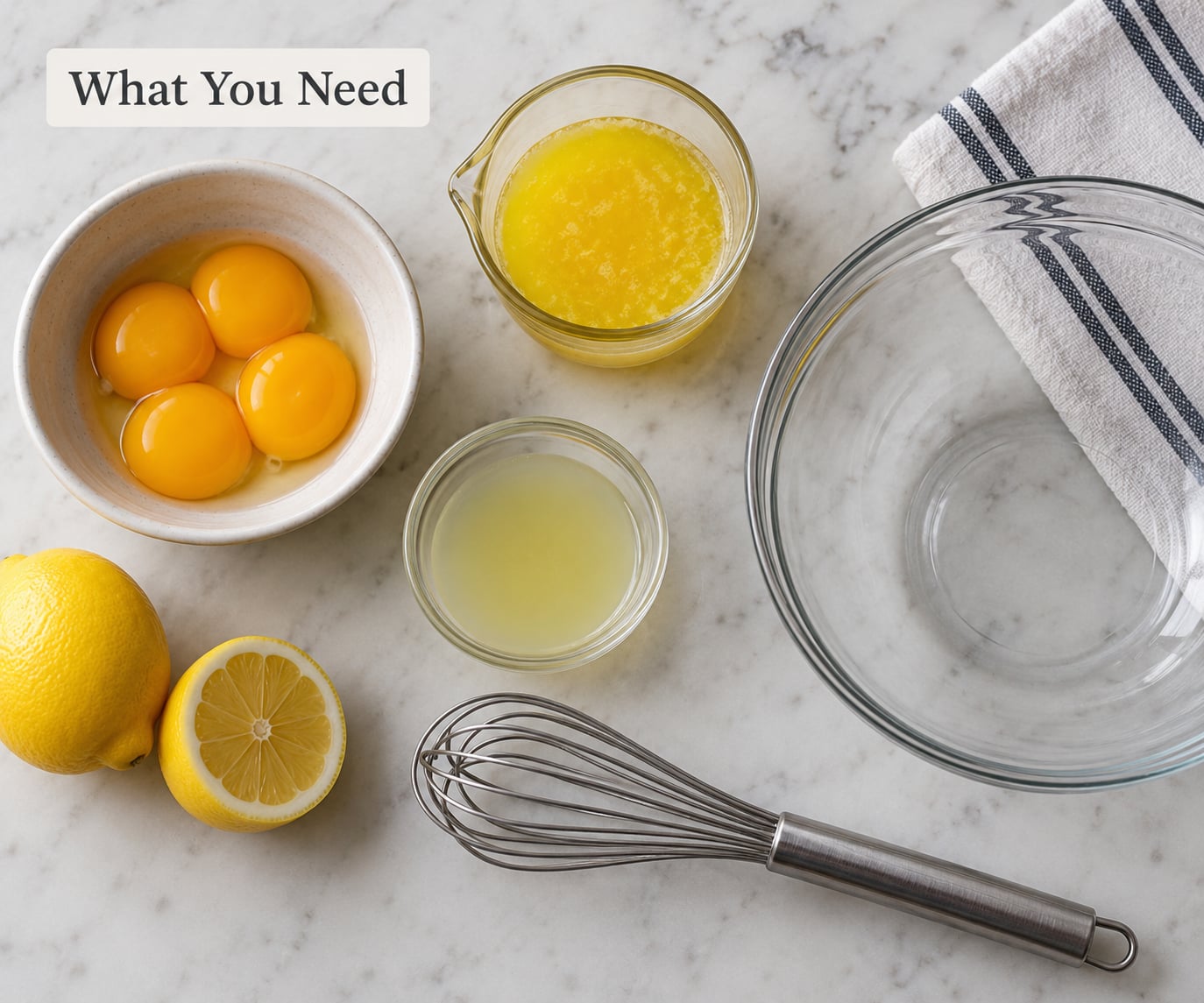
The ingredient list is short and the equipment list matters more than you would expect. A thermometer is the single most useful tool here, because “low heat” means nothing precise while you are whisking.
- Egg yolks. Four yolks to a stick of butter feeds four. Pasteurized yolks from the carton work fine and skip the raw-egg caution entirely.
- Unsalted butter. Salted butter makes every season you add taste twice as strong.
- Lemon juice. One tablespoon per four yolks, plus more to taste. White wine vinegar reduction is the traditional alternative and works identically.
- An immersion blender or a tight-lid blender. This is your insurance policy against breaking. It is not faster, but the emulsification is mechanical, so there is nothing to think about.
- A heatproof bowl and a saucepan. For the classic double boiler method. A folded kitchen towel to nest the bowl in keeps it from sliding.
- An instant-read thermometer. The whole game is staying out of the 160F danger zone.
- Optional: a teaspoon of Dijon mustard. Mustard carries its own emulsifier and buys you margin when the sauce is holding.
Yolk-to-butter ratio and what it changes
The ratio is the easiest lever you have and most people never touch it. More butter relative to yolk means a thinner, looser sauce that breaks with less provocation. More yolk means a thicker, more stable sauce that can sit through a long brunch service without separating.
| Yolks | Butter | Result |
|---|---|---|
| 3 | 8 tablespoons (1 stick) | Standard, restaurant-style. Pourable enough to drizzle. |
| 4 | 8 tablespoons | Thicker, holds a ribbon, very hard to break. Good for eggs Benedict. |
| 5 | 8 tablespoons | Very thick, closer to aioli. The most forgiving ratio you can make. |
| 4 | 4 ounces | Loose and rich. Expect it to thin out considerably and hold warmth longer. |
A note on why only the yolks. Egg white is almost pure protein and water with no fat to emulsify, so it makes a sauce that goes from thin to rubbery with nothing in between. The yolk carries lecithin, a natural emulsifier that coats each butter droplet and keeps it from merging with its neighbours. That single molecule is the whole trick.
Step-by-Step: How to Make Hollandaise Sauce That Doesn’t Break
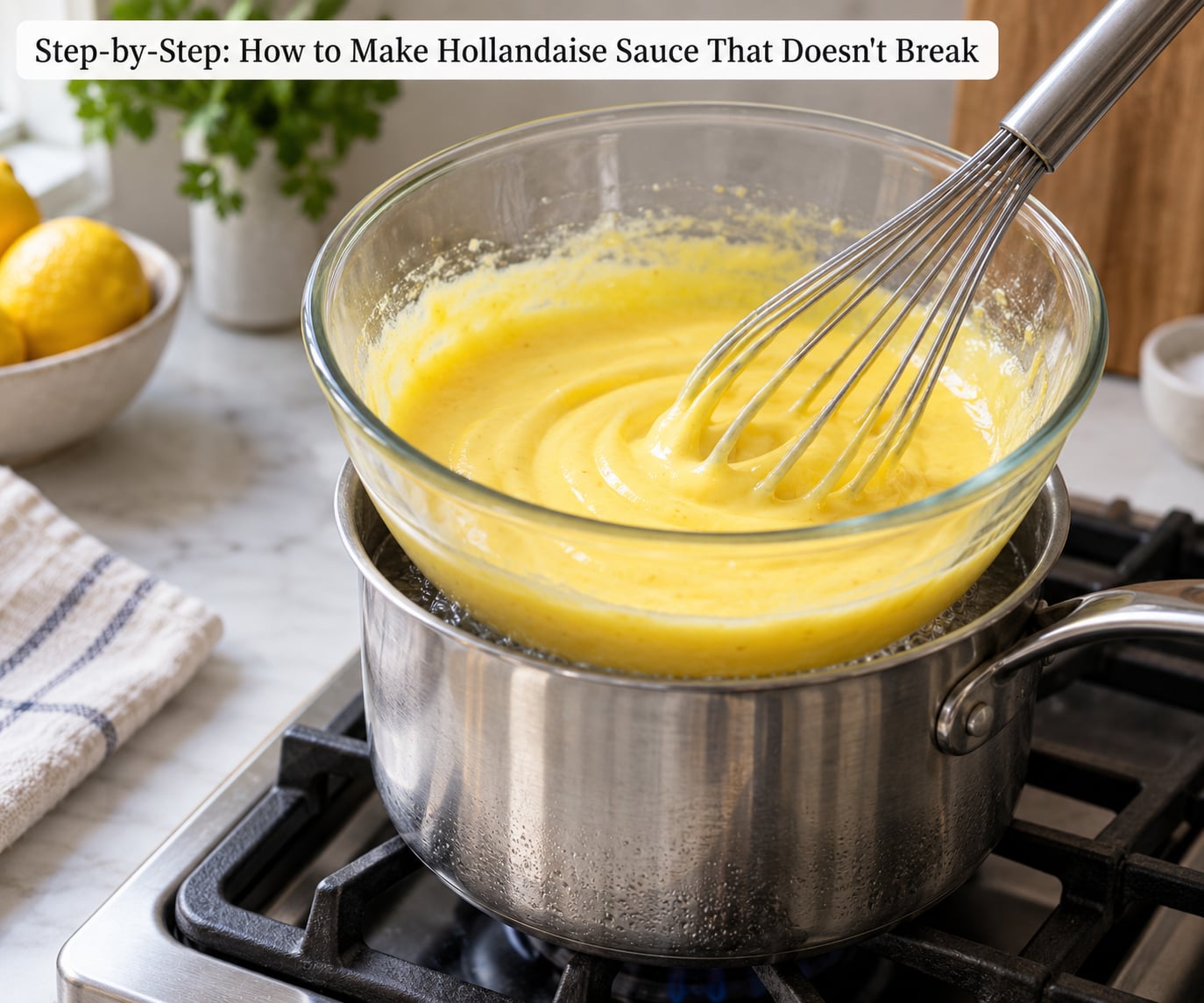
How to Temper the Egg Yolks Without Scrambling Them
Warm the yolks first and you get a sauce that is stable, glossy and forgiving. Skip it and you are relying on raw egg proteins that have never been set, and those will seize the moment things get hot.
Set a heatproof bowl over barely simmering water. Add your yolks, a tablespoon of lemon juice and a pinch of salt, then whisk steadily. You are looking for two cues: the mixture turns pale yellow from deep orange, and it thickens enough that a whisk lifted out leaves a ribbon that sits on the surface instead of vanishing.
Check the temperature as you go. Stay between 120 and 140F and the yolks thicken without setting. Push past about 160F and the proteins denature, stiffen into little grains and stop doing their job as an emulsifier, which is the moment the whole sauce falls apart.
If you have no thermometer, watch the water instead. It should never boil. If you can see the yolk steaming, you are too hot, so lift the bowl off and whisk the base until it cools.
How to Add the Butter Without Breaking the Sauce
This is where most batches die. Dumping half a stick of butter into a bowl of yolks is not emulsifying, it is just making scrambled eggs in a bowl.
Melt the butter until it is fully liquid and warm, not hot. It should pour easily and feel like warm bathwater rather than like a hot pan. Then set it over the yolks and pour in a thin stream at the centre while you whisk at a steady, energetic pace. Constant motion is what chops the butter into droplets fine enough for lecithin to coat.
Start with a tablespoon, wait for it to disappear, then add the next. The sauce should go from thin yellow liquid to something that looks like thin mayonnaise, then to a sauce that coats the back of a spoon and falls off slowly. The moment it holds a ribbon is the signal to stop adding butter, even if butter remains.
If the sauce suddenly gets looser than you want, that is not a break. It is simply more fat than the yolks can currently carry. Drop a tablespoon of hot water in while whisking and it tightens back up. The water goes in hot for a reason: cold water shocks the temperature and can break a sauce that was fine a second earlier.
The blender method skips most of this. Warm the jar with hot water and empty it, warm the yolks with lemon in it for 30 seconds, drop the butter in, and pulse in one-second bursts. The blades do the emulsifying, so heat never gets a chance to cook anything.
How to Season and Finish the Sauce
Season off the heat. Stir in the salt, the rest of the lemon juice, and any Dijon or cayenne you want, then taste it on a spoon. Sauce that looks seasoned on the whisk tastes flat on the plate.
Lemon juice timing is the most argued step in every recipe, and the disagreement is real. Recipes that whisk it in at the end can break the sauce, because the acid thins and destabilizes an emulsion that is already at its most emulsified point. Recipes that add it early are safer. My compromise is one tablespoon in with the yolks for stability and the rest at the end for brightness, added with the heat already off.
Fix thickness last, not first. Too thick means warm water, one teaspoon at a time, whisking between each. Too runny means a fresh yolk whisked with a tablespoon of hot water, then the sauce drizzled into it in a stream. Neither fix should ever involve a large splash of cold liquid at the end.
Hold it over barely warm water rather than on the stove, and stir it every few minutes. If you are building a brunch, keeping it warm is the same skill as making it, so do not plan to make it more than about an hour ahead. If you want something that tolerates a long sit, try an overstuffed sandwich that holds together on a different note entirely: both tricks come down to managing moisture in advance rather than fixing it later.
What to Do If Your Hollandaise Breaks
Work down this list in order and stop as soon as the sauce comes together. Each step costs you less than restarting.
- If the butter is sitting in a slick on top but the sauce underneath looks fine, whisk hard and fast. Sometimes the emulsion just needs motion to re-disperse. Ten seconds of aggressive whisking is free.
- If it is smooth but loose, add a tablespoon of hot water. Whisk it in and watch the sauce thicken back up. This is not a rescue, it is a correction.
- For a true split, start a fresh yolk in a clean bowl. Add one tablespoon of hot water and whisk until foamy. Set the bowl over barely simmering water.
- Add the broken sauce slowly into the new yolk. A teaspoon at a time, whisking constantly, until the new yolk has absorbed what it can. Keep pouring until the mixture looks glossy rather than oily.
- Strain it. Pass through a fine-mesh sieve to remove any grainy egg flecks. You will lose a little volume and gain a smooth sauce that pours.
- Give up gracefully when the sauce is grainy and smells of cooked egg. That means the proteins set, and no amount of whisking brings them back. Strain what you have and serve it as a dressing over vegetables, or make a fresh batch. It is a ten-minute loss, not a wasted dinner.
The trending short-form version of step four drops a couple of ice cubes into the broken sauce and blends. It works on a split that has not fully separated, because the shock of cold collapses the fat into a solid mass you can blend back in. It does nothing for a scrambled sauce, so judge by texture first.
Common Mistakes and How to Fix Them
The temperature window
Almost every broken batch traces back to one number. Cooks with a thermometer break far fewer sauces than cooks guessing.
| Temperature | What is happening | What to do |
|---|---|---|
| Below 120F | Yolks are cold and thicken slowly; butter may seize into lumps | Keep whisking and let the bowl warm over the water |
| 120-140F | The safe zone. Yolks thicken into a stable foam | Start the butter stream here and keep the whisk moving |
| 160-170F | Yolk proteins denature and grain up; the emulsion loses its emulsifier | If you are here, lift the bowl off the heat and whisk to cool before adding anything else |
| 80-90F | Service temperature for holding a finished batch | Warm, not hot. Stir every few minutes. Below about 70F it starts to stiffen |
| 40F or below | Refrigeration, for leftovers only | Airtight container, use within 2-3 days, reheat gently and whisk |
Three causes of breaking
- Too much heat. The single most-cited cause among experienced cooks. Direct or boiling heat gets you to the curdle point in seconds. Fix: a double boiler, a thermometer, and pulling the bowl off the heat the moment you notice steam.
- Butter added too fast. Fat arriving faster than the yolks can emulsify it pools, then floats. Fix: one tablespoon at a time, wait for full incorporation, keep whisking the entire pour.
- Stopping, or chilling the sauce. Emulsions need continuous motion. A bowl of finished sauce sitting on a cold counter drops below the temperature where the fat stays suspended. Fix: hold it over barely warm water and stir it.
Clarified butter and ghee raise the risk further. With the milk solids gone, there is less protein left to buffer the fat, so the emulsion has less margin before it separates. Whole butter is more forgiving, and for a first batch it is what you want.
Symptom, cause, fix
| Symptom | Likely cause | Fix |
|---|---|---|
| Slick butter floating on top | Butter poured too fast or the whisking stopped | Whisk hard for 10 seconds; if it returns, start a fresh yolk |
| Grainy, thick, smells of cooked egg | Sauce exceeded 160F and the proteins set | Strain out the flecks and use it as a dressing, or start over |
| Watery and thin after the butter went in | More fat than the yolks could hold, or cold butter seized | Whisk in a tablespoon of hot water, or a fresh yolk, a little at a time |
| Too thick to pour | Too little liquid, or too much time over heat | Add warm water one teaspoon at a time while whisking |
| Split the second lemon juice went in | End-stage acid on an emulsion at maximum thickness | Whisk in the lemon earlier with the yolks next time; rescue this batch with a fresh yolk |
| Splits again within minutes of serving | Held too cool, or held without stirring | Keep it at 80-90F over warm water and stir every few minutes |
Making it ahead and reheating
You can make hollandaise a few hours ahead and refrigerate it, sealed, at 40F or below. Plan on two to three days of storage for a homemade batch. Reheat slowly in a bowl over warm water with a whisk in your hand, and stop well before it steams.
Never microwave it in one go. The edges of the bowl get hot enough to set the egg while the middle stays cold, and you end up with hot curdled patches in cold sauce. Thirty seconds on high, a good stir, repeat. It is a fussy way to reheat, which is exactly why restaurants hold the sauce warm instead.
For holding a room full of people, the restaurant number is 80 to 90F in a metal bowl or a pan of warm water. Never hot, never direct heat, stirred regularly. Most cooks find a blender-made sauce holds an hour like this without complaint, and a thinner sauce degrades faster than a thicker one, which is another reason to err on the yolk-heavy side.
If the sauce is running thin at service, a last splash of hot water with the whisk running fixes it in seconds. Pair it with something that holds its own on the plate, the way it does on a deli platter made at home that looks catered, rather than a delicate fillet that disappears under the sauce.
Two variations are worth knowing. Add a tablespoon of shallot and a splash of white wine reduction to the yolks for béarnaise, which is the same emulsion with a different personality. Or whisk in a teaspoon of Dijon with the butter, which adds emulsifier of its own and makes the most forgiving sauce in this whole article.
Frequently Asked Questions
Why is my hollandaise sauce breaking?
Hollandaise is an emulsion, and it breaks when heat, speed or stillness overwhelms the yolk. Past about 160F the yolk proteins denature and grain up, so they can no longer coat the butter droplets. Pouring butter faster than you can whisk is the second cause, and letting the sauce sit below about 70F is the third. Any of the three let the fat droplets merge and separate.
Can I make hollandaise sauce ahead of time?
Yes, up to a few hours refrigerated at 40F or below in an airtight container. Homemade hollandaise keeps two to three days. Reheat it in a bowl set over warm water with a whisk in your hand, stirring constantly, and stop well before it steams. For longer holds, keep it at 80 to 90F over warm water and stir every few minutes.
How do I keep hollandaise sauce from separating while it sits?
Hold it warm and keep it moving. Restaurants keep finished hollandaise at 80 to 90F in a metal bowl or insert set over warm water, and stir it regularly, because an emulsion needs motion to stay suspended. Below roughly 70F the fat stiffens and pulls away from the water phase. A thicker sauce made with extra yolks holds far better than a thin one.
Can I use whole eggs instead of egg yolks in hollandaise?
You can, but the whites dilute the emulsion and add a large amount of protein that sets into an elastic, rubbery texture when heated. Since whites are mostly water and protein with no fat to emulsify, they push the sauce from thin to thick with nothing useful in between. If you must, save the whites for a meringue or a frittata and make the hollandaise with yolks only.
How thick should hollandaise sauce be when it is ready?
It should coat the back of a spoon and fall off slowly in a thick ribbon rather than running off like milk. The progression is thin yellow liquid, then a mayonnaise-like stage, then a glossy sauce that holds a line when you drag a whisk through it. That last stage is your signal to stop adding butter. Too thin is fixed with hot water; too thick is fixed the same way.
What can I do with hollandaise sauce that has already curdled?
Start a fresh yolk in a clean bowl with a tablespoon of hot water, whisk until foamy, and set it over barely simmering water. Add the broken sauce a teaspoon at a time, whisking constantly, until it looks glossy instead of oily. Strain out any grainy flecks. If the sauce smells strongly of cooked egg, the proteins have set and cannot be recovered; strain it and use it as a dressing instead.
Conclusion
Four things decide whether your hollandaise holds together: keep the yolks between 120 and 140F, melt the butter and pour it in a thin stream, whisk without stopping from the first tablespoon to the last, and keep the finished sauce warm and moving until it hits the plate.
Salt and season off the heat, and if it splits, remember that a broken batch is almost never a lost batch. One fresh yolk, one tablespoon of hot water, and a slow stream of the split sauce brings most of it back. The sauce that cannot be saved is the one that smells of cooked egg, and that was always about temperature.