
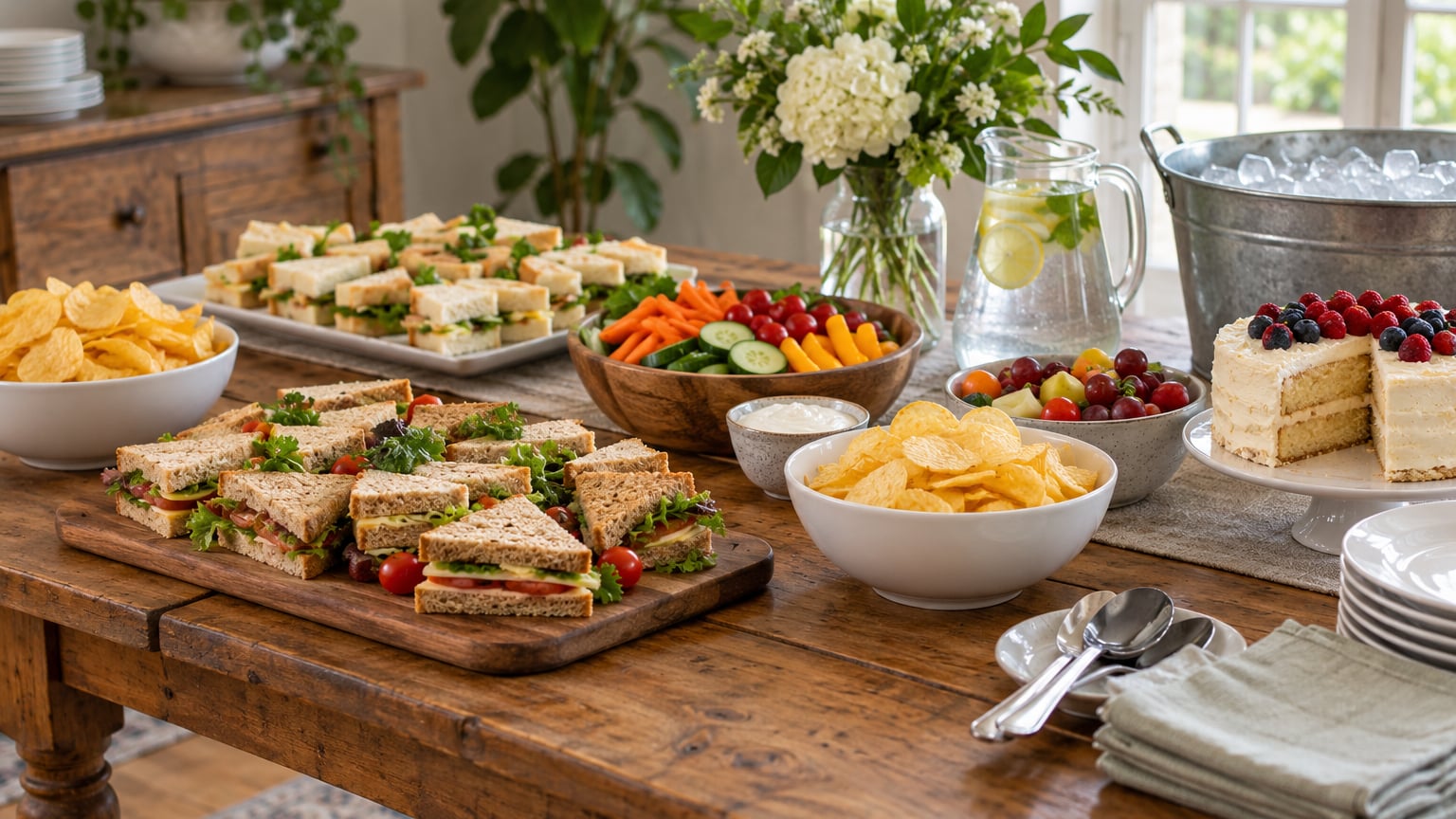
Plan on 1 to 1.25 pounds of total food per adult when the party is a full meal, which works out to about 6-8 ounces of protein, 4-6 ounces of each side dish, and 1-2 dessert servings per person. The real answer depends on how long the party runs, whether food is the main event, and how many children and big eaters are on your list.
I host enough parties to know the failure mode. Either the tray empties at 8pm and two people are eating crackers over the sink, or I have leftover potato salad in the fridge until Thursday. Both come from the same mistake: picking one number for every dish instead of working out a serving size per person for each item.
So here is the short version of how much food to make for a party per person, followed by the per-dish numbers, the math, and the adjustments for kids, drinks, and the leftovers you will actually have. Updated for 2026, these are the figures I use whether the party is twenty people or a hundred.
Table of Contents
- How Much Food to Make for a Party Per Person
- What Is the Standard Party Food Amount Per Person?
- How to Calculate the Total Amount of Food
- Party Food Quantities by Type of Dish
- How Much Should You Make for Sandwiches, Wraps, and Sliders?
- How Much Food Do You Need for a Casual Party or Buffet?
- How Much Food Should You Make for a Formal Dinner Party?
- How Much Food to Make for Children and Mixed-Age Groups
- What Drinks and Ice Should You Plan Per Person?
- How Much Extra Food Should You Make as a Buffer?
- How to Keep Party Food Safe and Fresh
- Frequently Asked Questions
- Conclusion
How Much Food to Make for a Party Per Person
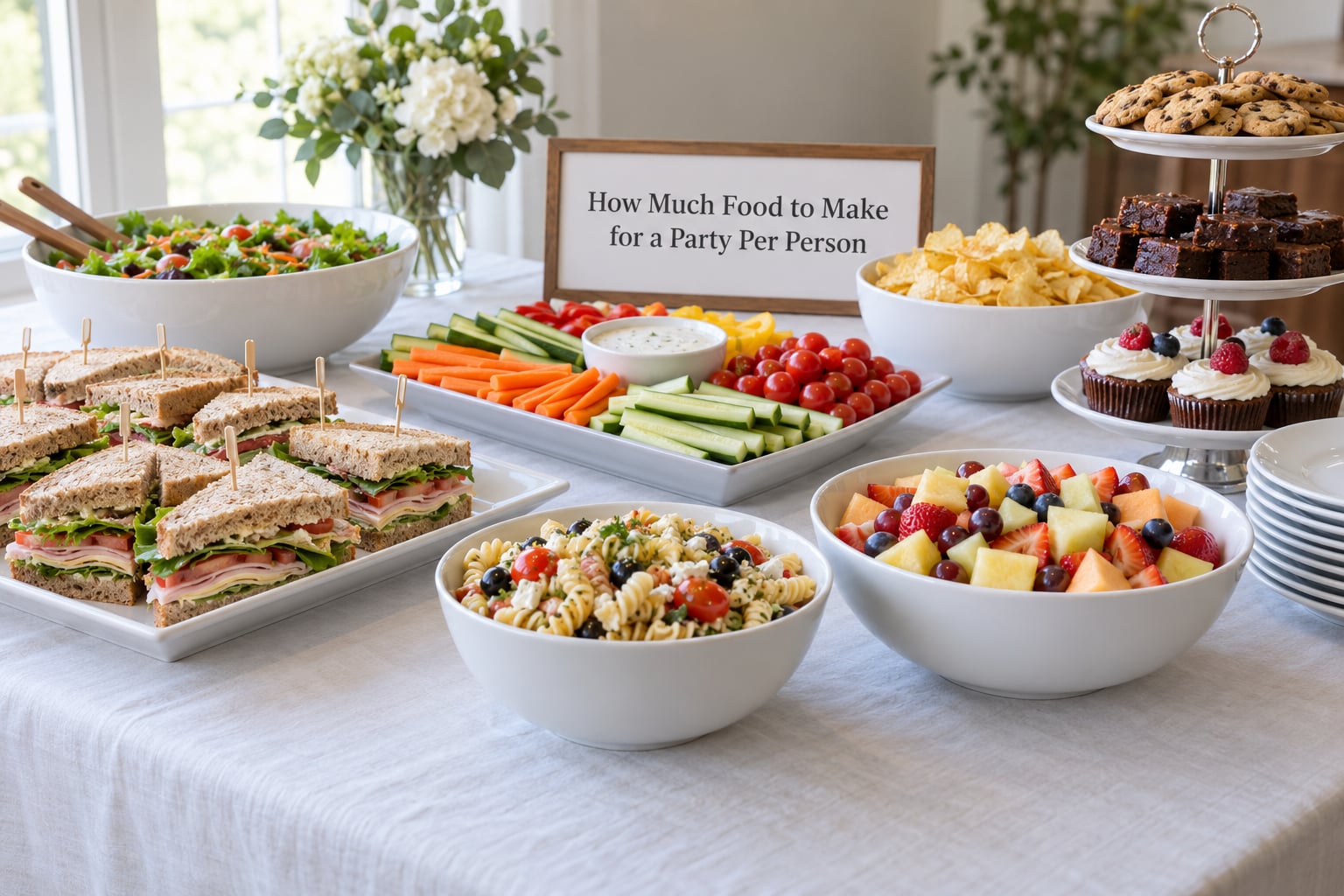
For a full meal, plan 1 to 1.25 pounds of total food per adult, counting the main, the sides, the bread, and dessert together. That breaks down to 6-8 ounces of protein, 4-6 ounces of each side dish, 4-6 appetizer pieces, and 1-2 dessert servings per person. For a snack-only party, cut the protein and sides entirely and plan on 4-6 small bites per person per hour.
| Food category | Per adult | Notes |
|---|---|---|
| Main dish (meat, fish, pasta) | 6-8 oz cooked | Add 2 oz for known big eaters |
| Each side dish | 4-6 oz | Two to four sides is plenty |
| Salad or raw vegetables | 3-4 oz | Small plates, big bowls |
| Sandwiches or wraps | 2-3 servings | Or 4-6 small sliders |
| Appetizers, no meal served | 4-6 pieces per hour | Count small bites as one piece |
| Chips and crackers | 1/2 to 1 oz | Two to four handfuls is typical |
| Dessert | 1-2 servings | Over-plan the sweet stuff |
| Water and soft drinks | 1 gallon per 4-5 guests | Plus more if it is hot outdoors |
One number will not fit every occasion, so treat this table as a starting point rather than a verdict. The right total changes depending on whether food is the main activity, a buffet meal, or light snacks between other things.
What Is the Standard Party Food Amount Per Person?
The working standard is two to three hours of eating, or roughly five to six substantial servings per adult. That covers a normal three-hour birthday party, a graduation open house, or a holiday dinner where the food is the point.
Three situations break from that standard. A snack-only party where guests arrive full from lunch needs far less, more like three to four bites per person per hour. A meal served at a set time needs less food but more of it per plate, since everyone eats at once. A long event running five hours or more needs more, because guests graze all evening rather than sitting down.
Guests are not average, either. A teenager will eat like a hungry adult. A nine-year-old eats maybe a third of an adult portion. Someone who ran five miles that morning eats considerably more than someone who sat all day. I count generous adults and teenagers as full servings, kids ages four to eleven as half, and toddlers as a third, then add a buffer where the crowd skews hungry.
Dietary differences matter too. If half your list is vegetarian, split the main rather than serving one meat dish that half the room skips. A guest who cannot eat nuts, gluten, dairy, or shellfish is the reason you make three small dishes instead of one big one.
How to Calculate the Total Amount of Food
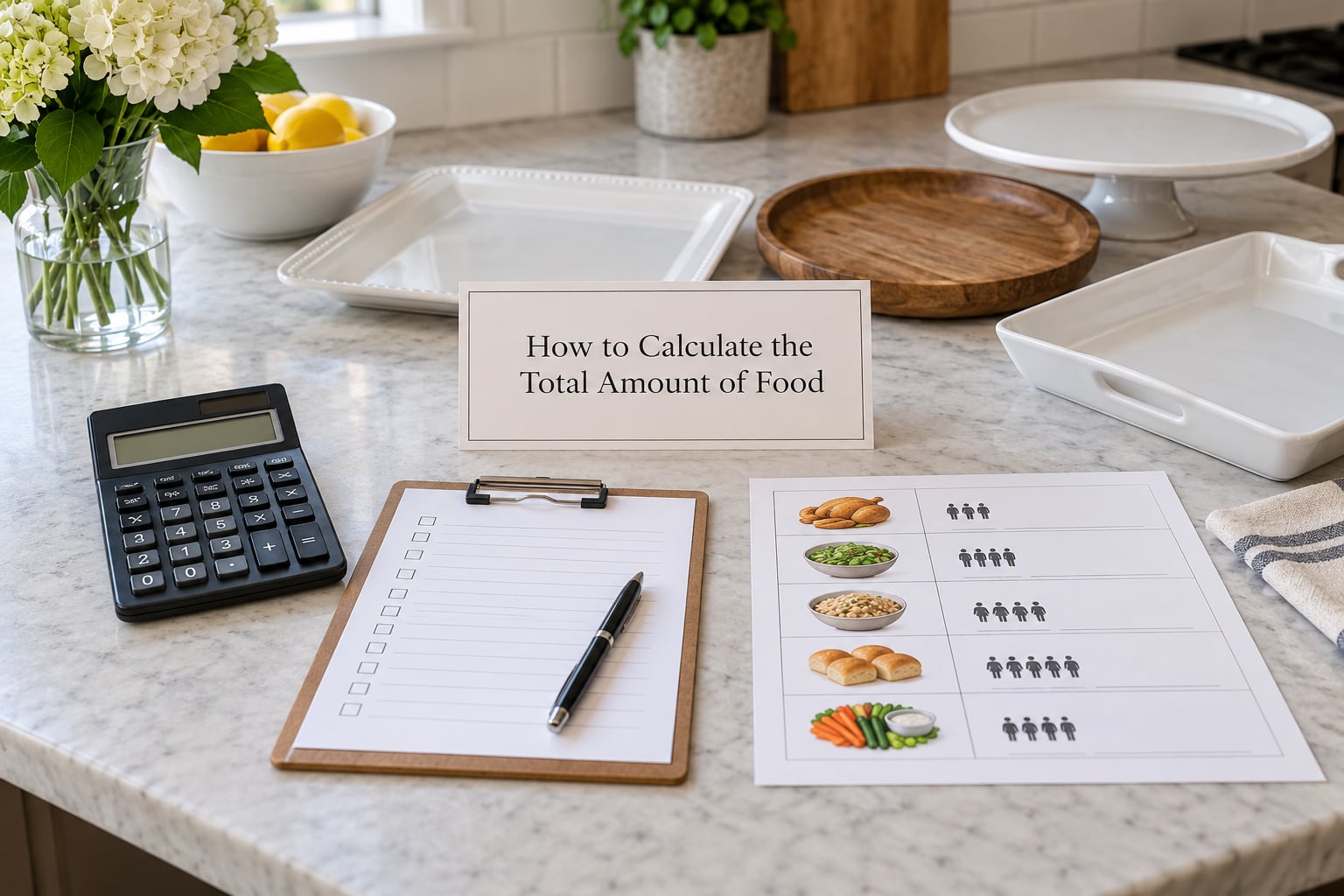
The calculation takes five minutes once you stop guessing. Write the menu down first, because you cannot multiply by a guest count for a dish you never chose.
Step 1: Lock the guest count. Count the people who will actually eat, including kids, but exclude people dropping in for five minutes. Send one reminder text the week before. A headcount you are confident about beats a generous guess.
Step 2: Write the menu. One protein, two to three sides, bread if you want it, and one or two desserts is a solid structure. More than four sides dilutes every portion, and your guests eat the same amount either way.
Step 3: Pick a serving size for each dish. Use the numbers in the table above, or measure a serving on your own plate and note it. A serving size is what one hungry adult takes, not what fits on a small plate.
Step 4: Multiply. Serving size times confirmed guests gives you the total for that dish. Do it dish by dish rather than only in pounds, because the pound total hides the fact that one item is short while another is in surplus.
Step 5: Add a small buffer and round selectively. Add 5-10 percent to the items most likely to run out, such as the main, the salad, and the dessert, and leave alone the dishes that reheat well. Rounding a 27-piece tray up to 30 is easy. Rounding a salad up to half again is waste.
Here is that method applied to a casual party for 20 adults:
| Dish | Per person | For 20 guests | With buffer |
|---|---|---|---|
| Sliders | 3 each | 60 | 66 (round to 70) |
| Pulled pork | 5 oz cooked | 100 oz | 110 oz |
| Potato salad | 5 oz | 100 oz | 110 oz |
| Coleslaw | 4 oz | 80 oz | 88 oz |
| Cookies | 2 each | 40 | 45 |
| Sheet cake, 9-inch rounds | 1 slice | 3 cakes | 4 cakes |
Note what the buffer did and did not touch. It went on the pork and the cake, which disappear. It stayed off the coleslaw, which was already generous and keeps for two days.
Portions by Service Style: How Much Food to Make for a Party Per Person
Once the menu is set, the same question comes back in three versions depending on the shape of the party.
Snacks only, no meal served. Plan 3-5 small portions per person for a two-hour event, then add one portion per extra hour. This is finger food territory: sliders, wings, vegetables with dips, crackers with cheese.
Appetizers plus a light meal. Plan 2-3 substantial appetizer portions per person, or roughly 8-10 small pieces, and pair them with one lighter main such as tacos, a pasta bake, or a soup.
Full meal with sides. Plan one main plus 2-3 sides, bread if you serve it, and dessert. The total lands at 1-1.25 pounds per adult. For a party running past four hours, add 2-3 more appetizer portions per person on top of the meal.
Party Food Quantities by Type of Dish
Serving sizes get abstract fast. These are the per-adult numbers I actually cook from, and the ones most hosts get wrong because the dish looks small on the table.
| Dish | Amount per adult | Easiest to overbuy? |
|---|---|---|
| Sandwich tray, filled | 2-3 quarters | Yes, if you size up |
| Deli meat and cheese | 5-6 oz sliced | No, people take less |
| Sliders | 4-6 small | No, they go fast |
| Pizza | 2-3 slices | Yes if slices are large |
| Pasta | 1.5-2 cups cooked | No, very predictable |
| Fried chicken or tenders | 3-4 pieces | Moderate |
| Wings | 5-7 pieces, 4-6 per hour without a meal | Yes, easy to overbuy |
| Potato, macaroni, or pasta salad | 5-6 oz | Yes, it is rich and heavy |
| Chips | 1/2-1 oz, about 2-4 handfuls | No |
| Raw vegetables | 3-4 oz | No, unless you are dip-heavy |
| Dip | 2-3 oz, so 1 lb serves about 6 | Yes, three tubs disappear |
| Layer cake or sheet cake | 1 slice, 2 for big crowds | Plan on the high side |
| Cookies or brownies | 2-3 | Moderate |
| Ice cream | 1/2 to 3/4 cup | Yes, especially in July |
The foods that get overbought are the rich, heavy, starch-based ones: potato salad, mac and cheese, fried items, and dips. They feel like a small scoop on a buffet plate but add up fast. The foods that get underbought are the ones that vanish one at a time: sliders, wings, crackers, and the second tray of ice.
How Much Should You Make for Sandwiches, Wraps, and Sliders?
For hand-held food, plan two to three sandwich servings per adult for a party that runs two to three hours, or four to six small sliders. If the sandwiches are tiny and filled generously, count three. If they are large and dense, two is plenty.
Sliders run smaller, so the number goes up. A slider is roughly a third the size of a standard sandwich, which means three sliders is about one full serving, not three. For a three-hour party with a main, two to three sliders per adult works. For sliders standing in for the whole meal, four to six.
Wraps sit in the middle. A full wrap is a meal, so one per adult is enough if you also serve sides. Cut wraps are counted as finger food, so two to three pieces per person fits a grazing party.
Bread size changes the math more than people expect. A party loaf cut into quarters is closer to two servings than three. Mini rolls, on the other hand, behave like sliders, and guests will take two of them for one serving of appetite.
If you are weighing store trays against your own kitchen, it helps to look at how a party platter works out per person before you buy. Our guide on what a store-bought party platter runs per person breaks that math down dish by dish.
How Much Food Do You Need for a Casual Party or Buffet?
For a buffet, plan roughly 10-15 percent more than the sit-down numbers, and lean toward food people can eat standing up. Event and wedding planners routinely plan for more heads than they have, and the reason is a buffet line takes a portion every time a guest passes, and passing is not the same as eating.
What changes most is portion structure. Instead of one big plate, offer several small items: two proteins, three or four sides, bread, and two desserts. Guests take small portions of many things, and a ten-dish buffet is a different meal from a four-dish one.
Have backup portions ready rather than making everything oversized. Extra cooked chicken, another tray of rolls, and a second dessert can go out mid-party while the potato salad sits untouched. That single habit solves most buffet anxiety.
Plan the physical setup too. You need a serving dish for every item, tongs or spoons for each one, plates, napkins, and a trash bin, and a table long enough that the line does not block the door. The same headcount planning applies whether it is a backyard barbecue or a company-wide lunch, which we cover in how much food to order for an office lunch by headcount.
If most guests are meant to build their own plates, a DIY sandwich bar is a good low-waste setup, since the bread and fillings are counted by the piece and the toppings barely need estimating.
How Much Food Should You Make for a Formal Dinner Party?
For a seated dinner, plan one main, one or two sides, bread if you serve it, and dessert. That is usually enough, and you can be more generous per plate than you would at a buffet. A buffet portion is small by design, so guests take a smaller amount than they would sitting down.
Serve the main family-style rather than plated in advance. It lets hungry guests take a second helping without you cooking two mains, and it solves the dietary problem, since guests can build a plate around what they can eat.
Allow for restriction without cooking separate everything. A nut-free or gluten-free guest usually needs one dish made differently, not a separate menu. Ask in advance and make the one exception, then tell the table why that dish is separate so nobody takes the wrong plate.
For a formal holiday dinner, the same structure holds. One protein, two to three sides, stuffing, gravy, and dessert is a full spread. A whole turkey for a group needs about 1 pound per person, which is more than a roast beef portion because some of that weight is bone and skin you never serve.
How Much Food to Make for Children and Mixed-Age Groups
Children eat less, but the difference is not only quantity. A smaller portion of an unfamiliar dish is often wasted, so keep at least one option you know they will eat.
Use these weights as a starting point: ages 12 and up eat a full adult portion. Ages 4 to 11 eat about half. Ages 1 to 3 eat roughly a third. Babies under one are not counted at all unless you are serving purees or formula for the caregivers.
Count the categories separately rather than averaging them. A party of 40 with 18 small children is 22 adult servings plus 9 child servings, so about 31 adult-equivalents. Treating all 40 as adults is how you end up with two full casseroles nobody finishes.
Build a menu that works for both ends of the age range. Mini sliders, small chicken pieces, fruit, crackers with cheese, and a familiar pasta all travel well. Skip raw vegetable platters for a young-heavy crowd and replace them with cucumber rounds, carrot sticks, and a creamy dip.
Seat kids away from the traffic path to the food. A separate low table for the under-fives saves a lot of dropped plates and makes it easier to keep an eye on what they actually ate.
What Drinks and Ice Should You Plan Per Person?
Plan beverages separately from food, because drinks are what most hosts under-buy. Start with 1 gallon of water per four to five guests, then add more if anyone is outside in warm weather or the party runs long.
| Drink | Amount per adult |
|---|---|
| Water | 2-3 cups, plus a gallon dispenser per 4-5 guests |
| Soda | 2-3 cans, or 1 gallon per 5-6 guests |
| Coffee | 1-2 cups if served morning or afternoon |
| Tea | 1-2 cups, often a refill station works better |
| Beer | 2 bottles over three hours |
| Wine | One 750 ml bottle per 2-3 guests |
| Ice | 1.5-2 lb per guest, 3 lb per guest outdoors in summer |
Alcohol is the least predictable line item. Guests drink differently at a birthday party, a holiday dinner, and a wedding reception, and the drink that runs out is usually the one nobody planned for. Have water, soda, and coffee flowing in the same sightline as the alcohol, and make sure drivers and any kids have an obvious option that is not it.
For ice, buy it the day of if you have a freezer. A typical bagged bag is about 20 pounds, which covers roughly ten guests in ordinary weather, and closer to seven when everyone is outside on a hot day.
How Much Extra Food Should You Make as a Buffer?
Add 5-10 percent to the dishes most likely to run out, and skip the buffer on everything else. The most popular items at my parties are rarely the ones I planned as the main event. Order for the skew, not the average.
A buffer is worth it on the main protein, the salad, and the dessert. It is wasted on a second side dish, on a tray of rolls nobody claimed, and on anything delicate that turns to paste after two hours on a warm table.
As for extras, the universal rule of thumb is that leftovers are a much smaller problem than running out. Still, a leftover is only useful if it gets stored correctly. Refrigerate perishable leftovers within two hours of serving, keep the fridge at 40°F or colder, and use refrigerated leftovers within three to four days. Freeze bread, meat, and sauce-heavy dishes you will not eat in time.
Soup, chili, pulled pork, casseroles, and pasta all reheat better than they re-warm as first-night leftovers. A tray designed to produce tomorrow’s lunch is a better use of that buffer than a second side dish nobody wanted.
How to Keep Party Food Safe and Fresh
Cook to the safe internal temperature every time, including the reheated casseroles. For poultry the minimum is 165°F, for ground meat it is 160°F, and for whole cuts of beef, pork, lamb, and fish it is 145°F. Use an instant-read thermometer in the thickest part, not against the bone.
The two-hour rule covers the party itself. Perishable food should not sit out longer than two hours at room temperature, and that drops to one hour when it is above 90°F outside. Dips, cut fruit, potato salad, and anything with mayonnaise in it are the first things to pull when people are slow to arrive.
Keep hot food at 140°F or above in chafing dishes, and keep cold items on ice rather than in a bowl sitting out. If a tray of food has been at room temperature for close to two hours, stop guessing and throw it out. Nobody needs a second trip to the hospital because of a party.
A few small habits do most of the work here. Put out the food in stages instead of all at once, so the first trays are still fresh when the second round goes out. Set up a separate small plate for returning guests so nobody is reaching into a tray that has been sitting by the door. And put out a small trash bin near the food, because most rejected food never makes it to a plate.
Frequently Asked Questions
How much food do I need for 25 people?
For 25 adults eating a full meal, plan about 25 to 31 pounds of total food, which is 6-8 ounces of protein each, 4-6 ounces of two or three sides, and 1-2 dessert servings. For a snack-only party, drop the main and sides and plan 4-6 finger food pieces per person per hour instead. Add 10 percent to the items most likely to disappear first.
How many trays or platters do I need for 30 to 40 guests?
Plan one serving tray per dish, plus one backup tray, so a 30-guest party running six dishes needs eight trays. For 40 guests, expect ten to twelve trays, because self-serve food should not cover more than two thirds of each tray. Rent or borrow chafing dishes for hot mains so you can hold them safely, and remember guests need roughly one plate for every two to three small portions.
Should I cook extra or plan exactly?
Cook 5-10 percent extra of the main, the salad, and the dessert, and leave the rest of your menu at the calculated amount. Extra of a popular dish is cheap insurance, while extra of a heavy side dish is just leftovers. Refrigerate perishable extras within two hours and eat them within three to four days, or freeze them the same day.
How much food should I bring to a potluck?
For a potluck, most hosts supply only one or two dishes, so plan on your own portion plus a small buffer. If 20 adults are coming and each person brings something, expect the equivalent of one to two main dishes for every 10 guests. Confirm with the host first, since a main dish is always needed and a tray of cookies rarely is.
How do quantities change for an office party?
Office parties skew toward lighter, faster food, so a sandwich platter, vegetable tray, and two desserts work better than a full hot meal. Plan 2-3 sandwich servings per adult plus 2-3 small bites per person per hour, and assume an afternoon party is busier than lunch. Order for the confirmed headcount rather than every person in the department.
What temperatures should party food be kept at?
Keep hot food at 140°F or above and cold food below 40°F. Cook poultry to 165°F, ground meat to 160°F, and whole cuts of beef, pork, lamb, and fish to 145°F. Perishable food should not sit out longer than two hours, or one hour when the outdoor temperature is above 90°F, so set out trays in stages rather than all at once.
Conclusion
Start by locking your guest count, then decide whether the food is the meal, the appetizer, or the background. Multiply each dish by its serving size, count children and teenagers separately from adults, and add 5-10 percent to the main, the salad, and the dessert.
That is the whole method. Once you can answer those three questions for a party, you know how much food to make for a party per person for any guest count, and you will not spend the evening wondering whether to send someone out for more sliders.