
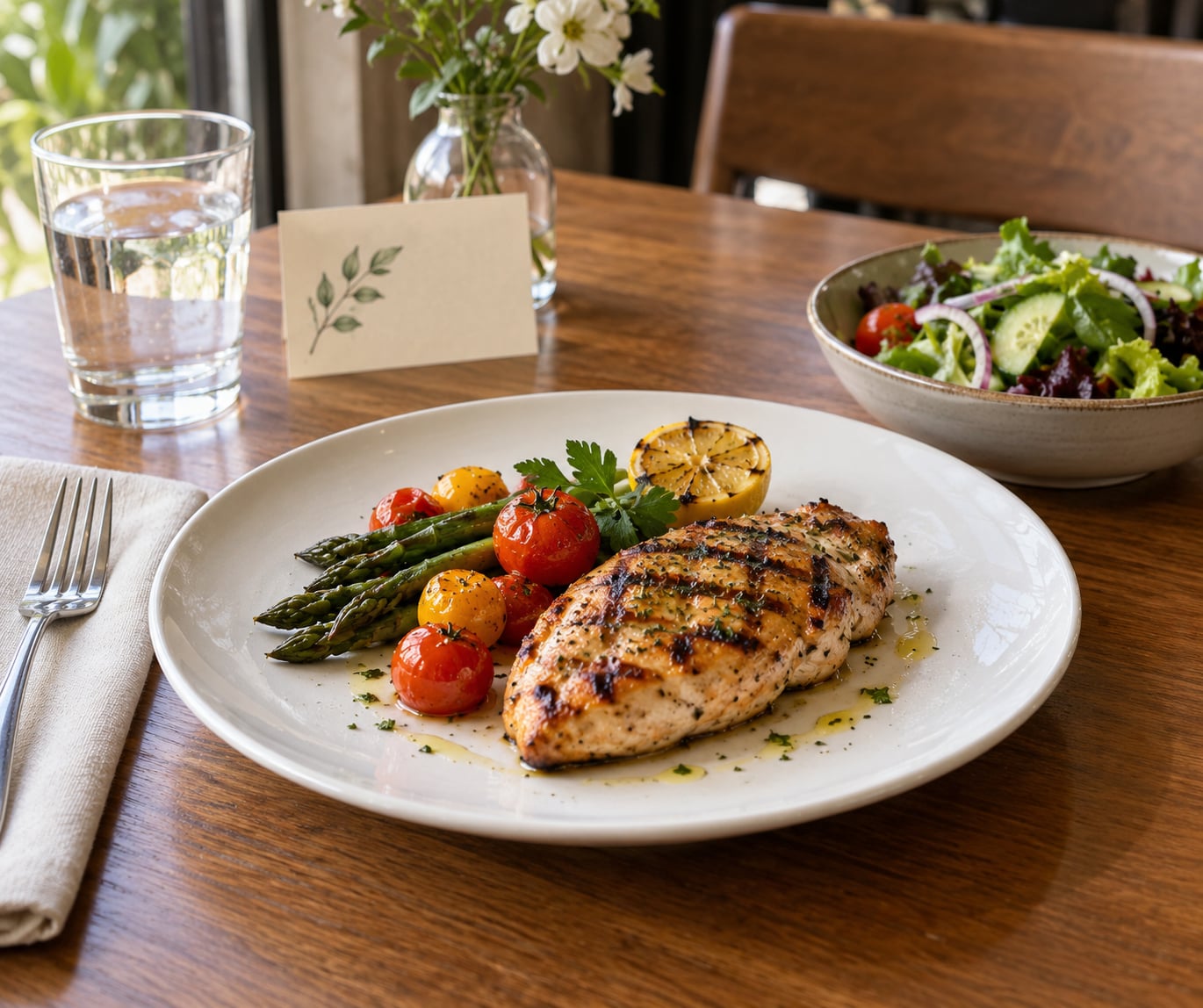
To avoid food poisoning when eating out, do three things: pick a restaurant with a current health inspection record and visible clean handling, order high-risk food thoroughly cooked rather than rare, and send back anything that arrives lukewarm or has been sitting out. Then refrigerate leftovers within two hours. No equipment, no certification, about sixty seconds of attention before you sit down.
The CDC estimates roughly 1 in 6 Americans get a foodborne illness each year, which works out to about 48 million people, 128,000 hospitalizations and 3,000 deaths. Most of those illnesses trace back to a single meal served by someone who handles food professionally.
That is not meant to frighten anyone away from restaurants. It is meant to explain why a few specific habits carry most of the weight. The CDC, FoodSafety.gov and the USDA all publish the same safe minimum internal temperatures, and every one of them reduces to a number you can check or a question you can ask.
What follows is the practical version: what to look at before you go, what to watch once you are seated, and what to do in the hours afterward if something felt off. I keep a short version of this in my phone notes for road trips, when I am picking a restaurant in a town I have never visited.
Table of Contents
- What You Need
- Step-by-Step: Make Safer Choices Before and During Your Meal
- 1. Choose a Restaurant With Visible Cleanliness Standards
- 2. Check How Staff Handle Raw and Ready-to-Eat Food
- 3. Ask About Cooking Temperatures When It Matters
- 4. Be Careful with Raw Shellfish and High-Risk Foods
- 5. Look at How Food Is Stored and Displayed
- 6. Choose Safer Order and Leftover Habits
- 7. Trust Your Judgment and Ask Questions
- 8. Know When to Seek Medical Help
- Common Mistakes and How to Fix Them
- Frequently Asked Questions
- Conclusion: Start With One Safer Choice
What You Need
Nothing to buy. There is no device, no app purchase and no certification that improves your odds here.
What you need instead is a habit and thirty seconds. Specifically, three things:
- Permission to look things up. Your state or county health department publishes inspection records for nearly every licensed restaurant, and most of them have a public search box.
- One polite question. Asking whether a sauce uses pasteurized eggs, or whether a steak can be cooked through, takes about five seconds and servers answer it constantly.
- Honesty about your own health. Pregnancy, being under five or over 65, a weakened immune system or a chronic illness change which foods are worth the risk.
The third item is the one people skip. The same menu is routine for a healthy 30-year-old and genuinely risky for someone immunosuppressed after a transplant, and the ordering habits should not be identical.
Step-by-Step: Make Safer Choices Before and During Your Meal
1. Choose a Restaurant With Visible Cleanliness Standards
Start with the inspection record, because it is the only public document that reflects a professional assessment of a kitchen you cannot see.
Search your state health department website for the restaurant name plus the words inspection or food establishment. City and county health departments in larger cities usually run their own searchable portals, and some post inspection reports as downloadable PDFs. If the official site is difficult to navigate, third-party dashboards and local community lookup tools built by residents tend to be faster and are worth using alongside it.
On the report, look for two things beyond the headline number: the date of the most recent inspection, and whether the same violations appeared on the previous visit. A single corrected violation matters less than the same defect three inspections in a row.
Then walk into the dining room and spend thirty seconds. These are the things you can see from a table:
- Restrooms that are dirty or out of hand soap.
- A display case or garnish station running unrefrigerated, or condensing.
- Servers handling salad, garnish and bread with bare hands.
- No food service permit posted near the entrance.
- Condiments crusted over, utensils dropped in the floor bin, or trash overflowing.
Appearance is weak evidence. A tidy dining room is usually a tidy kitchen, but nothing guarantees it, and a scruffy room does not prove the kitchen is unsafe. Read the record, glance at the room, and move on.
Timing helps a little. Restaurants at 11:45 a.m. on a Wednesday are cooking a small number of dishes for a small number of people. A busy Saturday service runs a hotter line, more cross-contact between raw and cooked food, and longer holds on prepared items. If you have the choice, go early.
One situation where this matters more than usual is eating out on the road, where the whole meal is built around convenience. Our pick of best lunches for truck drivers without stopping for fast food covers the pick-up side of that problem, and the inspection check below covers the rest.
2. Check How Staff Handle Raw and Ready-to-Eat Food
Cross-contamination is the quiet risk in most kitchens. Raw chicken carries Salmonella and Campylobacter, and a cutting board, a pair of tongs or a bare hand that touches raw poultry and then a cooked plate can move those organisms onto food you are about to eat without changing it in any way you can see.
Ready-to-eat food, meaning anything served without further cooking such as salads, cut fruit, sandwiches and garnishes, is where this matters most. Health codes generally require utensils or gloves for these items, and gloves only help if they are changed at the right moments.
What you can watch from a table: separate tongs for the salad bar and the cooked items, hands washed after handling raw meat and before touching anything ready to eat, and staff who do not pick up a piece of garnish, drop it, then put it back on the plate.
3. Ask About Cooking Temperatures When It Matters
You cannot verify a temperature with a probe at the table, but you can ask for the result rather than the appearance. Well done, please, is a completely ordinary request and it is the single highest-impact sentence in this guide.
The USDA safe minimum internal temperatures, the numbers worth remembering before you order:
- Poultry and ground poultry, including casseroles and reheated leftovers: 165°F / 74°C
- Ground meats, including beef, pork and lamb: 160°F / 71°C
- Fish and shellfish: 145°F / 63°C
- Whole cuts of beef, pork, lamb and veal: 145°F / 63°C with a three-minute rest
- Eggs and egg dishes: 160°F / 71°C
- Reheated food for hot holding, such as buffet trays: 165°F / 74°C
Two temperature rules cover most of what happens between the kitchen and your table. Hot food should be held at or above 140°F, cold food at or below 40°F, and the band between those numbers, 40°F to 140°F, is called the danger zone where bacteria multiply quickly.
That band explains the two-hour rule and the one-hour rule. Food should not sit in the danger zone longer than two hours, or one hour when the ambient temperature is above 90°F, which covers a parked car, a picnic table in summer and an un-air-conditioned patio.
4. Be Careful with Raw Shellfish and High-Risk Foods
Some foods carry a higher burden of pathogens than others, and some diners carry a higher penalty for getting infected. Raw oysters and clams can carry Vibrio, which is why they appear in the CDC’s own high-risk food list. Raw ground beef, unpasteurized milk and juice, unpasteurized cheeses, homemade ice cream made with raw egg, raw sprouts and cut fruit or juice from a street cart are the other common names on that list.
Raw egg shows up in more places than most people expect. Caesar dressing, hollandaise sauce, custards, tiramisu, mousse, some aioli and homemade ice cream all use it unless the eggs were pasteurized. Pasteurization kills Salmonella in the egg before it ever reaches the plate, which is exactly why the cooked versions are the safer versions.
You do not have to avoid all of this to eat out safely. You do have to know which of it you are ordering, and ask when you are not sure.
If you are pregnant, treating cancer, managing diabetes or another chronic condition, taking immune-suppressing medication, or dining with a child under five or an adult over 65, the safer default is to skip raw shellfish and unpasteurized items and order meat and eggs well done, every time, without exception.
5. Look at How Food Is Stored and Displayed
Buffets and salad bars ask more of you than a plated meal, mostly because you cannot see how long a tray has been out. Cold pans should be sitting in ice or a refrigeration well with the ice level up to the rim of the food. A pan sitting in an empty pan is a pan drifting toward room temperature.
Warm trays and chafing dishes should be steaming. Cover your own plate when you go back instead of letting the serving utensil land on the tray, take a small portion, and go back to the end of the line for a second trip rather than working the whole tray in one pass.
The first tray position gets the most handling. Skip it. Watch for the food being replenished rather than topped off, since topping off a tray gradually warms the food underneath the new layer.
If a self-serve area has food at room temperature with no ice and no heat source, and nobody can say how long it has been sitting, that is a tray you can simply pass on. Nothing about it looks obviously wrong, which is exactly the problem.
6. Choose Safer Order and Leftover Habits
Two habits cover most takeout risk. The first two-hour rule again, now applied in your own home: get leftovers into a refrigerator within two hours of the meal, or one hour if they sat in a hot car or on a warm patio.
The second is time. Refrigerated leftovers from a restaurant are safest within about three to four days, and a large container cools slowly, so divide a big box into shallow portions at home rather than eating from it for a week.
Reheat leftovers to 165°F, which means visibly steaming all the way through, not warm on the outside. Reheat only the portion you plan to eat.
Raw poultry, ground meat and seafood belong on the bottom shelf in a sealed container, below ready-to-eat food, so nothing drips onto the leftovers you will eat cold. And wash your hands before eating, including on the road, where soap and water for twenty seconds is a bigger barrier than most people think.
7. Trust Your Judgment and Ask Questions
There is a moment in every meal where you decide whether to keep eating, and the difficulty in avoiding food poisoning when eating out often comes from ignoring it. Food that smells sour, fizzy, or faintly chemical has moved past the point where it is worth the gamble.
Same with texture and appearance. A salad dressing that has turned cloudy and slimy, greens that have gone limp and slick, a burger with a raw pink center you did not ask for, a slice with a gray or translucent edge, a hot dish that arrives tepid to the touch. None of these prove a pathogen is present, because most harmful bacteria are odorless and invisible. They are simply signals that something was mishandled, and the cost of sending it back is fifteen minutes.
Ask questions without apologizing. Is the hollandaise pasteurized eggs? Can this be cooked well done? Is the fish fresh today? Servers handle these all day. If the answer is vague, order something else.
Save your receipt and write down the time of the meal and what you ordered. It takes fifteen seconds, and if you do get sick it is the only documentation that helps if you later want to report the restaurant.
8. Know When to Seek Medical Help
Symptoms of a foodborne illness usually appear 6 to 72 hours after the meal, which means the culprit is often not the last thing you ate. Assuming it is can point you at the wrong restaurant entirely.
Common symptoms include nausea, vomiting, abdominal cramps, diarrhea and fever. Viral causes such as norovirus tend to start sooner, within 12 to 48 hours, and bring vomiting and watery diarrhea with relatively little fever. Bacterial causes such as Salmonella, Campylobacter or E. coli tend to wait longer, often 12 to 72 hours, and bring more severe abdominal pain, bloody diarrhea and higher fever.
Contact a healthcare professional or urgent care if you have bloody diarrhea, a fever above 102°F, signs of dehydration such as very little urine, dizziness on standing, persistent vomiting that keeps fluids down, or symptoms that run more than about three days. Seek care promptly, without waiting, if the affected person is pregnant, a child, an adult over 65, or immunocompromised.
Hydration is the mainstay of care for most uncomplicated cases: small sips of oral rehydration solution or water with electrolytes, rather than large volumes at once.
You can report a suspected food poisoning incident to your local health department, and most accept anonymous complaints. Reports are how outbreak clusters get identified, and the restaurant also gets the results, which may be the point if you could see what you saw.
On a road or in another country, the same fundamentals hold. Eat where food is cooked fresh and where turnover is high, choose busy establishments over quiet ones, be cautious with ice, unpeeled fruit, raw salads and unpasteurized dairy, and skip food that has been sitting out at room temperature.
Common Mistakes and How to Fix Them
Judging a restaurant by appearance alone. A clean dining room tells you almost nothing about a kitchen you never saw. Fix: read the inspection record for the establishment name, and use the room as supporting evidence, not as the evidence.
Ignoring cross-contamination on the salad bar. The salad is the rawest item on the table and the most exposed to hands, utensils and a warm room. Fix: use the serving utensils, skip the first tray position, and avoid items that have been sitting out since you arrived.
Ordering the highest-risk dish regardless of your own health. The same raw oyster plate is a casual choice for one diner and a real risk for another. Fix: decide at the ordering stage whether this meal includes someone who is pregnant, under five, over 65 or immunocompromised, and adjust the order accordingly.
Taking takeout home and letting it sit. A box on the kitchen counter for three hours is a full trip through the danger zone. Fix: refrigerate within two hours, one hour if it was warm outside or sat in a car.
Blaming the last meal. With an onset window of up to 72 hours, the meal you just ate is frequently the wrong one. Fix: look back over the previous three days, including food served at someone else’s home.
Treating a high inspection score as a guarantee. Inspections are periodic snapshots and they do not cover everything a kitchen does between visits. Fix: read the violation history and the inspection date rather than the number alone.
One last myth worth clearing up: most foodborne pathogens are odorless and tasteless. A meal that smells fine can still make you sick, and a meal that smells off is simply not worth the gamble.
Frequently Asked Questions
Can I tell if a restaurant is clean just by looking around?
Not reliably. A tidy dining room, clean restrooms and tidy staff make a well-run kitchen more likely, but they do not prove one. Most kitchens are invisible to customers. Read the most recent health department inspection record for the establishment name, check its date, and see whether the same violations appeared on the previous visit. Appearance is supporting evidence; the inspection record is the document.
What temperature should restaurant food be cooked to?
USDA safe minimum internal temperatures are 165°F / 74°C for poultry and reheated leftovers, 160°F / 71°C for ground meats and eggs, 145°F / 63°C for fish and shellfish, and 145°F / 63°C for whole cuts of beef, pork and lamb with a three-minute rest. On the table you cannot check these yourself, so ask for well done, especially for poultry and ground meat. Also watch the arrival temperature: hot food at 140°F or above, cold food at 40°F or below.
How long can restaurant leftovers sit out safely?
Two hours at most, and one hour when the ambient temperature is above 90°F, such as a parked car or a hot patio. Food should not remain in the danger zone between 40°F and 140°F longer than that, because bacteria multiply quickly there. Once refrigerated, eat leftovers within three to four days, reheat them to 165°F until steaming throughout, and store raw meat below ready-to-eat food in a sealed container.
Should I avoid eating out if I am pregnant or have a weakened immune system?
Eating out is not off limits, but the rules should be stricter. Skip raw shellfish, unpasteurized dairy and juice, raw sprouts and raw-egg items unless made with pasteurized eggs. Order poultry, ground meat and eggs well done every time rather than occasionally. Avoid buffets and self-serve counters where food has been sitting out. Check the inspection record before you go, and tell your server you are ordering for someone with a higher-risk profile so they can flag allergens and preparation.
What symptoms after eating out require medical attention?
Contact a healthcare professional for bloody diarrhea, a fever above 102°F, signs of dehydration such as very little urine or dizziness on standing, persistent vomiting that prevents keeping fluids down, or symptoms lasting more than about three days. Seek care promptly, without waiting, if the affected person is pregnant, a child, an adult over 65, or immunocompromised. Until then, take small frequent sips of oral rehydration solution or water with electrolytes.
Conclusion: Start With One Safer Choice
If you do one thing, look up the inspection record before you leave the house. It costs about a minute, it is the only professional assessment you can get of a kitchen you cannot see, and it turns the rest of the meal into a normal meal.
Then keep three habits: ask for high-risk food well done, send back anything lukewarm or mishandled, and refrigerate leftovers within two hours. Between them they cover most of what actually causes restaurant food poisoning.
Nothing here replaces advice from your own doctor. If you are pregnant, immunocompromised or managing a chronic condition, ask your clinician which foods you should avoid before your next meal out.
Sources: CDC, FoodSafety.gov, the FDA, and USDA safe minimum internal temperature guidance. Local inspection records come from your state or county health department.