
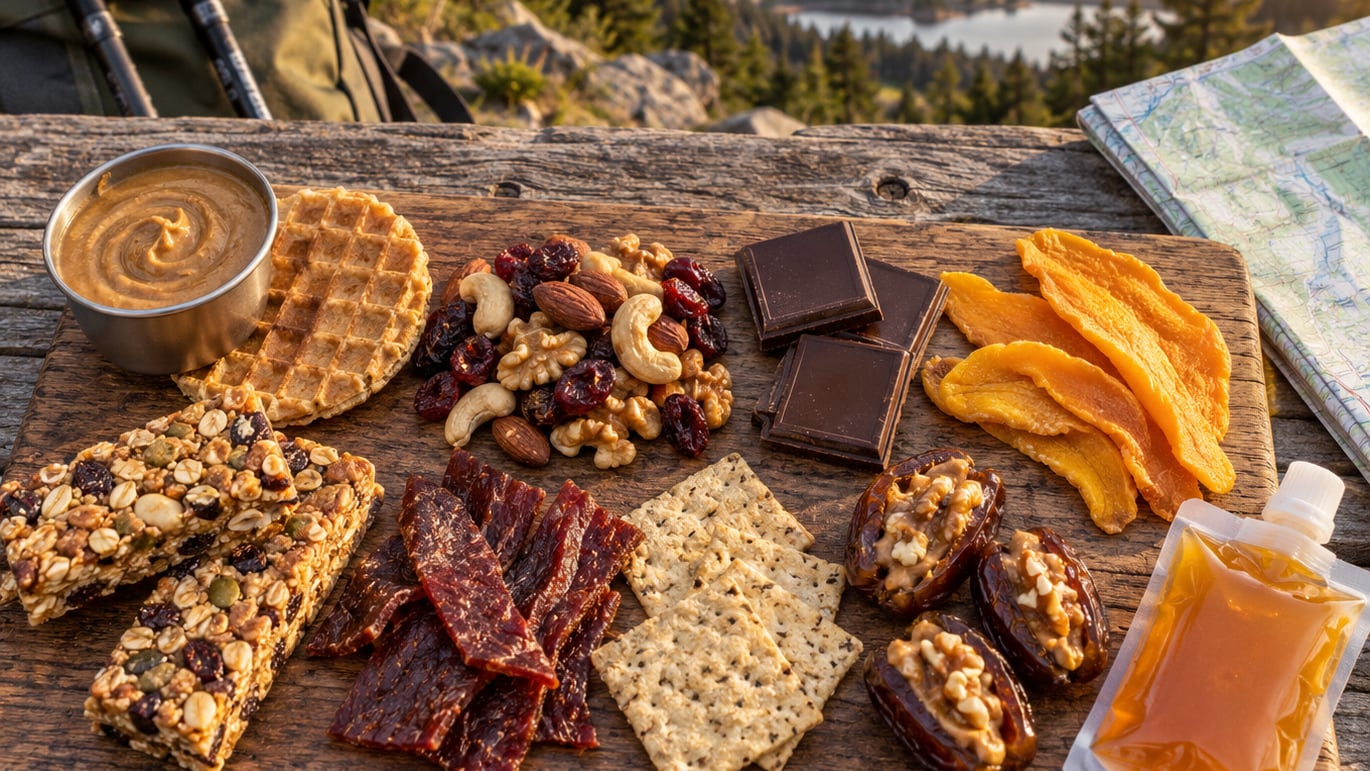
Most trail snacks are built for a two-hour walk, not a twelve-hour day. High-calorie lightweight hiking snacks deliver roughly 120 or more calories per ounce, so the same energy takes up far less space in your pack and survives a long climb without a stove. The list below ranks twelve portable options by calories per ounce, packed weight, and how they actually behave in a top pocket on hot, long days.
The math is simple. Fat carries 9 calories per gram while carbohydrate and protein carry 4, which is why the densest trail food is almost always fat-based: nut butter, nuts, chocolate, cheese, coconut. Hit 130 calories per ounce across a day and 3,500 calories of food weighs about 27 ounces, or 1.7 pounds. That is the difference between finishing a route fed and finishing it hungry.
Numbers below are typical ranges for grocery-store and specialty versions of each food. Brands vary widely, so check the label on the exact package you buy and treat the table as a ranking guide rather than a promise.
Table of Contents
- High-Calorie Lightweight Hiking Snacks at a Glance
- 1. Peanut Butter on Whole-Grain Waffle
- 2. Trail Mix with Nuts, Seeds, and Dried Fruit
- 3. Energy Bites Made with Oats and Peanut Butter
- 4. Dark Chocolate with Nuts
- 5. Trail Mix Granola Bars
- 6. Jerky with Cheese or Crackers
- 7. Dried Mango with Almonds
- 8. Nut-Butter Stuffed Dates
- 9. Cheese Crackers with Raisins
- 10. High-Calorie Energy Gel with a Small Food Bar
- 11. Peanuts or Mixed Nuts in a Resealable Bag
- 12. Compact Tuna or Chicken Salad with Crackers
- Frequently Asked Questions
- What is the lightest food with the highest calories?
- How many calories do I need to pack per day of hiking?
- What is the best food to bring on a lightweight hike?
- What high-calorie snacks do not spoil or melt in the heat?
- How do I stop snacks from getting crushed in my pack?
- Is peanut butter a good hiking snack?
- Conclusion
High-Calorie Lightweight Hiking Snacks at a Glance
| Snack | Approx. calories per ounce | Typical packed portion | Best trail use | Handling note |
|---|---|---|---|---|
| Peanut butter on a waffle | 190-200 | 2 oz | Steep climbs and cold starts | Wrap separately from anything damp |
| Trail mix (nuts, seeds, dried fruit) | 160-180 | 1.5 oz per handful | All-day grazing | Portion into a pouch so nuts stay intact |
| Oat and peanut butter energy bites | 150-170 | 2 to 3 balls, about 1.5 oz | Mid-morning lift | Firm up with extra oats or oats plus honey |
| Dark chocolate with nuts | 170-190 | 1 oz | Sterile stretches where water is scarce | Melt-proof pouch in summer; rigid tin in a pack |
| Nut and seed granola bars | 120-140 | 1 bar, about 2 oz | Fast fuel without fuss | Pick dense bars; airy ones crumble in a lid pocket |
| Jerky with cheese or crackers | 140-160 | 1 oz jerky plus 2 oz crackers | Savory midday calories | Reseal after opening in humid air |
| Dried mango with almonds | 140-160 | 1 oz mango plus 0.5 oz almonds | Quick carbohydrates after hard climbs | Sticks to everything; pack it last, eat it first |
| Nut butter stuffed dates | about 140 | 2 dates plus 1 tbsp nut butter | Desert and long flat miles | Rigid container, or the sticky mess moves in your pack |
| Cheese crackers with raisins | 135-150 | 6 crackers plus 1 oz raisins | Unhurried stretches and camps | Choose a sturdy cracker; thin ones shatter |
| Energy gel plus a small bar | about 70 combined | 1 pouch plus half a bar | Timing fuel on climbs and descents | Gels are light but not filling; pair for satisfaction |
| Mixed nuts in a resealable bag | 165-180 | 1 oz per handful | Reliable background calories | Keep in a rigid container or they turn to powder |
| Shelf-stable tuna or chicken with crackers | 110-130 | 1 pouch plus 3 crackers | Protein without a stove | Keep sealed; open and eat promptly |
How to pick high-calorie lightweight hiking snacks you will actually eat
Calorie density is the ceiling, not the goal. The snack that scores highest per ounce and sits uneaten in a side pocket on day four is a bad choice. Weight texture into the decision: crisp things early, chewy things when energy is low, savory options at midday when sweets stop appealing.
Some staples sit above all of the entries in the table. Olive oil runs near 240 calories per ounce and macadamia nuts near 200, coconut flakes and salami also rank high. Those four make strong additions to a tortilla wrap or a hard cheese slice, and they turn a plain energy bar into a real meal. If you want the savory end of the calorie range covered with actual meals instead of snacks, our picks on the 10 best sandwiches for hiking that survive a backpack cover the same durability problem from a different angle.
1. Peanut Butter on Whole-Grain Waffle
Peanut butter is the highest-calorie-per-ounce food most hikers can buy in a normal grocery aisle, and it does not spoil, freeze, or melt into a disaster. Add a small whole-grain waffle and you get fat, protein, and carbohydrate in one handheld item.
Spread about 1 tablespoon of peanut butter on a single small waffle, press another on top, and wrap the sandwich in a paper towel or a small zip bag. That combination lands around 200 to 230 calories in roughly 2 ounces. Wrap it separately from fruit or any wet food; a damp waffle turns soft and the peanut butter slides out.
2. Trail Mix with Nuts, Seeds, and Dried Fruit
Classic trail mix, sometimes called GORP, gets its density from nuts and seeds and its staying power from dried fruit. Seeds such as sunflower and pumpkin add bulk cheaply, which stretches the mix without stretching the calories per ounce.
Build your own in a one-pint zip bag: two parts nuts, one part seeds, one part dried fruit. A 1.5 ounce handful runs 240 to 270 calories. The mistake I see most often is packing the whole bag into a side pocket, where it compresses into a brick and then dusts everything in the pocket. Repackage single servings into small bags or a small container.
3. Energy Bites Made with Oats and Peanut Butter
Homemade energy bites give you control over density in a way nothing else on this list does. Oats carry the structure, peanut butter supplies the fat, and honey or maple syrup binds the mix.
One cup of rolled oats, one cup of peanut butter, a third cup of honey, and a half cup of chocolate chips makes about 20 balls at roughly 100 calories each. Two or three balls is a normal snack serving, about 1.5 ounces. If the mix crumbles when you roll it, add a tablespoon more oats; if it sticks to everything, add a tablespoon more honey. Store the batch in the freezer and pull a few out the night before a trip so they set firm.
4. Dark Chocolate with Nuts
Chocolate is mostly fat and carbohydrate, which makes it an efficient pair with nuts rather than a candy indulgence. A 70 to 85 percent cacao bar delivers 170 to 190 calories per ounce, and nuts bring the count in the same handful.
Eat one ounce of dark chocolate with one ounce of almonds, macadamias, or peanuts for roughly 330 to 360 calories. In summer, chocolate is the first thing in your pack to ruin, so carry it sealed and shaded or in an opaque pouch on the outside of your lid. In winter it goes hard and snaps, which is fine. Never let it ride loose in a pack where pressure turns it to dust.
5. Trail Mix Granola Bars
Bars built from nuts, seeds, oats, and dried fruit are the most compact option here: dense calories in a shape you can eat one-handed while moving. Most bars land between 120 and 140 calories per ounce, so a 2 ounce bar gives you 240 to 280 calories with no prep.
Choose by weight and texture, not by the wrapper. Break a bar in half inside the store if you can: if it crumbles into oats, it will not survive a pack. If it holds together dense and nutty, it will. Pack bars in the lid pocket rather than the main bag, and keep one bar at the top of your food bag so you can find it without unpacking everything.
6. Jerky with Cheese or Crackers
Jerky is high in protein and nearly shelf stable, but plain strips rarely finish the job on a big-mile day. Pair them with cheese or crackers and the same ounce of food becomes a real serving.
Pack one ounce of jerky with two ounces of hard cheese or thick crackers, about 220 to 260 calories total. A vacuum-sealed salami-and-cheese pack does the same work with no separate pieces. Meat has less fat than the plant options here, so treat jerky as a supporting player rather than your main calorie source, and reseal the bag after each opening so humidity does not turn it leathery.
7. Dried Mango with Almonds
Dried mango is fast carbohydrate in a form that does not need chewing much, which matters when you are breathing hard on a climb. Almonds add fat and protein, and the pairing slows down how quickly the sugar arrives and leaves.
One ounce of dried mango with half an ounce of almonds is roughly 210 calories. Portion both into a rigid container rather than a plastic bag, because mango strips fuse into one sticky block in a warm pack. It also transfers to everything else in the bag, so eat it early in the day and reseal the container. Chewy textures also help when sweet bars have stopped appealing.
8. Nut-Butter Stuffed Dates
Two dates filled with nut butter are about as compact as homemade food gets. There is no cooking, no ingredients list, and nothing to clean up, and the result is a soft, dense, high-energy bite that travels well in heat.
Split two large dates, fill each with half a tablespoon of almond or peanut butter, and press the pits back in. That gives you roughly 200 to 230 calories. Carry them in a small rigid container, ideally a reused jar or a hard plastic box, because a filled date in a soft bag will stick to the bag and to your other food. Eat two as a snack on long flat miles where you are moving but not burning up.
9. Cheese Crackers with Raisins
Cheese crackers with raisins cover more ground nutritionally than any other shelf-stable pairing on this list: carbohydrate from the cracker, fat and protein from the cheese, and quick sugar from the fruit.
Six sturdy crackers with one ounce of raisins come to about 230 to 250 calories. Skip the thin, crumbly crackers that turn to dust in a lid pocket, and pick a dense baked cracker or a shortbread-style one that snaps instead of shatters. Store the raisins separately from anything savory if you can, since they pick up the smell of jerky and cheese in a sealed pack.
10. High-Calorie Energy Gel with a Small Food Bar
Gels are the lightest thing you will carry and the least satisfying on their own. A 1.6 ounce pouch holds about 100 calories, which works out to roughly 60 calories per ounce, well below the 120 benchmark that makes food worth carrying.
Treat a gel as a timing tool rather than a meal. Take it just before a climb starts and on long descents, when your stomach wants something that goes down fast, then follow it with half a granola bar or a small handful of nuts for a real 200 to 260 calories. Carry the gel in a spot you can reach without stopping, and practice with a brand you have used before, because the texture of an unfamiliar gel is a real problem on a steep pitch.
11. Peanuts or Mixed Nuts in a Resealable Bag
Plain or lightly salted nuts are the most dependable background calorie source here. They need no prep, they never spoil, they pack down small, and almost everyone will eat them on day five when the bars stop working.
A 1 ounce handful of mixed nuts runs about 170 calories, so a daily handful adds up fast across a week. Weigh portions before you leave, because nuts are the easiest thing to overeat at a rest stop and the hardest thing to divide while walking. Keep them in a rigid container or a hard-sided pouch; in a soft bag they crush into fragments that leak oil onto everything around them.
12. Compact Tuna or Chicken Salad with Crackers
Shelf-stable pouches of tuna or chicken give you a protein base that costs almost no pack weight per calorie, which matters on routes with no resupply. They are the pick for hikers willing to carry a rigid container.
Plan on one pouch plus three crackers for roughly 170 to 190 calories, and pair it with nuts or nut butter if you need more. Keep the pouches sealed until you intend to eat, since opened fish deteriorates quickly. For any pouch you prepared at home with cooked chicken or tuna, chill it thoroughly, keep it at or below 40 F (4 C), and eat refrigerated food within two hours, or one hour if the temperature is above 90 F (32 C).
Frequently Asked Questions
What is the lightest food with the highest calories?
Olive oil tops the list at roughly 240 calories per ounce, followed by peanut and other nut butters near 190, macadamia nuts around 200, and dark chocolate near 175. Among prepackaged trail items, nut butter packets, mixed nuts, and energy bites deliver the most calories for the least weight.
How many calories do I need to pack per day of hiking?
Most long-distance hikers need 3,000 to 4,000 calories a day, and heavily loaded or cold-weather days can push that toward 5,000. Multiply your daily target by seven for a week. Carrying that weight is the reason calorie density matters, because 3,500 calories at 130 calories per ounce is only about 1.7 pounds of food.
What is the best food to bring on a lightweight hike?
On a day hike, bring roughly 500 to 700 calories: a granola bar, a handful of trail mix, and a fruit bar. On an overnight, add a dense dinner and a savory option. On a multi-day trip, mix one long shelf-stable item per meal with two or three snack options so the same flavor never repeats two days running.
What high-calorie snacks do not spoil or melt in the heat?
Nut butters in sealed packets, jerky, dried fruit, nuts, seeds, roasted chickpeas, and hard cheese all hold up well in heat. Chocolate, nut butter tubs, and anything with fresh fruit do not. In summer, keep chocolate and nut butter packets in an opaque pouch away from sun, and expect soft snacks to need a rigid container.
How do I stop snacks from getting crushed in my pack?
Use rigid containers for anything soft or crumbly, and put bars in the lid pocket where pressure is lowest. Never pack crackers, chocolate, or dried fruit loose in the main bag. Weigh and portion nuts into small bags before the trip, and keep a zip bag under the container to catch whatever crumbs and oil travel anyway.
Is peanut butter a good hiking snack?
Peanut butter is one of the highest-calorie foods you can carry per ounce, it needs no water, no prep, and no cleanup, and it is available almost everywhere including small trail towns. If you carry tubs, pack them in a rigid container because they soften and leak. Skip it entirely if you share a site with anyone with a peanut allergy.
Conclusion
If you pack one thing, make it nut butter with a waffle, then dried fruit with almonds and a dense granola bar to break up the sweetness. That trio covers roughly 600 calories in about 5 ounces and survives heat, pressure, and a week of repetition better than anything else in this list.
Test your kit on a shorter hike first, one that pushes you hard enough to learn which foods you actually want on day three. Then adjust portions, calorie density, and variety to match your route length, the weather, and how much you are carrying. Pack math rewards people who adjust it early.