
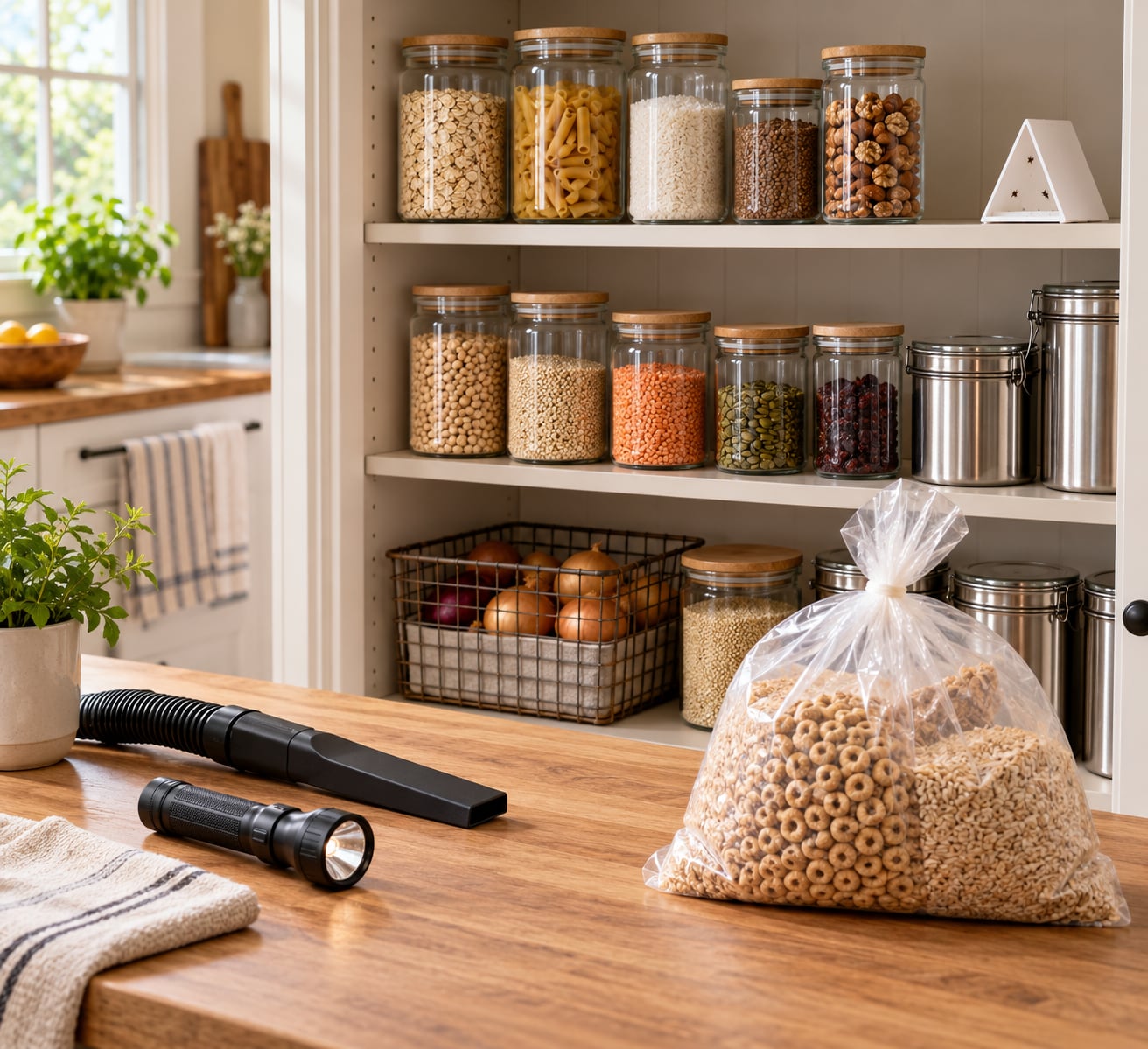
To get rid of pantry moths you need to do three things in order: find the infested food and get it out of the house, clean every crack and crumb in the storage area, then seal your dry goods airtight so nothing new can start. Indianmeal moths (Plodia interpunctella) are the usual culprit, they arrive inside packaged grain and cereal rather than flying in from outside. The whole job takes a weekend, most of it spent cleaning rather than spraying. This guide is updated for 2026 and covers identification, removal, cleaning and prevention in that order.
The frustrating part is that visible moths are the late stage, not the early one. By the time you see adults fluttering near a light, larvae have usually been eating through your dry goods for weeks. The eggs were laid inside the food, not on your shelves.
Table of Contents
What You Need
Gather these before you start. Nothing here is specialist equipment, but trying to improvise halfway through is how larvae get spread to a second room.
- Heavy-duty trash bags that seal, plus a roll of tape. You will double-bag suspect food.
- A vacuum with a crevice attachment or a narrow nozzle, for the holes and gaps in and around shelving.
- Hot water and dish soap, plus white vinegar or a food-safe cleaning wipe for shelves and drawers.
- An old toothbrush or small stiff brush for hinge lines, shelf joints and cabinet corners.
- A flashlight, ideally a headlamp, so your hands are free while you check packages.
- Airtight containers in glass, metal or hard plastic, with a marker for labelling.
- Pheromone moth traps, a few of them, one per pantry or closet you suspect. Optional in the sense that traps will not do the job alone.
Two habits matter more than the equipment. Confirm the source before you buy anything, and separate suspect food from clean food the moment you spot webbing. Everything you pull from the pantry goes onto a sheet on the floor or a clear table first, never straight back onto a shelf.
How to Get Rid of Pantry Moths Step by Step
Work through these in order. Skipping to the spray or the traps because it feels faster is the single most common reason an infestation survives.
1. Identify pantry moths and find where they started

Pantry moths are small, roughly half an inch across when their wings are spread, with a distinctive two-tone pattern: the front half of the wing is coppery or reddish brown and the back half is pale grey. If you see that split colouring, you are looking at Plodia interpunctella.
The larvae do the real damage. They are cream or pinkish caterpillars with a darker head, and they spin silken webbing through whatever they are eating. Silk webbing on the surface of a food, a trail of crumbs stuck together in a shelf corner, or a small sausage-shaped cocoon are all stronger evidence than the adult moth itself.
Adult pantry moths are strong fliers but weak navigators. They are usually found near windows and light fixtures, because that is where they ended up, not because that is where they breed. Finding moths in the kitchen does not mean the infestation is in the kitchen.
Here is what tends to get mistaken for a pantry moth problem:
| Pest | Size | Colour | Where you find it |
|---|---|---|---|
| Pantry moth (Indianmeal moth) | About half an inch wingspan | Front half coppery, rear half pale grey | Dry goods: flour, rice, cereal, pasta, spices, pet food, birdseed |
| Clothes moth | Similar size, wings held along the body | Plain buff or coppery, no two-tone split | Wool, felt, natural fibre clothing and rugs |
| Pantry beetle | About one eighth inch | Dark brown to black, hard shell | Same dry goods, but a beetle and moves fast |
| Fungus gnat | Very small, delicate | Dark body, clear or smoky wings | Overripe produce and drains, not in sealed grain |
If adults are showing up in a bedroom or closet with no food nearby, assume clothes moth until proven otherwise and treat that space separately. Trying to solve a clothes moth problem with pantry work wastes a month.
Now find the source. Check cereal, grain, flour, rice, oats, pasta, cornmeal, dried fruit, spices, cake mixes, pet food and birdseed, in that order of likelihood. Open packages rather than trusting a sealed-looking bag, because a thin vacuum bag or a cardboard box is no barrier to a larva. Look for clumped food, silk strands, webbing along the inside of the bag, and small holes chewed in paper or thin plastic.
Also check outside the pantry, because that is where repeat infestations usually start: the dog food bin, birdseed stored in the garage, a cereal box on top of the fridge, grains in a cardboard box in the basement, and recently opened bulk bags. Keep going until you find at least one actively infested package. If you cannot find one, the moth is probably not a pantry moth.
2. Remove and contain infested food
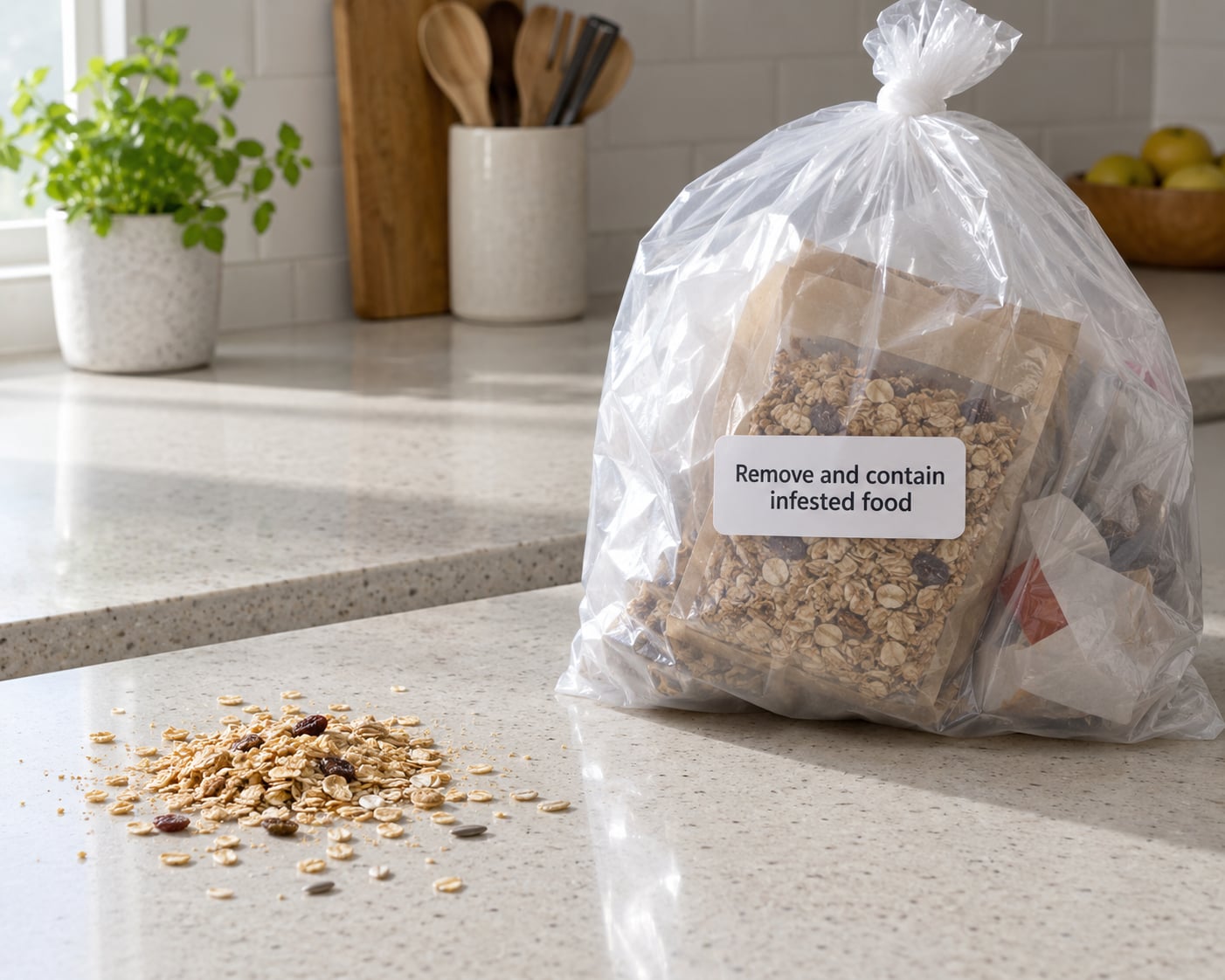
Bag, do not sort. Once you know which packages are infested, seal each one inside a trash bag, tie it, and put a second bag over the top. Tape it shut if you can.
Then take those bags outside to an outdoor bin. This is the step that quietly restarts the cycle for a lot of households, and it is one of the most common complaints in pest forums: a package tossed into the kitchen trash sits next to clean groceries for a week while larvae develop and walk back out. If you have no outdoor bin, put the sealed bags in a freezer for a week before taking them out, which kills anything inside.
Do not compost, do not rinse and reuse the bag, and do not pour the food into a new container hoping to save it. A handful of grain left behind is enough to rebuild the population, and eggs and larvae are usually distributed through the food rather than sitting at the bottom where you can see them.
For the ambiguous packages, use this rule. Silk webbing, clumped food, chewed holes, or anything you opened and found larvae in goes out. Sealed, hard containers and unopened factory packaging that looks clean can stay, once you have washed the shelf they were sitting on.
Do not wash or scrub an infested package. You only spread larvae across your counter and sink, and the food is not rescued by cleaning it.
3. Vacuum and wash every crack to get rid of pantry moths at the source
Cleaning only works if the food is out of the room. Once the shelves are empty, run the vacuum over every surface first. It picks up eggs, larvae, frass and cocoons that a cloth would smear around instead of removing, and the crevice attachment gets into shelf pin holes, hinge lines and the gap where a shelf meets the wall.
Empty the vacuum bag or canister outdoors right after, not in the kitchen bin.
Then wash, working top to bottom so you are not pushing contamination onto a clean surface:
- Scrub shelves and shelf edges with hot water and dish soap, using the toothbrush in corners.
- Wipe the back and side panels of the cabinet, where webbing and cocoons stick in the corners.
- Clean drawer runners and the underside of shelves, where crumbs fall and nobody looks.
- Wipe the vacuum head and the floor of the pantry last.
A 50/50 mix of white vinegar and hot water handles light residue and smells of cleaning rather than insecticide. For heavy webbing, a light bleach solution is the option people reach for most often in forums, and it works well on hard surfaces. Never mix bleach with vinegar or with ammonia, and rinse with plain water afterwards before food goes back on the shelf.
If you have pets or small children, ventilate the room and keep everything off the shelves until the surfaces are dry. The National Pesticide Information Center and the Northwest Center for Alternatives to Pesticides both recommend avoiding routine insecticide spraying around stored food, and their guidance is straightforward: remove the food, clean the space, monitor. Chemical sprays address adults that are already flying, and adults are the easy half of the problem.
Let everything dry completely before you begin step 4. Trapping moths in a damp pantry does not help either of you.
4. Refill the pantry and prevent reinfestation
Wait five to seven days after cleaning before you put anything back. That pause is where you would still see adults if any were surviving, and it is the cheapest test you will ever run.
Put food back in order of confidence. Containers you washed go back first, then unopened packages you inspected and found clean, then anything new from the store. Open packages go into airtight glass, metal or hard plastic rather than the paper bag or thin plastic sack they came in, because those materials are what a larva chews through. Label each container with the contents and the month, so rotation and dates stop being guesswork.
What keeps pantry moths away is boring: sealed containers, no open food lying around, and dry surfaces. Vacuum the pantry every three to four months, and put new bags of grain in the freezer for about a week before you store them. That freeze is a standard quarantine move and it catches eggs and larvae that arrived inside a new purchase.
Set the pheromone traps now, not later. One trap per pantry, another in any closet or cabinet you checked. They lure mating adults and glue them down, which gives you two useful things: a visible catch, which is the only thing that convinces most people the traps are doing anything, and an honest count of what is still active. Replace them when the glue is furred over. Two clean traps a month for a couple of months tells you far more than a single trap left in place for a year.
If you buy in bulk or keep birdseed, this is where infestations keep restarting, and no storage system makes it simple. Freezer the new stock before it goes in, use smaller containers so you open one at a time, and keep the storage bin outside the kitchen if you can. Many households who hit this wall permanently switch part of their dry goods to canned or frozen versions.
The other half of the problem is entry points. Seal gaps around pipes, under the sink and along cabinet edges, and check any small hole a pencil will fit into. Pantry moths arrive in food, not through walls, so sealing helps mostly with other pests, but it is worth doing while the shelves are already bare.
Give it four to eight weeks with no new sightings, no webbing and nothing showing on the traps, and you can call it done. Realistically, expect six weeks of small catches after a serious infestation, since eggs can sit dormant in overlooked cracks. If you are still finding adults every week after eight, or you never found the source food, look outside the pantry again rather than repeating the cleaning.
Common Mistakes
Almost every repeat infestation traces back to one of these mistakes.
Spraying insecticide near open food. Aerosol spray kills flying adults and does nothing for eggs and larvae inside sealed containers, while leaving a residue you then have to scrub off anyway. Fix: skip the spray until after the cleaning and restocking, and only then use it if adults keep appearing.
Keeping suspect food in the pantry to decide later. Deciding later is the decision. Fix: bag everything with webbing or clumped food immediately and move it outside, then come back to judge the rest.
Forgetting pet food and birdseed. A dog food bin in the laundry room or a bag of birdseed in the garage keeps the cycle alive no matter how clean the kitchen is. Fix: freeze new pet food and birdseed for a week before storing, and store it in hard sealed containers.
Cleaning while the food is still on the shelves. You will push larvae and frass behind containers where they are never disturbed again. Fix: everything comes out of the room first, onto a sheet, and only the empty space gets cleaned.
Assuming the adults you can see are the whole problem. Visible adults mean the mating cycle is still running. Fix: judge progress on a four-week window of trap catches and fresh webbing, not on a single bad day.
Reaching for foggers and mothballs. Do not use mothballs indoors, do not run an indoor fogger near food, and do not pour bleach and vinegar into the same sink. All three are deal breakers in the forums: foggers leave residue on every surface in a kitchen, mothballs are toxic and are regulated for a reason, and mixing cleaners produces a gas.
A short prevention routine that works: airtight containers for everything opened, a vacuum every three to four months, a freezer pass on new bulk dry goods, traps running during the warmer months, and a five-minute look inside any bag that has been sitting open on the counter for more than a day.
Frequently Asked Questions
Do pantry moths make food unsafe to eat?
No. Pantry moths are not carriers of disease and they do not bite or sting. The concern is contamination rather than infection: larvae leave webbing, droppings and body fragments, and damaged food can pick up moisture or mould where the packaging has been chewed. Government food safety guidance treats food found with pantry moth larvae or webbing as unfit to eat, mainly because it is no longer clean, not because the moth itself is dangerous.
Can I save pantry food that has pantry moths in it?
Some of it, yes. Food from an unopened, intact package with no webbing, no clumping and no chewed holes is generally fine once the shelf around it has been cleaned. Any opened bag with larvae, silk webbing or sticky frass goes out, because eggs and larvae are scattered through the food rather than sitting where you can see them. Frozen food and sealed cans are almost never affected.
How long does a pantry moth infestation usually last?
Weeks, not days. Expect continued trap catches for four to eight weeks after a thorough clean, because eggs laid before the treatment can survive in cracks you did not reach. You are finished when you have gone a month with no sightings, no fresh webbing and empty traps. If adults keep appearing after eight weeks, the source is somewhere other than the pantry you cleaned.
Are pantry moth traps effective on their own?
No. Pheromone traps catch mating adults and give you a count of what is still active, which is genuinely useful, but they cannot reach larvae or eggs inside food or in cracks. In forum threads, the pattern people report working is traps plus discarding the infested food plus vacuuming and washing the storage space. Traps on their own mostly tell you the infestation is still running.
Where else should I look for pantry moths besides the pantry?
Check the pet food bin, stored birdseed, bulk grain bought from a warehouse store, cereal boxes on top of the fridge or in the garage, and any dry goods stored in cardboard boxes in a basement or closet. Adults often turn up in bedrooms and closets that hold no food at all, which usually means clothes moths instead. A flashlight check of every open dry-goods container takes about ten minutes and usually finds the source.
How can I prevent pantry moths from coming back?
Store everything opened in airtight glass, metal or hard plastic, because larvae chew through paper and thin plastic. Freeze new bulk dry goods, pet food and birdseed for about a week before putting them away. Vacuum the pantry every three to four months, keep spilled food cleaned up immediately, run pheromone traps during warmer months, and date and rotate your containers so old stock does not sit untouched for years.
The First Thing to Do Next
Empty the space tonight. Pull every open package out, bag the ones with webbing or clumped food, take those bags outside, and leave the rest on a sheet while you vacuum and wash the shelves. That is the whole first move, and nothing works until it is done.
Then keep two habits running, because they are what actually stops this coming back: airtight containers for everything you open, and a quick look at new dry goods before it goes into the cupboard. A trap or a spray on its own will not hold the line, but containment and a clean pantry will.