
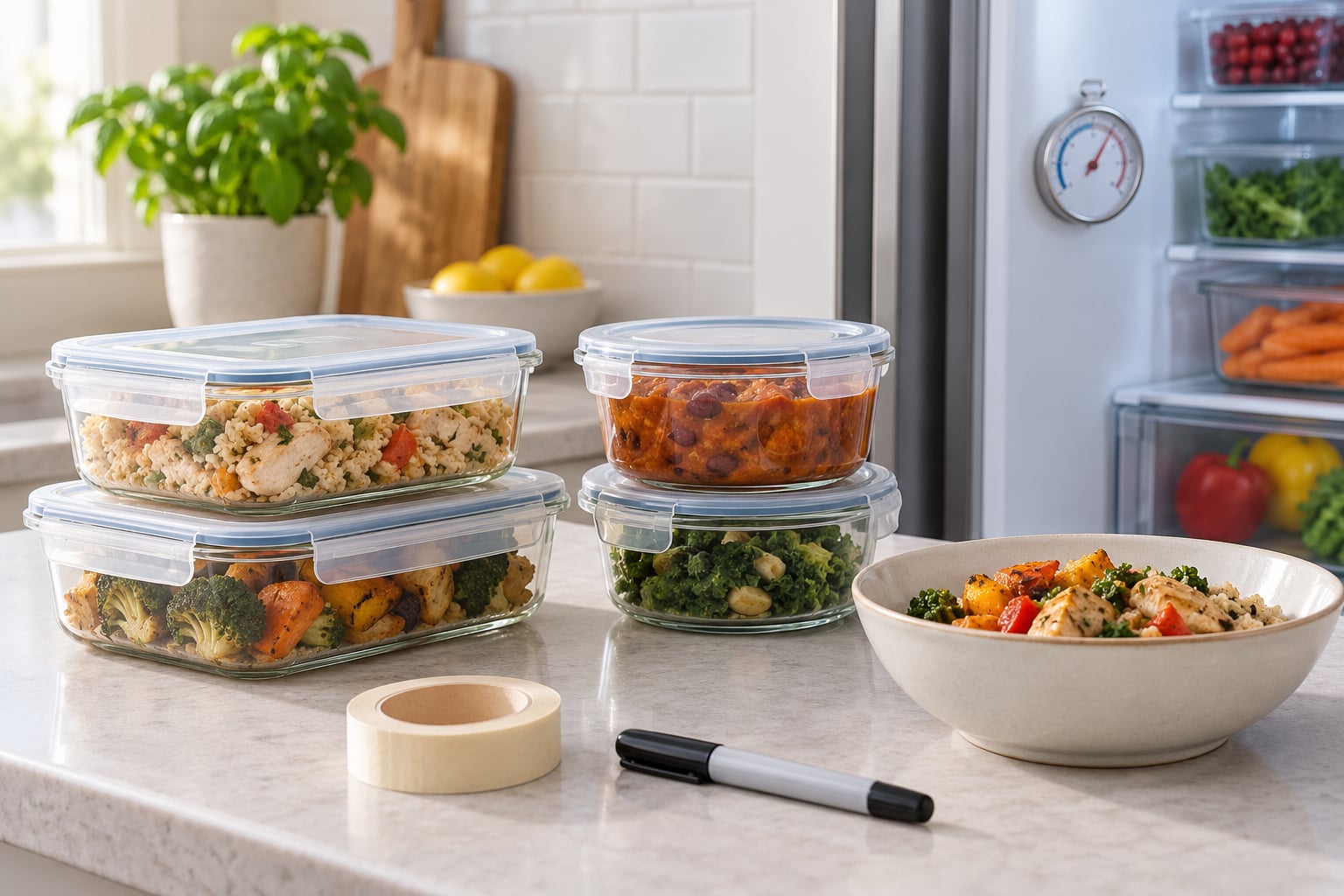
To store leftovers in the fridge properly, cool the food fast, move it into shallow airtight containers within two hours of cooking, and eat it within three to four days. The whole job takes about ten minutes of attention, and it is the difference between a Tuesday dinner you look forward to and one you find questionable three days later.
The rules are simple enough to remember but easy to break in a busy kitchen. Most problems I see come from one of three places: a big hot pot going straight into the fridge, a container that is only loosely covered, and leftovers pushed to the back of the shelf and forgotten until the smell changes.
Below is the process I use, plus the mistakes worth fixing first.
What You Need
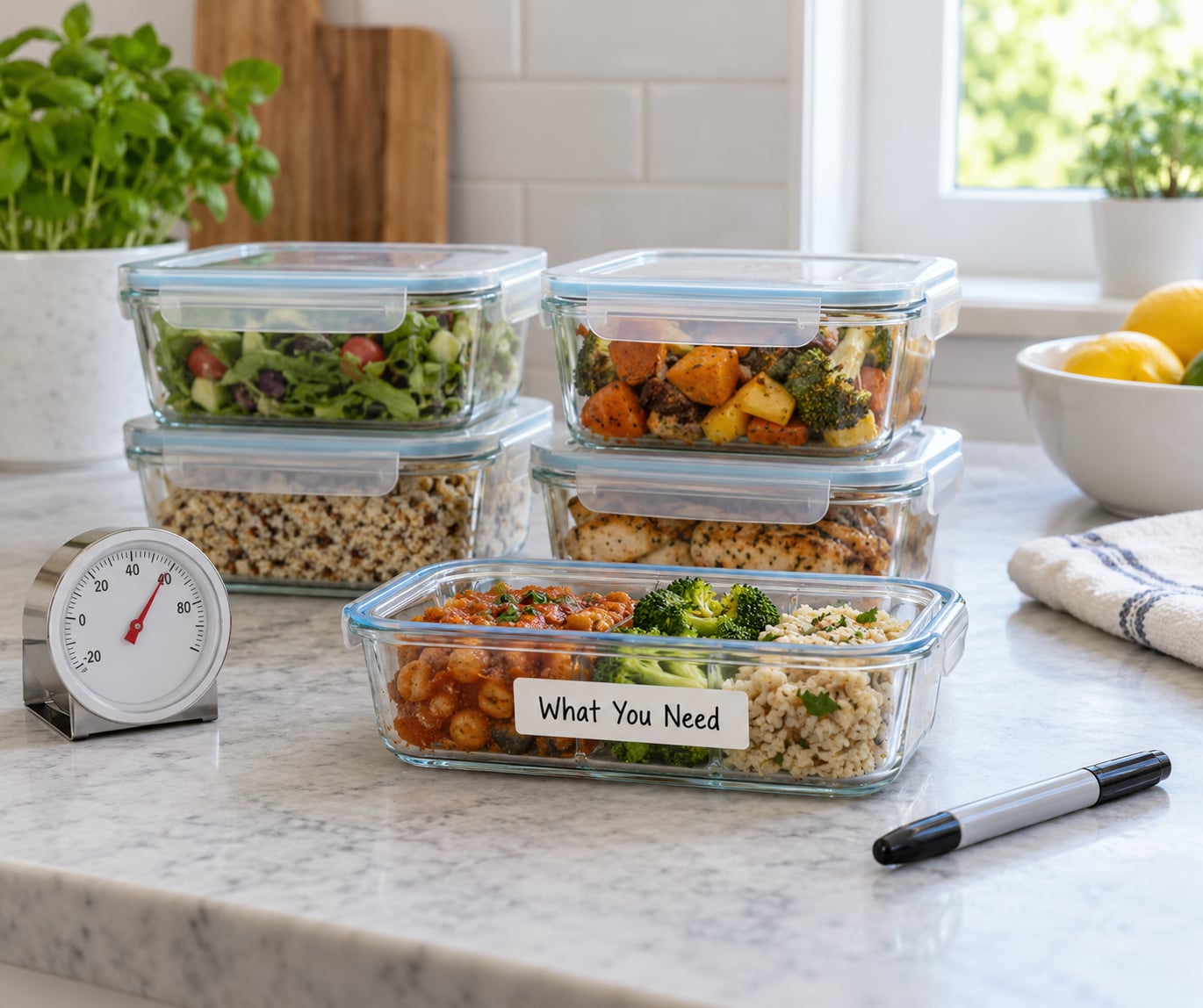
You do not need a lot of gear. You need shallow containers that seal, a thermometer you can check the fridge with, and a way to mark dates.
- Shallow airtight containers — glass or BPA-free plastic, two inches deep or less, with lids that snap shut. Wide-mouth jars work too, as long as they are not sealed from hot food.
- Covered plates or a cake pan with a lid — for bulky items like a half chicken, a wedge of melon, or a sheet pan of vegetables.
- A refrigerator thermometer — an inexpensive dial or digital unit on an upper shelf. Your fridge needs to sit at or below 40°F (4°C).
- Permanent marker and masking tape — for the food name and the date it went into the fridge.
- Clean hands, a clean counter, and clean utensils — the surface you portion food onto matters as much as the container.
Skip the thermometer if you like, but check your fridge once a year anyway. Frost buildup on the back wall and a freezer that never gets cold are both signs something is off with the temperature.
Step-by-Step
How to cool leftovers before refrigerating
Cool leftovers within two hours of cooking — one hour if the room is above 90°F (32°C). You do not need to wait for the food to reach room temperature first, and waiting makes things worse because the food sits in the danger zone of 40°F to 140°F the entire time.
Divide large portions into shallow containers right away. A quart of hot soup cools far faster spread across two one-quart containers than it does sitting in the pot, and depth is what decides cooling speed. Stirring every few minutes moves hot liquid from the center to the edges.
For a large pot, an ice bath works: set the pot in a sink or bowl with ice water and stir. Cover loosely while cooling so steam can escape, then seal the container once the food is chilled and it goes into the fridge.
Choose the right airtight container
Match the container to the food. Shallow, tight-lidded containers are the default for sauces, grains, vegetables, and casseroles. Solid plates under a cover or inverted cover handle bulky items that will not fit a box.
Material is a tradeoff. Glass handles heat and goes straight from fridge to oven to microwave, but it is heavier and chips if you knock it. Plastic is light and stacks better, though check the bottom for a dishwasher and freezer rating. Silicone bags and wraps work for bread and cheese, but liquids need a real seal.
Community storage habits follow the same logic. On r/mealprep and permies.com, people widely store soups and broths in wide-mouth mason jars, leaving headspace at the top so liquids can expand when frozen. Cooked components — rice, protein, vegetables — are stored separately rather than mixed, so you can combine them later instead of having everything turn soft.
A couple of habits from those discussions are worth borrowing: use one container type consistently so lids always match, and choose lids that vent steam in the microwave to avoid splatter on the ceiling.
Label leftovers with the date
Write the food name and the date on masking tape across the lid or on masking tape stuck to the container side. For a batch, add the portion count — “chicken, 4 servings” saves you guessing later.
Then use the label as a sorting system, not as proof of safety. Put the container dated soonest at the front of the shelf, at eye level, and push newer ones behind it. That one habit kills more wasted food than any other trick, because the forgotten tub in the back corner is always the one that spoils.
Dates are reminders. A dish that sat on a warm counter for four hours is not saved by a fresh sticker, and a dish that stayed cold the whole time does not become unsafe at day four on its own.
Put leftovers in the right refrigerator position
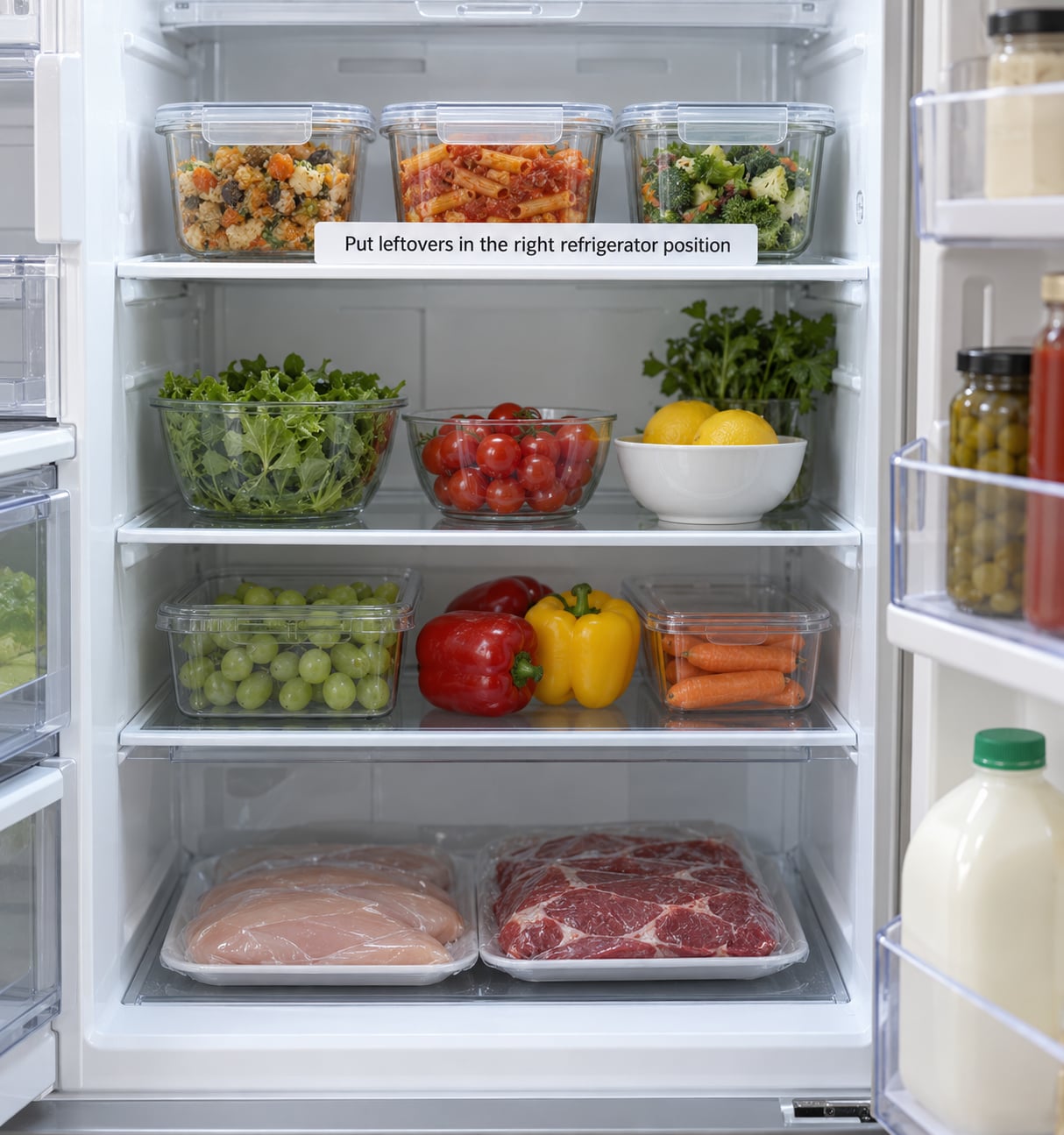
Cooked leftovers belong on an upper shelf or in a dedicated spot at eye level, where the air is colder and where you will actually see them. The middle and lower shelves hold the coldest air, which is why raw meat, poultry, and seafood go sealed on the lowest shelf in a tray that catches leaks.
Keep leftovers out of the produce drawer. Crisper drawers are designed for whole fruits and vegetables, and the humidity settings are wrong for cooked food, which ends up either dry or soggy.
Cover every container before it goes in, and do not stack heavy jars on top of a lid that is only resting there. Air needs to circulate for the fridge to hold 40°F (4°C) throughout.
Store and reheat leftovers safely
Refrigerated leftovers are safest eaten within three to four days. Freeze anything you will not finish in that window, and it is worth doing on day three rather than day four so you are not making decisions at the deadline.
Reheat to 165°F (74°C) measured in the center of the food, and stir or rotate halfway through. The USDA safe minimum internal temperatures are 165°F (74°C) for poultry, 160°F (71°C) for ground meat, and 145°F (63°C) for whole cuts of meat and fish. Bring soups, sauces, and gravies to a rolling boil and stir often.
How you reheat changes the texture. The stovetop and oven reheat more evenly than the microwave, which tends to heat the edges while the middle stays cool. Cover food loosely while reheating to hold moisture in, and add a splash of water when reheating rice, sauces, and curries. Add cheese or fresh herbs after reheating so they do not turn rubbery or dull.
| Food | Fridge time at or below 40°F | Freezer time |
|---|---|---|
| Cooked poultry and leftovers from it | 3 to 4 days | 3 to 4 months |
| Cooked meat, ground meat | 3 to 4 days | 3 to 4 months |
| Cooked fish and shellfish | 3 to 4 days | 3 to 4 months |
| Soups and stews | 3 to 4 days | 3 to 4 months |
| Cooked rice and other grains | 3 to 4 days | 3 to 4 months |
| Cooked vegetables | 3 to 4 days | 10 to 12 months |
| Pizza | 3 to 4 days | 2 to 3 months |
| Cooked pasta and sauces | 3 to 4 days | 3 to 4 months |
Cooked rice deserves one extra sentence. Bacillus cereus spores survive cooking, and the danger comes from cooked rice sitting warm for hours. Refrigerate it within the two-hour window, cool it fast in a shallow container, and eat or freeze it within a day or two.
The shorthand some kitchens use is the 2-2-4 rule: two hours to cool, two hours to reheat, four days in the fridge. Different households phrase it slightly differently, so treat it as a memory aid rather than a standard, and follow the numbers above where they conflict.
For packed lunches and food that travels unrefrigerated, pick dishes that hold their texture without a microwave or a fridge. My list of 12 best work lunch ideas with no microwave and no fridge covers that ground.
Common Mistakes
Almost every spoiled batch of leftovers traces back to one of these. Each fix takes under a minute once you know it.
- Leaving food out for hours. Put it in within two hours of cooking, or one hour when the room is above 90°F (32°C). A long dinner with the food sitting on the counter counts as time on the clock.
- Refrigerating one big hot pot. The center stays warm for hours. Split it into shallow containers and chill an ice bath if the pot is large.
- Using loose foil or a plate balanced on a bowl. These keep dust out but let odors and moisture through. Use a lid that seals.
- Crowding the fridge. Packed fridges block cold air. If you cannot see the back wall from the door, leave a gap.
- Storing food uncovered. Everything goes in covered, before it goes in, not after.
- Skipping the label. Undated containers turn into fridge archaeology. Date them and move the oldest to the front.
- Keeping cooked food past four days. Day five is gambling. Freeze on day three instead of deciding on day four.
- Reheating unevenly. Heat in the center, stir halfway, and verify 165°F (74°C) rather than trusting the timer or the color on the edge.
- Mixing components too early. Storing pasta and sauce together, or dressing on a salad, causes sogginess. Store them separately and combine at eating time. If you enjoy building banh mi at home, these 10 best store-bought shortcuts for banh mi at home cut prep time so assembly is fast enough to do it daily.
A few habits that make the whole system easier: keep a shallow “eat first” bin at eye level for opened packages, cool a second dish the night before you cook again so there is something to grab, and freeze single portions so one defrosted tub does not turn into four days of meals or one enormous lunch.
After a power outage, keep the fridge closed. Food in an unopened fridge stays safe for about four hours, and food in the freezer holds for roughly 48 hours if it is full and unopened. Throw out perishable food that sat above 40°F (4°C) for more than two hours, and discard ice cream and frozen seafood no matter how they look.
Frequently Asked Questions
How long can leftovers stay in the refrigerator?
Most cooked leftovers keep for three to four days in a fridge held at or below 40°F (4°C). That window covers cooked meat, poultry, fish, rice, pasta, soups, and cooked vegetables. Freeze anything you will not eat by day four, ideally on day three, so you are not guessing at the deadline. Always reheat to 165°F (74°C) before eating, and throw away food that sat out more than two hours.
Should I let cooked food cool before putting it in the fridge?
No. You do not need to wait for food to reach room temperature, and waiting works against you because it adds time in the 40°F to 140°F danger zone. Speed cooling instead: divide food into shallow containers two inches deep or less, stir to move heat from the center, and refrigerate within two hours of cooking, or one hour if the room is above 90°F (32°C).
How can I tell if leftover food has gone bad?
Start with smell, then look, and never taste food to test it. Sour, fermented, or ammonia-like odors mean discard it, even if it looks fine. Visible mold on soft, moist foods like cooked rice, yogurt, deli meat, or soft cheese means the whole container goes, because mold threads run deeper than what you can see. Liquids that have thickened or separated into a film, and containers swollen or leaking, are also signs.
Can I freeze leftovers to make them last longer?
Yes, freezing works well for cooked meat, poultry, fish, soups, stews, rice, cooked vegetables, and baked goods. Cool the food first, leave headspace in the container so liquids can expand, and use lids rated for the freezer. Squeeze excess air out of bags before sealing them, and thaw overnight in the fridge rather than on the counter. Soggy texture is common, so sauces often need a splash of water while reheating.
What is the safest way to reheat leftovers?
Reheat to 165°F (74°C) in the center of the food and stir or rotate halfway through so no cold pocket survives. The stovetop and oven heat more evenly than a microwave, and a loose cover keeps moisture from escaping. Bring soups, gravies, and sauces to a rolling boil. Let food rest a minute before eating, and reheat only the portion you are eating rather than the whole container.
Conclusion
Start tonight with the dish you are most likely to forget. Divide it into shallow containers, cover it tightly, write the name and date on the lid, and put it on an upper shelf at eye level while the fridge holds 40°F (4°C) or below. When you come back to it, you will know what it is and how long it has been there, and reheating it to 165°F (74°C) takes two minutes.