
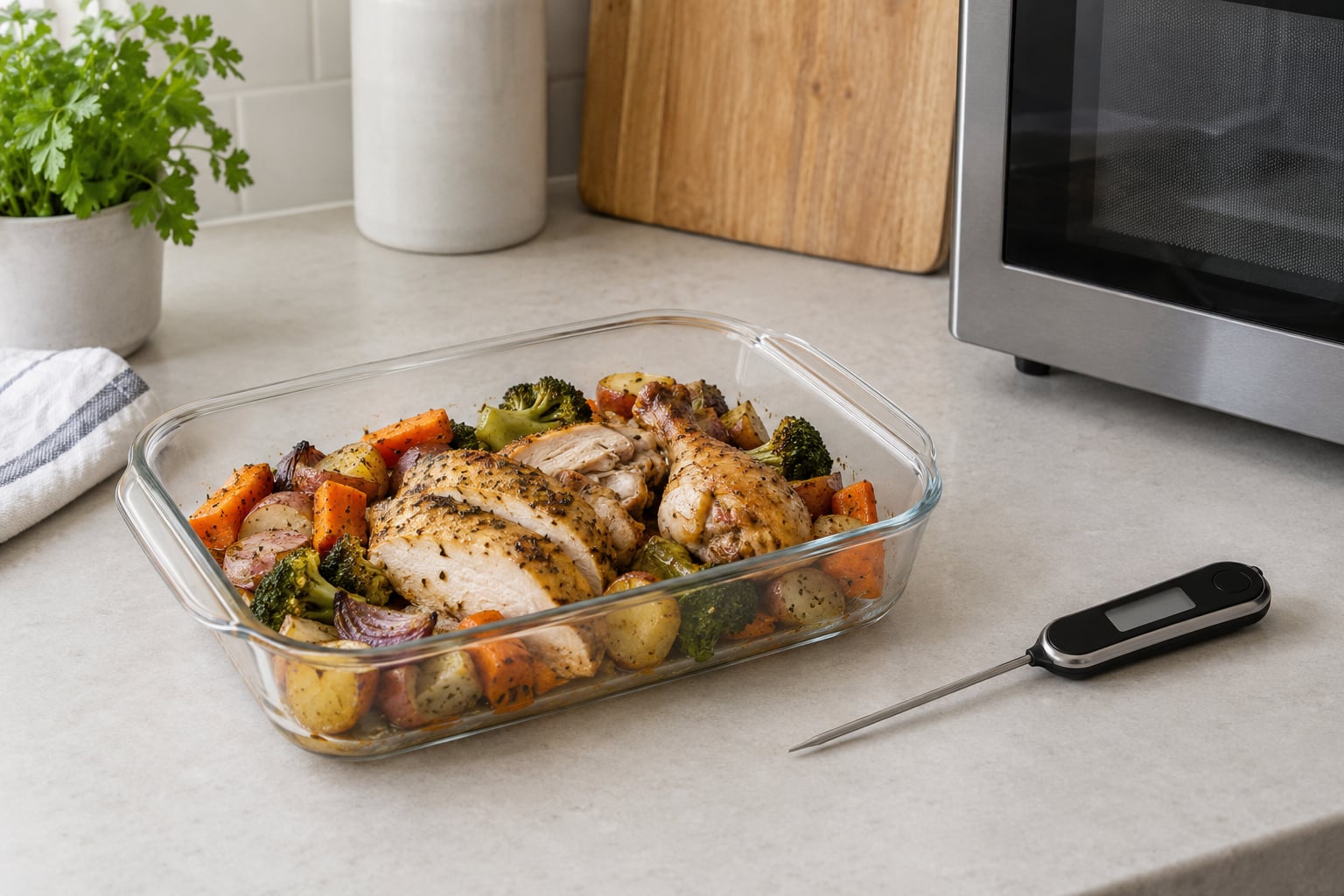
Reheat leftovers until the center of the food hits 165°F (74°C), then verify it with an instant-read thermometer. The food should be steaming hot throughout, not just warm on the outside. Even heat plus a real temperature check is most of what knowing how to safely reheat leftovers comes to, and neither a timer nor the look of the food will do it for you.
Most reheating goes wrong in one of two ways. Either the food spent too long sitting in the danger zone between 40°F and 140°F, and reheating cannot fix that. Or the edges are scorching while the middle is still lukewarm, which means bacteria in the cold center survived.
This guide covers the equipment that matters, the method for each appliance, the target temperature for each type of food, and the mistakes that quietly undo all your careful work. It takes about ten minutes of setup, and the real cooking time depends on the food.
Table of Contents
What You Need
You do not need a full test kitchen. You need four things, and only one of them is optional in a strict sense.
- An instant-read thermometer. This is the one tool that turns reheating from guesswork into a check. It has to reach into the thickest part of the food, not touch the pan or the side of the dish.
- A microwave-safe dish or bowl. Glass or ceramic, wide enough that the food sits in an even layer. A deep pile heats unevenly.
- A skillet or a baking sheet. The skillet does the stovetop work, the sheet does the oven work. Both handle the wetter leftovers like rice, pasta and saucy chicken better than a microwave does.
- Oven mitts. Dishes come out of a 350°F oven dry enough to be boring and hot enough to be dangerous.
- A refrigerator thermometer. Optional, but it is the cheapest way to find out whether your leftover problem is actually a storage problem.
If you order takeout often, add one more: a glass or ceramic dish you can transfer food into. Reheating restaurant food in black plastic trays, foam boxes or deli containers is common, and it is worth avoiding.
How to Safely Reheat Leftovers: Step-by-Step
These five steps work no matter which appliance you use. The method sections after them tell you how to heat, stir and cover for each one.
- Check the leftovers first. Look at them and smell them. Discard anything that smells off, looks slimy, or has sat out past the safe window. Heating does not reliably kill every toxin bacteria have already produced.
- Take the temperature you found cold. A probe stuck straight from the fridge tells you how much work the reheating has to do. Cold leftovers need more time and more stirring than lukewarm ones.
- Heat to 165°F (74°C). Bring the center of the thickest portion to that temperature and let it hold for about 15 seconds, which helps even out the reading.
- Choose the method that fits the food. Microwave for speed and small portions, oven for crisp or dry foods, stovetop for sauces, soups and anything with a sauce you do not want to scorch.
- Rest, then eat promptly. Let the food sit for a minute or two after heating so the temperature settles, serve it, and refrigerate any portion you are not eating straight away.
The rule underneath all of it: reheat food once. A second reheating adds another cycle of bacterial growth, and reheating for a second time is where most takeout becomes a problem.
How to Safely Reheat Leftovers in a Microwave
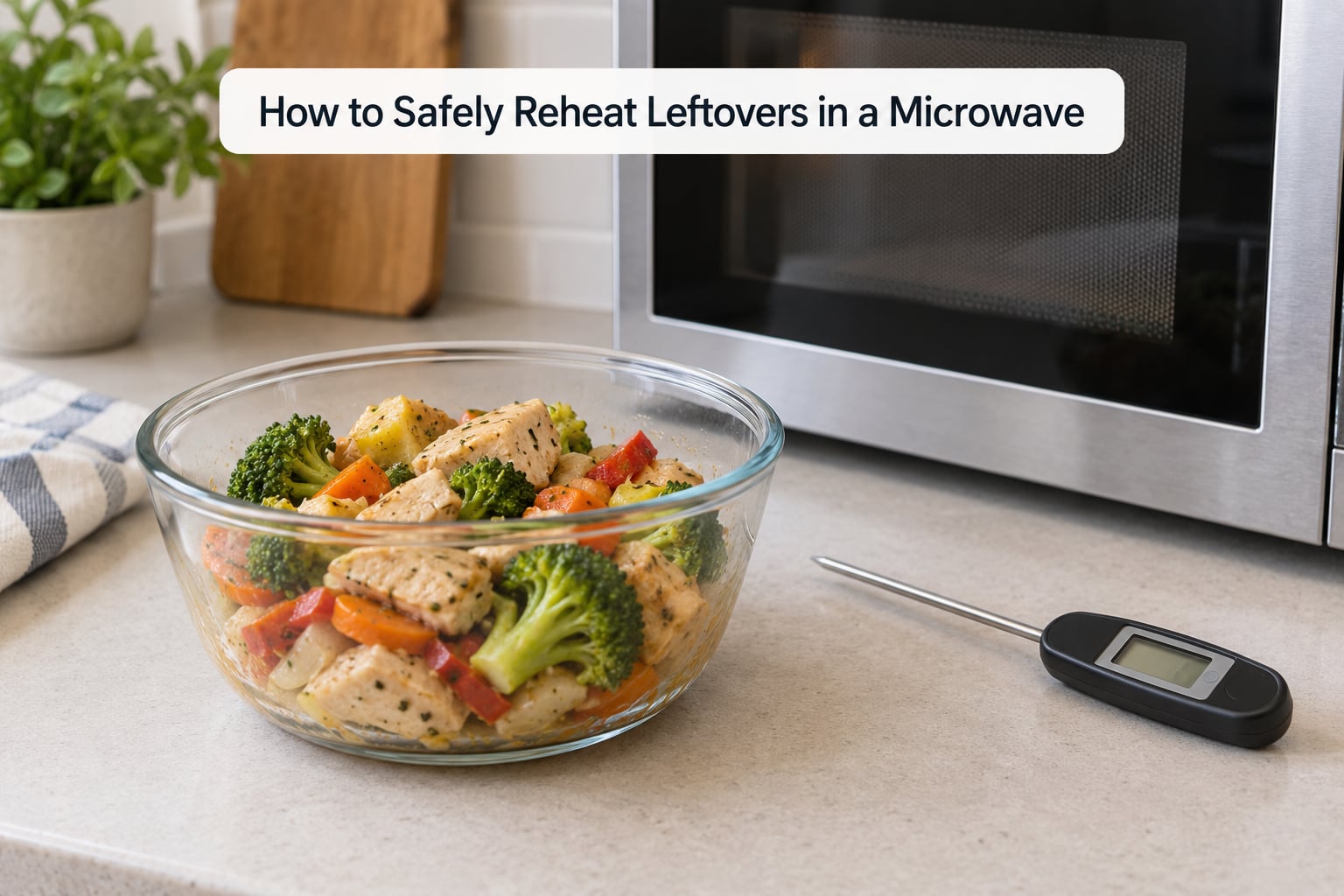
The microwave is the fastest method and the one that hides cold spots best. It heats water molecules, so the edges and any dry surface run hot while a dense center such as a chunk of chicken or a scoop of rice can stay cool enough for bacteria to survive.
- Spread the food in a single even layer. A wide shallow dish beats a deep bowl every time. If you have more than one portion, heat them in batches rather than stacking.
- Cover loosely. A lid or microwave-safe plate on top traps steam and keeps moisture in. Leave one edge open so pressure can vent, and never seal a container airtight.
- Heat in short bursts. Start with 60 to 90 seconds for a normal portion, then check. Long unattended cycles are what create hot rings and cold middles.
- Stir and rotate halfway. Stir from the bottom edge to the center and turn the dish a quarter turn. This is the step people skip, and it is the one that fixes uneven heating.
- Stand for a minute. Let the food sit covered so heat finishes moving into the center.
- Probe the thickest part. Push the thermometer into the center of the largest piece, avoiding the dish wall. It needs 165°F (74°C). If you only have a microwave, this step is the whole game.
Never run an empty container, and never use a container that is cracked, warped or has no bottom. Melted plastic in a microwave has ruined more than one dinner.
How to Safely Reheat Leftovers in the Oven
The oven is the best method for pizza, roasted vegetables, fried food, casseroles and anything where you want the surface to crisp again. Set the oven to 350°F, which is gentle enough that the food heats through before the outside burns.
- Pizza and breaded or fried items: place the slices directly on the baking sheet so the crust touches metal and gets crisp. Ten minutes is usually enough.
- Roasted vegetables: spread them in a single layer with a small amount of oil so they do not dry out. Fifteen minutes.
- Casseroles and gratins: put the dish in the oven, loosely cover with foil for the first 15 minutes so the center steams through, then pull the foil and brown for 10 more.
- Dry leftovers such as stuffing or grain: add a splash of broth or water and cover loosely. Dry heat without added moisture is how food turns to cardboard.
An air fryer or toaster oven works the same way at a slightly higher temperature, usually 375°F, and in less time because the chamber is small. Keep an eye on it, since these appliances brown food faster than a full oven does. Check the center temperature with the same 165°F rule, and transfer the food onto a plate rather than reheating in a foam or plastic takeout tray.
How to Safely Reheat Leftovers on the Stovetop
The stovetop gives you control, which makes it the right choice for soups, stews, curries, pasta and any dish with a thick sauce. Heat is also the most uneven method if you walk away from it.
- Use a wide skillet. More surface area means the food heats evenly rather than in a hot ring around the edge.
- Add a little liquid. A spoonful of water, broth, or the dish’s own sauce keeps rice and grains from drying into hard pellets and stops a thick sauce from scorching on the bottom of the pan.
- Cover when it helps. Put the lid on for rice and pasta so steam gets the heat through the middle. Leave it off for anything you want to reduce or brown.
- Stir often. Every 30 seconds or so, which is roughly how long it takes heat to reach the center and the coldest pockets to catch up.
- Check the thickest portion. The probe goes into the biggest piece or the center of the pile, not the liquid at the edge, and it needs to read 165°F (74°C).
Save the slow cooker for cooking from scratch, not for reheating. A slow cooker holds food in the 40°F to 140°F range for hours at a time, which is the worst possible temperature for bacteria.
Safe Internal Temperatures for Different Leftovers
USDA guidance is to bring all leftovers to 165°F (74°C). The table below breaks that down by food type, along with how long each one keeps in the refrigerator.
| Leftover type | Minimum internal temperature | Refrigerator time at or below 40°F |
|---|---|---|
| Poultry leftovers (chicken, turkey) | 165°F (74°C) | 3 to 4 days |
| Ground meat leftovers (burgers, meatballs, sausage) | 165°F (74°C) | 3 to 4 days |
| Leftovers containing meat (sauces, casseroles with beef or pork) | 165°F (74°C) | 3 to 4 days |
| Casseroles and soups | 165°F (74°C) | 3 to 4 days |
| Whole cuts of meat and fish leftovers | Reheat to 165°F (74°C) | 3 to 4 days |
| Fresh cooked rice | 165°F (74°C), use within 1 day | 1 day |
| Cooked vegetables, soups and plain side dishes | 165°F (74°C) | 3 to 4 days |
Freshly cooked food belongs in the refrigerator within two hours, or within one hour if the room is above 90°F. Divide large pots into shallow containers so the center cools fast, and use food within three to four days or freeze it.
If you cook in metric, 165°F is 74°C and 40°F to 140°F is roughly 4°C to 60°C. The 165°F (74°C) figure is a floor, not a target to overshoot.
Common Mistakes
Here are the habits that cause reheated food to make people sick, and what to do instead.
- Reheating food that sat out too long. The 2-hour rule is about time in the danger zone, and reheating does not reverse bacterial growth. Food that sat out all night at a dinner party is a disposal, not a reheating project.
- Trusting the clock instead of a thermometer. Every microwave and every pan behaves differently. A three-minute cycle that works on Tuesday leaves the center cold on Thursday.
- Heating the edges and forgetting the middle. If your food is scorching around the rim, it is not done. Stir, redistribute, and check again.
- Going by appearance. Food can look steaming and smell fine while the center is still below the safe temperature. Appearance is a hint, not proof.
- Reheating in a slow cooker or a warm oven. Both hold food in the growth range for a long time, which is exactly what reheating is supposed to avoid.
- Reheating the same batch twice. Rice and pasta are the usual offenders, because reheating a portion and putting the rest back is a common habit. Cook once, eat once.
- Putting hot food straight back in the fridge and eating it hours later. A deep, steaming-hot container warms the whole shelf and cools the center slowly. Cool fast in shallow containers, then refrigerate.
- Microwaving takeout in its original container. Move restaurant food into glass or ceramic first. Black plastic, foam and deli trays are not built for microwaving.
Five foods deserve real caution. Cooked rice can carry Bacillus cereus, whose spores survive cooking and whose toxins are not destroyed by reheating, so refrigerate rice within an hour and eat it the next day. Potatoes and other green vegetables can build up heat-resistant compounds, so eat them within a day or two rather than reheating repeatedly. Mushrooms and seafood spoil quickly and turn risky fast. And reheated oil from fried food is a good thing to skip.
One last habit worth building: wipe down the stovetop and the microwave handle after you reheat. Those surfaces are where raw food, phones and hands meet, and they are the most common source of cross-contamination in a home kitchen.
Frequently Asked Questions
How long should leftovers be reheated?
Heat leftover food until the center reaches 165°F (74°C). Most portions take 1 to 2 minutes in a microwave with a stir halfway, 10 to 15 minutes in a 350°F oven, or 5 to 10 minutes in a skillet with a splash of liquid. Time is only an estimate, so check with an instant-read thermometer in the thickest part and keep heating if it reads cold.
Can I reheat leftovers more than once?
No. Official guidance is to reheat food only once, because each round trip through the danger zone of 40°F to 140°F gives bacteria another chance to multiply. If you only want to heat part of a container, warm that portion and leave the rest cold. Curry and rice are the foods people most often reheat twice, and both are worth the extra effort to portion correctly.
How do I know leftovers are hot enough?
Use an instant-read thermometer and push the probe into the thickest part of the food, avoiding the dish wall. It should read 165°F (74°C) or above, and the food should be steaming hot throughout rather than just around the edges. Hold it there for about 15 seconds so the reading settles. If you do not own a thermometer, buy one, since it is the cheapest safety tool in your kitchen.
Should you cover leftovers when reheating them?
Usually yes. A loose cover traps steam so heat reaches the center of the food faster and moisture stays in, which is what stops rice and pasta from drying out. Leave a gap so pressure can vent, and never seal a container airtight in a microwave. Leave the cover off for pizza, fries and roasted vegetables, where you want the surface to dry out and crisp.
How long can leftovers stay in the refrigerator?
Most cooked leftovers keep for three to four days at or below 40°F (4°C). Cooked rice is the exception: cool it within an hour, refrigerate it promptly, and eat it within one day. Get leftovers into the refrigerator within two hours of cooking, or within one hour in a room above 90°F. When in doubt, throw it out, because reheating cannot make food that grew bacteria at room temperature safe again.
Reheat Leftovers Safely: What to Do First
If you take one thing from this guide, make it the thermometer. How to safely reheat leftovers comes down to even heat and a verified 165°F (74°C) reading in the center, not a timer and not how steaming it looks.
Start by checking that the food was refrigerated within two hours and stored at or below 40°F. Pick the method that suits the food, keep stirring or covering so the center catches up with the edges, and probe the thickest portion before you serve it.
Eat it right away, refrigerate the uneaten portion in a shallow container, and discard anything that spent more than two hours at room temperature. That last habit prevents more cases of food poisoning than any reheating technique ever will.