
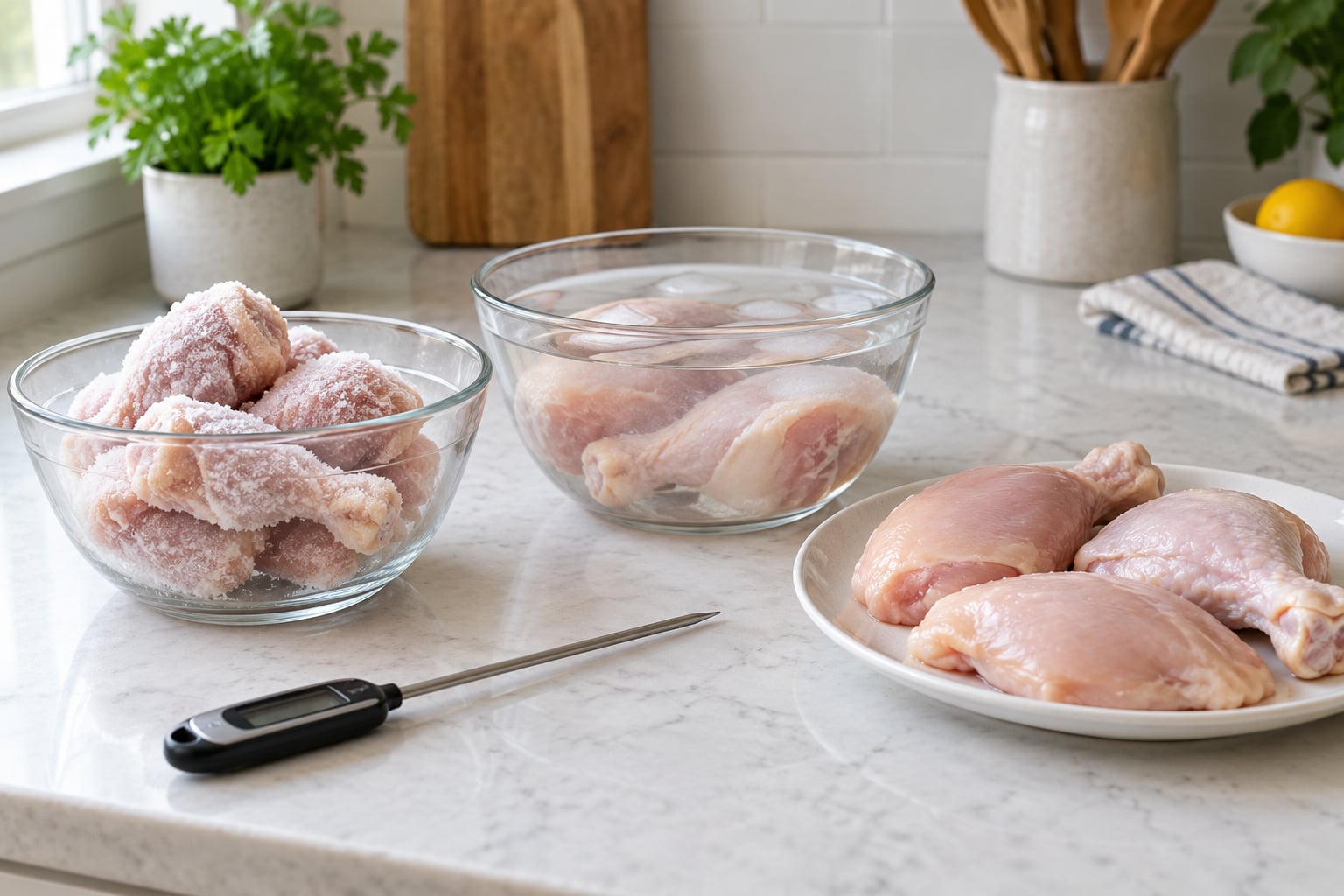
There are three ways to thaw chicken safely: the refrigerator overnight, cold tap water changed every 30 minutes, or the microwave on its defrost setting. Cold water is the fastest safe option for a same-day dinner, and the microwave beats it for small portions you are cooking immediately. The counter and hot water are not on the list for a reason.
That is the whole rulebook, and it comes from the USDA Food Safety and Inspection Service, which allows exactly those three methods. Everything else you have heard — warm water soaks, a hair dryer, salt and vinegar, chicken sizzling in a skillet to loosen the ice — either does nothing or pushes raw poultry into the temperature range where bacteria multiply fast.
Chicken is the food most often thawed badly, because the dangerous version is easy and habitual. A frozen breast on the counter at noon is a fully thawed, warm outer surface by dinnertime, and the middle is still ice. Cook that and you have an undercooked center wrapped in a lot of surface area bacteria were perfectly happy to grow on.
The fix is less about technique than about planning, so here is what you need, the three methods with real times, and the mistakes to stop repeating.
Table of Contents
What You Need
You do not need any special equipment. You need a refrigerator running at 40°F or below, a leakproof bag or sealed container, a bowl big enough to submerge the chicken completely, cold tap water, and a cutting board you can wash with hot soapy water afterwards.
A few things that make the job easier. Tongs let you lift a wet, slippery breast out of a water bath without dropping it on the counter. A plate or shallow tray under the fridge-thawed package catches the pink exudate that leaks as the meat warms, which matters because that liquid is raw and salty enough to stain a shelf. A reliable instant-read thermometer is the one tool that removes all the guessing, and it is worth owning before you need it rather than after.
Before you start, clear a stretch of fridge space. Chicken thawed in the refrigerator belongs on the lowest shelf, below anything you plan to eat raw, so a leak cannot drip onto a container of salad or fruit.
Step-by-Step: How to Thaw Chicken Safely and Quickly
How to Thaw Chicken in the Refrigerator
This is the safest method and the best one for texture, because the meat warms so slowly the juices stay where they belong. Put the chicken in the refrigerator the night before, or move it to the fridge in the morning for an evening meal.
Leave it in its original wrapping, or slide it into a leakproof bag or container. Set it on the lowest shelf, ideally on a tray or in a bowl to catch drips. Do not rinse it. Rinsing raw chicken splashes bacteria across your sink and does nothing useful.
Plan on roughly 24 hours per 2 pounds. A 1-pound package of boneless breasts will usually be ready overnight; a 4-pound whole bird needs closer to two days in the fridge, and putting it in on Sunday for Monday dinner is a real possibility rather than a worst case.
Once thawed, chicken thawed in the refrigerator is the only method that lets you put it back in the fridge and cook it later. That is why it suits meal prep: you can thaw a week of portions on Sunday and cook them as you need them through the week.
How to Thaw Chicken Quickly with Cold Water
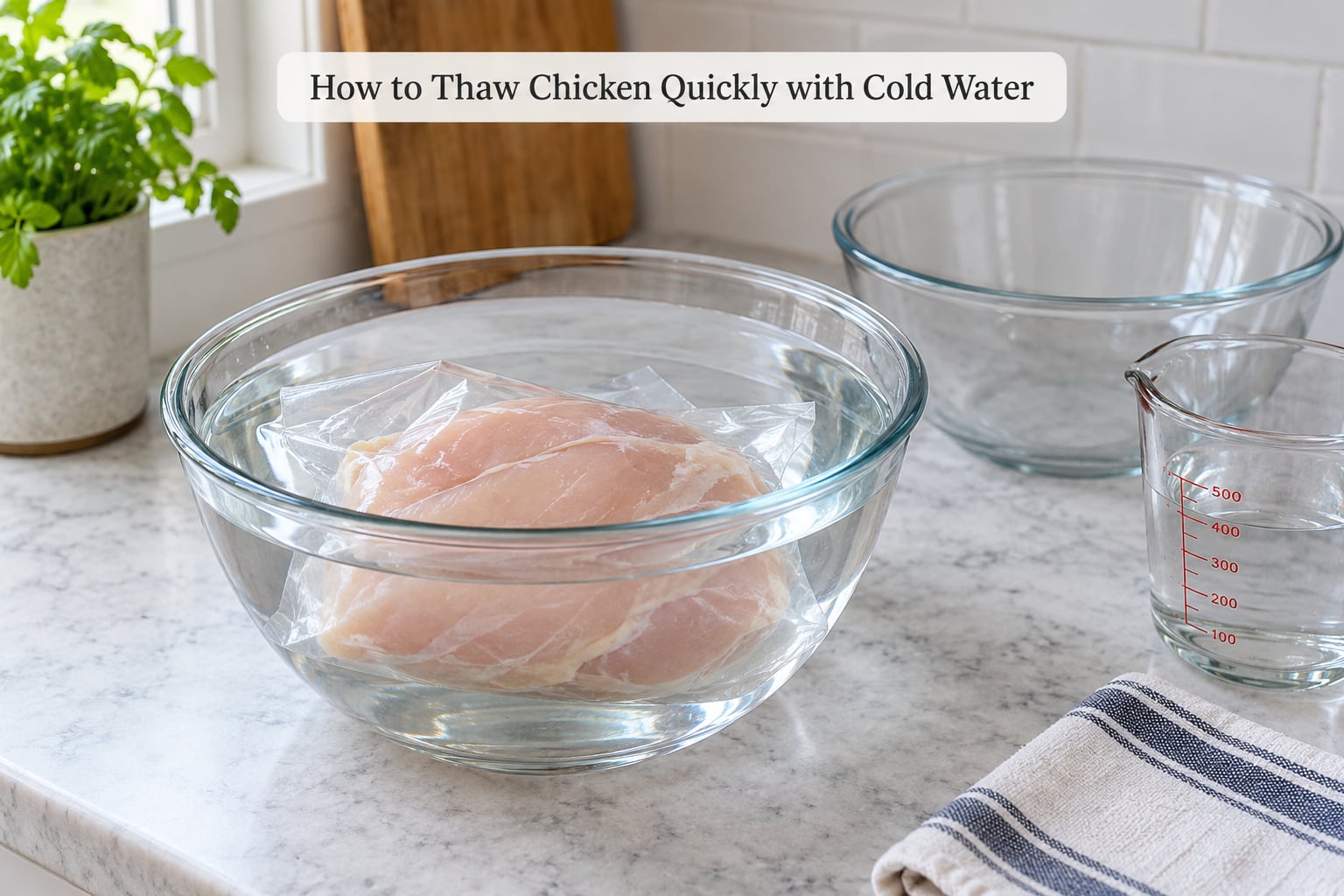
This is the fastest safe method, and it is the one to use when dinner is four hours away and you forgot. The USDA’s cold water method is four steps, and it works because moving water carries heat off the surface far faster than still air does, while staying well below the 40°F danger zone.
- Put the chicken in a leakproof bag, or make sure its packaging is sealed.
- Submerge it completely in cold tap water.
- Change the water every 30 minutes.
- Cook it immediately after thawing.
The details matter more than the list suggests. “Submerge it completely” is not negotiable, because any part of the chicken sitting above the water line thaws in air instead and warms up. Changing the water every 30 minutes is what keeps the bath cold enough to stay safe, and a tap running at a trickle over the package works for the same reason.
Allow about 1 pound per hour. A 2-pound bag of boneless breasts takes roughly two hours; a whole 4-pound chicken takes three to four. Wrap the bowl in a towel or run cold water into it if your kitchen is warm, and use a bowl you can lift with two hands once the weight is in it.
Cook immediately. Chicken thawed in cold water is sitting at refrigerator temperature in a wet environment, and it stays in the fridge fine only until it leaves the water, so plan the cold water bath around dinner rather than around the morning commute.
How to Defrost Chicken in the Microwave
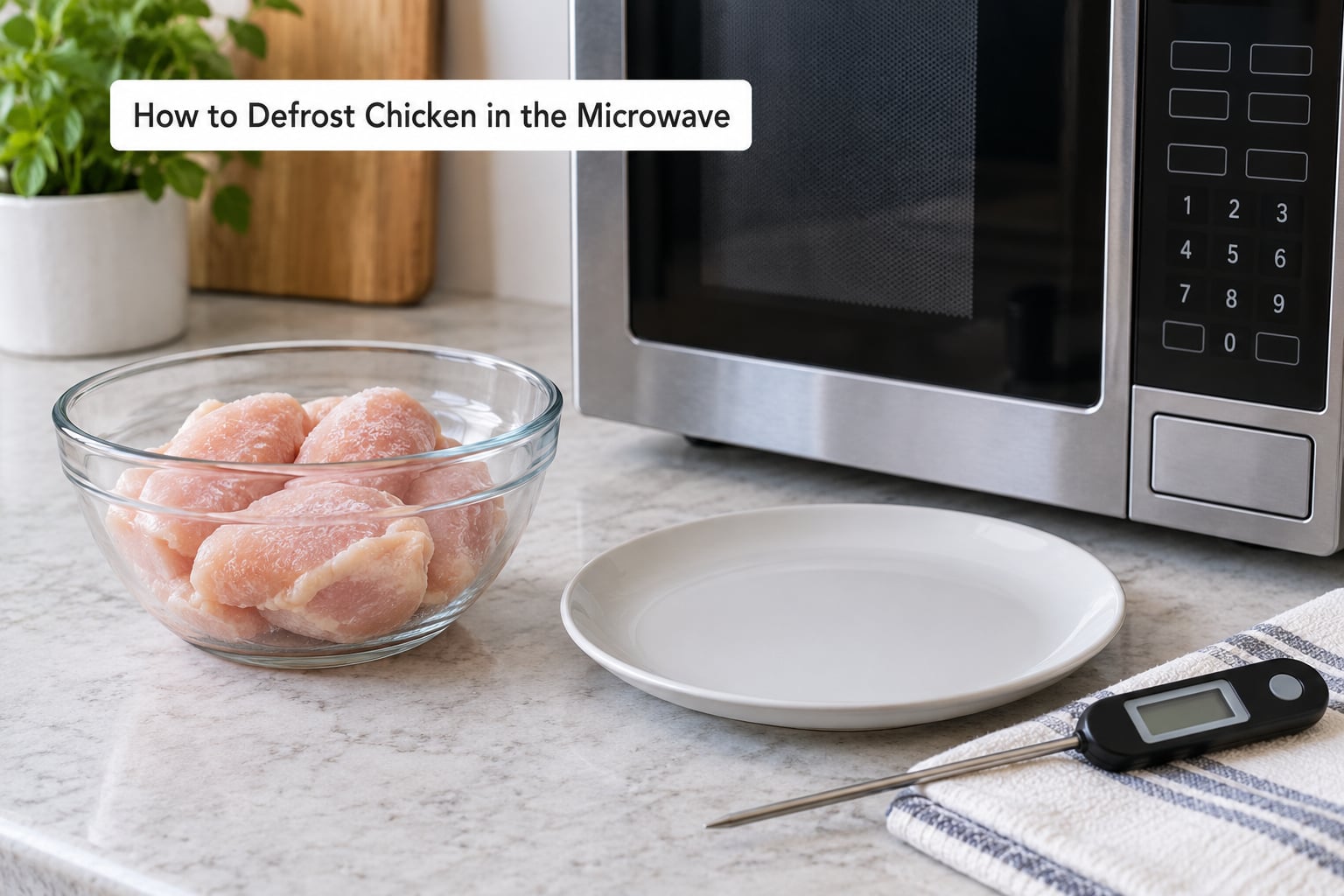
This is the fastest method overall, and it is the right choice for a single breast or a small bowl of pieces when you are cooking within the hour. It is also the easiest to get wrong, because full power cooks the outside while the center is still frozen.
Remove all packaging. Put the chicken on a microwave-safe plate rather than a bare turntable, set the microwave to defrost or 30 percent power, and run it in short bursts. Check after the first two minutes, then every minute or so. Turn and rotate the pieces between bursts so no single edge sits against hot plastic.
Stop the microwave the moment the chicken is pliable, not the moment it looks done. Pale cooked edges are a sign you have gone too far, and they will be rubbery after you finish it in a pan.
Cook it straight away. Microwave-thawed chicken is the most perishable of the three methods, because the uneven heating has already warmed the outside more than the inside.
One warning about air fryers: they do not have a defrost cycle, and running frozen chicken through one thaws unevenly while the outside burns.
How Do You Know When Chicken Is Fully Thawed?
Three signs, in order of usefulness. Press the thickest part with your thumb: thawed chicken gives and dents slightly, while frozen chicken is hard and springy. Look for ice crystals, especially in the crevices around a bone-in cut. Then check the temperature with a thermometer inserted into the thickest part: 40°F or below means it is thawed.
None of these means the chicken is safe to eat. Thawed is not cooked. Raw chicken is only safe once it reaches an internal temperature of 165°F, verified with a thermometer in the thickest part and not touching bone.
How Long Does It Take to Thaw Chicken?
Timing depends on the cut, the thickness, and the method. The table below covers the cuts people actually cook, ordered from smallest to largest.
| Cut | Refrigerator (about 24 hours per 2 lb) | Cold water (about 1 lb per hour) | Microwave on 30 percent power |
|---|---|---|---|
| Boneless chicken breasts, 1 lb | 9-12 hours | 1 hour | 2-3 minutes |
| Boneless chicken breasts, 2 lb | 18-24 hours | 2 hours | 5-6 minutes |
| Bone-in breasts, 2-3 lb | 1-1.5 days | 2-3 hours | 8-10 minutes |
| Chicken thighs, boneless or bone-in | 12-24 hours | 1-2 hours | 4-6 minutes |
| Drumsticks | 18-24 hours | 1.5-2 hours | 5-7 minutes |
| Chicken wings | 9-18 hours | 30-60 minutes | 3-5 minutes |
| Whole chicken, 3-4 lb | 2 days | 3-4 hours | Not recommended |
| Ground chicken, 1 lb | 12-24 hours | 1 hour | 2-3 minutes |
Three things move these numbers. Thickness beats weight, so a stack of thin cutlets thaws in a fraction of a whole breast of the same total weight. Freezer temperature matters, and a piece frozen solid at 0°F takes longer than one that has been in the freezer for a week. And thawing in a sealed bag on the coldest part of the fridge is faster than thawing on a middle shelf in a warm kitchen.
The best fix is a freezing habit. Chicken frozen flat in single-meal portions in a layer, not rolled into one thick block, thaws faster and more evenly every time you need it. A frozen brick of chicken can take two days to thaw no matter which method you use.
Common Mistakes
Thawing on the counter. The surface of the chicken enters the 40°F to 140°F danger zone within roughly two hours, and Salmonella and Campylobacter multiply fast in that range while the center is still frozen solid. Fix: move it to the fridge or a cold water bath. If it has genuinely sat out for more than two hours, throw it away rather than cooking it and hoping.
Using hot or warm water. Hot water thaws the outside in minutes and drives the surface straight into bacterial growth territory. Warm running water is gentler but still the wrong idea because you cannot control the temperature. Fix: cold tap water, changed every 30 minutes.
Dropping chicken straight into water with no bag. Loose chicken in a water bath lets raw juices and bacteria spread through the water and onto your sink, counter and hands. Fix: a sealed leakproof bag every time, even if the packaging looks solid.
Running the microwave at full power. You end up with cooked edges and a frozen middle, which means uneven cooking and a ruined texture. Fix: the defrost setting or 30 percent power, in short bursts, turning between checks.
Skipping the thermometer. Color is not a temperature. Chicken can look pink and cook dry, or look done and still be raw near the bone. Fix: check 165°F in the thickest part before serving.
Leaving thawed chicken out while you prep everything else. The cook-immediately rule exists because a thawed breast warms into the danger zone faster than most people expect while they chop onions. Fix: thaw cold-water chicken right before you cook, and refrigerate fridge-thawed chicken if you need to wait.
Believing the hacks. Salt water, vinegar, milk, a hair dryer, boiling water and running hot water do not thaw chicken faster in any way that matters, and several of them push the surface into the danger zone while the center stays frozen. The one that genuinely helps is cold moving water, which is already on the list.
Frequently Asked Questions
What is the fastest safe way to thaw chicken?
Cold water changed every 30 minutes is the fastest safe method for most portions, running about 1 pound per hour. A 1-pound bag of boneless breasts takes about an hour and a 2-pound bag about two. The microwave is faster still, roughly 3 minutes for a single breast, but it is only practical for small portions you cook within the hour. Never use hot water, which thaws the outside into the bacterial danger zone while the center stays frozen.
Can I thaw chicken in hot water?
No. Hot water drives the outer surface of the chicken into the 40°F to 140°F danger zone within minutes while the center is still frozen, giving Salmonella and Campylobacter ideal conditions to multiply. Cold tap water is the standard instead, and changing it every 30 minutes keeps the bath safely cold. Warm running water has the same problem in slower motion, and the sink also picks up raw chicken juices.
How long does it take to thaw chicken in cold water?
Allow about 1 pound per hour with the chicken fully submerged and the water changed every 30 minutes. That means roughly 1 hour for a 1-pound package of boneless breasts, 2 hours for a 2-pound package or a pack of drumsticks, 30 to 60 minutes for wings, and 3 to 4 hours for a whole 3 to 4 pound chicken. Cook it immediately after, since fridge-thawing is no longer an option once it has been in the water.
Can I cook chicken that is still frozen?
You can, and it is safe if you plan for it. Cooking from frozen needs roughly 50 percent more cooking time, and it only works well for pieces, not a whole bird. Skip searing and start it in a pan or oven, then check with a thermometer: the thickest part must reach 165°F. Thawing first still gives you better texture and far more control, so cook from frozen as a fallback rather than a habit.
Should thawed chicken be refrozen?
It depends on how it was thawed. Chicken thawed in the refrigerator can be safely refrozen, though texture may soften slightly. Chicken thawed in cold water or the microwave should not be refrozen, because the uneven warming pushes the outer layer above refrigerator temperature. If you thawed it in cold water and changed your mind, cook it first, then refreeze the cooked meat.
What is the safe internal temperature for cooked chicken?
165°F, measured with an instant-read thermometer in the thickest part of the breast or thigh, avoiding bone, and for ground chicken you cannot check until it reaches 165°F throughout. Let chicken rest for 3 to 5 minutes after cooking so the juices redistribute. Color alone is unreliable, which is why a thermometer that costs very little is the single most useful tool in this whole process.
Conclusion
If you have overnight, use the refrigerator: put the chicken on the lowest shelf in a sealed container, and give it about 24 hours per 2 pounds. If dinner is a few hours off, cold water changed every 30 minutes is the fastest safe route, at roughly an hour per pound. Either way, cook it promptly to 165°F and check with a thermometer, because thawed chicken is not the same thing as safe chicken.