
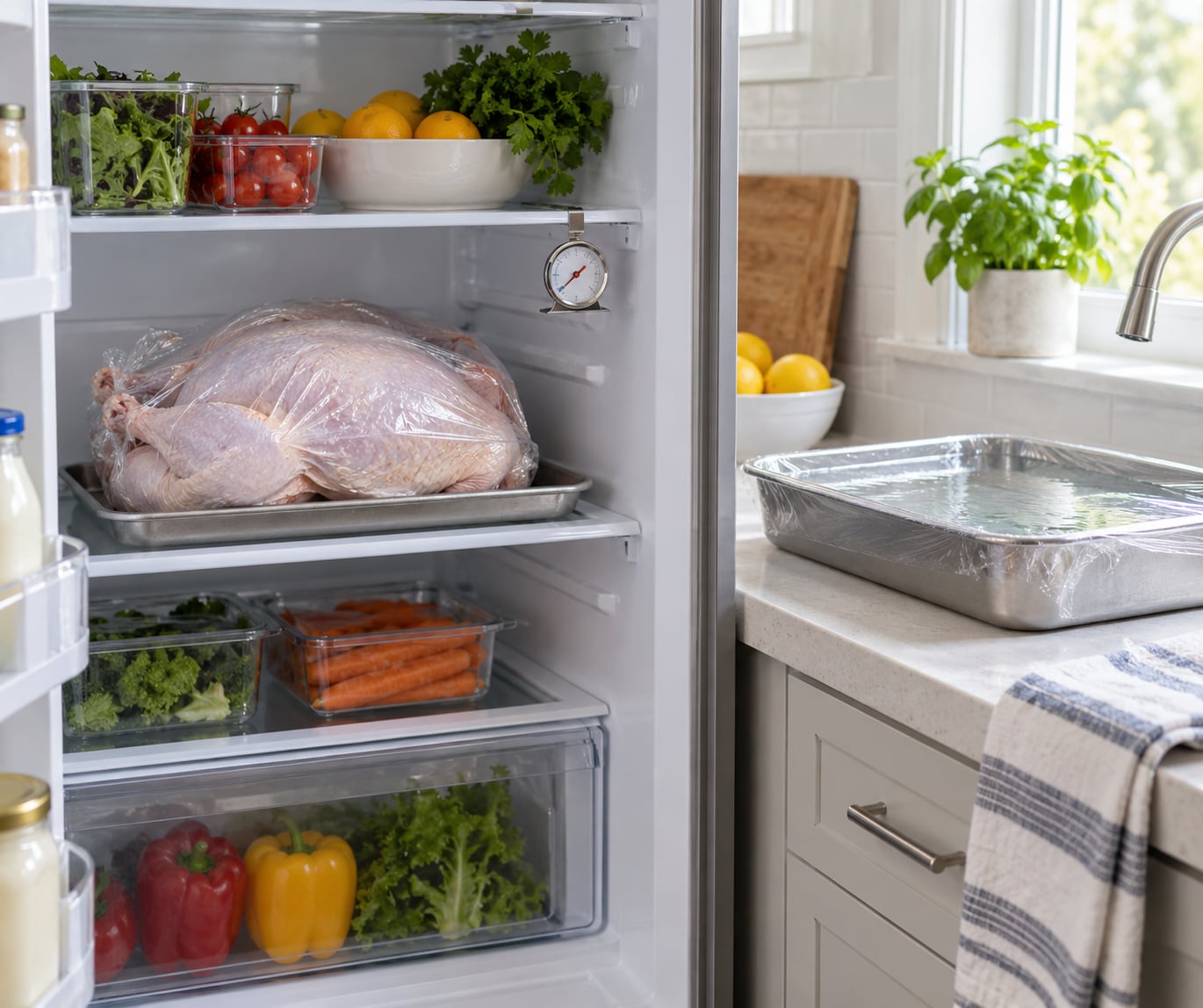
The USDA recommends three ways to defrost a turkey: in the refrigerator, in cold water, or in the microwave. The refrigerator is the safest and slowest, cold water is fast but demands attention every 30 minutes, and the microwave only works for small birds that fit with room to turn. Pick the slowest option your schedule allows, and the job takes anywhere from a few hours to five days.
The whole game is temperature. Bacteria such as Salmonella and Clostridium perfringens multiply quickly between 40°F and 140°F, the range the USDA calls the danger zone. A turkey parked on the counter enters that range within an hour or two, and the toxins those bacteria produce are heat-stable, which means a bird can reach a safe internal temperature of 165°F and still make someone sick. Thawing slowly at or below 40°F is what keeps that from happening.
If this is your first bird, work backwards from your dinner date. A 20 lb turkey needs about four to five days in the refrigerator, plus time for brining, plus travel and serving. Buying it a few days late is the single most common reason holiday turkeys end up in a panic.
Table of Contents
- What You Need
- Step-by-Step: How to Thaw a Frozen Turkey Safely
- How Do You Know When a Turkey Is Fully Thawed?
- How Long Should You Thaw a Turkey?
- Common Mistakes
- Frequently Asked Questions
- Is it okay to leave a turkey out overnight to thaw?
- How long does it take for a frozen 20 lb turkey to thaw out?
- How long to defrost a frozen turkey in cold water?
- Can you put turkey back in the fridge after thawing in cold water?
- How do I know when my turkey is fully thawed?
- Can you refreeze a turkey that has already thawed?
- Conclusion
What You Need
- A refrigerator thermometer. Household fridges vary, and the USDA rule is 40°F or below. If yours reads higher, dial it down before you start.
- A rimmed baking sheet or deep tray. A thawing turkey leaks juices, and those juices belong in a pan rather than on your crisper drawer.
- The turkey’s weight. Every time estimate on this page is per pound. The weight sticker on the wrapper is your entire calculation.
- A clean food-safe container for the cold-water method, deep enough to submerge the bird completely.
- A kitchen thermometer with a thin probe, for checking thaw progress and the finished internal temperature.
- A cutting board and a clean sink if you will be cold-water thawing, plus a way to sanitize the basin afterward.
Leave the turkey in its original leak-proof wrapper for refrigerator thawing. It keeps the surface from drying out and from picking up odors, and it stops drips from spreading.
Step-by-Step: How to Thaw a Frozen Turkey Safely
Method 1: How to Thaw a Frozen Turkey Safely in the Refrigerator
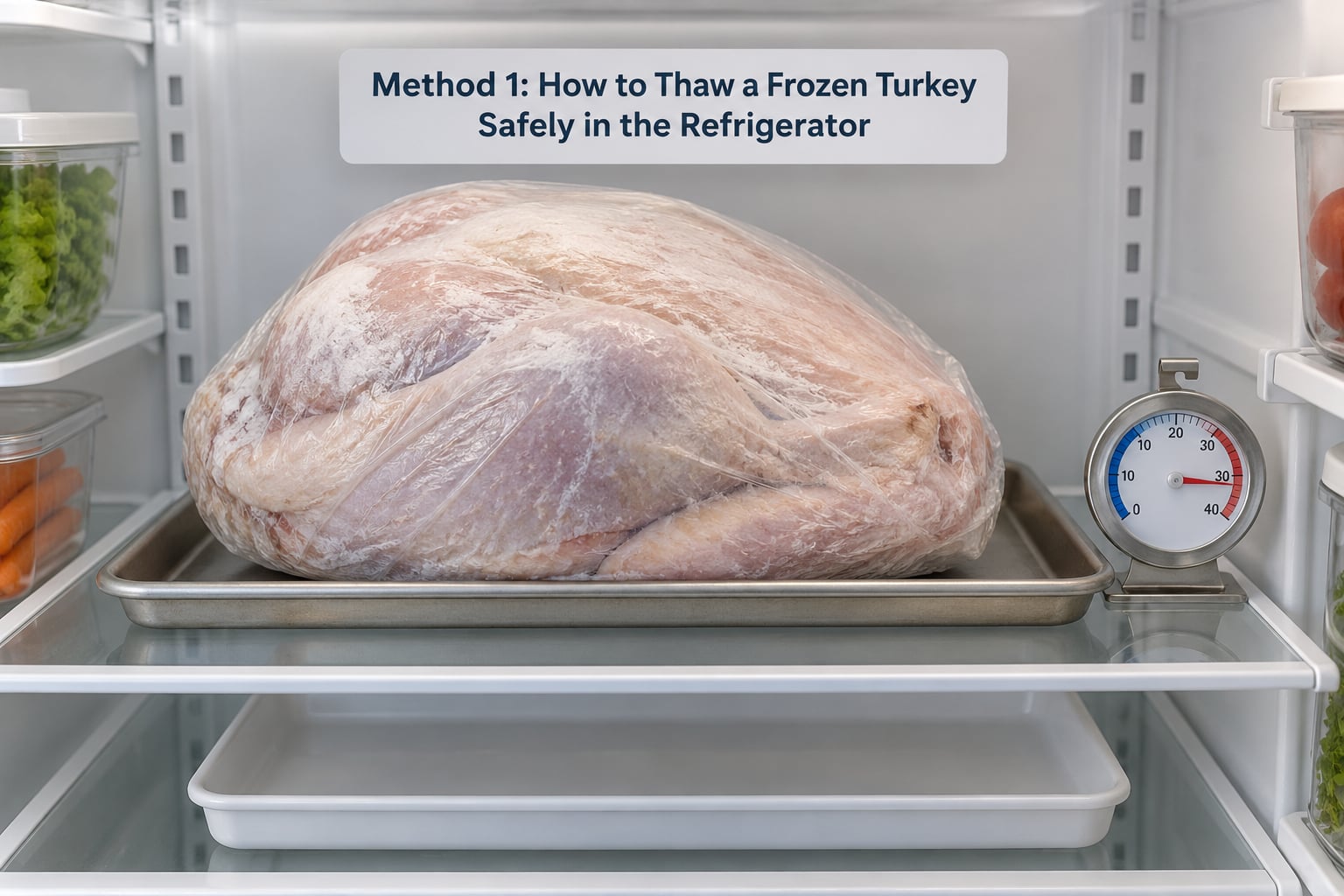
How to do it: Set the refrigerator to 40°F or below. Put the wrapped turkey breast-side up on a rimmed baking sheet on the bottom shelf, which is the coldest part of a typical fridge and keeps raw poultry away from anything you eat uncooked.
Time required: About 24 hours for every 4 to 5 pounds. That is 1 to 2 days for a 12 lb bird and 4 to 5 days for a 20 lb bird. USDA Food Safety and Inspection Service guidance treats these as estimates, so add a cushion day for birds at the top of a band.
After thawing: A fridge-thawed turkey can stay refrigerated 1 to 2 more days before cooking, and it can be safely refrozen. That buffer is exactly why the refrigerator is the right plan when you have the time.
No room for a 20 lb bird on the shelf? A clean cooler or insulated bin with plenty of ice packs, kept at 40°F or below, works as a refrigerator substitute. Load it in the morning, check the temperature once a day, and top up the ice as it melts.
Method 2: Thaw the Turkey in Cold Water
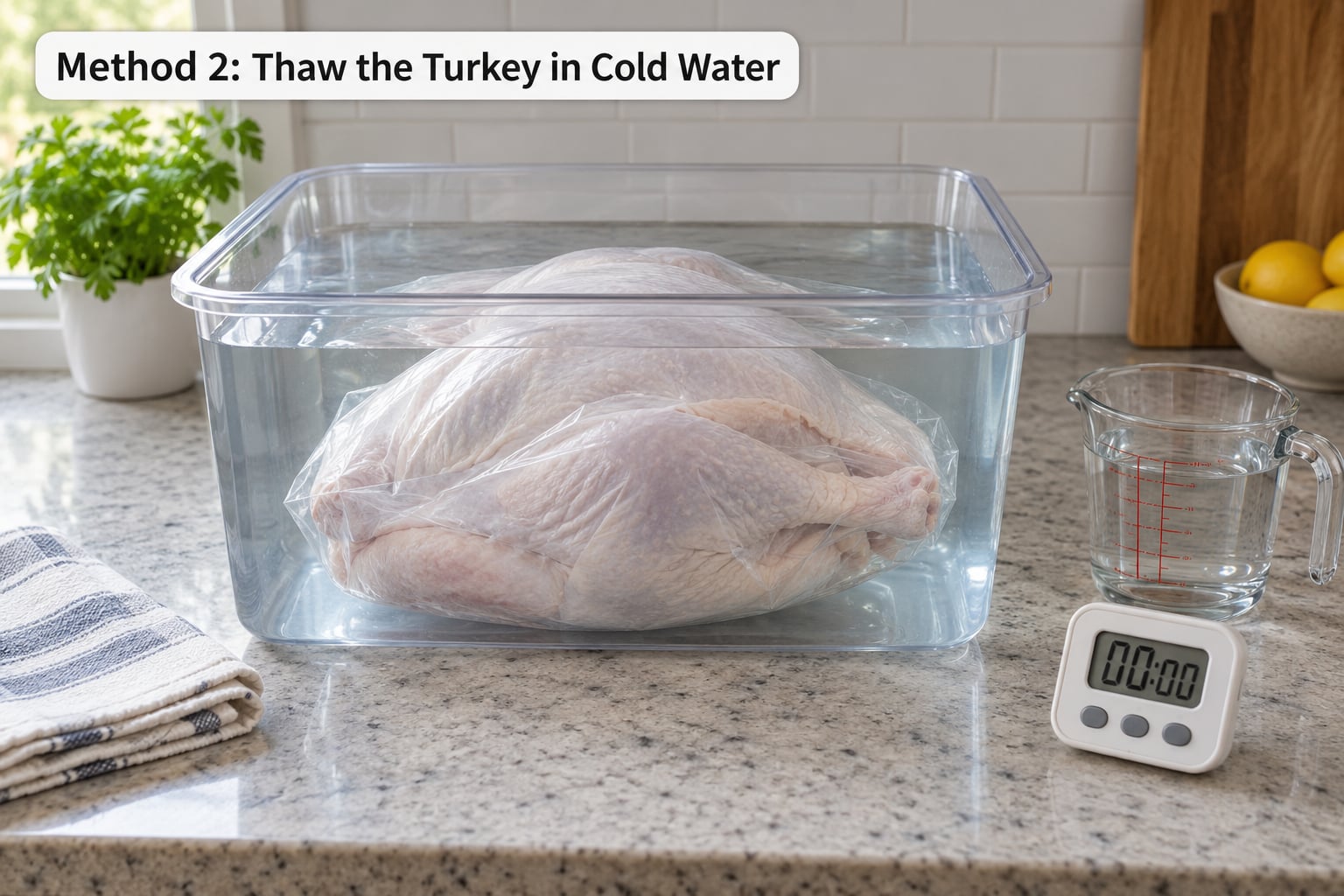
How to do it: Keep the turkey sealed in its leak-proof wrapper, submerge it fully in cold tap water in a clean sink, food-safe bin or cooler, and weigh it down with a heavy plate or clean cans so it stays under the surface.
Time required: 30 minutes per pound. A 20 lb bird takes about 10 hours of active attention, so this is realistically an all-day or overnight job.
After thawing: Cook it immediately. A turkey thawed in cold water cannot go back in the refrigerator or the freezer.
Dump the full volume of water and refill every 30 minutes. That is the step people skip, and a bath that warms past 40°F puts the bird back into the danger zone. If you have an insulated cooler, filling it with ice water and adding more ice as needed holds the temperature steady without you babysitting it.
Combine methods if you need to. Two or three days in the refrigerator followed by a cold-water finish is safe and is a common rescue for a large bird, as long as the cold-water stage ends with cooking.
Method 3: Thaw the Turkey in the Microwave
How to do it: Remove every bit of packaging, foil and plastic. Set the turkey in a deep microwave-safe dish so the juices have somewhere to go, run the defrost setting, and stop frequently to turn and reposition the bird so it defrosts evenly.
Time required: Roughly 6 minutes per pound at defrost power, checked in short bursts rather than set blind.
After thawing: Cook it straight away. The microwave warms thin parts like the wing tips long before the center gives, so this method suits a turkey under about 12 lb.
Microwaved turkey often cooks unevenly because the thawed outer edges dry out during roasting. Starting it in the microwave and finishing it in the oven gives you a gentler, more even result.
Method 4: Use an Emergency Cold-Water Method
This is the fallback for the bird that is bigger than expected or the dinner that moved up. Start a cold-water thaw earlier in the day than you think you need to, not later. A 25 lb bird at 30 minutes per pound is about 12.5 hours of monitored thawing.
Keep the turkey sealed, keep the water cold, and replace it completely every 30 minutes. If you cannot supervise that, abandon the cold-water route rather than leaving the bird sitting in warm water.
If the turkey cannot be thawed safely in the time remaining, cooking from frozen is a legitimate last resort. USDA guidance suggests roughly 50% additional cooking time for a fully frozen turkey and about 25% more for a partially frozen one. A frozen bird absorbs very little brine, so season it during cooking instead, and check the internal temperature early and often.
Never move a turkey to a hot garage, a parked car, or next to a heater to make it go faster. Cold outdoor air is not a safe thawing environment, and the same is true indoors.
How Do You Know When a Turkey Is Fully Thawed?
Check three things without cutting into the bird.
- Joint flex. Move the wing and the leg at the joint. A thawed bird bends easily with no resistance; a frozen one is stiff and rigid.
- Cavity check. Look inside the body cavity. No ice crystals, no hard frozen patches along the spine or the hip joints.
- Probe reading. Slide a thin thermometer into the thickest part of the breast, avoiding the bone. A thawed bird reads close to refrigerator temperature, roughly 32°F to 35°F. Ice-cold, rock-hard tissue reads well below that.
The breast is the last part to thaw and the first thing to check, because the legs and wings thin out earlier and can fool you.
Thawed is not the same as safe to serve undercooked. Thawing is about temperature control; safety is confirmed only when the thickest parts of the breast, the innermost thigh and the wing reach 165°F, measured at the bone. Let the bird rest 20 to 30 minutes before carving so the juices settle.
How Long Should You Thaw a Turkey?
These are USDA Food Safety and Inspection Service estimates, calculated as 24 hours per 4 to 5 pounds in the refrigerator, 30 minutes per pound in cold water, and roughly 6 minutes per pound in the microwave.
| Turkey weight | Refrigerator | Cold water | Microwave (defrost) |
|---|---|---|---|
| 4 to 12 lb | 1 to 2 days | 2 to 6 hours | 25 to 75 minutes |
| 12 to 16 lb | 2 to 3 days | 6 to 8 hours | 75 to 100 minutes |
| 16 to 20 lb | 3 to 4 days | 8 to 10 hours | 100 to 120 minutes |
| 20 to 24 lb | 4 to 5 days | 10 to 12 hours | 120 to 145 minutes |
| 24 lb and up | 5 days or more | 12 hours or more | Not recommended |
Counting back from the dinner, a 16 lb bird bought frozen should reach the refrigerator about 4 days ahead. An 18 lb bird gets 5 days, a 22 lb bird gets 6. Add your brining time on top, since an overnight brine only works on a fully defrosted bird.
Common Mistakes
- Thawing on the counter. The outer surface enters the danger zone hours before the center thaws. Corrective action: move it to the refrigerator or cold water immediately.
- Using warm or hot tap water. Warm water pulls bacteria to the surface fast. Corrective action: cold water only, changed every 30 minutes.
- Leaving the turkey bare on a shelf. Juices drip onto produce and dairy. Corrective action: keep the wrapper on and set the bird on a rimmed tray on the bottom shelf.
- Setting the microwave and walking away. Defrost power still warms thin sections. Corrective action: run in short bursts and turn the bird between bursts.
- Opening the wrapper too early. Thawing in the sink or microwave without packaging lets the surface dry and lets sink water touch the meat. Corrective action: keep it sealed for the microwave, or use a clean bag in the sink.
- Returning a cold-water or microwave-thawed bird to the fridge. Those birds must be cooked right away. Corrective action: plan the cooking time before you start the thaw, not after.
- Trusting the clock instead of the bird. Stuffy packaging, a cold fridge or a partially frozen bird can add a day. Corrective action: use the joint flex and probe checks.
Two kitchen habits pay off here. Sanitize the sink, container and any utensils after cold-water thawing, since they touched raw poultry. And keep the fridge at 40°F or below, because a full holiday fridge warms up more than an empty one.
Once the bird is carved, most of the work moves to storage and sandwiches. These ideas on ways to turn extra turkey into sandwiches beyond the basics help a big bird not go to waste, and this breakdown of which cheeses work best on turkey settles the provolone-versus-something-else debate. Deli-style cured birds are a different route entirely, with smoked turkey brands worth trying in a club if you want a sandwich without roasting anything.
Frequently Asked Questions
Is it okay to leave a turkey out overnight to thaw?
No. Counter thawing is the most common way people get foodborne illness from holiday poultry. The outer surface enters the 40°F to 140°F danger zone within a couple of hours while the center stays frozen. Bacteria multiply fast and the toxins they produce survive cooking, so the bird can reach 165°F and still make guests sick. Use the refrigerator, cold water or the microwave instead.
How long does it take for a frozen 20 lb turkey to thaw out?
In the refrigerator, allow about four to five days, based on the USDA rule of 24 hours for every 4 to 5 pounds. In cold water it takes roughly 10 hours at 30 minutes per pound, with the water changed every 30 minutes and the turkey cooked immediately after. A microwave can do it in about two hours, but a 20 lb bird is too large for most microwaves.
How long to defrost a frozen turkey in cold water?
Plan on 30 minutes per pound. Keep the turkey sealed in a leak-proof wrapper, submerge it completely in cold tap water, weigh it down so it stays submerged, and drain and replace the entire volume of water every 30 minutes. Once thawed, cook it immediately, because a cold-water-thawed turkey cannot be refrigerated or refrozen.
Can you put turkey back in the fridge after thawing in cold water?
No. USDA guidance says a turkey thawed in cold water must be cooked immediately, since the thawing itself was not done under refrigeration. Only a turkey thawed in the refrigerator can sit in the fridge for an extra 1 to 2 days or be safely refrozen. If you have time, move it to cold water only when you can cook right after it gives.
How do I know when my turkey is fully thawed?
Test three things without cutting into it. The wing and leg joints should flex easily with no resistance, the body cavity should show no ice crystals or frozen patches, and a thin probe in the thickest part of the breast should read around 32°F to 35°F rather than ice-cold. The breast is the last area to thaw, so check there first, and remember thawed is not the same as cooked.
Can you refreeze a turkey that has already thawed?
Only if it thawed in the refrigerator. USDA guidance treats a refrigerator-thawed turkey as safe to refreeze, and it stays usable while thawed for 1 to 2 days in the fridge. A turkey thawed by cold water or microwave should be cooked right away, and refreezing it is not recommended. Refreezing also costs quality, since the second freeze damages the texture.
Conclusion
How to thaw a frozen turkey safely comes down to one rule: keep the bird at or below 40°F until it is in the oven. The refrigerator does that with no supervision at roughly a day per 4 to 5 pounds. Cold water does it in 30 minutes per pound if you change the water every 30 minutes and cook straight away. The microwave does it in about 6 minutes per pound for smaller birds, and you cook it immediately.
Do this first: check the weight on the wrapper, then count back from your dinner date using the table above. If the math does not work, buy a smaller bird or cook from frozen with the extra time the USDA recommends, rather than letting the turkey sit on the counter.
Whichever route you take, finish by confirming 165°F in the thickest part of the breast, the innermost thigh and the wing, then rest the bird before carving.