
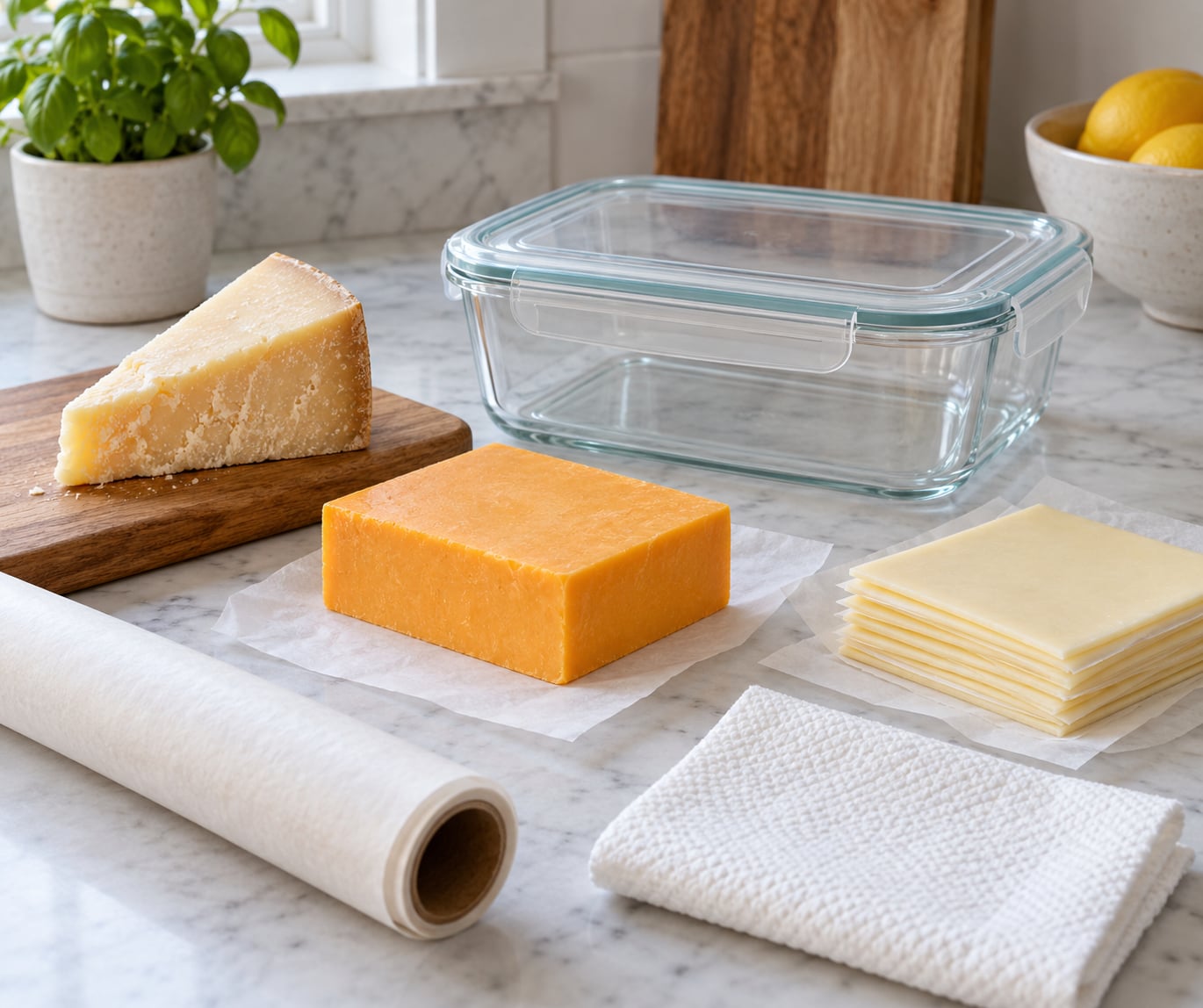
Wrap the cheese in parchment paper, wax paper or cheese wrap, seal it inside an airtight container or zip-top bag, and refrigerate it in the cheese drawer at 40°F or below. That combination controls the moisture mold needs without drying the cheese out, and it takes about 30 seconds per block. Do it right and a hard wedge keeps three to four weeks in the fridge instead of going fuzzy in a week.
The catch is that most people get half of this right. Plastic wrap alone seals condensation against the surface and breeds mold; paper alone lets the cheese drink up air and turn rock-hard in a few days. You need both, and which one goes on the outside depends on the type.
Here’s what to gather before you start wrapping anything.
Table of Contents
- What You Need
- Step-by-Step
- Common Mistakes
- Frequently Asked Questions
- Should cheese be wrapped airtight to prevent mold?
- Why does cheese mold faster in the refrigerator door?
- Can soft cheeses like Brie and cottage cheese be stored the same way as blocks?
- What do you put next to cheese so it doesn’t get moldy?
- How long can cheese stay in the fridge without molding?
- Is it safe to eat cheese that has a small amount of mold?
- Conclusion
What You Need
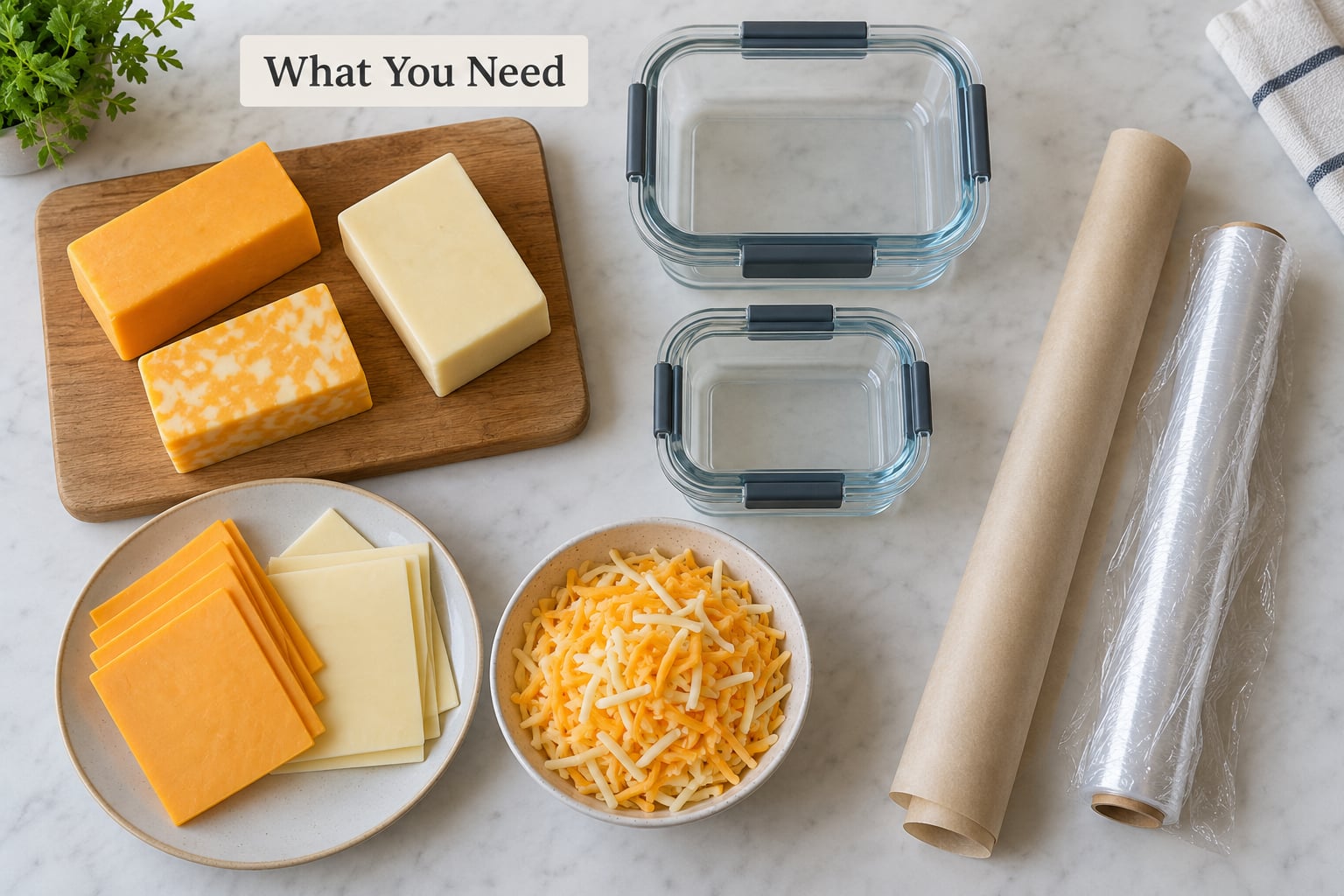
A rigid airtight container or a zip-top bag is the base. Rigid is better because cheese is easy to damage when you squeeze it, but a bag works, and a bag is what you want for odd-shaped wedges that won’t sit flat in a box.
- Breathable wrap: cheese paper (the Formaticum or Deli Wrap style sold in cheese shops), baking parchment, or wax paper.
- Plastic wrap or foil: for the outside layer, or for wrapping blue and other pungent cheeses on their own.
- Paper towel or a clean kitchen towel: for a damp liner, which holds humidity steady inside the container.
- A clean, dry cutting board and knife: wet surfaces push moisture into a block and give mold spores a place to start.
- A refrigerator thermometer: cheap, and the only way to know whether your fridge is actually cold enough.
Optional extras that cost almost nothing: two sugar cubes to buffer humidity, a coffee filter to wick surface moisture, and a pour of olive oil for feta that has lost its brine.
Step-by-Step
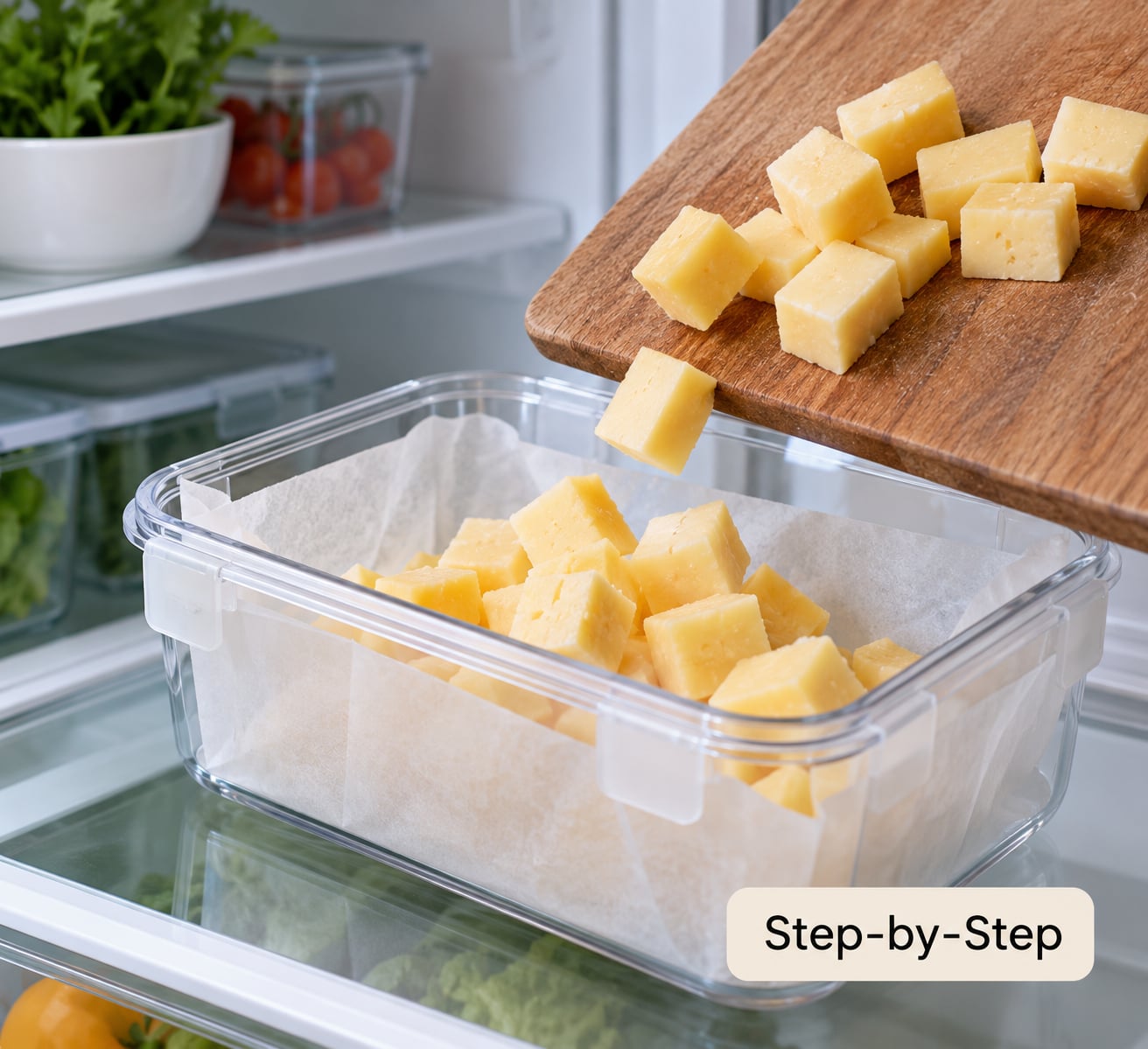
Step 1: Choose a Clean Container
Start with washed, fully dry containers. Any water clinging to the plastic or glass transfers to the cheese, and a wet spot under the wrap is exactly the surface where mold takes hold.
Next, take the cheese out of the supermarket packaging. Vacuum-sealed blocks and pre-wrapped wedges are packed in an atmosphere that does more harm than good once you cut into them, and the sealed film doesn’t reseal once it’s open. The smell and texture people blame on a bad wheel usually start here.
For large chunks that won’t fit a small box, cut the block into portions that will, then wrap each one separately. Home cheese people on r/Cheese go further and vacuum-pack the portions, flipping them about once a week so every surface keeps even contact. If you plan to portion more than a few times a year, a decent vacuum sealer pays for itself, and it’s worth reading our pick of vacuum sealers for deli meat and cheese first.
Step 2: Wrap the Cheese Correctly
Wrap in paper first, seal in plastic or a rigid box second. The paper lets the cheese breathe and release the byproducts that feed surface bacteria; the container holds the humidity steady so it never dries out.
| Wrapper | Best for | Breathable | Drying risk |
|---|---|---|---|
| Cheese paper (Formaticum, Deli Wrap) | Blocks, wedges, whole cheeses on a board | Yes, by design | Low |
| Baking parchment | Blocks, wedges, slices | Yes | Low |
| Wax paper | Cheddar, Jack, hard and semi-hard cheeses | Slightly | Low |
| Plastic wrap | Outside layer, soft creamy cheeses, fresh mozzarella in its liquid | No | None |
| Foil | Pungent cheeses on their own, or an outer layer | No | None |
For a block or wedge, lay a sheet of parchment over the surface, press out the air, and fold the ends up. Double-wrap for aged cheeses that need more protection. For sliced sandwich cheese, use a square of paper per small stack rather than one sheet for the whole pile, since stacked slices trap condensation at the edges.
Shredded cheese gets the same method but a shallower container, so you scoop from the bottom without crushing the shreds. Keep pre-shredded cheese in its original bag, pressed flat and sealed tight, because the anti-caking coating on those shreds dries out quickly once exposed.
Wet-packed cheeses are the exception to the paper rule. Fresh mozzarella keeps its packing liquid, and feta keeps its brine. If you have to sub the liquid, use olive oil rather than water, which pulls salt and flavor out of the cheese.
One community method worth knowing, circulating on Reddit’s r/Cooking: dampen a paper towel with white vinegar, wring it until it’s just moist, wrap the cheese in it, and put the whole thing in a loosely zipped bag. Users report the vinegar slows mold without changing the flavor. Cheesemakers on r/cheesemaking put it more bluntly: humidity is the controlling variable, and sitting around 70 to 80 percent relative humidity keeps surface mold off young cheeses.
Step 3: Refrigerate at the Right Temperature
Target 40°F or 4°C. Drop an inexpensive thermometer in a glass of water in the back of the fridge and check it after a day, since the dial on the door is decorative more often than not.
The cheese drawer is the best spot in most kitchens. It runs cooler and steadier than the shelves, and the humidity swing is smaller. The door is the worst place on earth for cheese: it warms up every time someone grabs milk or butter, and those swings are exactly the conditions mold likes.
Give the fridge room to move air. An overpacked fridge holds onto warmth, and a fridge running warmer than 45°F will mold a block in days no matter how well you wrapped it.
Keep cheese away from ethylene-producing fruit and vegetables, including apples, pears, bananas and ripe tomatoes, since those accelerate ripening and aging nearby. Give pungent cheeses their own container so the odor doesn’t travel, and keep cheese off the same shelf as raw meat or strong-smelling leftovers such as onions and leftover fish.
Odor transfer is worth worrying about for its own sake. A wedge of blue or washed-rind cheese left uncovered in a shared fridge will lend its smell to everything above it, including butter and leftovers you can’t reseal.
Step 4: Check and Refresh the Cheese
Look at it once a week. If the paper or liner inside the container feels damp, swap it for a fresh dry sheet. If the wrapper has gone loose or torn, rewrap rather than taping over it, because gaps let the humidity drop.
This chart covers the fridge times that matter, most of them well under what most people expect.
| Cheese type | Fridge after opening | Freezer |
|---|---|---|
| Hard aged (parmesan, grana padano, aged cheddar) | 4 to 6 weeks | 3 to 4 months |
| Semi-hard (cheddar, Jack, gouda, Swiss) | 3 to 4 weeks | 2 to 3 months |
| Blue (gorgonzola, Stilton) | 3 to 4 weeks | 2 to 3 months |
| Shredded, from a block | 3 to 4 weeks | 3 to 4 months |
| Pre-shredded | about 5 days | 2 to 3 months |
| Soft-ripened (brie, camembert) | about 1 week | Texture suffers, skip it |
| Fresh wet-packed (mozzarella, ricotta) | 2 to 5 days | No |
Shredded cheese stands up to freezing better than a block does, which is why people who buy by the wheel shred down what they won’t eat and bag it. Thaw it in the fridge overnight, not on the counter.
Don’t leave an opened bag of deli slices in the fridge with a twist tie. Press out the air and lay it flat, or move it into a container lined with a paper towel. If you’re building lunches rather than slicing at the stove, our work lunch ideas that need no fridge cover the other half of the problem, and our breakdown of the best cheese for cold Italian subs versus toasted ones shows how the pick changes how it sits by lunchtime.
Common Mistakes
Wrapping wet cheese. Pat it dry before it goes anywhere near a wrapper. Moisture you can see is moisture mold will find.
Sealing everything in plastic wrap alone. Condensation collects against the surface and mold follows within days. Paper inside, plastic outside.
Leaving it in the refrigerator door. Move it to the cheese drawer or a back shelf where the temperature holds steady.
Leaving the container slightly open and hoping. That trick works for soft-ripened cheeses that need airflow. For cheddar, Swiss and Parmesan, an open box just dries them out.
Wrapping the whole block in one big sheet. Condensation hides in the folds. Wrap in smaller pieces instead.
Storing everything together. Blue cheese, feta in brine and a wedge of gouda in one box means three different humidity needs fighting each other.
Confusing hardened cheese with spoiled cheese. A block that has dried out and turned crumbly is a wrapping problem, not a safety problem. Grate it and it usually still tastes fine.
Ignoring the smell test. Look and smell beat any date range. Sour, musty or ammonia-sharp means it’s gone regardless of how it looks.
Frequently Asked Questions
Should cheese be wrapped airtight to prevent mold?
Not on its own. Sealing cheese airtight in plastic wrap traps condensation against the surface, and that damp film is what mold grows on. Wrap the cheese in parchment, wax paper or cheese wrap first, then place it in an airtight container or zip-top bag. The container sets the humidity; the paper keeps the surface from staying wet. Soft-ripened cheeses like brie are the exception, and they want the lid slightly ajar.
Why does cheese mold faster in the refrigerator door?
Because the door warms up every time someone opens it. Most household fridges hold 34 to 40°F inside the main compartment but swing several degrees higher in the door shelf, and repeated warming and cooling gives mold the temperature swings it needs. Dairy also sits in the door on many default shelf settings. Move cheese to the cheese drawer or a back shelf where the temperature stays at or below 40°F.
Can soft cheeses like Brie and cottage cheese be stored the same way as blocks?
No, and trying it is why soft cheese goes slimy. Brie and camembert are ripened by surface mold, so they want airflow and humidity around 70 to 80 percent, which means the container lid left slightly open. Cottage cheese and ricotta are high-moisture and mold fast in any case, so keep them sealed, use them within a few days, and skip the paper layer entirely.
What do you put next to cheese so it doesn’t get moldy?
Next to very little, ideally. Keep cheese away from ethylene-producing produce such as apples, pears, bananas and ripe tomatoes, which speed up aging and spoilage nearby. Strong-smelling foods transfer odor both ways, so store pungent cheeses in their own sealed container. Raw meat and fish belong on the lowest shelf, and a damp paper towel liner in the container keeps humidity steady without touching the cheese.
How long can cheese stay in the fridge without molding?
Hard aged cheeses such as parmesan and grana padano keep four to six weeks after opening, and semi-hard cheeses like cheddar and Swiss keep three to four weeks. Blue cheese runs three to four weeks. Soft-ripened cheeses last about a week, and fresh mozzarella or ricotta only two to five days. Pre-shredded cheese is the shortest of all at roughly five days unless you freeze it.
Is it safe to eat cheese that has a small amount of mold?
It depends on the type. On a hard cheese such as parmesan, cheddar or grana padano, cut at least 1 inch around and below the spot and keep cutting until nothing smells odd, then use it. On any soft, creamy or moist cheese, discard the whole thing, because mold threads run deeper than the surface you can see. Blue and aged natural-rind cheeses with surface mold are normal and not a concern.
Conclusion
Start with the fridge drawer and a fresh sheet of parchment. Keep the cheese cold, cut the air and moisture exposure with paper inside and a container outside, and wrap each shape the way it needs: paper for blocks and wedges, sealed in its own liquid for wet-packed cheeses, lid ajar for soft-ripened rounds.
Reviewed for accuracy in 2026.