
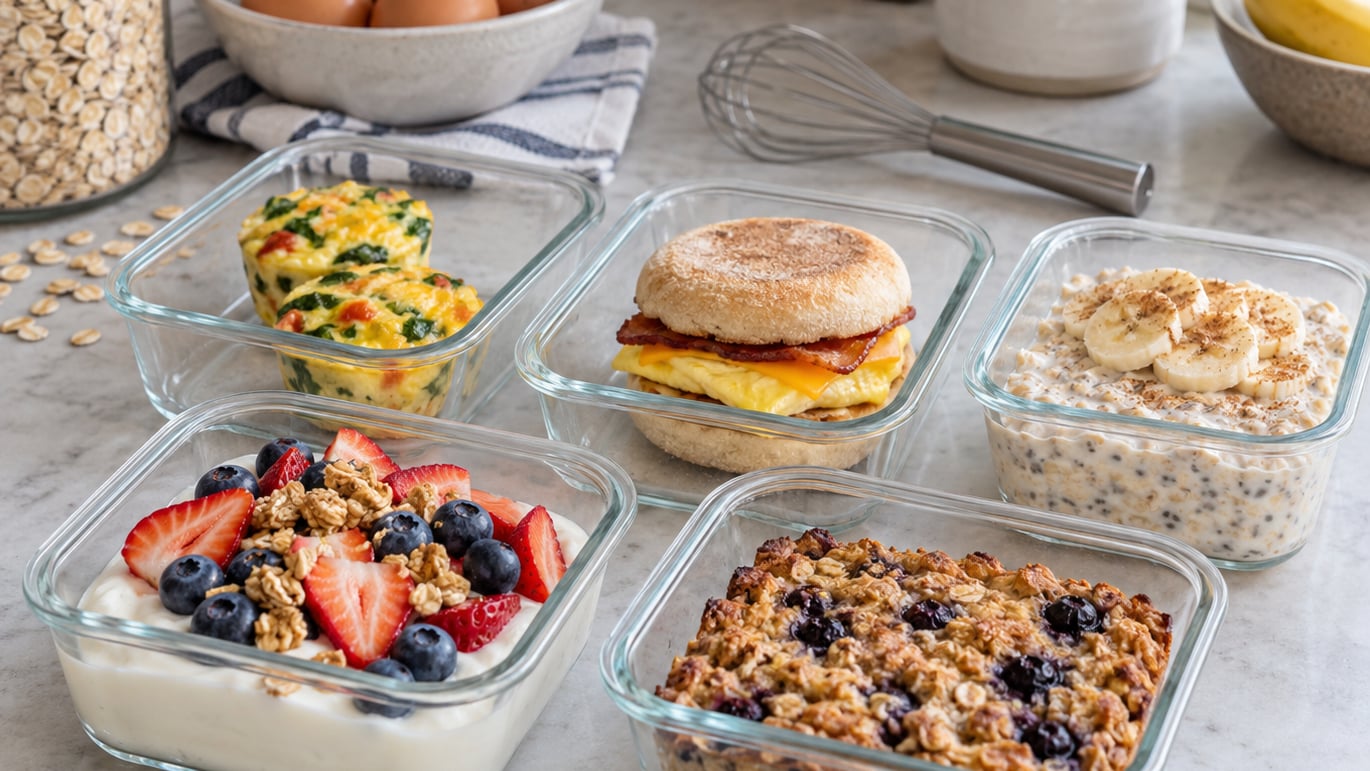
To meal prep breakfast for the week, cook two or three make-ahead breakfasts in one 60- to 90-minute Sunday session, portion each one into its own airtight container, refrigerate the first three or four days, and freeze whatever is left over. Weekday mornings then take a two-minute reheat instead of a skillet.
The part people get wrong is not the cooking. It is the packing, and the fact that most of us plan seven identical servings and quit by Wednesday. A mix of savory and sweet, with the wet ingredients kept separate, fixes both problems.
Here is the system I use: five breakfasts across five days, built from shared components so the shopping list stays short and the prep session stays under 90 minutes.
Table of Contents
- What You Need
- Step-by-Step: How to Meal Prep Breakfast for the Week
- 1. Choose Five Breakfasts You Will Actually Eat
- 2. Build a Shopping and Prep List
- 3. Cook and Cool the Batch Components
- 4. How to Meal Prep Breakfast for the Week
- 5. Store the Right Components Together
- 6. Refrigerate or Freeze Promptly
- 7. Reheat and Eat the Next Morning
- Common Mistakes
- Quick Meal-Prep Breakfast Tips
- Frequently Asked Questions
- Conclusion
What You Need
Before you shop, gather the gear. Most of it you already own.
- Five containers per person, per week. Snap lids or screw-top glass with dividers beat open tubs that tip in a bag. If yours leak, that is worth solving before the first batch, not after.
- A sheet pan and a muffin tin. The sheet pan handles eggs and roasted sweet potato; the muffin tin is for egg cups and baked oatmeal.
- Labels or a marker. Every container gets the weekday name, not just the date.
- Freezer bags or freezer-safe wrap. For burritos and sandwiches you plan to eat later in the week.
- Parchment paper. It keeps egg cups from welding themselves to the muffin tin.
- A cooling rack. Cooling hot food in a sealed box is the fastest route to a soggy container.
Two jars of rolled oats and a tub of Greek yogurt cover most of the sweet side of the week. If you plan to prep sandwiches, our breakfast sandwiches that freeze best list is a good place to pick which ones survive the freezer.
Step-by-Step: How to Meal Prep Breakfast for the Week
1. Choose Five Breakfasts You Will Actually Eat
Write down five breakfasts before you write down a single ingredient. Aim for a mix, not five of the same thing. Two savory and three sweet works well, or three savory and two sweet if you prefer a savory-leaning week.
For one person, count five servings of each component. If you are feeding a family of four, that is twenty servings, and most standard recipes already land close to it. Nothing gets more expensive than prepping too much, so measure your real week first.
Then be honest about texture. If you do not like oatmeal cold at 7 a.m., do not put it on the list. Prep only what you will eat at its worst, which is usually day four.
2. Build a Shopping and Prep List
Group the shopping list by shared base instead of by recipe. Eggs, spinach, and feta can serve both a frittata and a set of egg cups. One bag of spinach, not two. One block of feta, not two.
Then mark the fresh-only items. Fruit that browns, avocado, and anything crisp get bought or added later, not cooked on Sunday. That single habit prevents most of the disappointing Wednesday containers.
3. Cook and Cool the Batch Components
Cook the components in the order of longest to shortest, so nothing sits waiting and going cold. Roast a sheet pan of sweet potato and peppers at 425°F while the eggs bake, then make the oatmeal cups in the same oven.
Use a thermometer, not a guess. Egg dishes need to hit 160°F, ground meat 160°F, and poultry 165°F. Hard-boiled eggs need 12 minutes from the moment the water returns to a boil.
Let everything cool on a rack until it is close to room temperature before any lid goes on. A sealed container holding warm food traps steam, and steam is exactly what turns a muffin rubbery by Tuesday.
4. How to Meal Prep Breakfast for the Week
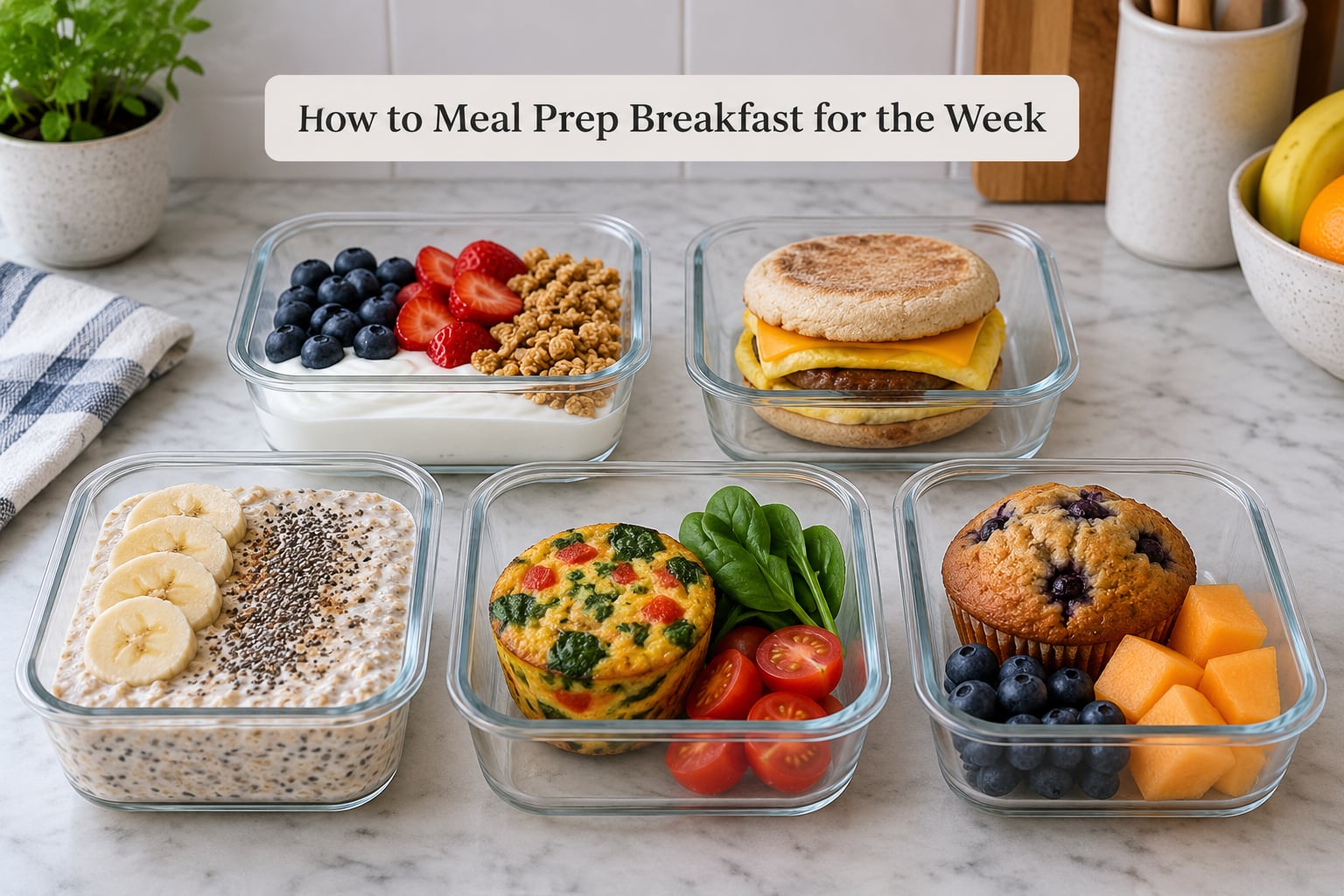
Assemble one breakfast per container, working down the line: one, two, three, four, five. Repeat for the second person. Consistency is the whole trick here, and a five-container assembly line takes about ten minutes.
Decide for each breakfast what belongs together and what rides along separately. A yogurt bowl travels as one container. An egg cup with toast travels with the toast wrapped in foil, not stacked on the egg. A breakfast sandwich gets assembled in layers with a paper square between the egg and the bread.
Label each one with the weekday it is for. Filling Monday through Thursday first and Friday last means you grab the container you actually need without opening the ones you do not.
5. Store the Right Components Together
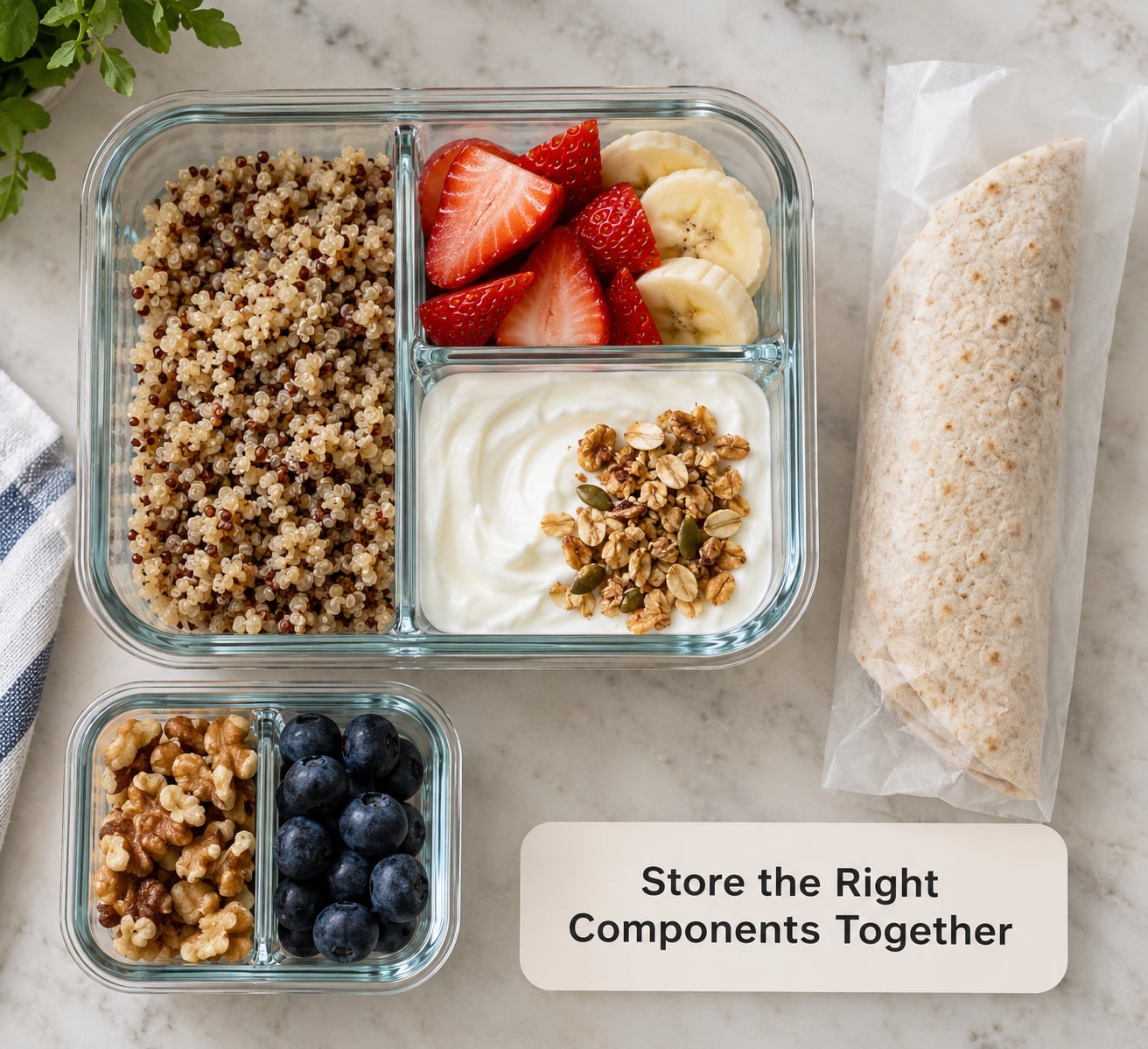
Moisture is the enemy. Yogurt, salsa, and wet fruit release water, and anything bread-based stored against them goes soft within hours. Keep wet ingredients in a small sealed cup with a lid, and keep crunch, lettuce, and tomatoes out of prepped containers entirely.
The same applies to tortillas. Pack them beside the burrito filling, wrapped in foil or tucked in a separate compartment, rather than rolled around wet beans. If you want the details on containers that hold up under a commute, our guide to meal prep containers that don’t leak covers lids, gasket types, and upright bag storage.
6. Refrigerate or Freeze Promptly
Get food into the fridge within two hours of cooking, and no more than one hour if your kitchen is hot. That two-hour rule is the one line of food-safety advice that matters most in prep-day practice.
Refrigerate days one through four and freeze days five and beyond. Egg dishes, frittata, and casseroles keep well covered in the fridge for 3 to 4 days. Egg muffins, breakfast burritos, and cooked sweet potato freeze well for 2 to 3 months. Overnight oats turn watery after day two, so freeze the dry oats and yogurt separately instead.
Thaw in the fridge overnight, never on the counter. Anything that smells off, looks grey, or has been sitting out past two hours goes in the bin without a second opinion.
7. Reheat and Eat the Next Morning
Warm egg dishes and breakfast burritos in the microwave for 30 to 60 seconds, or about 1 to 2 minutes depending on size, until the center reaches 165°F. Wrap a burrito in a damp paper towel first; the steam softens the tortilla instead of leaving it leathery.
Toast bread separately. A 20-second toast brings an English muffin or sandwich bun back to something worth eating, and it costs less attention than fighting a soggy bun.
Some things never need heat at all. Overnight oats, yogurt with fruit, and chia pudding are built to be eaten cold, which is a real win on a morning when you are already late. If you packed a wet cup separately, pour it on at the table in the thirty seconds it takes to unscrew the lid.
Common Mistakes
- Prepping five identical servings. Fix: rotate two or three breakfasts so Wednesday does not feel like a punishment. Freeze the extras you cannot face.
- Packing wet ingredients too early. Fix: yogurt, salsa, and dressings go in separate lidded cups and get added at the table.
- Refrigerating food while it is still hot. Fix: cool on a rack first. Lidding warm food traps steam and speeds up spoilage.
- Freezing in the wrong container. Fix: remove the air from freezer bags, double-wrap, and leave an inch of headspace for expansion. If you cook sandwiches a lot, our breakfast sandwich maker guide explains when a press is worth having and when it is not.
- Labeling by date only. Fix: write the weekday. It removes the daily fridge-staring and stops the oldest container from getting shoved to the back.
Quick Meal-Prep Breakfast Tips
- Cook two versions of the same egg muffin batch when the tin is already out, since the oven is running anyway.
- Make one big batch of baked oatmeal and portion it into cups, which costs the same effort as a smaller batch and covers more mornings.
- Roast one sheet pan of vegetables and split it between a frittata, egg cups, and a breakfast bowl, so one oven load feeds three containers.
- Add variety with sauces and spice, not with more cooking. Different yogurt flavors and a different hot sauce change a repeat breakfast more than a new recipe does.
- Use leftover night-of vegetables rather than throwing them away. A frittata is the easiest place to spend a half-wilted bag of spinach.
- Start with the smallest possible first action: boil twelve eggs and label five containers. That takes 20 minutes and buys you breakfast for three days, which is usually enough to start the habit.
Frequently Asked Questions
How long does meal-prepped breakfast last in the fridge?
Most prepped breakfasts keep 3 to 4 days in the refrigerator, which is why Sunday prep covers Monday through Thursday and the rest gets frozen. Cooked egg dishes, frittata, and casseroles sit at that window. Hard-boiled eggs still in their shell last up to a week. Cooked grains and rice should also be eaten within 3 to 4 days, and anything left at room temperature past two hours is discarded.
Can I freeze breakfast sandwiches, oats, or egg muffins?
Egg muffins, breakfast burritos, and most sandwich varieties freeze well for 2 to 3 months if wrapped tightly and frozen flat. Freeze bread-based sandwiches rather than tortilla-based ones when you can, since tortillas soften more noticeably on thawing. Overnight oats do not freeze well once mixed, because they turn watery and gluey. Freeze the oats, yogurt, and toppings in separate bags and stir them together the night before.
What breakfasts hold up best after being refrigerated?
Egg cups, frittata, and savory oatmeal hold up best, because reheating actually improves them and they keep a firm texture for 3 to 4 days. Muffins and baked oatmeal stay good for the same window but dry out slightly, so a damp paper towel helps. Yogurt bowls, chia pudding, and overnight oats are stable but soften and go watery after day two, so pack the fruit and toppings separately.
How do I keep meal-prepped bread from getting soggy?
Keep bread away from moisture. Store sandwiches and English muffins in a paper bag or foil inside the container rather than pressed against wet ingredients, and never seal a warm sandwich. Yogurt, salsa, and fresh tomatoes belong in separate cups until the morning you eat them. Wrapping the sandwich in foil before refrigerating slows the transfer of moisture from the egg, which is the main cause of a mushy bun by Tuesday.
Is it safe to meal prep eggs and cooked meat for the week?
It is, as long as you cook, cool, and store eggs and meat properly. Egg dishes need to reach 160°F while cooking, and reheated egg dishes should hit 165°F. Cool everything on a rack, then refrigerate within two hours. Store cooked meat and eggs in sealed containers on the bottom shelf of the fridge, below anything raw, and eat prepped meat within 3 to 4 days or freeze it. Freeze egg-based dishes and cooked meat instead of pushing them to day five in the fridge.
Conclusion
Start with twelve boiled eggs and five labeled containers. Twenty minutes tonight gives you three breakfasts, and once the system is in place the rest of the week is just a Sunday batch session on autopilot.
Before next week’s session, reset with three questions: Which breakfast did I actually finish? Which one went back in the fridge untouched? What ingredient ran out fastest? Then rebuild the five-breakfast week around those answers, keep the wet ingredients in separate cups, and refrigerate the first four days while the rest goes to the freezer.