
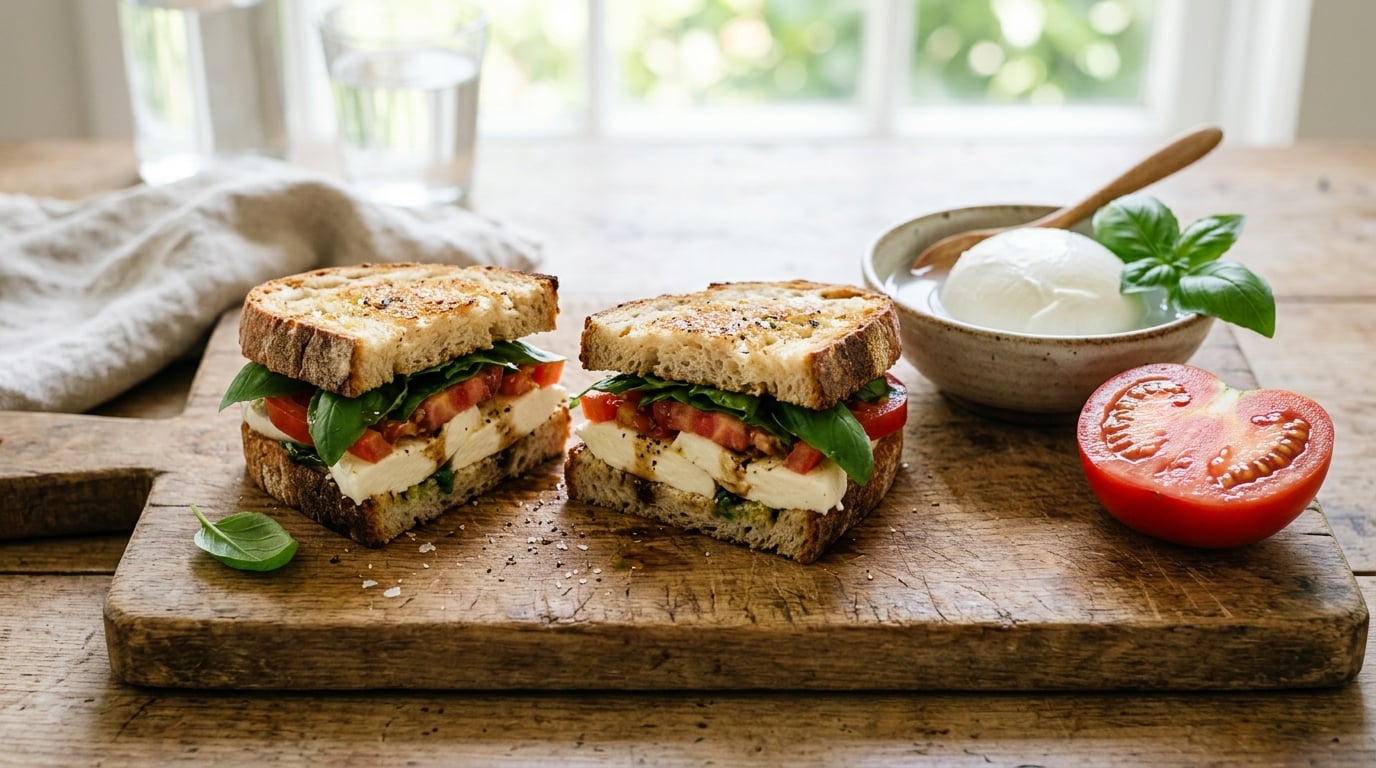
A soggy Caprese is almost always a moisture problem, not a recipe problem. The best fresh mozzarella for caprese sandwiches that don’t get watery is the firm, semi-dry kind: it slices cleanly, holds its edge under a tomato, and gives up very little liquid after draining. Soft buffalo-milk balls taste wonderful, but they need more prep and a sturdier roll.
I’ve made a lot of these sandwiches, and the failure mode is consistent. You drain the ball, pat it, slice it, layer it on focaccia, and within ten minutes there’s a dark wet ring spreading through the bread. That ring is whey and tomato juice pooling on a surface that was never dry to begin with.
So this is a guide to the ten fresh mozzarella formats worth using, judged on one thing: how they behave between the brine jar and your mouth. It also covers the draining, patting and layering order that matters more than any brand name. I buy the cheese a day or two ahead rather than the morning of, which sounds backwards but keeps it inside its best window instead of past it.
Table of Contents
- Best Fresh Mozzarella for Caprese Sandwiches That Don’t Get Watery at a Glance
- 1. Low-Moisture Fresh Mozzarella for the Driest Caprese Sandwich
- 2. Fresh Mozzarella Di Bufala for a Creamy, Tangy Caprese
- 3. Fior di Latte Fresh Mozzarella for a Mild, Milky Flavor
- 4. Ciliegino Fresh Mozzarella for Small, Firm Sandwich Bites
- 5. Stracciatella Fresh Mozzarella for a Creamy Center
- 6. Firm Fresh Mozzarella Logs for Neat, Sandwichable Slices
- 7. Semi-Dry Fresh Mozzarella for the Best Balance
- 8. Smoked Fresh Mozzarella for a More Assertive Sandwich
- 9. Herbed or Flavored Fresh Mozzarella for Variety
- 10. Fresh Mozzarella for Grilling or Toasting
- How to Keep Fresh Mozzarella from Making Caprese Sandwiches Watery
- Frequently Asked Questions
- Conclusion
Best Fresh Mozzarella for Caprese Sandwiches That Don’t Get Watery at a Glance
Every format below holds a different amount of water after draining, and that number decides how fast the bread gives up. Texture matters just as much: a springy slice stays put under a tomato, a loose curd spreads out and squeezes liquid sideways.
| Format | Texture | Moisture after draining | Flavor | Best sandwich use |
|---|---|---|---|---|
| Low-moisture fresh | Firm, sliceable | Very low | Mild, clean | Driest possible Caprese |
| Di bufala | Soft, creamy, springy | Low to moderate | Rich, tangy | Creamy tang on sturdy bread |
| Fior di latte | Soft, milky, tender | Moderate | Light, sweet, milky | Letting tomato and basil lead |
| Ciliegino | Firm, small, dense | Low | Clean and buttery | Two-bite sandwich portions |
| Stracciatella | Loose curds in cream | High | Light, creamy | Small amount, on a plate |
| Firm fresh log | Dense, even | Low | Clean, milky | Neat, uniform layers |
| Semi-dry fresh | Firm but tender | Low | Fresh and rounded | Best all-round compromise |
| Smoked fresh | Firm, slightly oily | Low after extra drying | Smoky, savory | When you want a bolder sandwich |
| Herbed or flavored | Usually soft | Moderate to high | Seasoned, herbed | When basil and garlic are the point |
| Grilling or toasting | Firmest available | Very low | Toasty, mild | Panini and hot Caprese toast |
Read the moisture column as a relative ranking, not a lab measurement. Anything labeled low will still weep a little if you slice it hours ahead and leave it uncovered.
1. Low-Moisture Fresh Mozzarella for the Driest Caprese Sandwich
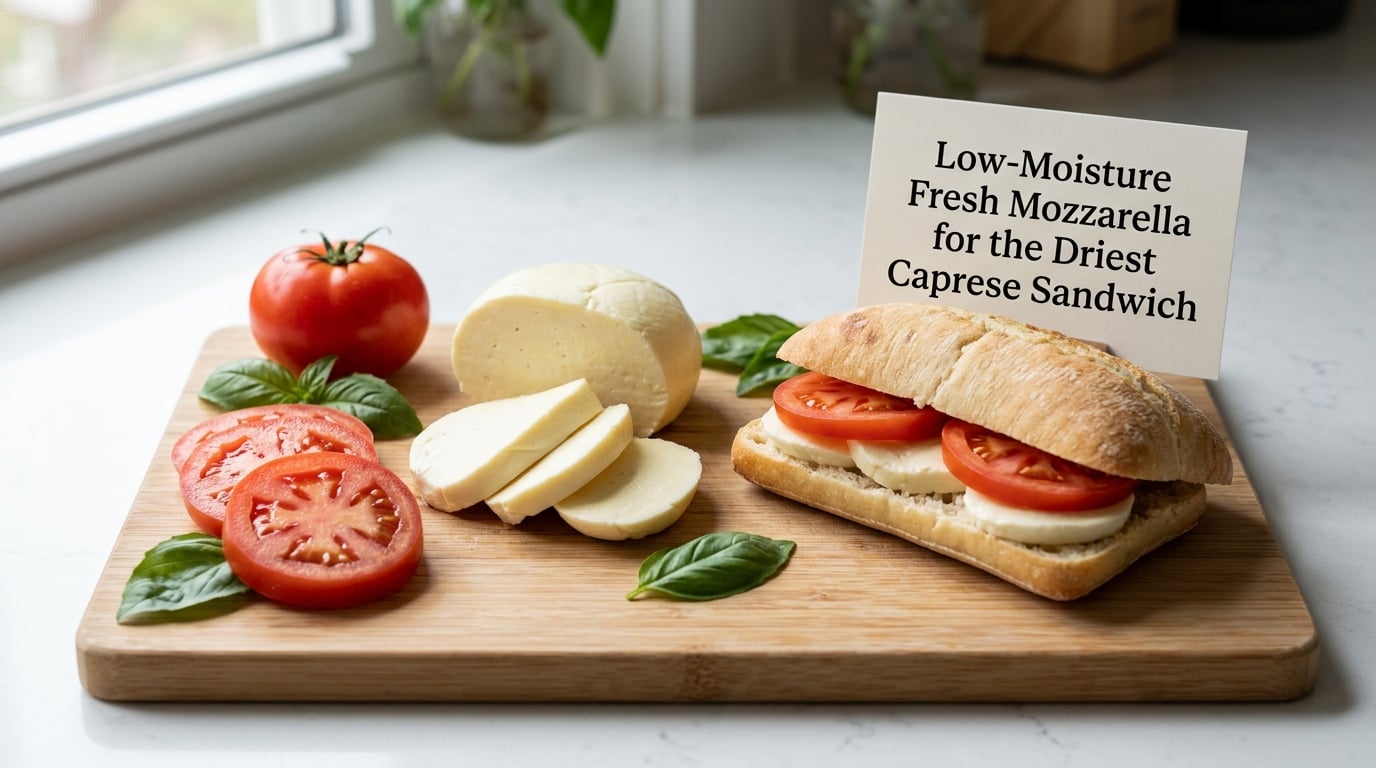
Low-moisture fresh mozzarella is the safest starting point when the sandwich must not release water. It is still a fresh-style cheese with a clean milk flavor, but it is made and handled so it holds a clean edge when you cut it.
The practical advantage is sliceability. A soft fior di latte ball tears and smears when you press a knife through it, which creates uneven surfaces that trap juice. A firmer low-moisture piece gives you flat slices with clean sides, so the tomato sits on cheese rather than in a puddle of it.
Give it 20 to 30 minutes draining on a towel, then pat both faces dry. Flavor is mild enough that tomato and basil still read clearly, and it holds up on almost any bread, including a sturdy ciabatta or a thick sourdough slice.
One caveat: this is the least interesting option on flavor. If you want the sandwich to taste like Italian cheese rather than like a tomato sandwich with a firm white layer, the semidry or buffalo options below are worth the extra draining.
2. Fresh Mozzarella Di Bufala for a Creamy, Tangy Caprese
Mozzarella di bufala is made from buffalo milk, and that milk carries more fat and a distinct tang. The result is a richer, creamier cheese with a flavor that holds its own next to basil and a heavy drizzle of oil.
It is a good choice for a Caprese if you drain it properly and use bread with some backbone. Buffalo-milk cheese is softer and looser than cow’s-milk fresh mozzarella, so it wants a longer, gentler drain and a sharp knife rather than a blunt one. A thin slice that tears into ragged edges is the first step toward a wet sandwich.
Cooks on cooking forums almost consistently rate buffalo mozzarella above cow’s-milk fresh mozzarella for caprese, pointing to the richer, creamier result. The tradeoff they mention is the same one you will find: it is more expensive and harder to source outside a specialty Italian grocer.
For texture, sturdy bread is non-negotiable. Focaccia, ciabatta, a baguette split lengthwise or a thick slice of sourdough all work. A soft, thick sandwich roll will compress under the weight of a wet cheese slice within a few minutes.
3. Fior di Latte Fresh Mozzarella for a Mild, Milky Flavor
Fior di latte is the cow’s-milk version, and it is the gentlest of the fresh formats. The flavor is light and milky with a faint sweetness, which means the tomato and the basil stay in charge of the sandwich.
That mildness is the point for a lot of home cooks. If buffalo mozzarella reads as too tangy or too wet for your taste, fior di latte gives you a fresh, tender bite without pushing the flavor around. It is also the most widely available of the fresh formats, so it is the easiest one to find and to buy a couple of days ahead.
Moisture behavior is moderate rather than extreme. It weeps more than low-moisture and less than stracciatella, which makes it a reasonable middle ground. Drain it 20 minutes, pat it well, and slice it just before you build.
Because the texture is tender, slice against the grain if you can feel it, and let the knife do the work instead of pressing down. A sawing motion preserves the shape; a straight push compresses it.
4. Ciliegino Fresh Mozzarella for Small, Firm Sandwich Bites
Ciliegino is the small-format fresh mozzarella, roughly the size of a cherry or a large grape. The size is the whole appeal for sandwich work: no cutting, no guessing at slice thickness, and an even portion on every sandwich you build.
These smaller pieces also tend to be denser, partly because there is less interior to hold loose liquid. That makes them a good pick if you want fresh-mozzarella flavor without the structural problem of a big soft ball.
The risk is brine leakage rather than internal weeping. A small ball has a high surface-area-to-volume ratio, so liquid escapes quickly once you cut or bite into it. Drain them in a single layer, not piled in a colander, and pat each one individually before it goes on the bread.
Ciliegino works well for a two-bite caprese, a cocktail bite, or a packed lunch where you want the sandwich to still be intact an hour after you made it.
5. Stracciatella Fresh Mozzarella for a Creamy Center
Stracciatella is the softest option on this list: loose curds suspended in a pool of cream. It is genuinely delicious, and it is the reason a classic caprese salad plate is so good.
It is also the hardest to put in a sandwich without creating a soggy one. That cream is not going anywhere, and it migrates straight into the crumb. Even after draining, stracciatella holds more releasable liquid than any other fresh format here, so a generous layer will dampen bread quickly.
If you want it in a sandwich, use a spoonful rather than slices, and put it against something with fat and structure, like a thick toast or a grilled slice. Think of it as a filling accent rather than the main layer.
For a plated caprese salad, which is where it belongs, drain 10 minutes and pour off the cream before serving. Add the tomatoes and basil right before the plate goes to the table.
6. Firm Fresh Mozzarella Logs for Neat, Sandwichable Slices
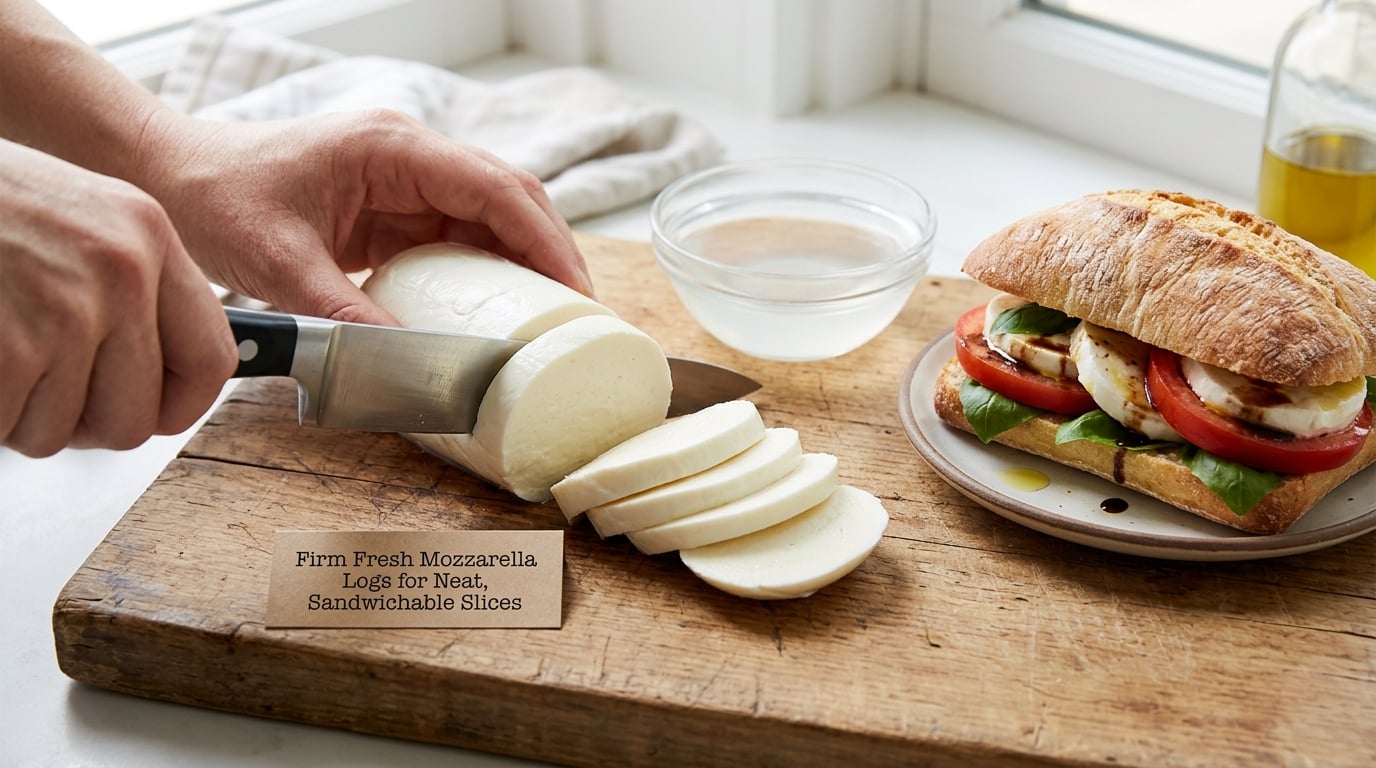
A fresh mozzarella log gives you the most control of any format. Because it comes as a cylinder, you can cut even slices of a consistent thickness, and even thickness is what keeps a sandwich from collapsing in one spot and staying dry in another.
Remove the log from its brine and let it sit on a folded paper towel for 15 minutes, rolling it once or twice. Then pat the whole surface dry. A log that has lost its surface liquid will keep a clean cut face instead of pushing whey out onto the board and then onto your bread.
If the cheese feels very soft straight from the tub, chill it for 20 to 30 minutes before cutting. Cold fresh mozzarella slices cleanly. Room-temperature fresh mozzarella compresses, and a compressed slice is a slice that squeezes its own liquid sideways under the tomato weight.
One more timing note: do not slice hours in advance and leave the slices uncovered. They start losing moisture the moment the cut face is exposed. Slice once, right before assembly.
7. Semi-Dry Fresh Mozzarella for the Best Balance
Semi-dry, or partially drained, fresh mozzarella sits between the wet tub cheese and a firm block. It still tastes fresh and milky, but it has been drained or pressed long enough to hold a slice together under load.
This is usually the best compromise for a sandwich. You get fresh flavor, which low-moisture block mozzarella does not really deliver in a cold sandwich, and you get structure, which the wetter fresh formats do not deliver. If you only buy one thing for Caprese sandwiches, this is the format I would pick.
It is worth being clear about how it differs from packaged low-moisture block mozzarella. Block mozzarella is stretched, salted and pressed into a dense brick, designed for melting on pizza. It is excellent for that and wrong for a cold Caprese, where you want the milky, unbaked character of fresh cheese.
Refrigerate it until shortly before you build, and use it within a couple of days of opening. Semi-dry fresh cheese has a shorter window than block and cannot be frozen with any good result.
8. Smoked Fresh Mozzarella for a More Assertive Sandwich
Smoked fresh mozzarella is worth trying when you want the sandwich to taste savory and layered rather than clean and fresh. The smoke is usually gentle enough that tomato and basil still register, but it gives the bread something to sit next to.
It should not be treated as plain fresh mozzarella. Smoked versions often carry a slightly oily surface from the smoking process, and that oil plus the cheese’s own moisture is a double contribution to a damp sandwich.
Drain it slightly longer than you would a plain fresh ball, about 25 to 30 minutes, and blot the surface rather than just letting it sit. That extra drying step matters more here than with any other format.
Flavor-wise, it pairs well with a heavier bread. A toasted rye or a sturdy focaccia gives the smoke somewhere to land, and a small amount of cured meat on top is a natural fit.
9. Herbed or Flavored Fresh Mozzarella for Variety
Herbed, basil, garlic and olive-oil flavored fresh mozzarella solves a real problem: getting flavor into a sandwich without a long ingredient list. If you want the basil and garlic to taste even after it sits, this is the shortcut.
The catch is that seasoned fresh mozzarella is usually softer and comes with added oil, which is exactly the combination that makes a sandwich drip. Read the ingredient list. If oil is listed early, or if you see added water, stabilizers or gums, expect more moisture and more grease in the sandwich.
It works best in smaller amounts on bread with a crumb, where the oil soaks in rather than pooling. Skip it on a flat, thin slice of bread, where the oil has nowhere to go.
As an alternative, plain fresh mozzarella with a layer of pesto spread on the bread gives you the same herby character while letting you control the oil. You spread what you need, not what the package gives you.
10. Fresh Mozzarella for Grilling or Toasting
A hot Caprese is a panini or a grilled sandwich, and heat changes the rules. Fresh mozzarella that is too soft collapses and releases water as it warms, so for a toasted or grilled version you want the driest, firmest fresh cheese you can find.
Low-moisture fresh or a firm log is the right choice here. Drain it thoroughly, pat it dry, and slice it even. If you are using a ball, firm it in the refrigerator first so it holds its shape long enough to cook.
Toast or grill the bread on its own first, then build and close the sandwich. That way the bread gets its crust without spending that heat on the cheese, and the cheese gets just enough heat to soften without turning to liquid.
Keep the heat moderate and the time short. A Caprese sandwich that needs five minutes per side is past the point where the cheese is still a cheese.
How to Keep Fresh Mozzarella from Making Caprese Sandwiches Watery
Cheese choice matters, but technique does more. These are the steps that turned my soggy sandwiches into good ones, in the order they matter.
- Drain it properly. Set the cheese on a folded paper towel or a mesh strainer over a plate, in a single layer rather than piled up, for 20 to 30 minutes. Pour off the collected liquid. Longer is better for buffalo and stracciatella.
- Pat, never squeeze. Blot both faces of the cheese with a dry paper towel. Squeezing pushes liquid out of the curd and leaves it with a broken, grainy texture that traps more juice later.
- Firm it if it feels soft. A soft ball that squishes under your finger will not hold a slice. Twenty to 30 minutes in the refrigerator gives you a clean cut face.
- Slice just before you assemble. The cut face starts losing moisture immediately. Do not slice in the morning for an evening sandwich.
- Toast the bread first. A few minutes in a hot pan or toaster gives the crumb a barrier that slows moisture moving in. Brushing the cut face with olive oil before toasting helps more.
- Build a barrier layer. Spread pesto, mayo, or a thin coat of olive oil on the cut bread face before the cheese goes down. This is the single most effective trick for a packed lunch.
- Salt the tomatoes separately. Salt draws liquid out of tomato slices. Do it in a colander over the sink for 10 minutes, then blot, then layer. Skip the salting and your bread has two wet ingredients on it instead of one.
- Add wet ingredients at the last second. Basil in a paper towel, oil drizzled on the plate rather than pooled in the sandwich, and assemble right before you eat.
Two more things worth knowing. Refrigerating an assembled Caprese makes it worse, not better: the cold slows nothing that matters and encourages the tomato and cheese moisture to sit in the bread. And fresh mozzarella has a short peak window. Buy it a day or two ahead rather than the day of, use it within a couple of days of opening, and store the unused portion submerged in its own liquid in the refrigerator.
A simple moisture test before you commit: press the cut face firmly with your thumb. If liquid beads up and runs off, it needs more drying. If it is tacky but no liquid appears, you are fine to layer it. Some brands are sold packed in whey and others in water, and the whey-packed ones generally hold their texture longer, so check what the label says.
Cooking forum regulars point to patting the cheese, toasting the bread and adding a condiment barrier as the fixes that actually worked for them. All three are on the list above, and none of them require a different recipe.
Frequently Asked Questions
What type of mozzarella is best for caprese?
Fresh mozzarella is the right type, and semi-dry or firm fresh is best for a sandwich. It keeps its slice shape under a tomato while tasting milky and fresh, which block low-moisture mozzarella does not in a cold sandwich. Choose di bufala if you want richer, tangier flavor and can find it, and fior di latte if you prefer something milder.
Why is my caprese sandwich soggy?
Almost always one of three things: the cheese was not fully drained, the tomato was salted and released its own liquid, or the bread had no barrier. Fresh mozzarella sits in liquid by design, so a ball that goes straight from the tub to the bread brings that liquid with it. Drain 20 to 30 minutes, pat dry, salt tomatoes in a colander, and toast the bread first.
How to make fresh mozzarella less wet?
Set it on a folded paper towel in a single layer for 20 to 30 minutes and pour off what collects. Then blot both cut faces with a dry towel rather than squeezing, which damages the curd texture. If it is still soft, chill it for another 20 to 30 minutes. Slice only when you are ready to build the sandwich, since the cut face starts losing moisture right away.
Is it normal for fresh mozzarella to be wet?
Yes. Fresh mozzarella is sold submerged in whey or water to keep it from drying out and hardening, so wetness is expected in the package. What matters is how much liquid it holds after draining. A well-drained piece should feel tacky and hold a clean edge when sliced, with no liquid running off the cut face. A heavy pool in the tub usually means an older pack.
Does fresh mozzarella in liquid need to be rinsed before use?
No, and most cooks do not. Rinsing washes away the whey or brine that helps the cheese keep its texture, and it will absorb water while you drain it. Just drain it, pour off the liquid, and pat the surface dry. If the cheese smells strongly sour or the liquid is pink, cloudy or slimy, skip it rather than trying to rinse it clean.
How do I tell if fresh mozzarella has gone bad?
Look at the cheese and the liquid together. Good fresh mozzarella is opaque ivory-white with a tight, unbroken surface. A yellowish slime skin, a broken or cracked exterior, or liquid that has turned cloudy or pink all mean it has gone past its window. It should smell milky and clean, never sour or ammonia-sharp. When in doubt, the texture is the giveaway: it should spring back, not collapse.
Conclusion
Start with a firm, semi-dry fresh mozzarella, drain it for 20 to 30 minutes on a towel, pat it dry, and slice it at the last moment. Add the tomato only after it has been salted and blotted in a colander, toast the bread first, and put something like pesto or olive oil between the bread and the cheese. That sequence fixes most soggy sandwiches on its own, before brand choice ever enters into it.
When you want more flavor, move up to di bufala for a creamy, tangy result and expect to give it more draining time and a sturdier roll. Fior di latte is the gentler pick when the tomato and basil should lead. And keep stracciatella on the plate rather than in the bread, where its cream has nowhere to go but into the crumb.
Whichever format you pick, buy it a day or two ahead, keep it submerged in its own liquid in the refrigerator, and check the cut face for beads of liquid before it goes down. That check takes two seconds and it is the difference between a sandwich and a puddle.