
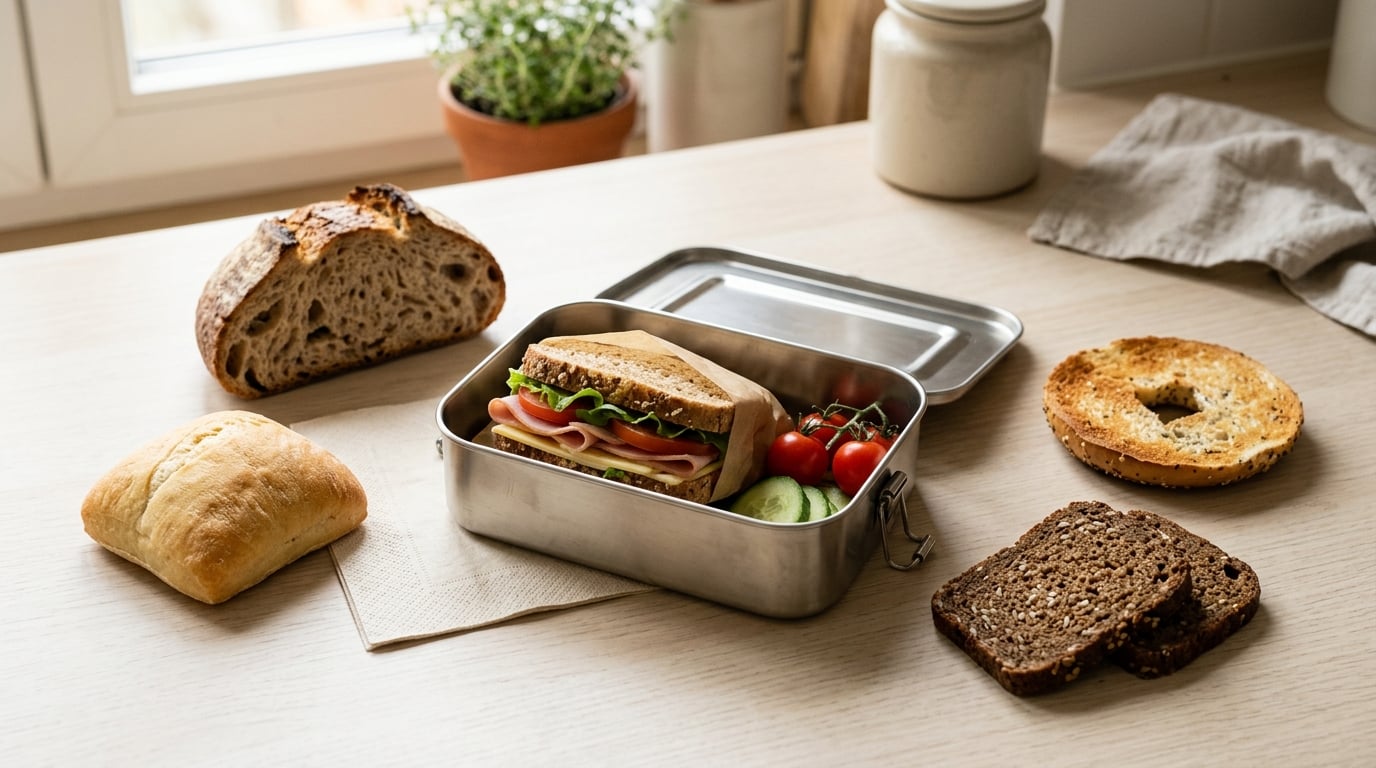
The best bread for packed lunches that won’t get soggy is dense, crusty, chewy bread like sourdough, ciabatta, whole wheat, rye, and pumpernickel, because its tight crumb absorbs far less water than soft white sandwich bread. One sentence explains the whole thing: moisture migrates from wet fillings and condensation into bread starch, and soft white bread drinks it up, while a firm crumb with a crust resists it for hours.
That matters more than most people expect. A sandwich that looked good at 7am is often compressed, cracking, and dull by noon, and the fix is usually the bread rather than the filling. What follows is a rundown of twelve breads that hold up between assembly and lunchtime, sorted by density, flavor, and how easily each one fits a lunchbox.
Table of Contents
- Best Bread for Packed Lunches That Won’t Get Soggy at a Glance
- 1. Sourdough Bread for Sturdy Sandwiches
- 2. Ciabatta Rolls for Lunchbox-Friendly Portions
- 3. Whole Wheat Bread for Hearty Daily Packed Lunches
- 4. Rye Bread for Moisture-Resistant Sandwiches
- 5. Pumpernickel Bread for Dense, Filling Portions
- 6. Toasted Bagels for Extra-Sturdy Bases
- 7. English Muffins for Compact Sandwiches
- 8. Pita Bread for Wraps and Pocket Sandwiches
- 9. Lavash Bread for Rolled Lunch Wraps
- 10. Thin French Baguette for Bring-Your-Own Sandwiches
- 11. Focaccia for Savory, Pressed Lunches
- 12. Small Naan Flats for Mini Sandwiches
- Frequently Asked Questions
- How can I keep any sandwich bread from getting soggy by lunchtime?
- What ingredients should I avoid putting directly on packed sandwich bread?
- Should sandwich bread be refrigerated, frozen, or kept at room temperature?
- Is it safe to pack a sandwich with lettuce, tomato, or other fresh vegetables?
- Can I use a toaster or microwave to revive bread before lunch?
- What is the best bread choice for a child’s lunchbox?
- Conclusion
Best Bread for Packed Lunches That Won’t Get Soggy at a Glance
Sogginess resistance here means how well the crumb stands up to moisture over a four-to-six-hour window, not how the bread tastes fresh on day one. Rows are ordered from most to least resistant.
| Bread | Best use | Expected sogginess | Filling compatibility | Packing format | Standout benefit |
|---|---|---|---|---|---|
| Sourdough | Everyday packed sandwiches | Very low | Dry to moderately wet | Thick slices | Sturdy crust plus a tang that stands up to strong fillings |
| Ciabatta rolls | Kids’ lunchboxes and small portions | Very low | Dry to moderately wet | Split roll | Built-in portion control and a crackly shell |
| Whole wheat | Daily packed lunches, high-fiber eaters | Low | Dry to moderately wet | Thick slices or small rolls | Fiber slows moisture absorption and adds staying power |
| Rye | Cold meat and cheese sandwiches | Low | Best with dry fillings | Slices or light rye rolls | Compact crumb and assertive flavor that needs no heavy spread |
| Pumpernickel | Small, filling portions | Very low | Best with dry fillings | Thin slices, cut small | Dense and low-moisture, so portions go a long way |
| Toasted bagels | Hearty sandwiches that need to survive transit | Very low | Wide range | Halves, toasted | Toasting seals the surface before any filling goes on |
| English muffins | Compact cold sandwiches | Low | Dry to moderately wet | Split horizontally | Nooks trap filling and keep a thinner sandwich from sliding apart |
| Pita bread | Pocket and folded sandwiches | Low when sturdy, high when soft | Moderately wet | Pocket or halved | Pocket keeps wet filling away from the outer bread |
| Lavash | Rolled wrap-style sandwiches | Low | Moderately wet | Rolled tightly | Thin but strong, so a full wrap will not tear |
| French baguette | Bring-your-own round sandwiches | Low | Best with dry fillings | Thin rounds, cut on the bias | Crisp crust and an airy crumb that stays crunchy |
| Focaccia | Pressed or panini-style lunches | Low | Moderately wet | Pressed, cut into fingers | Airy but oiled, so a light press keeps it from flattening |
| Small naan | Mini sandwiches and snack plates | Moderate | Dry to moderately wet | Trimmed or split | Mild flavor that takes on strong fillings without fighting them |
1. Sourdough Bread for Sturdy Sandwiches
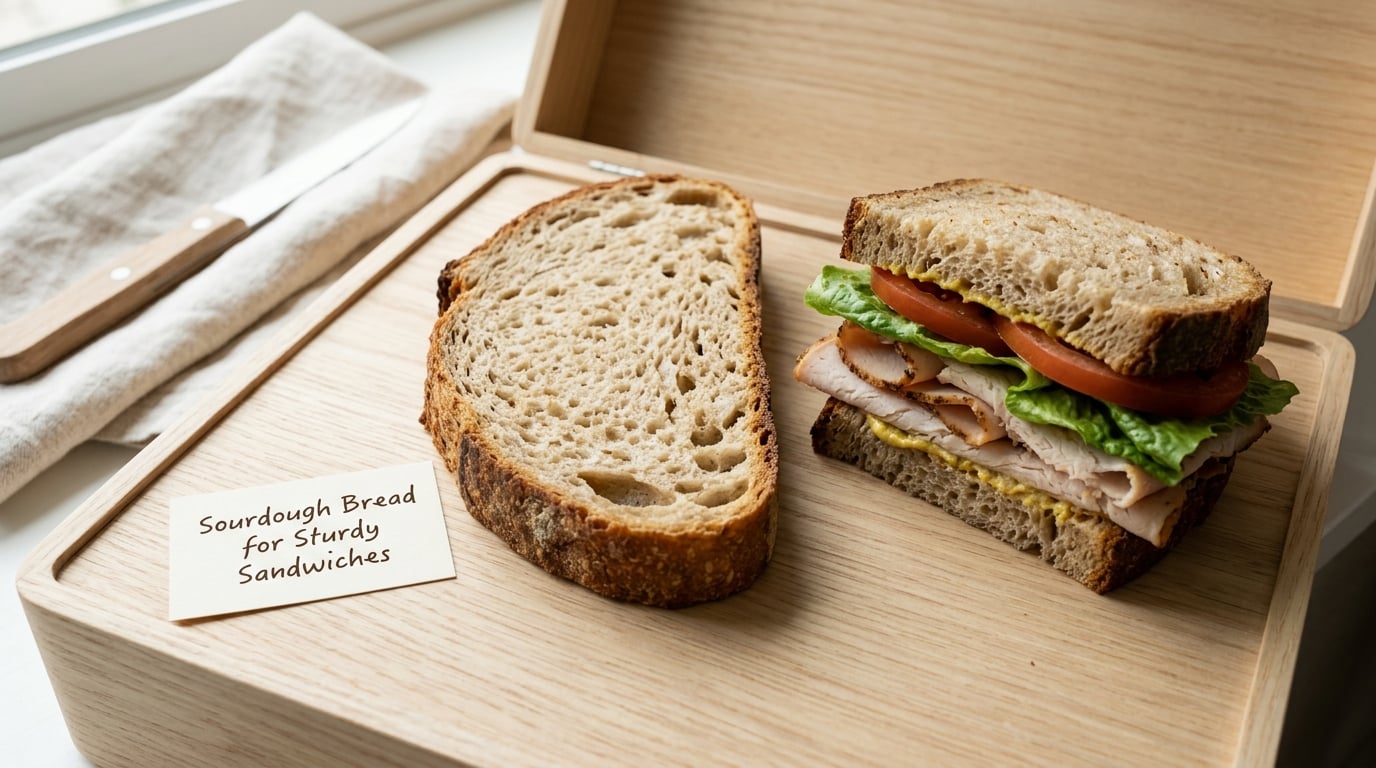
Sourdough is the best bread for packed lunches because the crust carries the load and the crumb underneath stays chewy rather than soft for the whole morning. Its open structure means there is less fine, starch-heavy crumb available to soak up juice from a filling.
Choose a dense country-style loaf over a light one. A loaf that feels heavy for its size and springs back when you press the crust will survive a backpack; a light bakery sourdough squashes into the filling by 11am.
Two habits make it work. Put a full layer of butter, mustard, or mayo directly on the bread before anything wet touches it, and keep tomato and cucumber in the middle of the sandwich rather than against the slices. A thick cut, toasted for two minutes, adds more protection still.
The honest trade-off is chew. Sourdough is a grown-up sandwich bread, and texture-sensitive eaters often find it too dense, so it is worth keeping a softer option in the rotation for kids.
2. Ciabatta Rolls for Lunchbox-Friendly Portions
Ciabatta rolls solve two problems at once: the dough is sturdy enough to resist moisture, and the size is already portioned for a lunchbox. That makes them a favorite for school lunches, where a full sandwich gets eaten in three bites and then abandoned.
Watch the center. A classic ciabatta has a hollow middle, so a thin filling leaves an empty pocket that collapses, and any liquid runs straight to the bottom. Fill the hollow with a slice of cheese, a folded piece of deli meat, or a bed of shredded lettuce before the wet ingredients go in.
Small rolls also survive a bag better than large loaves, since there is less leverage for the sandwich press. Split the top, fill the bottom, and put the lid on at an angle so condensation runs down the roll rather than into the crumb.
3. Whole Wheat Bread for Hearty Daily Packed Lunches
Whole wheat resists sogginess mainly because of what it is missing: refined white flour and its fine, easily hydrated starch. The bran and germ left in the loaf give it a tighter, more fibrous crumb that takes on liquid slowly.
Density is the part people miss. Two whole wheat loaves can feel equally soft in the bag and behave completely differently by noon, so press the slice with your thumb. If it compresses easily and stays compressed, skip it and find one with more body.
Fresh-baked whole wheat carries more moisture than the packaged version, so let a newly opened loaf sit uncovered for a few hours, or toast it, before it goes anywhere near a sandwich. For fillings, favor roasted vegetables, sliced chicken, cheddar, and pickles over heavy tomato or cucumber.
4. Rye Bread for Moisture-Resistant Sandwiches
Rye has a compact, tight crumb with very little open space for water to occupy, and that is why a rye sandwich usually survives the morning better than a white one. It also has enough flavor that it needs less spread to taste complete, and less spread means less moisture in contact with the crumb.
The catch is that rye is assertive. It works beautifully with corned beef, pastrami, smoked salmon, cream cheese, and sharp mustard, and it fights anything sweet or delicate. A light rye is milder and softer; a dark rye such as pumpernickel is denser still and needs heavier toppings to balance.
If you are using a lighter rye, treat it like white bread and build in a barrier. A thin layer of butter or cream cheese, with tomato and cucumber kept off the outer slices, keeps the crumb from turning to paste in a warm lunchbox.
5. Pumpernickel Bread for Dense, Filling Portions
Pumpernickel is the most moisture-resistant bread on this list, and it is also the least forgiving of large sandwiches. Baked slowly at low heat from a dense rye dough, it is low in free moisture and takes a long time to soften at all.
That density makes it a strong choice for portion control. A single slice carries a surprising amount of filling, which is useful for a child who eats slowly or for anyone trying to keep a week of lunches from getting expensive in calories.
Cut it thinner than feels reasonable and keep the topping list short: cream cheese and smoked salmon, or butter and ham, or a thick slice of Swiss with mustard. It also has the longest keeping window of any bread here, so a pumpernickel sandwich left overnight is the least likely to be a problem in the morning.
6. Toasted Bagels for Extra-Sturdy Bases
A lightly toasted bagel is the toughest sandwich base available, and toast is what makes the difference. Drying the surface slows water movement into the crumb and gives the cut face enough rigidity to stay flat in a bag.
Go light, though. A bagel toasted until it is dark and rigid turns into something hard to bite through and hard to cut, especially for kids. Two or three minutes in a toaster or about four minutes in a low oven is plenty.
Plain or everything bagels both work, and everything adds a bit of crunch along the crust ring. Good traveling fillings are cream cheese with smoked salmon, peanut butter with banana, or egg salad, which is a little forgiving because the mayo binds the filling together.
7. English Muffins for Compact Sandwiches
English muffins pack well because of their shape rather than their density. The nooks and crannies on the cut face hold filling in place, so a thin sandwich stays assembled instead of sliding out from under the top when you pick it up.
They are also thin, which matters in a lunchbox. A sandwich built on a whole-grain English muffin is roughly a centimeter thinner than the same sandwich on country bread, and that difference decides whether it gets eaten or survives to come home.
Do split them horizontally and fork the inside before filling. The main weakness is that an English muffin is only lightly sweet and fairly soft, so it needs a barrier spread like butter, mayo, or cream cheese, particularly for tomato-based fillings.
8. Pita Bread for Wraps and Pocket Sandwiches
Pita is a strong choice only when you buy the sturdy version, and the difference between a good pita and a soft one is the whole story. Soft pita folds into a damp flat and fails by mid-morning; sturdy pita keeps its shape and its pocket.
The pocket is the useful part. A standard pocket is a separate sealed chamber, so wet filling sits inside it rather than migrating into bread, which is why chicken salad or chopped cucumber in a pocket pita travels better than either one on a slice.
Check the label for a higher protein flour and a short ingredient list, and pass over anything labeled soft or snappy. If you only have soft pita, toast it briefly first, fold rather than roll, and keep the wet ingredients minimal. The large pocket-style pitas sold for wraps are a different cut and usually too thin to hold moisture back.
9. Lavash Bread for Rolled Lunch Wraps
Lavash is a thin, strong flatbread used for rolled wraps in every Middle Eastern bakery, and it is a genuinely excellent choice for a packed lunch. It is thin enough to roll tightly but dense enough that a full wrap will not split at the seam.
The thinness is a limitation as much as an advantage. A single lavash takes a modest amount of filling, so plan on two per person, and cut the wrap on the bias before rolling so it stays flat instead of tapering to a point.
For filling ratios, aim for roughly two-thirds spreadable filling to one-third solid. That sounds backwards from a burger, but the spreadable layer is what binds the wrap and keeps the solid pieces from puncturing it. Rest the completed roll seam-side down in the container and press it gently to help it hold its shape.
10. Thin French Baguette for Bring-Your-Own Sandwiches
A French baguette sliced very thin on the bias makes an excellent bring-your-own sandwich, and the reason is the contrast between a crisp crust and an airy crumb. There is very little crumb per square centimeter, so little to absorb, and the crust stays audibly crunchy for hours.
Thin is the operative word. Cut rounds no more than a couple of centimeters thick, use the bias cut so the sandwich is easy to grip, and be disciplined about the filling. A thick-cut baguette sandwich is mostly bread by lunchtime and gets crumbs everywhere in the bag.
Keep wet ingredients out. A baguette is not the right choice for a tomato-and-cucumber sandwich packed for four hours. It is at its best with roast chicken, cheese, butter, ham, or a nutty spread, all of which also add the fat that slows moisture transfer.
11. Focaccia for Savory, Pressed Lunches
Focaccia works when you treat it as a pressed sandwich base rather than a soft one. The dough is airy and forgiving, and a quick press before packing gives you a flatter, denser sandwich that resists both squashing and moisture.
Pick a sturdy portion. A thick, dimpled, olive-oil-heavy focaccia holds up; a soft, thin, wet version from a bakery bag turns into a sponge. Thicker is also easier to cut cleanly into fingers that a child will actually want to pick up.
The oil on the surface is helpful and the dimples are a trap. Olive oil slows absorption at the crust, but a puddle of dressing or a very wet topping settles into the dimples and soaks straight to the center. Keep wet toppings in a thin layer, and skip a wet tomato on a freshly baked focaccia entirely.
12. Small Naan Flats for Mini Sandwiches
Small naan makes a flexible mini sandwich base, and its main advantage is a mild, slightly buttery flavor that absorbs strong fillings without competing with them. For a snack plate or a bento-style lunchbox, two small halves are often just right.
Naan is moderately soft, so trim or split it before filling. Cut off the rounded top, split the flat through the middle, and press it with a rolling pin to flatten the center. That extra step is the difference between a flat sandwich and one that folds over itself in the container.
Naan carries a light oil and char flavor that works with hummus, falafel, grilled chicken, or a fried egg, and it also toasts quickly if you want a drier surface. It is the least moisture-resistant bread here, so give it the same barrier treatment you would give white bread and use it on the same day.
Frequently Asked Questions
How can I keep any sandwich bread from getting soggy by lunchtime?
Put a full layer of fat on the cut bread first. Butter, mayo, mustard, cream cheese, or avocado all slow the movement of water from wet filling into starch. Keep wet ingredients in the middle of the sandwich rather than against the slices, pat tomatoes and cucumbers dry, and let cooked ingredients cool completely before assembly. Toasting the bread dries the surface and helps, as does an airtight container. These steps work on soft white bread too, though a denser loaf still holds up better.
What ingredients should I avoid putting directly on packed sandwich bread?
Raw tomato releases a surprising amount of water as it sits, and it is the most common cause of a flattened packed sandwich. Cucumber and iceberg lettuce drip if they are not dried. Pickles and olives add salt, which pulls moisture out of the crumb and makes it tough and limp within an hour. Creamy salad fillings leak through any gap in the seal. If you love tomato, slice it thick, salt it briefly, blot it with a paper towel, and keep it in the center of the sandwich.
Should sandwich bread be refrigerated, frozen, or kept at room temperature?
Never refrigerate bread. Refrigeration accelerates staling, so a loaf that was soft on Monday can be firm by Wednesday. Keep bread at room temperature in a paper bag or a cloth-covered box, and freeze slices you will not use within a few days. Freezing is the single best move for week-long meal prep: toast slices, cool them, then freeze them flat on a tray before bagging so they do not stick together.
Is it safe to pack a sandwich with lettuce, tomato, or other fresh vegetables?
Yes, fresh vegetables are not a food safety concern on their own. The concern is perishable fillings such as cooked chicken, tuna, egg salad, deli meats, cheese, and cut fruit, which should be kept at or below 40 degrees Fahrenheit. USDA guidance is two hours unrefrigerated, or one hour in temperatures above 90 degrees Fahrenheit. Pack perishable items with an ice pack, and if there is no refrigerator, a sandwich of dry-roasted vegetables, nut butter, or canned tuna drained well is the safer choice.
Can I use a toaster or microwave to revive bread before lunch?
A toaster works best for bread that is merely soft. Put slices in a single layer and toast on a middle setting, watching them, because denser breads brown faster than white ones. A microwave makes bread chewy within minutes, so it is not a good option. If you have a few minutes and an oven or skillet, a low-temperature oven at around 300 degrees Fahrenheit, or a dry skillet with a lid, will re-crisp a crust without drying out the crumb. Spread the halves out rather than reassembling the sandwich first.
What is the best bread choice for a child’s lunchbox?
A small ciabatta roll or a lightly toasted bagel half is the most reliable pick. Both are portioned for small hands, sturdy enough to survive a backpack, and easy to eat one-handed. A toasted bagel is the sturdiest option and the easiest to hold. Sourdough, whole wheat, and pumpernickel all resist moisture well but tend to be rejected by younger children for being chewy or dense, so keep them for adults. Soft white bread is the one option to avoid, since it compresses fastest and arrives least appetizing.
Conclusion
Start with the loaf that matches the filling you use most. If your lunches are mostly chicken and cheese, pick a sturdy sourdough or ciabatta roll; if they lean tomato and cucumber, choose bread with a crust and a real barrier spread. Add a moderate amount of moisture rather than assuming you have to eliminate it, and then test one sandwich in a real lunchbox over a real morning before buying anything in bulk. Bread that survives a week of packed lunches is almost always denser, chewier, and less sweet than what came out of the bag on Monday.