
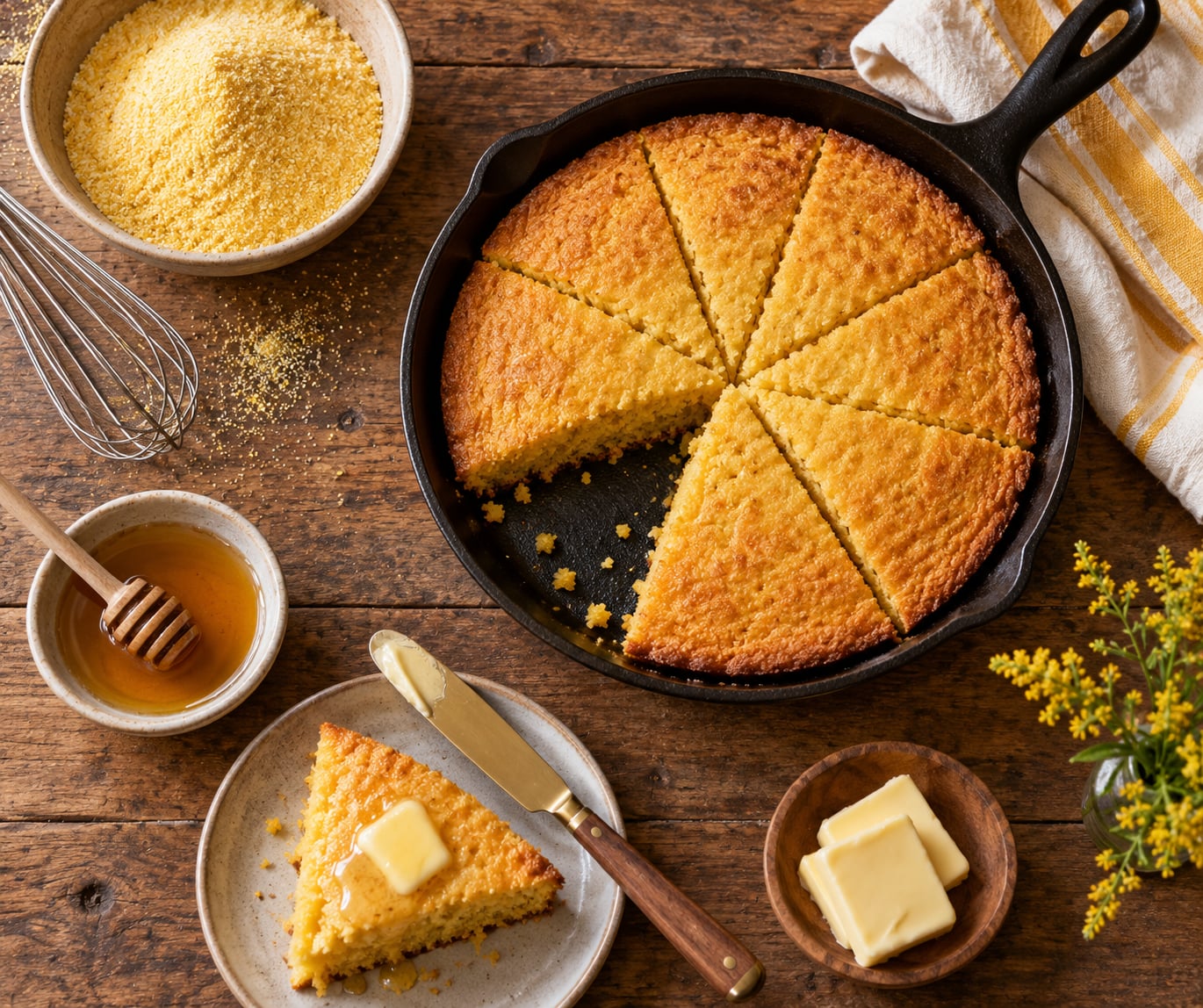
How to make cornbread from scratch takes about 35 minutes, and the whole thing comes together in one bowl with pantry ingredients you probably already have. Cornmeal, flour, baking powder, an egg, milk and butter are enough for a tender square that tastes like corn instead of like a boxed mix. The one thing that decides whether it works is how gently you mix it.
Beginners worry about the wrong things. Nobody cares that your pan was cast iron or that you used stoneground cornmeal. What people notice is whether the crumb is moist, whether the top browned before the middle set, and whether it fell apart when you cut it. Get those three right and the rest is decoration.
Table of Contents
What You Need
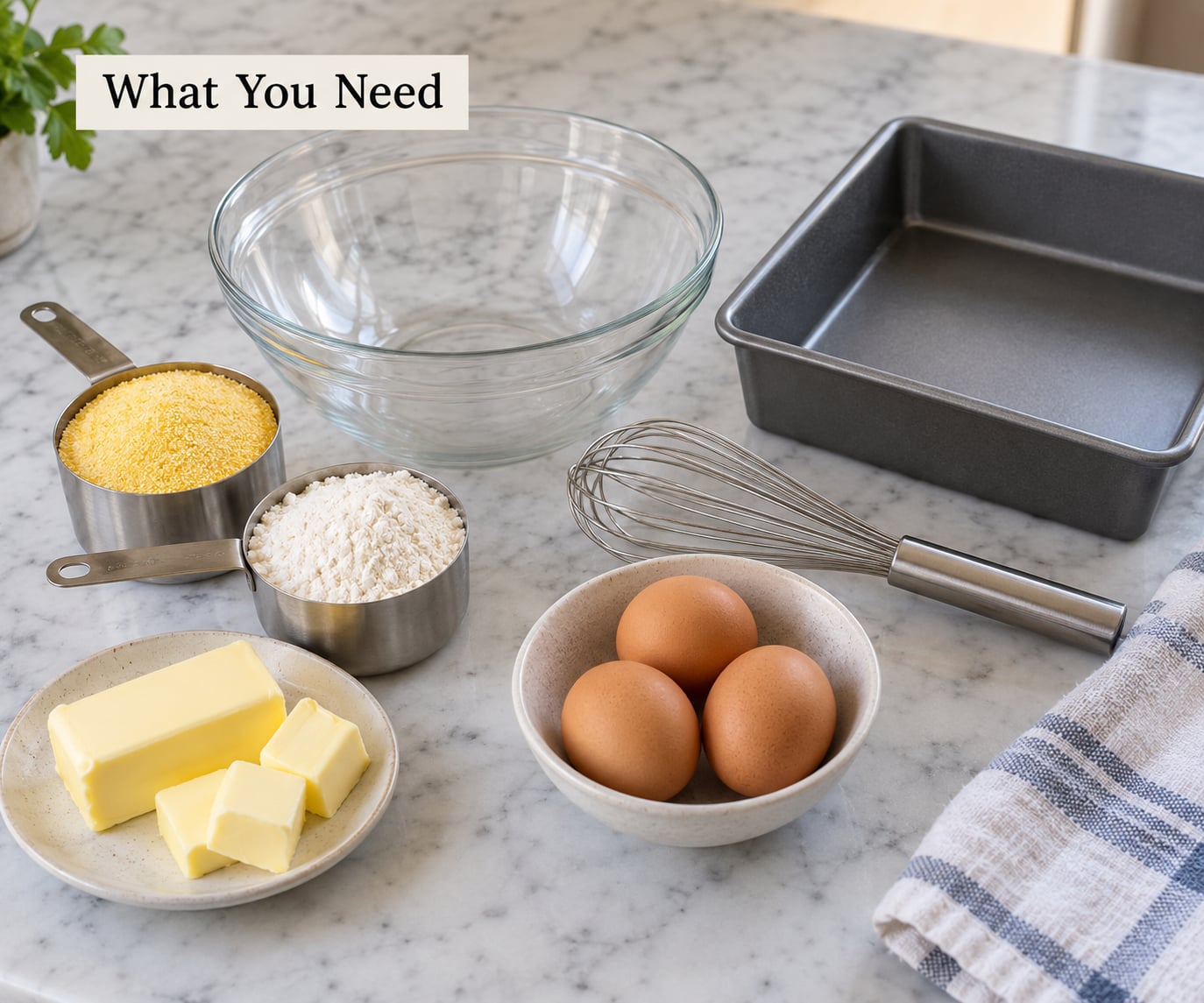
The classic recipe (8-inch square pan or 10-inch skillet)
- 1 cup yellow cornmeal, medium or coarse grind
- 1 cup all-purpose flour
- 1 tablespoon sugar (optional, for a slightly sweet loaf)
- 1 tablespoon baking powder
- 1 teaspoon baking soda
- 1 teaspoon salt
- 2 large eggs
- 1.5 cups buttermilk, or milk plus 1 tablespoon lemon juice or vinegar
- 6 tablespoons unsalted butter, melted and cooled slightly, plus more for the pan
That yields a 9-inch round or 8-inch square loaf, about 8 generous wedges. A 10-inch cast iron skillet works too; it just bakes about 3 minutes faster than a glass pan because the metal pulls heat out of the batter faster.
What each ingredient is actually doing
Cornmeal gives the flavor and most of the weight. It has no gluten, so on its own it cannot hold a crumb together, which is exactly why the flour is there.
The flour supplies gluten. That is your binding agent, and it is also the ingredient you can leave out if you want a crumbier, more traditional fry-bread texture. Most people cut it in half rather than removing it.
Baking powder and baking soda do the rising. Baking powder works alone. Baking soda needs acid to activate, and that is where buttermilk comes in. Use plain milk with baking soda and the loaf will rise less and taste flatter, which is how most boxed mix cornbread ends up dense.
The egg sets the structure and gives the crust its shine. The butter carries flavor and keeps the crumb tender by coating the flour particles before gluten can link up. Oil works in its place and costs less, but you lose the butter flavor and get a slightly cakier texture.
Equipment
You need an oven, a mixing bowl, a whisk or fork, a 9-inch round baking dish, 8-inch square pan or 10-inch skillet, and a cooling rack if you own one. A pastry brush or a paper towel works for greasing, and an instant-read thermometer takes the guesswork out of doneness.
Cornmeal and substitutions
- Yellow cornmeal: the classic choice, sweet and earthy. Buy a bag from a bakery or a co-op if you can, since supermarket cornmeal is often too finely ground and tastes dusty.
- White cornmeal: milder and more delicate. Traditionally served with beans and posole in the Southwest, and pairs well with a savory herb finish.
- Coarse stoneground cornmeal: grittier, more corn-forward, less rise in the corners. This is the one people describe as authentic.
- Fine cornmeal: smoother crumb, closer to a cake. Good if you plan to serve cornbread to someone who finds coarse grain off-putting.
- No buttermilk: stir 1 tablespoon lemon juice or white vinegar into 1.5 cups milk and let it sit 5 minutes.
- Gluten-free: swap the flour for a 1-to-1 gluten-free blend. The loaf will be more fragile and want 2 to 3 extra minutes out of the oven.
Step-by-Step: How to Make Cornbread from Scratch
1. Heat the oven and prepare the pan
Set the oven to 400°F (205°C) and give it a full 10 minutes to preheat with the rack in the middle. An oven that is still warming up when the batter goes in gives you a pale top and a doughy center.
Butter a 9-inch round pan, an 8-inch square pan or a 10-inch skillet, then dust the bottom and sides with a thin layer of cornmeal. Tap the pan out over the sink to shed the extra. That cornmeal layer is what keeps a sticky batter from bonding to the pan, and it leaves a fine, faintly sweet crust on the bottom after baking.
If you are using cast iron, put the empty skillet in the oven while it preheats and brush it with fat right before the batter goes in. A hot pan creates steam on contact, and that steam is where the lift in a skillet cornbread comes from. Heavy cold cast iron is the one thing you do not want, since it soaks heat away from the batter.
2. Combine the dry ingredients
Whisk the cornmeal, flour, sugar, baking powder, baking soda and salt together in a large bowl until there is no visible flour left at the bottom.
Give it a full 30 seconds of whisking. Baking powder and baking soda settle to the bottom of the bowl where they meet the least liquid, and that uneven distribution is a common cause of a sunken center. A quick whisk of each individual leavening with the flour first is even more reliable.
If you are going coarse, whisk the cornmeal in first and let it sit for a minute before adding the flour. It gives the coarse particles time to hydrate, which softens the grit without any extra work on your part.
3. Mix the wet ingredients
Whisk the eggs, buttermilk and melted butter together in a second bowl until the mixture is uniform and no streaks of yolk remain.
Measurements matter more here than most recipes admit. If you eyeball the milk you will be off by an ounce or two, and that is enough to change the texture noticeably. Use a liquid measuring cup and read it at eye level.
Let the butter cool for two or three minutes before adding it. Melted butter straight from the microwave will scramble the eggs on contact, and any solid butter that clumps will leave streaks of unincorporated fat in the finished crumb. For the same reason, bring the eggs and milk out of the fridge ahead of time. Room temperature wet ingredients emulsify cleanly into the dry mix, which is what stops lumps from forming later.
Optional flavor additions go in now rather than later: a teaspoon of vanilla for a sweet loaf, a cup of corn kernels, or a tablespoon of honey in place of the sugar.
4. Make the batter and avoid overmixing
Pour the wet mixture into the dry and stir with a spatula just until the streaks of flour disappear. Stop there. Ten or fifteen strokes is plenty.
The finished batter should look thick, pale yellow and slightly lumpy, closer to drop biscuit dough than to pancake batter. Lumps at this stage are correct, and they are the reason a well-mixed cornbread has a tender crumb. Gluten in the flour starts linking into a network the moment liquid hits it, and heavy stirring makes that network tight, which bakes up heavy and tough.
If the batter sits for more than 20 minutes after mixing, stir it once more before pouring. Cornmeal keeps absorbing liquid as it rests, so a batter that looked right can stiffen into something that bakes up dry.
Scrape the batter into the prepared pan and smooth the top. Level it with the back of the spoon so the corners bake evenly, and don’t press it down.
5. Bake until golden and tender
Bake at 400°F (205°C) for 22 to 30 minutes, until the top is deep golden brown and the edges have pulled slightly away from the sides of the pan. The center should spring back lightly when you press it, and a toothpick inserted into the thickest part should come out clean or with a few moist crumbs clinging to it.
If you are using cast iron or an oven thermometer you trust, pull the loaf when the internal temperature reaches 200°F (93°C). That is the most reliable doneness signal there is, since oven dials routinely run 25°F off in either direction.
For a crisp bottom crust, use cast iron or a dark metal pan and lower the temperature to 375°F (190°C), which gives the base longer contact with the heat. Cast iron goes in the oven already hot.
If the top browns early, drape a loose sheet of foil over the pan. Cornbread is a quick bread with a high sugar-to-flour ratio by comparison to yeast bread, so it burns faster than most loaves.
If the center is still raw while the outside looks done, the usual cause is a pan that is too deep for the batter. In a narrow loaf tin or an overfilled muffin cup the outside sets long before the middle can cook through, so use a shallow pan, or bake the leftovers as muffins for another 20 minutes.
6. Cool, cut, and serve
Let the cornbread sit in the pan for 10 minutes. Then turn it out onto a wire rack and cool completely, about 45 minutes, before cutting. Cutting hot gives you a gummy crumb that smears instead of tearing.
Cut with a serrated knife in a gentle sawing motion. A straight pull drags the crumb apart and sends half of it onto the cutting board.
Cornbread is at its best the day it is baked. It keeps at room temperature in an airtight container or under a clean tea towel for 2 days, and up to a week in the refrigerator, though refrigeration dries the crumb out faster.
For serving, butter and a drizzle of honey is the obvious move. It is just as good with chili, a bowl of soup, or alongside roast chicken and greens, and cornbread makes excellent croutons for a salad. Leftovers turn into a stuffing base for Thanksgiving with very little work, and toasted squares make a sturdy sandwich bread that holds up to fillings better than most sandwich loaf. On that note, this guide to how to make an overstuffed sandwich hold together is worth a look if you are layering a lot of filling. If you are pairing it with a soup or chili where moisture is the enemy, these 10 best spreads to keep bread from getting soggy apply just as well to a warm square of cornbread.
Common Mistakes
Dry, crumbly cornbread is the most common complaint by a wide margin, and it has four usual causes. Too much flour is the first; the crumb needs the gluten but not more than it needs. Overmixing is the second, since a tight gluten network squeezes out moisture as it bakes. Overbaking is the third, so pull it at the low end of the time range if you are unsure. And baking in a dark metal pan on high heat dries the whole loaf out faster, because the heat is coming from every direction at once. Fix one of these and the loaf changes immediately.
A dense, heavy crumb usually means the chemical leavening never got the chance to work. That happens when baking powder is old and flat, when you use baking soda with milk but no acid, or when the batter sat so long after mixing that the leavening spent itself before the pan went in the oven. Check your baking powder by adding a teaspoon to a cup of hot water. If it does not foam hard right away, toss it.
A sunken middle means the batter was spread thickly in one spot, mixed too long, or poured into a pan that was not hot enough to start the rise immediately. Level the batter in the pan, and if you are using cast iron, make sure the pan is properly preheated and buttered.
Cornbread sticking to cast iron is nearly always one of three things: a cold skillet, a pan wiped clean instead of greased at the moment the batter goes in, or a cornmeal layer that was skipped. Waxed paper with a light buttering works as a liner if you want a guaranteed release, though you lose a little of the crust.
A pale top means the oven was cool or the loaf was shielded. Give the oven a full 10 minutes at 400°F, use a light-colored pan, and put the loaf on the middle rack rather than the bottom.
Cornbread that crumbles into sand when you cut it needs a little more fat and a little more liquid. Melted butter in the batter rather than only in the pan is the single biggest upgrade, and buttermilk instead of milk softens the grain noticeably.
Two habits fix most of the above before they start. Mix everything the night before, keep it sealed, and bring it to room temperature for 30 minutes before baking. And use a scale for the cornmeal and flour whenever you can; volume measurements for flour can swing 20 percent between a spooned and a scooped cup, which is easily the difference between a tender crumb and a brick.
Frequently Asked Questions
Can I make cornbread from scratch without cornmeal?
You can, but it will not taste or look like cornbread. Without cornmeal you are essentially making a sweet quick bread with a little corn flavor. Substituting masa harina for part of the flour gets you closer, since it is made from corn and still holds moisture better than plain flour.
Why is my cornbread dry?
The four usual causes are too much flour, overmixing, overbaking, or a dark metal pan at high heat. Start by cutting the flour in half or by a quarter and mixing only until the streaks disappear. Then pull the loaf at 22 minutes rather than the full 30, and check with a toothpick or an instant-read thermometer at 200°F.
Should I use yellow cornmeal, white cornmeal, or a combination?
Yellow cornmeal is the standard for classic American cornbread: sweeter, more corn-forward, and what most recipes assume. White cornmeal is milder and pairs well with savory additions like cheese or herbs. A half-and-half blend is a reasonable middle ground if you want corn flavor without the intensity of all-yellow.
Can I prepare the cornbread batter ahead of time?
You can mix the dry ingredients days ahead and keep them sealed in a jar. Mixing the wet batter ahead is risky, since the cornmeal keeps absorbing liquid and the baking powder starts losing strength. If you must, refrigerate the mixed batter for no more than 12 hours, stir it well, and let it come to room temperature before baking.
How do I keep cornbread from sinking in the middle?
Level the batter in the pan instead of leaving it mounded in the center, and stop mixing as soon as the flour streaks disappear. Make sure your baking powder is still active, use buttermilk with baking soda rather than plain milk, and preheat the oven for a full 10 minutes so the loaf begins rising before the top sets.
Can I freeze homemade cornbread?
Yes. Cool it completely, then wrap individual slices tightly in plastic wrap and place them in a freezer bag or container. Frozen cornbread keeps for up to 3 months. To reheat, wrap slices in foil and warm them in a 350°F oven for 15 minutes, or use a toaster oven. The oven method brings back the crust better than the microwave.
Start with the recipe as written: 400°F, a buttered and cornmeal-dusted pan, and gentle mixing. Bake the first one, pull it at 22 minutes, and note the result. From there, adjust one thing at a time, usually the flour or the cornmeal grind, and you will have a version that works every time.