
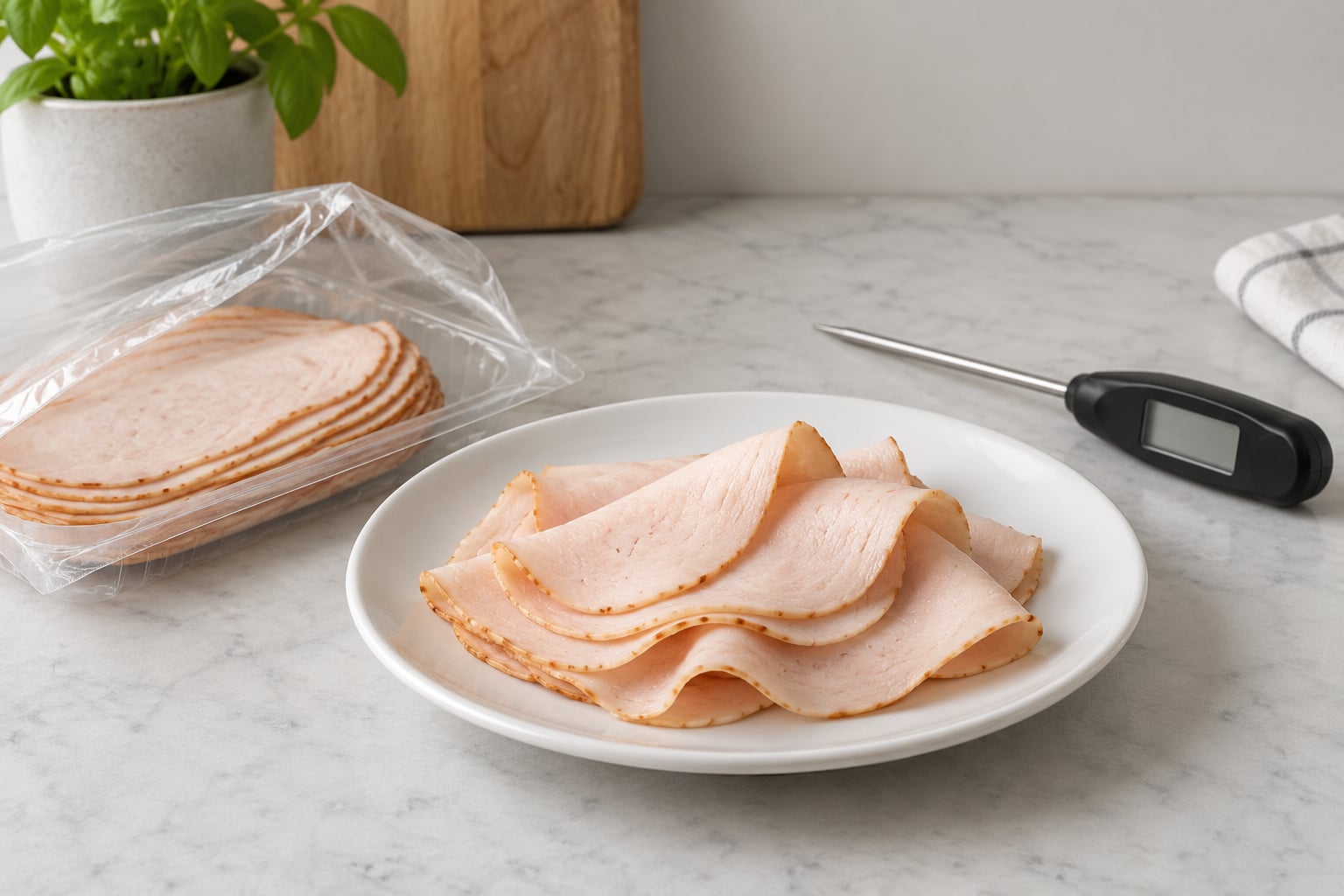
You can tell if deli meat has gone bad by checking for a slimy or sticky surface, a sour or rotten smell, and unusual discoloration. Add the package date and how the meat was stored, and you have five checks that take about a minute. Never taste it to check.
The reason the smell test alone is not enough: deli meat is ready to eat, so there is no cooking step between the package and your sandwich. And Listeria monocytogenes grows at refrigerator temperature, which means cold cuts can look and smell fine and still be a problem. Storage history is what breaks the tie.
This guide covers pre-packaged lunch meat bought at the store and meat sliced to order at a deli counter. Both need the same checks; the counter version just has no printed date to lean on.
What You Need
- The original package, or the deli-counter paper and the receipt with the purchase date
- A refrigerator holding 40°F (4°C) or below
- Clean hands, washed and dried for twenty seconds
- A clean fork for lifting a slice without touching it
- A paper towel or plate to set the meat on
- A trash bag ready to tie up, so you are not holding questionable meat while you decide
Set the package on a cold plate or a folded paper towel. If you are checking something from the fridge door, move the whole container out first, because the temperature of the meat itself lags behind the air around it.
Step-by-Step
Run the checks in this order: package and storage history, then color and surface, then smell, then texture. Taken together they give you a much clearer read than any single sign. Color and texture usually shift before odor shows up, so if something looks off, keep going rather than leaning on your nose alone.
How to tell if deli meat has gone bad: check the package and storage history first
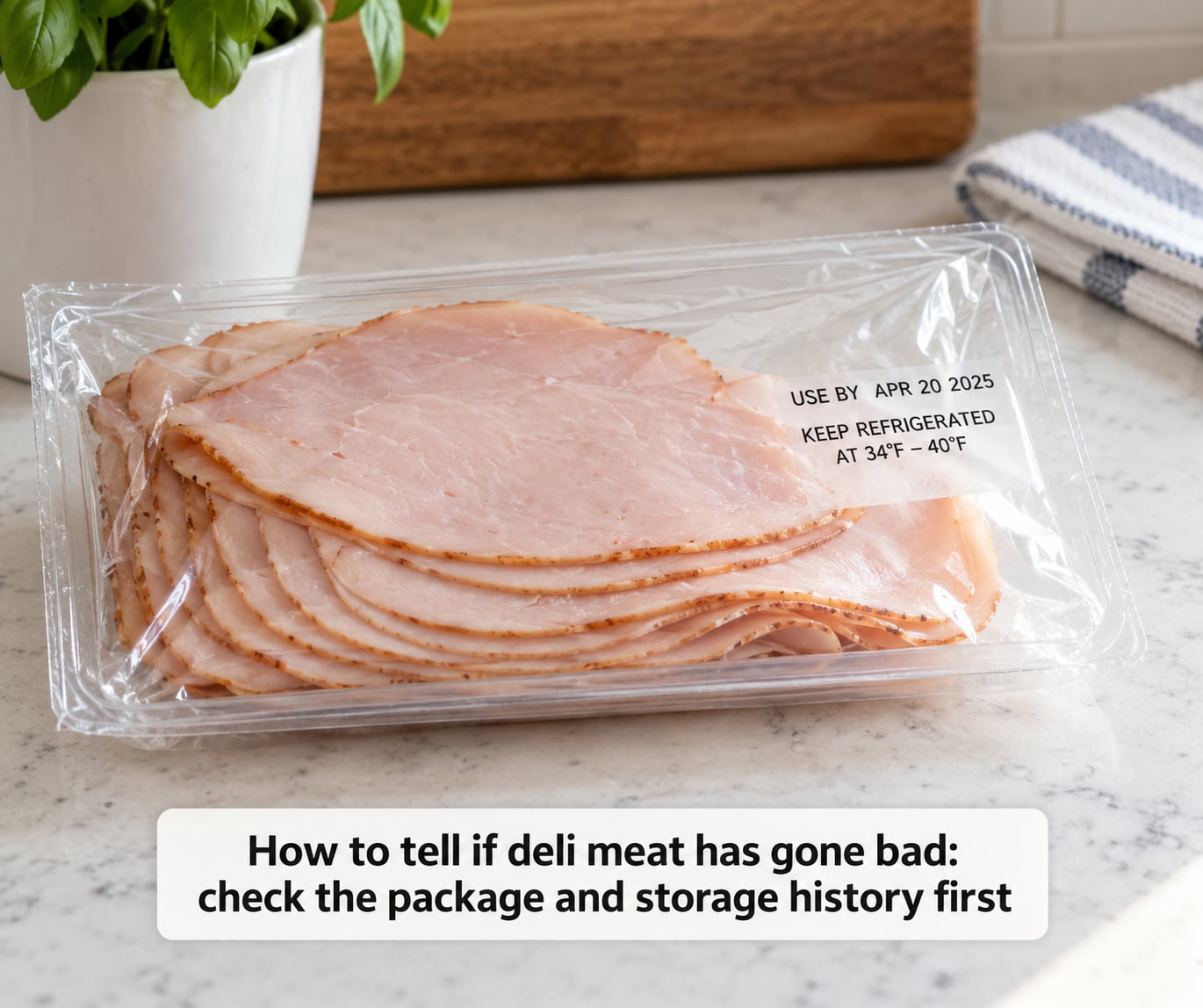
Look for a seal that is intact. A bulging pouch, a leaking seal, or liquid pooled under the tray means gas and liquid are escaping, and the meat goes in the bin without a second look. Past that, check whether the package is dated, and if so, whether the date has actually passed.
Then reconstruct the storage history, which matters more than the date itself. When did it get opened? Has it sat in the refrigerator the whole time at 40°F (4°C) or below? Any warm car, countertop, or picnic longer than two hours breaks the cold chain, and meat that breaks the chain is not rescued by an intact package. If you cannot remember how it was kept, treat the timeline as unknown.
One more practical point: sliced meat does not share a shelf life with the block it came from. Meat bought at a deli counter and sliced on request is generally given a shorter window than sealed pre-packaged meat, and if you are weighing the two for weekly lunches, our guide to pre-packaged vs deli-counter lunch meat covers the difference in packaging and timing.
Inspect the color and surface
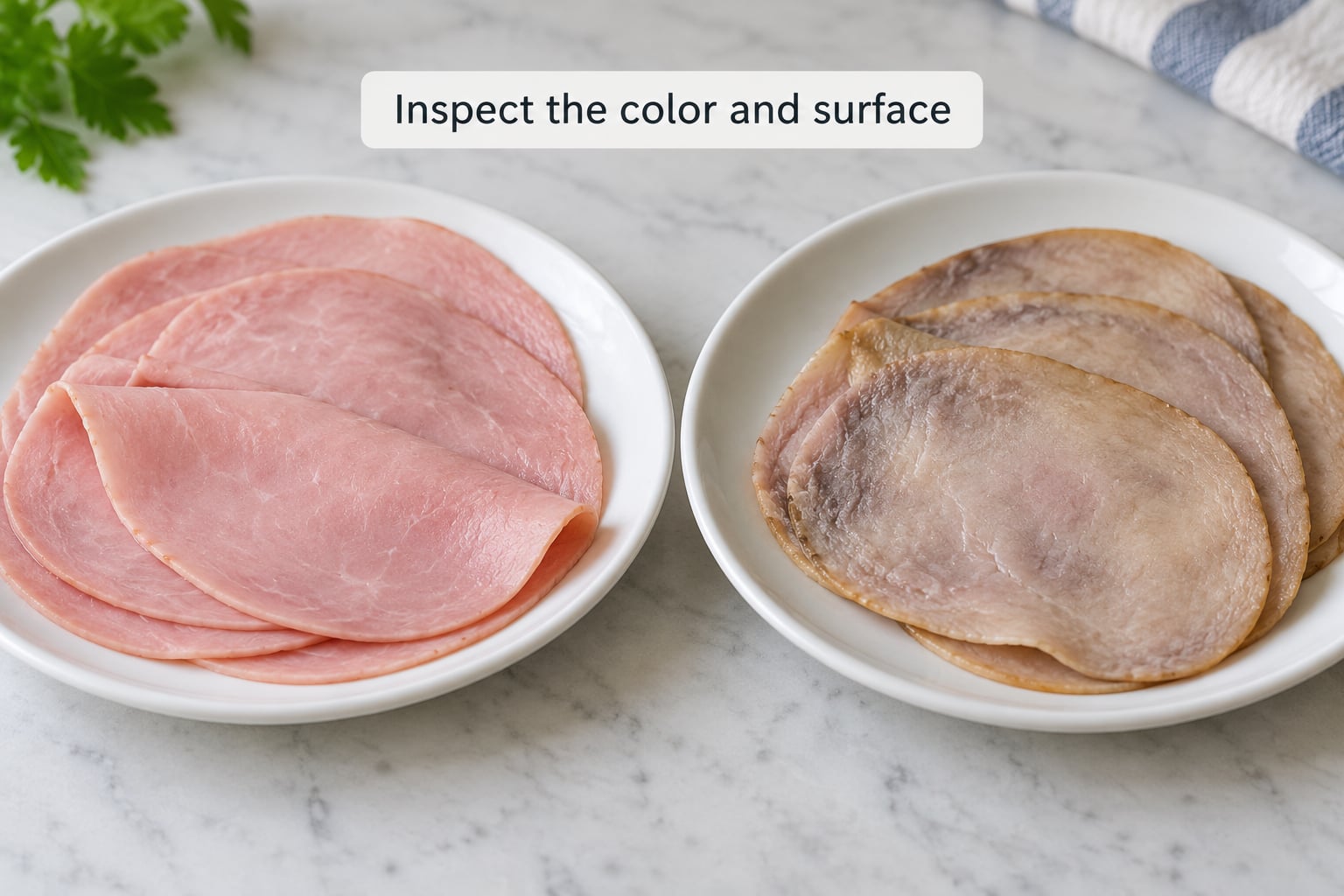
Good ham is pink with a little darker red where the muscle ran. Turkey is pale beige-pink with cream fat. Roast beef is deep red to maroon, and a hard dry sausage like salami is tan or brownish by design. Color shifts across brands and styles, so judge your meat against the last slice of the same package, not against a photo online.
Warning signs include gray or gray-green patches, a greenish film, purple or unusually dark areas, or edges that have dulled to brown while the center is still bright. A rainbow or oil-slick sheen on turkey or ham is normal, produced by light reflecting off the fat and moisture film, and it wipes or fades with handling. The same goes for the small holes in the slices, which come from the blades of the slicing machine.
Brown specks on the surface of ham are usually oxidation, the same thing that makes a cut apple brown. Small and dry with no odor or slime, they are cosmetic. A fuzzy patch, a wet dark spot, or mold on a slice means the entire package goes out, because you cannot see or reach all of it.
Smell the meat without tasting it
Open the package over the sink or over the trash and inhale once, briefly. Fresh deli meat smells faintly of the meat itself with a clean, salty or smoky note. Spoiled meat smells sour or vinegary, rotten, sulfurous like decaying eggs, or sharp and ammonia-like. That odor comes from bacteria breaking down protein and fat, and it is the strongest single signal you have.
Do not taste a single slice to test it. A small taste is exactly how foodborne illness starts, and the amount needed to prove anything is never the amount worth risking. If you need to smell the inside of a sealed package rather than the surface, lift a slice with a clean fork instead of leaning in and pulling it apart with your hands.
Check the texture and moisture
Pick up a slice with a fork or clean fingers and notice what your hand feels. Bad deli meat has a tacky, slick or mucous-like coating, and the liquid in the tray turns cloudy or thick. Soft spots that give under pressure while the rest of the slice stays firm point to localized bacterial growth, often before any odor is obvious.
Expect some variation by product. Soft bologna and turkey are moist and springy, a hard salami or pepperoni is dense and slightly dry, and cured ham has a firmer surface. What is not normal is a dry leathery exterior on a soft lunch meat, a rubbery gummy chew, or moisture pooling far beyond what the packaging should hold.
When in doubt, discard it
Use a simple rule. Two or more warning signs, or one sign plus an uncertain storage history, means the meat goes in the trash. Also discard on any mold, any swollen or leaking package, or any date more than five days past opening when the meat was refrigerated the whole time. You can extend the life of borderline meat by freezing it, or by cooking it into a hot dish such as a pizza topping or a pan of scrambled eggs, but only meat that still looks and smells normal.
After disposal, wash your hands with soap and water for twenty seconds and wipe the plate, knife, and cutting board. Deli-counter meat sitting on a warmer case next to it may be worth a second look, and it is worth checking the container on the fridge shelf where the suspect meat sat.
If you already ate it and feel unwell, food poisoning symptoms usually start within a few hours to a couple of days: nausea, vomiting, cramps, diarrhea, and sometimes fever. Contact a doctor if you cannot keep fluids down, if there is blood in the stool, or if symptoms run longer than three days. Pregnant readers, anyone over 65, and anyone with a weakened immune system should speak to a healthcare professional right away rather than waiting it out, and the CDC and FDA both advise heating deli meat to 165°F (74°C) before eating it if you fall in those groups. Reheating kills many bacteria but does not reverse spoilage, and it does not make meat that has already gone off safe to eat cold.
Common Mistakes
Trusting the printed date as the final word
A best-by or sell-by date is a quality guideline, not a switch that flips the meat from safe to dangerous. Dates also assume refrigeration from the slicer to your plate, so a package eaten five days past its date that never left a 38°F fridge is a very different situation from one that spent a morning in a car. Use the date as a starting reference and let the other checks decide.
Treating smell as the only reliable test
People on r/foodsafety post about packages that look, smell, and feel perfectly fine long past the date, and retail workers describe spoilage gases and yeasts that show up in texture and color before odor arrives. Smell is one input, not a verdict. If color, texture, and packaging all raise a flag, the absence of an odor does not save the meat.
Tasting a questionable slice to settle it
There is no safe sample size. Food-safety guidance is clear that you do not taste food to test it, and this habit accounts for a meaningful share of unnecessary foodborne illness. Sniff, look, and touch, then decide.
Leaving sliced meat out on the counter
USDA guidance is the two-hour rule, one hour when the temperature is above 90°F (32°C). Sliced meat has a lot of exposed surface area, so it loses the cold faster than a block does. If lunch meat has been sitting out during sandwich prep, that time counts against the shelf life you have left.
Judging freshness by color alone
A rainbow sheen, small holes, and a few dry brown specks are normal, and throwing meat out over them is the kind of habit that adds up to real waste. Equally, bright uniform color means nothing on its own, because color can be adjusted by curing. Color is one check next to odor, texture, and package condition.
Storing meat in the fridge door
The door is the warmest part of the refrigerator and it swings open all day. Deli meat belongs on an interior shelf, in the coldest section, in a sealed container or the resealable original package. If you buy for the week, how much deli meat to buy for a family of four is worth reading before you shop, so you freeze what you will not reach before the week ends.
Frequently Asked Questions
What happens if I ate bad deli meat?
Symptoms of food poisoning from spoiled lunch meat usually begin within a few hours to two days and include nausea, vomiting, stomach cramps, and diarrhea, sometimes with a fever. Drink fluids and rest. Seek medical care if you cannot keep fluids down, see blood in your stool, or if symptoms last more than three days. Pregnant people, adults over 65, and anyone with a weakened immune system should contact a clinician promptly.
What does spoiled deli meat smell like?
Spoiled deli meat smells sour or vinegary, rotten, or sharp like ammonia. Fresh cold cuts have a clean, salty or lightly smoky smell with no sourness at all. Open the package, inhale once briefly, and do not taste a slice to confirm. An odor usually appears after the first visible sign of spoilage, so if the surface looks slick or discolored you do not need to smell it at all.
Can I eat 2 week old deli meat?
Two weeks is past the USDA window of 3 to 5 days for opened deli meat kept refrigerated, so I would not eat it cold. Freezing at day three or four would have kept it safe. If it has been refrigerated the entire time and looks, smells, and feels completely normal, the date alone is a quality guideline rather than a danger threshold, but the risk is not worth it for a two-week-old package.
Are the little holes in deli meat safe to eat?
Yes, the small holes in sliced deli meat are normal. They come from the high-speed blades of the commercial slicing machine and sometimes from the texture of the cured meat itself. The same is true of a faint rainbow or oil-slick sheen on turkey and ham, which is light reflecting off the surface fat. Neither is a spoilage sign on its own.
Can I freeze deli meat?
You can, and it is the easiest way to save meat you will not use within 3 to 5 days of opening. Slice it off the original block, lay the slices flat in a single layer on a tray to freeze solid, then move them into an airtight bag or container. Thaw in the refrigerator, not on the counter, and use within a couple of days once thawed.
How long does sliced ham last in the fridge?
Sliced ham keeps 3 to 5 days in the refrigerator at 40°F or below once the package is opened, and about a week while still sealed. Meat sliced fresh at a deli counter gets a shorter window, closer to 3 days, because it has no protective packaging. Freeze it in portions if you bought more than you can eat that week.
Conclusion
Start with the package and the storage history, because that tells you more than anything you can see. Then look at the color, smell it once, and pick up a slice to check the texture. If two or more of those checks come back wrong, or you simply are not sure how the meat was kept, throw it out. Knowing how to tell if deli meat has gone bad is less about perfect detection and more about having a rule you can follow without arguing with yourself at 7 a.m.