
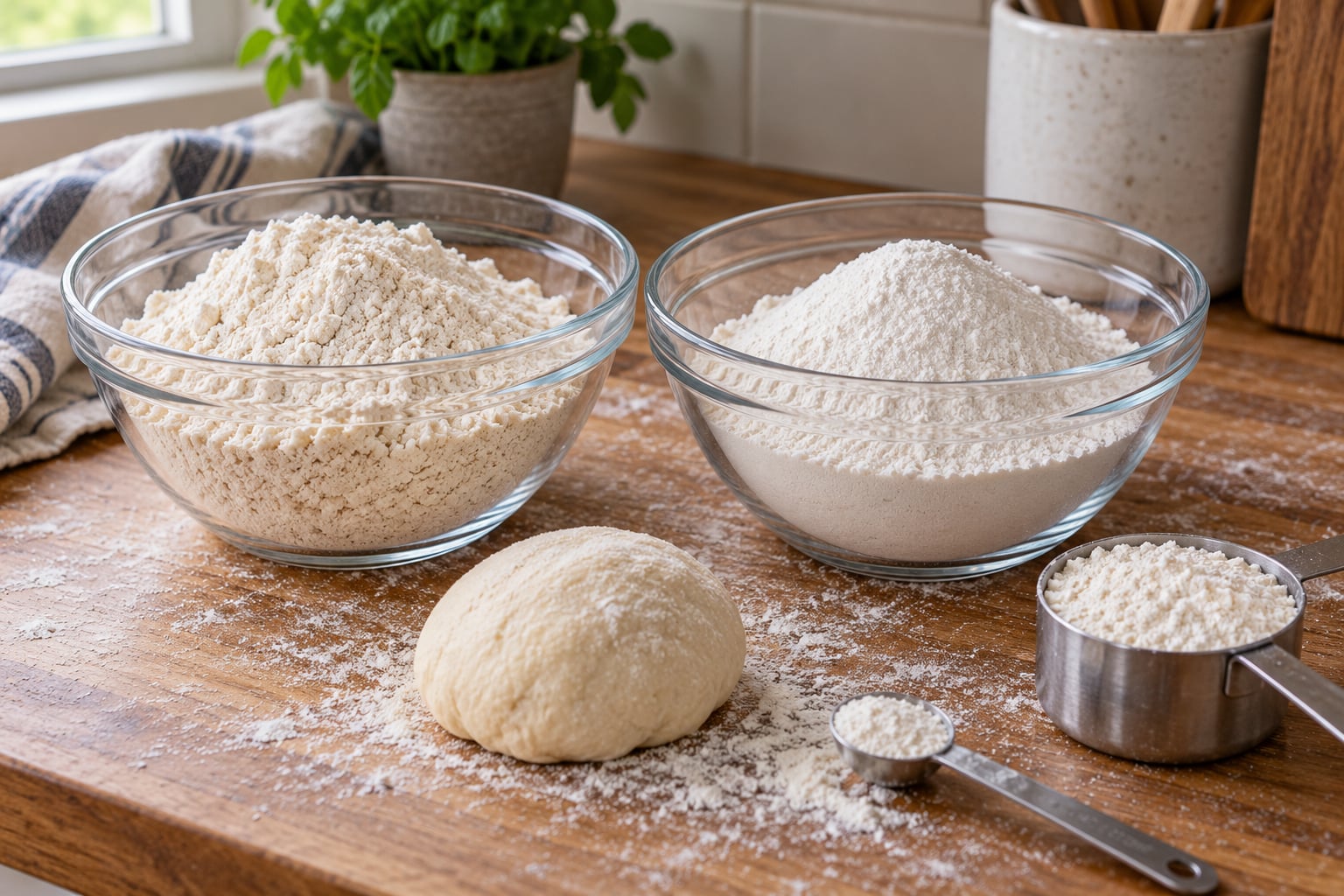
The short answer to bread flour vs all-purpose flour for bread baking is protein. Bread flour runs roughly 12-15%, all-purpose flour about 9-12%. More protein means stronger gluten, so bread flour bakes higher with a more open, chewier crumb, while all-purpose flour spreads more and stays a little softer.
That is the whole story, and it is enough to explain most of what confuses people about swapping one for the other. Recipes disagree because bakers disagree about how much structure a loaf needs, not because either flour is wrong.
What follows is a straight comparison, plus the practical numbers: how much to cut water when you swap, how to blend the two, and what to do about a loaf that spreads out on the counter.
Table of Contents
- Bread Flour vs All-Purpose Flour for Bread Baking at a Glance
- What Is the Difference Between Bread Flour and All-Purpose Flour?
- How Does Protein Affect Bread Dough and Crumb?
- Which Flour Is Better for Different Types of Bread?
- Bread Flour vs All-Purpose Flour for Bread Baking: How to Choose
- Can You Mix Bread Flour and All-Purpose Flour?
- How to Substitute All-Purpose Flour or Bread Flour in a Recipe
- Which Should You Choose?
- Frequently Asked Questions
- What is the difference between bread flour and all-purpose flour?
- Can I use all-purpose flour for bread baking?
- What happens if I accidentally use all-purpose flour instead of bread flour?
- How do I change all-purpose flour to bread flour in a recipe?
- Is all-purpose flour or bread flour better for sourdough?
- Is bread flour healthier than all-purpose flour?
- The Short Version
Bread Flour vs All-Purpose Flour for Bread Baking at a Glance
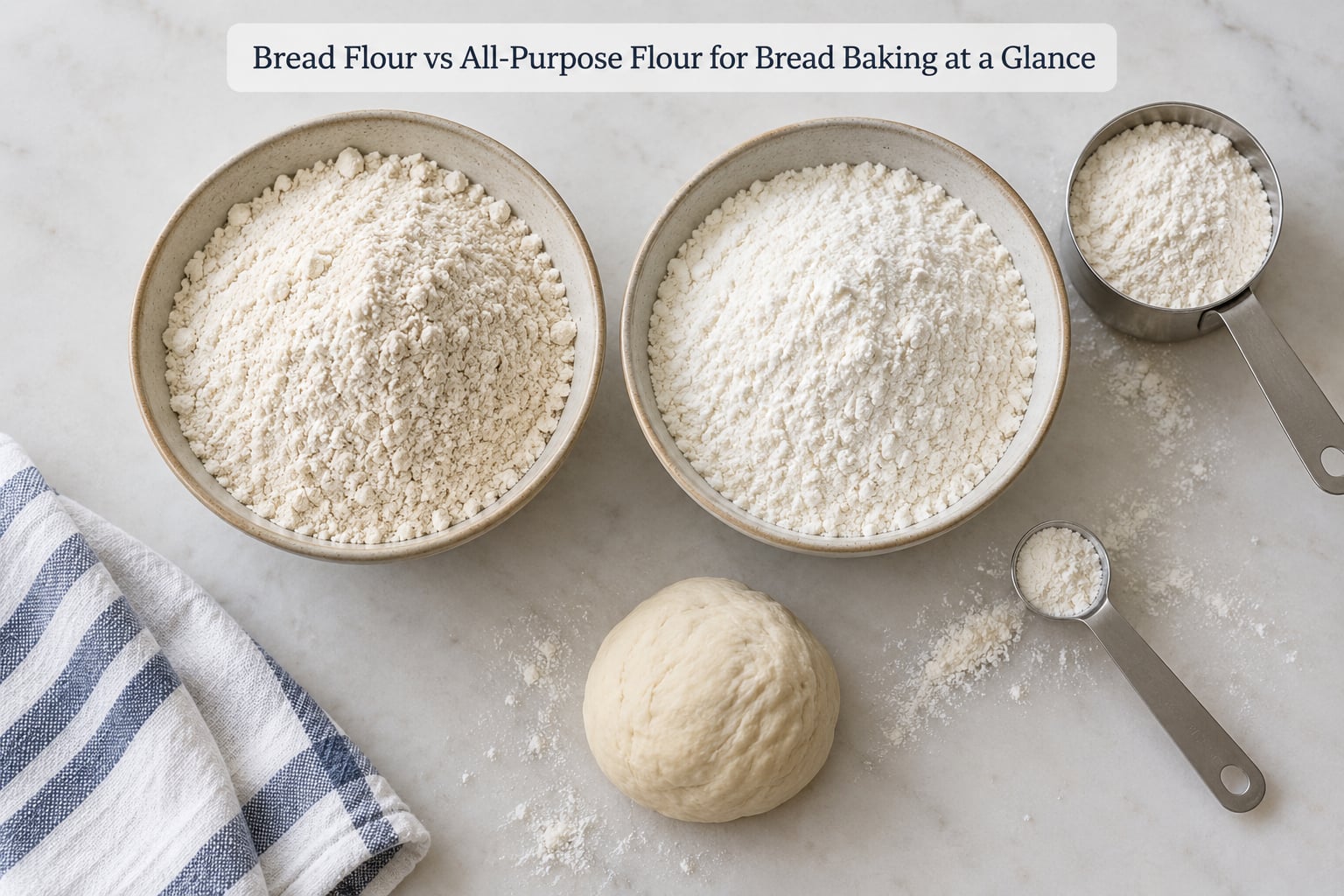
| Factor | Bread Flour | All-Purpose Flour |
|---|---|---|
| Protein content | About 12-15% | About 9-12% |
| Gluten strength | Strong, elastic, holds shape | Moderate, less elastic under long fermentation |
| Milled from | Hard spring or hard red wheat | Blend of hard and soft wheats |
| Hydration tolerance | Handles 70-80% hydration well | Best around 65-70% hydration |
| Dough feel | Stiff, smooth, springs back | Soft, sticky, tears more easily |
| Oven spring | Higher, rounder belly | Lower, wider profile |
| Crumb | Open and irregular, with fewer large holes | Tighter, more even, slight gummy risk |
| Bite | Chewy and substantial | Tender and soft |
| Best for | Sourdough, bagels, pizza, artisan loaves | Sandwich bread, rolls, enriched doughs, beginners |
| Flavor | Slightly nutty, deeper crust | Mild, neutral, bakes pale |
| Cost per pound | Usually higher | Usually lower |
One note on the protein figures: they are ranges, not promises. Brands vary, and bag-to-bag swings happen because wheat protein content shifts with growing conditions and harvest year. Read the nutrition panel rather than trusting the name on the front of the bag.
What Is the Difference Between Bread Flour and All-Purpose Flour?
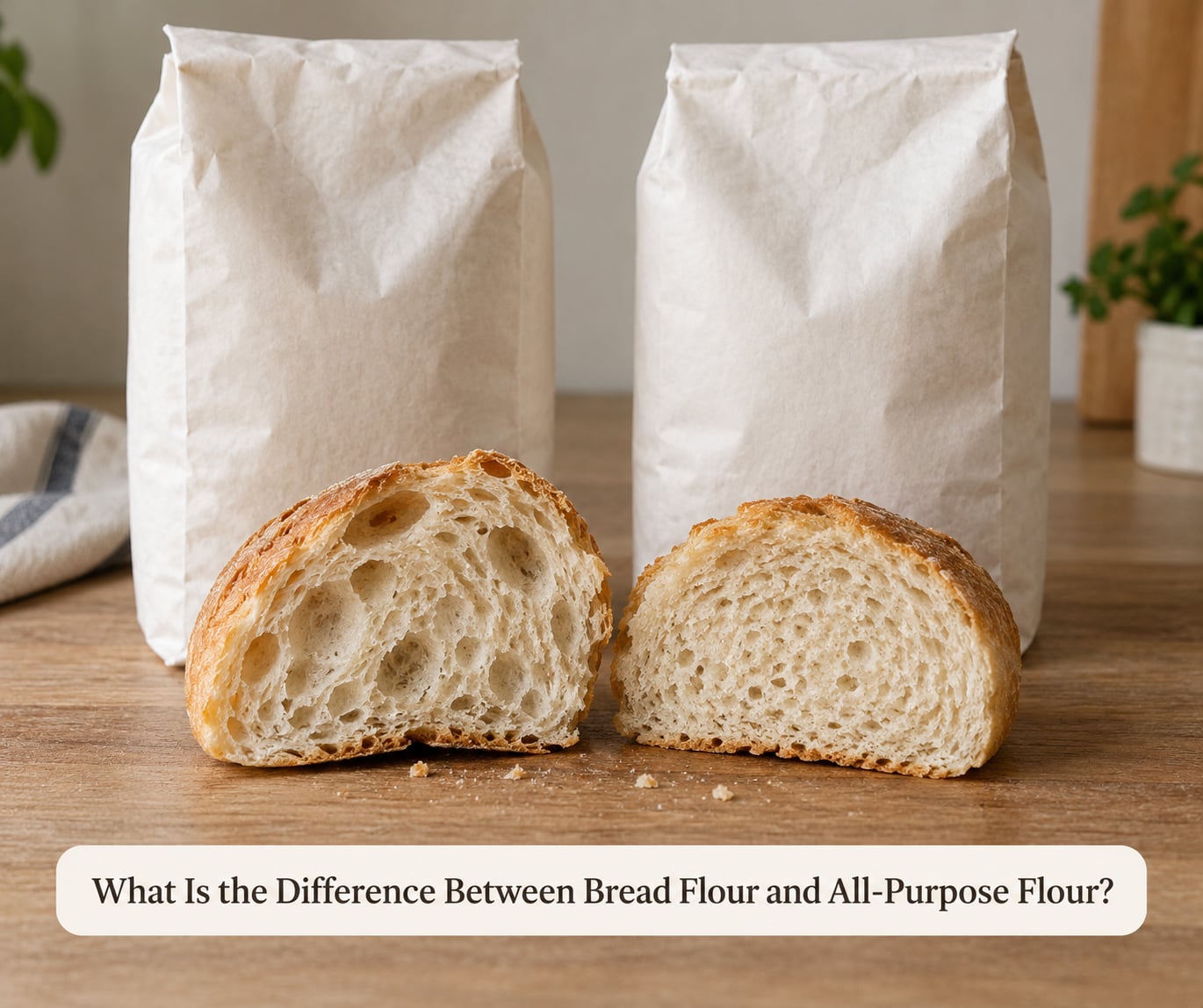
The difference is protein content, and everything else follows from it. Bread flour is milled from hard wheat, which has a higher protein level, and it is usually milled with a coarser grind. All-purpose flour blends hard and soft wheat to hit a middle protein target that works in cookies, cakes, pancakes and bread alike.
Protein content is the percentage of the flour by weight that is protein. In bread flour that sits around 12-15%; in all-purpose flour it sits around 9-12%. Soft wheat flours run lower still, which is why cake flour lands near 6-9% and pastry flour near 8-10%.
Protein is what becomes gluten. Two proteins do the work: glutenin gives dough its strength and elasticity, and gliadin gives it extensibility so it can stretch without snapping. When water and mechanical work pull these proteins together, they link into an elastic network called the gluten network.
That network does three jobs in a loaf. It stretches to trap carbon dioxide from fermentation, it holds the shape of the dough as it heats, and it sets into the chew that you feel between your teeth. More protein means more network, which means more gas retained and a stronger skeleton once baked.
Flour labeling is messier than the categories suggest. In the United Kingdom and Canada, plain flour and all-purpose flour often sit higher than US all-purpose flour, and strong white flour is the local equivalent of bread flour. Indian maida and Italian 00 grinds follow their own conventions. If a bag says strong, high-protein, or bread, assume it behaves like bread flour until the label tells you otherwise.
How Does Protein Affect Bread Dough and Crumb?
More protein produces a dough that stretches, holds shape and rises higher, and it demands more water and more mixing to develop properly. That is the whole bargain: you get a better loaf in exchange for a stiffer dough and a longer mix.
Why bread flour vs all-purpose flour changes how the dough behaves
Bread flour dough feels smooth and elastic. It holds a windowpane when you stretch it, springs back after a poke, and resists tearing during a long bulk ferment. When you shape it, it stays round instead of slumping.
All-purpose flour dough feels softer and stickier. It tears in small slits during stretch and folds, spreads faster on the bench, and by the time it goes into the oven it may be flatter than you wanted. None of that ruins the loaf, but the volume will be lower.
Gluten development is the process of organizing those protein strands into a connected network. More protein, more strands, better network. Mixing matters too: bread flour usually reaches a well-developed gluten in a stand mixer or by hand in 8-10 minutes of kneading, and warm or high-hydration dough develops faster than stiff dough.
Because the network is doing more work, bread flour also absorbs more water. A formula that feels right with all-purpose flour at 68% hydration can feel dry, tight and under-mixed at the same number with bread flour, which is the single most common complaint from people making the switch.
Oven spring is the rapid expansion that happens in the first minutes of baking as trapped gas and water vapor expand and yeast activity finishes. A stronger gluten network holds that expansion, so bread flour loaves rise higher in the oven and set with a rounder profile. Weak networks give out earlier and settle, producing a flatter loaf with a denser bottom.
Crumb, the interior texture of the finished bread, follows the same logic. Bread flour crumb is typically more open and irregular, with fewer, larger holes and a chewier bite. All-purpose flour crumb is tighter and more uniform, and if the loaf is over-baked or under-proofed, that tighter crumb can turn gummy rather than tender.
Which Flour Is Better for Different Types of Bread?
Match the flour to the structure the dough needs. Open, high-volume, long-fermented bakers want bread flour; tender everyday loaves and enriched doughs are better with all-purpose flour.
| Bread or dough | Better choice | Why |
|---|---|---|
| Rustic sourdough country loaf | Bread flour | Handles 75-80% hydration and gives a strong open crumb |
| Sourdough with a beginner or gentle schedule | All-purpose flour or a blend | More forgiving, easier to shape, still bakes a good loaf |
| Sandwich bread and pan loaves | All-purpose flour | Tender crumb that stays soft, no blowouts, cheaper per loaf |
| No-knead bread | Bread flour | Long fermentation needs strength to hold shape without kneading |
| Pizza dough | Bread flour | Stiff, strong dough bakes into a crisp, chewy, thin crust |
| Dinner rolls and enriched doughs | All-purpose flour | Eggs, butter and sugar already add tenderness; extra strength is overkill |
| Brioche | All-purpose flour or a light blend | Enriched doughs go soft and gummy with very high protein |
| Bagels and pretzels | Bread flour | Dense chew and dough strength through a short boil and bake |
| Quick breads and muffins | All-purpose flour | Batter, not dough; structure comes from eggs and leavening |
| Whole wheat blends | 20-30% bread flour with the rest all-purpose | Adds structure without making the dough slack |
A blend is a legitimate choice rather than a compromise. It lets you tune structure without a second bag of flour, which matters when a dough has to be handled in the morning before work.
Bread Flour vs All-Purpose Flour for Bread Baking: How to Choose
Choose bread flour when you want high rise, open crumb, high hydration and a chewier bite. Choose all-purpose flour when you want a tender, predictable, forgiving loaf and your dough is enriched or your baking schedule is casual.
Start from the result you want, not the label. Taller loaf and more open holes, or softer crumb and easier handling. Those two goals point to different flours, and no compromise satisfies both equally.
Next, look at hydration. Above about 70%, bread flour is the sensible pick, because a moderate-protein dough at that water level tears and spreads before it can hold a shape. If your recipe sits at 65% or below and includes butter, eggs or sugar, all-purpose flour is usually the better tool.
Then look at your mixing confidence. Under-developed bread flour gives you a dense loaf and a torn crumb, so the flour choice and your technique have to agree. If mixing by hand for 10 minutes is a stretch on a weeknight, all-purpose flour will usually produce a better loaf than undeveloped bread flour.
Finally, check the label. A bag labeled bread flour in one brand may sit at 12.7% protein while another brand’s all-purpose flour reaches 11.5%, which means the flours are nearly identical. If that dense sandwich loaf problem keeps coming up, our guide to why homemade sandwich bread comes out dense walks through the other usual culprits.
Can You Mix Bread Flour and All-Purpose Flour?
Yes, and bakers mix them constantly. A blend averages out the protein of each flour, which is the easiest way to land on the dough strength a specific recipe wants instead of guessing at a bag you did not buy.
The simple math is a weighted average. If your bag lists 12.7% for bread flour and 10% for all-purpose flour, then a 50/50 mix lands around 11.35% protein, which behaves like a solid mid-strength bread dough. Blend by weight, not by scoop, because a cup of one flour does not weigh the same as a cup of the other.
Useful starting points:
- 50/50 blend: about 11-12% protein. Strong, forgiving, good for sandwich loaves and everyday sourdough.
- 70 bread / 30 all-purpose: about 12% protein. A gentler dough for long cold ferments, good for beginners.
- 30 bread / 70 all-purpose: about 10.5% protein. Tender, still handles 65-70% hydration without tearing.
- 80 bread / 20 all-purpose: about 12% protein. Bagels, pretzels and high-hydration loaves that still need to be shapeable.
Because a blend is usually less thirsty than straight bread flour, cut water by 2-4% from the bread flour figure when you move to a blend. Bakers on Reddit describe blends as the fix for dough that is stiff and unshapeable one week and slack and sticky the next.
How to Substitute All-Purpose Flour or Bread Flour in a Recipe
Swap freely in small amounts and adjust with care in large ones. The direction of the swap decides how much water you add or subtract and how forgiving the dough will be.
All-purpose flour for bread flour is the easy direction. Your loaf will be slightly lower and denser with a tighter crumb, and it may spread a little more on the baking sheet. No formula change is required, and if the dough feels slack while you mix, hold back 10-20g of water.
Bread flour for all-purpose flour is the direction that needs a number. When the flour’s protein rises by 3 points or more, reduce water by 5-10% of the total flour weight. So a formula with 450g flour and 315g water at 70% hydration becomes roughly 450g bread flour and 285-293g water.
A few practical adjustments when you move up in protein:
- Expect a stiffer dough and add 5-10 minutes to mixing until the gluten network is developed.
- Shape on an unfloured or lightly floured surface, since a tough dough grabs onto the bench.
- Shorten bulk fermentation slightly, because a strong dough over-ferments and can collapse.
- Give the loaf 5-10 minutes less in the oven, since a denser crumb takes longer to set and can scorch before the inside dries out.
- Watch the dough rather than the clock, and expect the loaf to ride higher in the pan.
If the recipe uses bread flour for something that is not a dough, such as a cookie or a cake, skip the water adjustment entirely. In batters, higher protein means a chewier, cakier result rather than a taller one.
One other substitution worth knowing: cake flour is all-purpose flour diluted with cornstarch, so about 1 tablespoon of cornstarch per cup replaces the protein difference. That is why a cake-flour cookie spreads and a bread-flour cookie does not.
Which Should You Choose?
Buy bread flour when you are chasing open crumb, high hydration, high oven spring and a chewier bite, and when you are baking sourdough, pizza, bagels or a crusty country loaf. Commit to one brand and one protein number, learn how that dough feels, and adjust from there.
Buy all-purpose flour when you are making sandwich bread, rolls, quick breads, muffins or enriched doughs, and when you bake occasionally. A 10% protein all-purpose flour makes a genuinely good sandwich loaf and a perfectly edible loaf of sourdough.
For beginners, a 70/30 all-purpose and bread blend is the best control you can buy. It handles more like all-purpose flour, holds more like bread flour, and it gives you room to change hydration without fighting the flour.
For pizza night, check our tips on prepping sandwiches that do not go soggy, since the flour choice changes how the slice holds up after it cools. And if you want a hands-off option, our roundup of bread machines for sandwich loaves covers what you can bake while it works for you.
Frequently Asked Questions
What is the difference between bread flour and all-purpose flour?
Protein content is the difference. Bread flour runs about 12-15% protein and is milled from hard wheat, so it forms a strong elastic gluten network that traps fermentation gas, holds its shape and bakes with an open, chewy crumb. All-purpose flour runs about 9-12% protein from a blend of hard and soft wheat, so it stays softer, spreads more and produces a tighter, more even crumb. Read the bag label, because brands vary.
Can I use all-purpose flour for bread baking?
Yes. All-purpose flour bakes a perfectly good loaf of bread, and most sandwich bread, dinner rolls and beginner sourdough recipes are designed around it. The results are a little lower in volume with a tighter, more uniform crumb and less chew. If you want a taller, more open loaf, move to bread flour and cut your water by 5-10% so the dough does not go stiff.
What happens if I accidentally use all-purpose flour instead of bread flour?
Expect a shorter, wider loaf with a denser, more even crumb and slightly less chew. The dough will also feel softer and stickier, and it may spread further on the baking sheet during the final proof. Nothing is ruined, and the bread will still taste good. Next time, read the protein percentage on the bag rather than the product name, since some all-purpose flour is already close to bread strength.
How do I change all-purpose flour to bread flour in a recipe?
Weigh out the same amount of bread flour as the recipe called for, then cut the water by 5-10% of the flour weight, since stronger flour absorbs more liquid. Add 5-10 minutes to mixing so the gluten network fully develops, and expect a stiffer dough that needs a lightly floured bench. Watch bulk fermentation more closely and pull the loaf a few minutes early, because the crumb is denser and browns faster.
Is all-purpose flour or bread flour better for sourdough?
Bread flour is better for high-hydration sourdough and for a taller loaf with an open, irregular crumb, and most recipes that push past 75% hydration call for it. All-purpose flour is better for new bakers, for long cold ferments and for anyone who wants a softer, more even crumb without wrestling a stiff dough. A 70/30 blend is a sensible middle ground, and plenty of bakers never leave the blend.
Is bread flour healthier than all-purpose flour?
Not meaningfully. Both are milled from the same grain and differ mainly in protein content and how finely they are milled, so calories per cup are close. The differences people notice are practical rather than nutritional: higher protein is not a health claim, and enriched flour is the standard in both. If you want more fibre and micronutrients, move to whole wheat flour or add bran and germ rather than switching between white flours.
The Short Version
Start with the bag in front of you. If it says 12% protein or more and you want open crumb and high rise, use it as bread flour and cut 5-10% of the water. If it says 10-11%, treat it as an excellent all-purpose flour for sandwich bread, rolls and beginner loaves.
Pick one flour, bake with it twice, and learn how that dough behaves. That single habit will improve your bread more than any equipment change.