
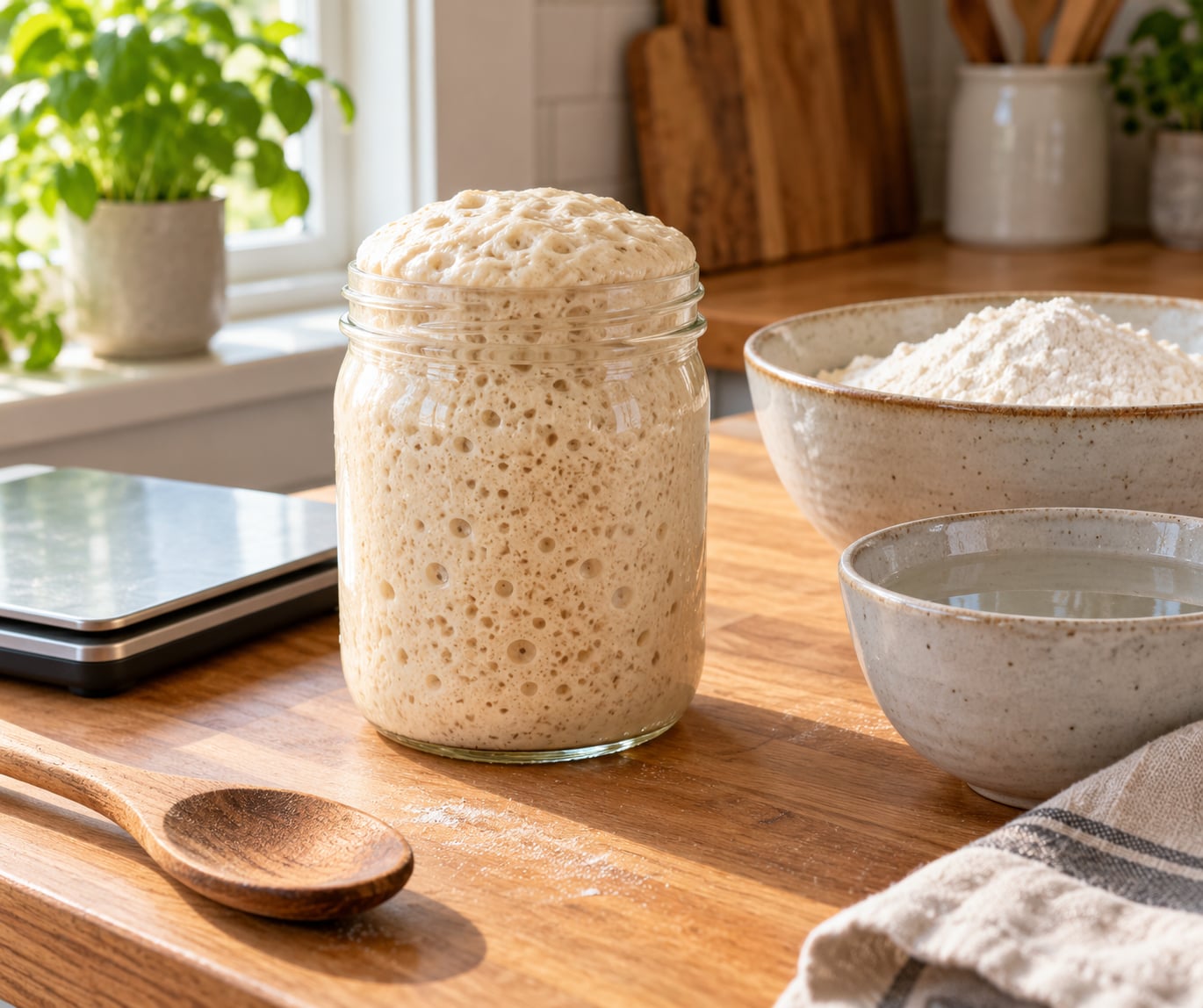
To make a sourdough starter from scratch, mix equal parts flour and water by weight in a clean glass jar, cover it loosely, and feed it once a day with fresh flour and water until it reliably doubles in size. That takes 7 to 14 days at a kitchen temperature around 26C / 78F, and sometimes longer. No special equipment, no yeast packet, and about five minutes of attention a day.
What you are building is a small ecosystem. Wild yeast and lactic acid bacteria already live on the flour you buy, and the jar is where you give them room to take over. The flour supplies food, the water keeps them moving, and the daily feed is what keeps the strongest cultures in the jar rather than letting them wash out.
Nobody can rush this. A starter that looks ready on day 9 usually makes better bread than one that passes on day 4, because the culture needs time to build enough strength to lift a wet dough. Plan on two weeks of near-daily feeding, set the jar somewhere you’ll see it every morning, and decide what you’ll do with the bits you throw away before you begin.
Table of Contents
What You Need
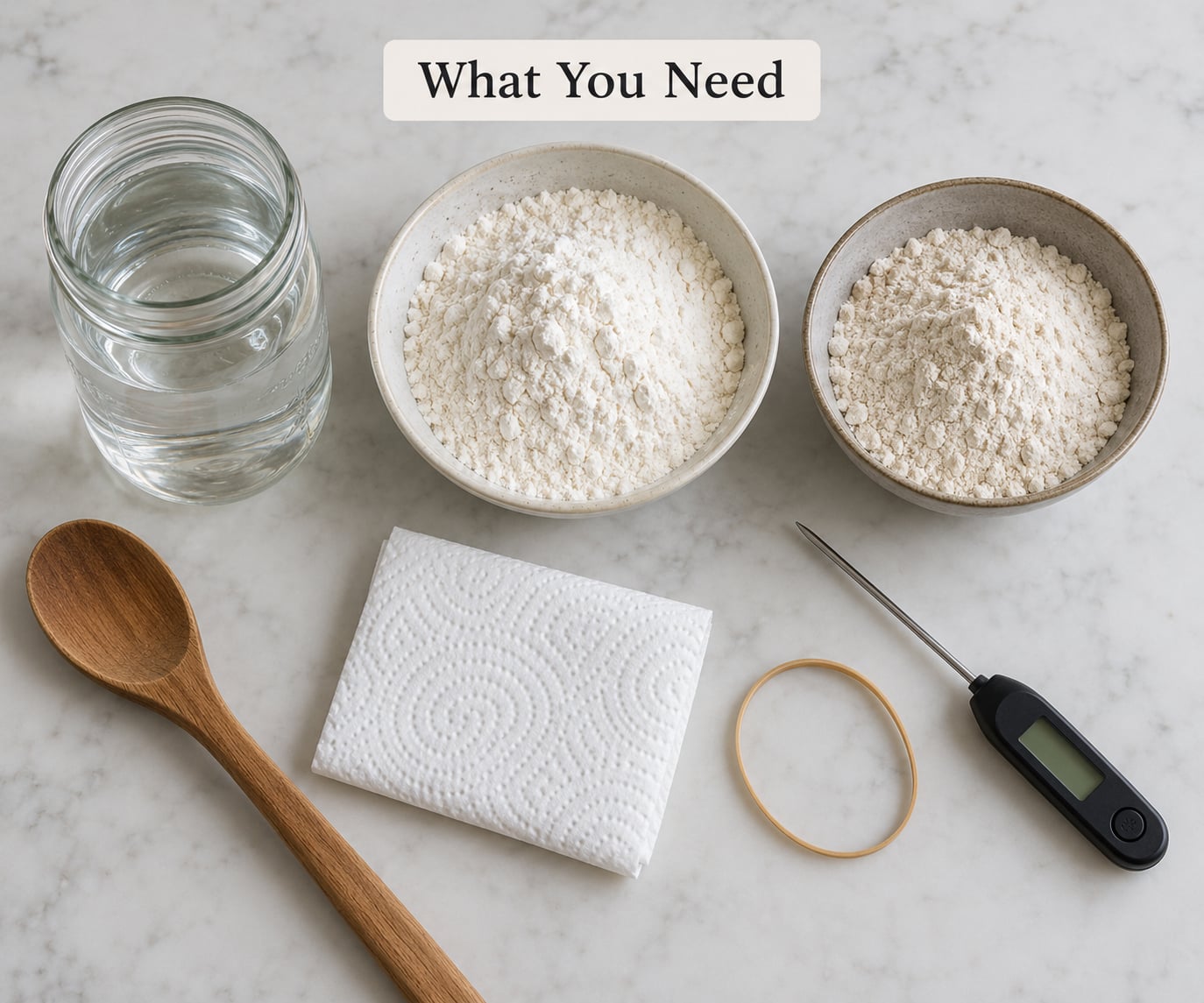
Four things do the real work: flour, water, a jar and a scale. Everything else is convenience.
- Flour. 100 to 150 g to start. Unbleached all-purpose or bread flour works, and so does whole wheat or whole rye. Whole grain ferments faster because it carries more minerals and germ, which is why many bakers begin with a whole wheat blend.
- Water. Room temperature is fine, or warm water brought to about 26C / 78F in a cold kitchen. Most tap water works. If yours smells strongly of chlorine or chlorine sits heavily on bread flavour, let it stand uncovered overnight or use filtered water.
- A glass jar. A clean pint or quart jar with straight sides. Straight sides matter because you read rise off the side, not the curve at the top. No lid needed, though a screw-top jar you loosen daily is handy.
- A digital kitchen scale. Read in grams. Cups and tablespoons vary enough between kitchens to throw off the 1:1 ratio that holds the culture steady.
- A spoon or spatula, and a rubber band. The band goes around the jar at the starting level so you can see rise against a line.
- Optional: a kitchen thermometer. Only useful if you like watching the numbers move, but it settles arguments in a cold flat.
Why does equal parts flour and water work at all? A one-to-one mix by weight gives roughly 100% hydration, which is thin and pourable but not unmanageable. Any flour that already has a raising agent in it, including self-raising and cake flour, has no place in a jar. Bleached flour is legal but slower, so unbleached buys you a few days.
How to Make a Sourdough Starter from Scratch: Step-by-Step
The order never really changes: mix it, feed it, read it, thin it out, then bake with it. Work through the stages below in sequence and the timeline will look familiar by the end of week one.
How to Make a Sourdough Starter from Scratch: Day 1
Day 1 is the mix, and it takes two minutes. Put 50 g of flour in the jar, add 50 g of water, and stir until there are no dry pockets clinging to the glass.
Rub a rubber band around the jar at the height of the batter and cover it loosely. Loose matters: an airtight lid traps carbon dioxide and can push the mixture up the jar, and a sealed jar also breeds the acetobacter bacteria that turn a starter grey and vinegary. A plate, a tea towel or a lid set on top is right.
Leave it for 12 to 24 hours somewhere out of direct sun. Expect nothing much on day 1, maybe a faint flattening. If you see bubbles and a sour or nail-polish-remover smell, good, the wild yeast is already working.
Feed the Starter Once a Day
From day 2 onward, empty about 90 percent of the jar into the bin and feed what remains. With a 1:1:1 ratio you keep about 20 g of old starter and add 20 g flour and 20 g water. That small retained amount is the carryover, and every feeding it grows until the whole thing is new culture again.
If the jar smells sharply acidic after several days at 1:1:1, widen the ratio. Add 40 g flour and 40 g water to the same 20 g of starter for 1:2:2, then try 1:5:5. A bigger feed dilutes the acid and gives the yeast more food, which is the usual fix for a starter that bubbles but never doubles.
Water temperature nudges the pace. Around 26C / 78F is the baseline. If your kitchen runs cold, use water a little warmer than the room; if it bakes up in summer, cool water slows things down to a manageable rate. Keep the jar loose and feed at roughly the same time each day so the culture learns a rhythm.
Here is the full calendar. The gram weights assume a 50 g / 50 g jar, and every feed keeps about 20 g of carryover.
| Day | Retain | Flour | Water | Time | What you will see |
|---|---|---|---|---|---|
| 1 | 50 g mix | 50 g | 50 g | 12-24 hrs | Thin paste, barely any smell |
| 2 | 20 g | 20 g | 20 g | 24 hrs | Possible small bubbles, sharp smell |
| 3 | 20 g | 20 g | 20 g | 24 hrs | Stirring feels looser, tangy |
| 4 | 20 g | 20 g | 20 g | 24 hrs | First visible rise, dome on top |
| 5 | 20 g | 20 g | 20 g | 24 hrs | The lull: low or no rise, sour smell |
| 6 | 20 g | 20 g | 20 g | 24 hrs | Bubbles at the sides |
| 7 | 20 g | 20 g | 20 g | 24 hrs | Noticeable rise for the first time |
| 8 | 20 g | 20 g | 20 g | 24 hrs | Rise to the rubber band and a little past |
| 9 | 20 g | 30 g | 30 g | 24 hrs | Clear dome, dome holds a few hours |
| 10 | 20 g | 40 g | 40 g | 24 hrs | Bubbles across the surface |
| 11 | 20 g | 50 g | 50 g | 24 hrs | Peaks then settles, sour then yeasty |
| 12 | 30 g | 60 g | 60 g | 24 hrs | Rise in 6-8 hours |
| 13 | 30 g | 70 g | 70 g | 24 hrs | Rise in 4-6 hours, honeycomb visible |
| 14 | 30 g | 70 g | 70 g | 24 hrs | Doubles reliably, floats in water |
Watch for Bubbles and a Tangy Smell
Activity is the only reliable signal, so learn what it looks like in your jar. Small bubbles along the glass, a domed top that springs back when you knock it, and a loose, aerated texture all count.
The smell changes as the culture matures. Early on it is sharp, sometimes like acetone or vinegar. That is a hungry, acidic starter, not a ruined one. Later it turns yeasty and bread-like, sometimes with a faint yogurt note. Bread on day 14 is a good sign.
Around day 4 to 6 the rise often stops or nearly stops, and the smell hardens. This lull shows up in almost every culture and it is not a death. Keep feeding at the same ratio and the rise usually returns within two or three days. Binning a starter here is the most common beginner mistake, so put the jar out of sight of the bin.
Discard and Refresh as Activity Increases
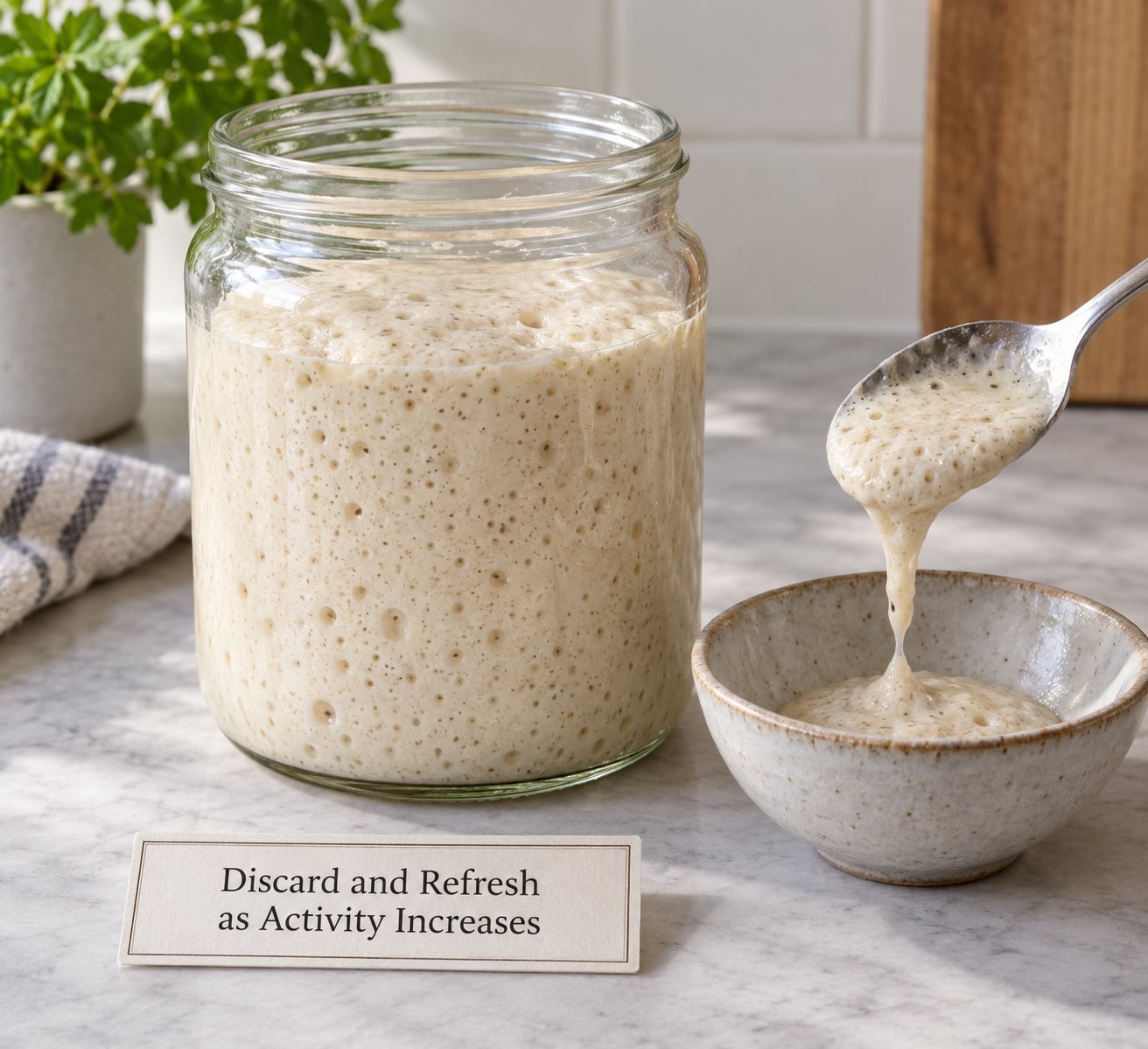
Why throw starter away at all? Because each feed adds new flour without adding any new yeast in proportion. If you kept piling it up, the acidity would climb until the culture stalled and eventually died out. The discard keeps the acid low and the culture strong.
In practice, empty most of the jar into a container, keep the portion you need for the next feed, and put the rest in the fridge. Discard is not wasted flour: it makes excellent pancakes, waffles, crackers and quick banana bread at roughly the same proportions as a wet batter.
Once the starter doubles in 4 to 6 hours you can drop to one feed every two days at room temperature, or one feed a week in the fridge. Feeding responsively beats feeding on a fixed timetable: if the jar has not risen much since the last feed, wait another few hours.
Use the Starter Once It Doubles in Size
Run these four checks before you commit flour to a loaf. All four together mean ready; one alone means maybe.
- It doubles, or better triples, within 4 to 6 hours after feeding.
- Bubbles run through the whole mass, not just the surface, so lifting it shows a honeycomb.
- It smells pleasantly sour and yeasty, never nail polish remover.
- A spoonful floats in a glass of water.
The float test is the weakest of the four. A very young starter loaded with gas can sink, and a stiff starter with gluten can sink too, so treat a sink as one data point rather than a verdict. Rise speed and structure tell you far more.
To start baking, feed the starter in the morning, wait until it peaks, then weigh out 50 g of it for a first loaf while it is still domed. The bubbly, doubled portion you set aside is a levain, and anything you take from the jar for baking without feeding first is just discard, even though it is active.
Once the loaf is out of the oven, the bread choice matters as much as the starter. Sourdough vs Rye vs Ciabatta: which bread works best for deli sandwiches compares the three in the sandwich context, and if you are layering thick fillings, how to make an overstuffed sandwich hold together covers the structural side of a very thick sandwich.
Between bakes, keep the jar in the fridge with a loose lid and feed it weekly. Some bakers dry half of it on parchment paper for a spare backup, then revive it later with equal parts flour and water.
Common Mistakes
Almost every starter problem is a ratio, temperature or timing problem, and all three are fixable. Match your symptom in the table first.
| Symptom | Likely cause | Fix |
|---|---|---|
| Bubbles but no doubling | Too acid from small repeated feeds, or too cold | Widen to 1:2:2 then 1:5:5, switch to whole wheat or rye for a few feeds, and warm the water |
| Strong vinegar smell | Overfed at 1:1:1 in a warm kitchen | Feed twice a day at 1:2:2 or move the jar somewhere cooler |
| Thin, watery, grey surface | Too much water over time, or hooch left in | Pour off the liquid, switch to a stiffer 1:1:1 mix, feed twice daily |
| Rise happens then collapses | Fed at peak instead of before the fall, or read late | Watch the jar and use the starter at the top of the rise |
| Nothing at all after 7 days | Too cold, or bleached flour only | Add a rye feed, use warmer water, and move the jar to the warmest corner |
| Hard, cracked paste | Water absorbed but no fermentation | Stir in a splash of room-temperature water and feed twice a day |
| Fuzzy pink, green or black growth | Mold, almost always from a wet jar or a rusty utensil | Discard the whole jar, scrub it, dry it fully and start again |
A few habits prevent most of the above. Weigh everything rather than eyeballing, and mark the jar so you compare rises against a fixed line. Wash the spoon between feeds and never tip water straight into the jar, since a wet rim is where mold starts.
If you skip two or three days, feed twice in a row rather than once. If you come back after a fortnight of neglect in the fridge, expect the first feed to do very little and give it three or four days. A neglected starter is dormant, not dead, as long as there is no mold and the smell is not rotten.
Frequently Asked Questions
How long does it take to make a sourdough starter from scratch?
Seven to 14 days of daily feeding is the normal range at a warm room temperature. Whole wheat and rye starters sometimes peak in four or five days, while cool kitchens can take three or four weeks. Judge readiness by activity rather than the calendar: a starter that reliably doubles in 4 to 6 hours after a feed is ready, whatever the date.
Can I make sourdough starter with all-purpose flour?
Yes, unbleached all-purpose flour is a perfectly good choice, and many first starters are built on nothing else. It activates a little more slowly than whole wheat or rye because it carries fewer minerals. If you want a faster start, mix 20 g of whole wheat or rye into your 50 g of all-purpose for the first few feeds.
Why is my sourdough starter not bubbling?
Usually temperature, not technique. A jar in a cold kitchen ferments too slowly to notice within 24 hours, so switch to water around 26C / 78F and move the jar to the warmest spot you have. Also check that the flour was unbleached and that you have actually been feeding daily rather than once a week.
What is hooch, and should I remove it?
Hooch is the grey, dark or yellowish liquid that sits on top of a starter left too long between feeds. It is not mold; the culture simply excreted it and went into a resting state. Stir clear hooch back in, feed the starter twice a day until the level stops appearing, and pour off dark hooch because it carries a heavy sour taste.
How should I store sourdough starter between uses?
For a week or two, refrigerate it in a jar with a loose lid and feed once a week. For longer storage, spread a thin layer on parchment paper, let it dry fully, then break it into pieces and keep it sealed in the freezer. To revive dried starter, soak a few pieces in equal parts water, add flour, and feed twice a day for three or four days.
How do I know my sourdough starter is ready for bread?
It should double or triple within 4 to 6 hours of a feed, show a honeycomb of bubbles through the whole mass, smell pleasantly sour and yeasty, and float in a glass of water. A peak that lasts two hours and flattens counts too, as does a dome that holds when you knock the jar. Skip any single sign on its own, especially the float test.
Conclusion
Mix 50 g of flour with 50 g of water, cover the jar loosely, and feed it once a day. That is the whole method, and the rest is attention: mark the jar, watch for bubbles and a domed top, and keep feeding through the quiet patch around day 5.
Stop counting days and start reading activity. A starter that doubles in 4 to 6 hours after a feed has everything it needs for bread, whether you got there in seven days or thirty. Once it is going, move the jar to the fridge, drop to one feed a week, and bake with the bubbly portion you take out.