
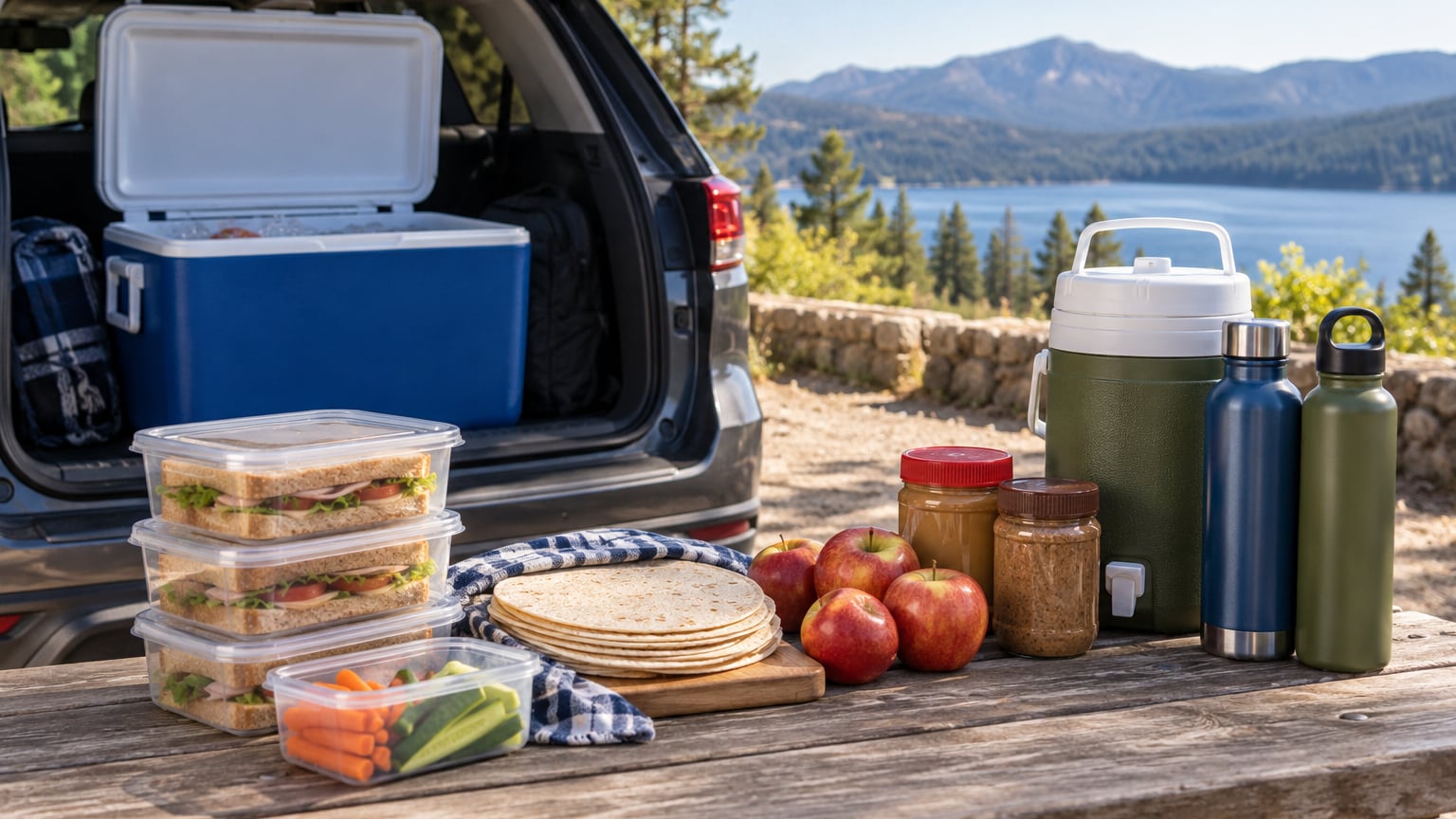
How to eat cheap on a road trip comes down to three things: shop for most of your food before you leave, keep it cold in a cooler, and treat eating out as the exception rather than the plan. Groceries bought at home cost a fraction of what the same items cost at a highway rest stop, and a packed cooler covers most of your meals on a normal driving day.
It takes about an hour of planning and one grocery run to set up a week of inexpensive eating. Below is the whole system, in the order you would actually do it.
- Set a daily food number before you shop and write it down where you can see it.
- Buy the first half of your food at a regular grocery store, not at the gas station.
- Fill the cooler with frozen water jugs instead of loose ice so it stays cold longer.
- Plan one real sit-down meal a day and let sandwiches, wraps and snacks cover the rest.
- Keep a backup meal in the car for missed exits, closed restaurants and delays.
Table of Contents
- What You Need Before You Leave
- Step-by-Step: How to Eat Cheap on a Road Trip
- Common Mistakes
- Frequently Asked Questions
- Are convenience-store meals cheaper than fast-food meals on a road trip?
- What is the cheapest food to eat while driving on a road trip?
- How long can sandwiches and leftovers stay safe in a car cooler?
- Should I buy food at grocery stores or restaurants during a road trip?
- How can I eat cheap on a road trip with kids or dietary restrictions?
- Conclusion
What You Need Before You Leave
None of this is expensive or complicated. The list is short, and every item on it earns its space in the car.
A food budget and a place to track it
Decide a per-person, per-day number and write it somewhere visible, like a note on your phone or a scrap of paper on the dashboard. A number you cannot see is a number you will blow through without noticing.
A cooler, or two coolers if you have them
One cooler is enough for a weekend. For anything longer, a two-cooler system works far better: a large cooler in the trunk for bulk items you only need once a day, and a small one in the front seat for the things you want to reach without stopping.
Frozen water jugs
They are the single best packing hack. They keep the cooler cold, they do not melt into a puddle of water by lunchtime, and you drink them as the day goes on. Travelers on road trip forums consistently say the same thing about them.
Insulated bags or soft-sided totes
These hold sandwiches and cut fruit without the whole thing tipping over in a cup holder. A bag per person also stops the food-sharing argument before it starts.
Refillable water bottles and a jug of water
Buying single-serve water at a rest stop is one of the quietest ways a road trip budget leaks money. A gallon jug at a grocery store plus refillable bottles costs a fraction of it and produces far less trash.
Reusable containers, a can opener, and utensils
Round containers stack better in a cooler. A can opener that stays in the car saves you from eating unopened cans on day three. Napkins, a stack of paper towels, wet wipes and a small trash bag handle the mess that comes with eating in a car.
An emergency food supply
Stash shelf-stable bars, a handful of nuts and a few extra water bottles somewhere passengers can reach without opening the cooler. This is the stash you eat when the exit you planned for is closed, and it keeps the cooler food untouched.
Step-by-Step: How to Eat Cheap on a Road Trip
Set a Daily Food Budget Before You Leave
Start with a total, then divide it by the number of travel days. Most people overestimate what they need on the road and underestimate how quickly convenience store snacks add up, so write the number down in two categories instead of one.
Meals get the bulk of the money. Snacks and drinks get a smaller set amount, because that is where the impulse buying happens, usually around hour three when everyone gets restless.
Keep a small emergency reserve, roughly five percent of the total, in a separate envelope. That money covers a toll plaza detour, an unexpected hotel night, or a broken-down car that turns dinner into a gas station stop. Pulling from a reserve you planned for beats pulling from the food budget.
Write the daily limit on the first page of whatever you are using to track trip spending. Every purchase then gets checked against one visible number instead of a vague intention to eat cheaply.
Buy Groceries for the First Half of the Trip
A grocery store near your house is the cheapest food you will eat all trip. Plan to resupply once, about halfway, at a supermarket in a small town where the prices are usually lower than tourist-area stores.
Build the list around portable, low-crumb, forgiving food.
- Bread and wraps. Tortillas and pita travel better than sliced bread because nothing gets squashed. They also reheat without going stale.
- Protein that keeps. Canned tuna, canned chicken, peanut butter, and jars of salsa or cheese for quick assembly.
- Crackers and pretzels. Cheap, filling, and they survive a hot trunk.
- Whole fruit. Apples, oranges, bananas, and clementines. Clementines do not bruise and do not need peeling knives.
- Raw vegetables. Baby carrots and celery travel fine and make a wrap feel like a real meal.
- Shelf-stable milk or plant milk in a small carton. No refrigeration needed if you buy the shelf-stable version.
- Individually packaged snacks. Single-serving bags of nuts, trail mix, or dried fruit so everyone gets the same amount without weighing.
What to skip is as important as what to buy. Avoid anything that needs refrigeration, anything that produces a serious mess in a moving car, and anything that cannot survive a day in a closed car on a warm afternoon.
Save the messy and fragile food for dinner at your destination. That is where a lettuce salad or a bowl of soup actually makes sense.
One more trick: buy a rotisserie chicken from the grocery store. It becomes dinner once, sandwich filling for two lunches, and a topping for whatever grain you are already packing.
How to Eat Cheap on a Road Trip at Convenience Stores
You will stop at convenience stores. That is fine. The trick is treating them as a deli with a bakery attached rather than a restaurant, and the answer to whether their food is cheaper than fast food depends entirely on what you pick up.
Compare unit prices, not package prices. A larger bag of crackers that costs a few dollars more than the small one is the cheaper option per serving. The shelf label usually lists both numbers, and that label is the most useful thing in the store.
Assemble instead of buying ready. A sandwich from the deli case plus a piece of fruit and water from a fountain costs a fraction of a prepared meal, and you control the portions.
Drink water. Fountain water is the cheapest thing in the building, and a bottle of sweet tea or energy drink is a markup on plain water plus sugar. Same money, worse outcome.
Use prepared food only when it is genuinely filling and priced like a meal. A hot dog at a convenience store is a legitimate cheap lunch when paired with fruit and a snack. A hot snack-sized item served beside a row of energy drinks is not dinner.
Restaurant-style counters at bigger truck stops and grocery deli sections are usually the better deal, and they are where you find sandwiches big enough to count as lunch.
Plan Affordable Lunches and Dinner Stops
Pick your one sit-down meal of the day and decide in advance what it is. Having the decision made in advance is what stops the expensive, impulsive version from happening at mile 300.
Cheap lunch options that do not require cooking include grocery deli sandwiches, bakery sandwiches, burrito wraps, and bagged salad kits you add dressing to yourself. Check the portion before you buy, not after. A salad kit with a small bottle of dressing is a better value than a prepared salad drenched in dressing you did not want.
For dinner, look for places with a genuine meal deal rather than a discounted appetizer menu. Early-evening hours usually cost less than prime time, and many casual restaurants run a specials board that changes daily. If you walk in and see no specials, that is your cue to look at the grocery store two blocks away.
Rest areas with picnic tables work well for dinner. Eating outside means nobody is waiting on you, the kids can move around, and you can eat what is in the cooler instead of what is on a menu. Some rest areas have grills, which turns a pile of wraps into an actual cooked meal.
If you have a hotel with a kitchenette or a microwave, cook instead. Pasta, soup, and frozen burritos cost a small fraction of a sit-down dinner and clean up in two minutes.
Our favorite packed lunches are the ones that never need a plate. Wraps held in a reusable container, cut in half, eaten in a parking lot in six minutes.
Keep Food Cold and Safe in the Car
A parked car heats up fast, so the cold chain matters more than anything else you pack. USDA guidance is simple: keep perishable food at or below 40°F, and treat anything that has been warmer than that for more than two hours as food you should not eat.
Pack coolers the night before and add frozen jugs on top. Cold sinks, so the food closest to the ice stays coldest, and anything delicate goes in first. Open the cooler as few times as possible.
For a long day of driving, keep refrigerated items in the small front cooler and take them out what you will eat within a couple of hours. Reserve the trunk cooler for drinks and non-perishables.
If you do cook, follow the safe minimum internal temperatures: 165°F for poultry, 160°F for ground meat, and 145°F for whole cuts and fish. That includes deli meat you reheat in a hotel microwave.
A refrigerator with a small freezer is not the same as a cooler, and it is worth choosing a hotel with a real fridge if you plan to use it. A mini fridge is usually about 40°F and does not chill much. Put a thermometer in it and check before you trust it.
Everything perishable that came out of the cooler can go back in after the drive. Most road trips involve more than one leftover cycle, so keeping the habit is easier than trying to re-learn it on day five.
Use Leftovers and Flexible Meal Swaps
Leftovers are the quietest savings on the whole list. A rotisserie chicken bought on day one is still dinner on day two and lunch on day three.
Use the same base more than once. Buy a large pack of tortillas and one jar of tuna, one jar of chicken, and one jar of chickpea mash. That single base produces three different wraps from the same ingredients, and none of them taste the same by day four.
Build one backup meal for the days that go wrong. Missed exit, closed restaurant, weather that turns an early start into a six-hour drive. Keep it separate from the main food so it survives the day you are dreading.
Flex means you adjust without rebuilding. Someone wants hot food, so the soup goes in the microwave. Someone else is happy with the crackers and cheese. Nobody has to cook twice.
For ideas built specifically for this, have a look at 12 cold lunch ideas for road trips and cheap sandwich ideas when deli meat costs too much. On a long route through the Midwest, regional sandwich stops are worth planning into the day before you get hungry.
Common Mistakes
Almost every road trip budget failure is one of eight predictable things.
Treating the gas station as your grocery store
Everything there carries a markup because of the roof rent and the location. Fix: pack the snacks you would actually eat, and use the convenience store for the one item you forgot, not for the whole day’s food.
Buying bottled water
It is the most common line item nobody plans for. Fix: a gallon jug plus refillable bottles, refilled whenever you pass a store or a rest area with a fountain.
Letting coffee add up
A daily drive-through stop is a recurring expense that never appears in your head as a meal. Fix: a French press or a pour-over cone and an electric kettle in the room. The kettle is usually already in the hotel room.
Eating three restaurant meals a day
Three sit-down meals a day is a hotel-room bill disguised as a food bill. Fix: one sit-down meal, two packed meals, and snacks in between.
Buying a cooler full of ice
Bagged ice is wet, heavy, and gone by afternoon. Fix: frozen water jugs that become drinking water later in the day.
Overpacking perishable food
A cooler packed with fresh meat and dairy for a week will disappoint you. Fix: treat the cooler as a two-day storage system and buy fresh food on the halfway resupply run.
Letting kids pick freely at each stop
Open access to snacks means someone eats through three items at every stop. Fix: pre-bagged snack portions in gallon zip bags, one per person per stop. It also ends the arguing.
Ignoring the small expenses
Tolls, ice, napkins, and a bottle of water add up quietly. Fix: keep a running total somewhere visible and check it once a day.
A few habits that help more than the rest: compare the shelf unit price rather than the package price, split larger packages instead of buying individual portions, and never shop when you are starving. Hungry shopping in a gas station is how budgets disappear.
Frequently Asked Questions
Are convenience-store meals cheaper than fast-food meals on a road trip?
Usually, but only if you assemble instead of grabbing something off the heated shelf. A deli sandwich plus fruit and fountain water usually comes in well under a fast-food combo. A hot prepared meal from the same store can cost as much or more, especially if it comes with a drink and chips. Compare the shelf unit prices and eat the largest, cheapest protein option you can find.
What is the cheapest food to eat while driving on a road trip?
The cheapest food while driving is shelf-stable and hand-held: peanut butter on crackers, tortillas with canned tuna, whole fruit, and nuts in small bags. None of it needs a cooler, a plate, or much cleanup, which also matters when the person eating is driving. Fill a small container rather than bringing the whole bag, because portion control stops the snack from quietly becoming a meal.
How long can sandwiches and leftovers stay safe in a car cooler?
Keep perishable food at or below 40 degrees Fahrenheit. In a cooler maintained at that temperature, sandwiches and cut fruit generally hold up for the day, and cooked foods run one to two days. Food left in a warmer cooler, or in a parked car, should be treated as unsafe after two hours above 40 degrees. If the ice melted and everything feels lukewarm, throw it out.
Should I buy food at grocery stores or restaurants during a road trip?
Grocery stores, for most of it. Plan one sit-down restaurant meal a day and cover breakfast and lunch with packed food. Grocery deli sections, bakery counters, and supermarket meal deals give you real food at a fraction of the price of a sit-down dinner. Reserve eating out for the nights when you want to be at a table instead of in the car, and keep it to one per day.
How can I eat cheap on a road trip with kids or dietary restrictions?
Both get easier once every food is packed in individual portions. Pre-bag snacks per child so nobody eats through the whole supply at one stop. For dietary restrictions, buy your own staples at home, shop the grocery store rather than the highway, and pick hotel restaurants with a full menu instead of fast food. Check labels at the store, since packaged deli meat and wraps vary a lot by brand.
Conclusion
Start with the number. Decide what you can spend per person per day, write it where you can see it, and split it into meals and snacks before you shop. Then do one grocery run at home, pack a cooler with frozen water jugs, and put one backup meal in the car that nobody else touches.
Everything after that is easy to judge, because you have a limit to judge it against.