
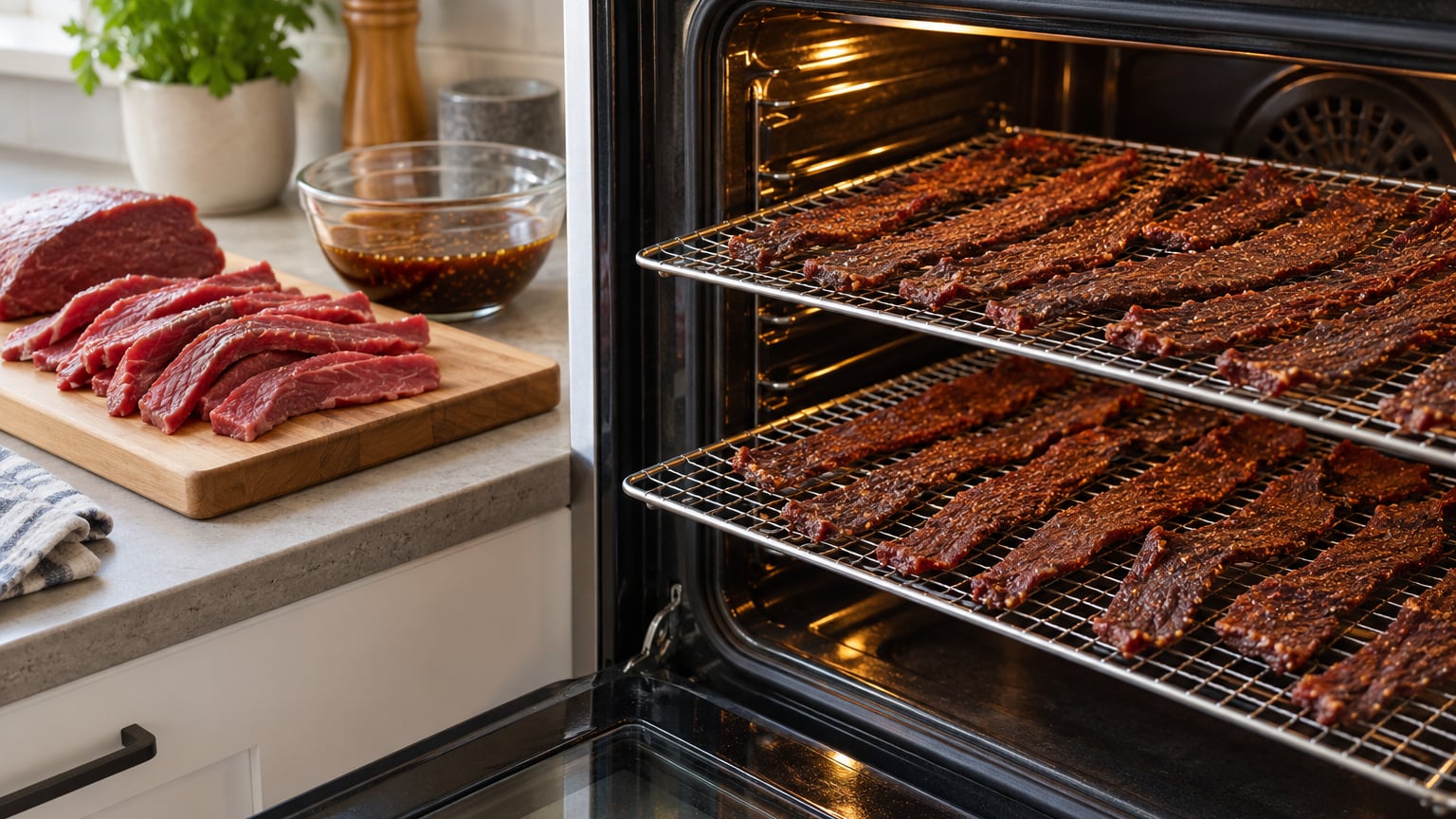
You can make good beef jerky in a regular home oven. Set it to its lowest setting (usually 170 to 175°F, or 77 to 80°C), prop the door open so moist air can escape, and dry thin marinated strips for 4 to 8 hours. Most of that time is hands-off, so how to make beef jerky in the oven is really a project you start in the morning and finish in the evening.
The catch is that ovens run hotter than food dehydrators, and the whole recipe lives or dies on temperature control, airflow and even slicing. Get those three right and the result is leathery, salty-satisfying and genuinely shelf-stable.
Table of Contents
What You Need
Start with 2 to 3 pounds of lean, fully inspected or inspected-and-cooked beef. Top round, eye of round, bottom round, sirloin tip, flank steak and skirt steak all work, and bottom round is usually the best value of the bunch.
Buy the leanest grade you can find and trim every bit of visible fat and silver skin yourself. Fat does not render at oven drying temperatures, so it stays greasy, turns rancid during storage and shortens the shelf life of the batch.
For the marinade you need low-sodium soy sauce, brown sugar or honey, Worcestershire sauce, liquid smoke, garlic powder, onion powder and black pepper. Red pepper flakes and smoked paprika suit people who like heat. Coconut aminos work in place of soy if you are avoiding gluten.
Optional but worth having: pink curing salt, also sold as Cure #1 or Prague Powder #1. It is a measured dose of sodium nitrite, and it protects colour and shelf life. It does not cook the meat, so it never replaces the safety step later on.
On the equipment side, you want a sharp knife, a cutting board, two rimmed baking sheets, wire cooling racks set inside the pans (never lay meat straight on a pan, where it steams instead of drying), heavy foil for the oven floor, a wooden spoon or block for the door, and skewers if you want to hang the strips.
Add an instant-read thermometer, a jar or bag of curing salt, and airtight containers for storage. A dehydrator is nice to have but not needed here.
One planning note: if your jerky is going into lunchboxes all week, portion it in advance alongside ideas like a sandwich that still tastes fresh at lunch. Both suffer when they sit unsealed.
Step-by-Step: How to Make Beef Jerky in the Oven
1. Choose and Trim the Beef
Lean, uniform muscle is what you want. Whole-muscle cuts dry evenly, while a fatty or heavily connected piece will dry on the outside and stay chewy in the middle.
Trim the meat on a cold cutting board: pull off the external fat cap, then shave off silver skin with the knife held at a shallow angle. Cut the trimmed roast into 2 to 3 pound sections so you can handle it and slice it straight.
How do you know the trim worked? When you bend a finished strip, it should flex and show fine surface cracks rather than snapping. Any strip that breaks cleanly means there was still fat or connective tissue holding it together.
2. Slice the Beef Into Thin Strips
Chill the beef for 20 to 45 minutes in the freezer until it is firm but not frozen solid. Cold meat slices cleanly instead of tearing, and you do not need a meat slicer.
Aim for 1/8 inch thick, and accept up to 1/4 inch for a chewier result. Thinner strips dry through faster and turn leathery; thick strips need a much longer bake.
Slice across the grain for a tender strip, or along the grain when you want more chew. Find the grain by looking for the direction the muscle fibres run and cut perpendicular to it.
Check your work: strips should be roughly the same width and thickness and bend without tearing when held with tongs. If one strip is half the thickness of its neighbour, pull the thin one and let it dry on an upper rack.
3. Make the Marinade or Seasoning
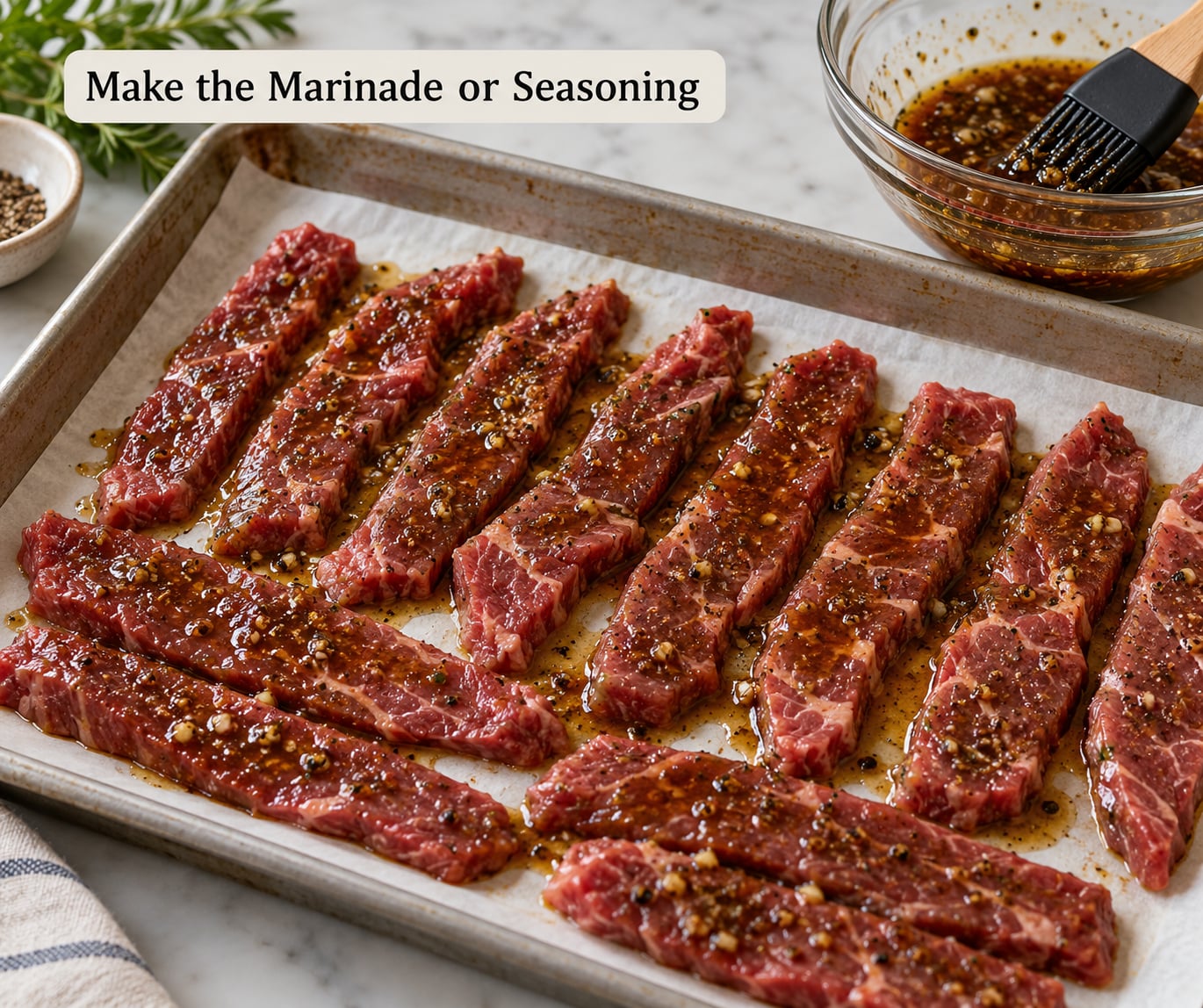
Mix 3/4 cup low-sodium soy sauce, 1/4 cup brown sugar, 2 tablespoons Worcestershire sauce, 1 tablespoon liquid smoke, 1 tablespoon garlic powder, 1 teaspoon onion powder and 1 teaspoon black pepper in a large resealable bag or container. A tablespoon of red pepper flakes and a teaspoon of smoked paprika are good additions.
Balance matters more than any single ingredient. Too much sugar burns at the edge of a long bake and turns bitter, while too much salt pulls water out of the surface and leaves you with leathery rather than chewy jerky. Start with the quantities above and adjust the next batch.
Pour the marinade over the strips, seal, and massage for a minute so every piece is coated. The coating should look glossy and even, with no dry patches and no puddle sitting at the bottom.
For a dry seasoning instead, skip the liquid entirely: toss the strips with salt, black pepper, garlic powder, onion powder and smoked paprika right before they go on the rack. Expect a purer beef flavour and a slightly softer texture, and add the liquid smoke and Worcestershire to the dry rub if you like.
4. Marinate and Drain the Strips
Marinate in the refrigerator for 24 to 48 hours. Turn and massage the strips every 6 to 8 hours so the seasoning reaches every side.
Under 8 hours the flavour is light; past 72 hours in a salty marinade the surface can go mushy and the meat loses its chew. Keep the container cold and closed, and never leave raw marinated beef on a counter, even for a quick photo.
Drain the strips in a colander for 15 minutes, then blot the surfaces dry with paper towel. Lay them on wire racks inside your rimmed sheets with a finger’s width of space between each piece. Air has to move around the meat, and any strip touching another piece dries in stripes.
How do you know the arrangement worked? Look down at the pan before it goes in: you should see rack surface between every strip, not overlapping meat.
5. Bake Low and Slow: How to Make Beef Jerky in the Oven Without a Dehydrator
Heat the oven to its lowest setting, which on most models is 170 to 175°F (77 to 80°C). If your oven only drops to 200°F (93°C), it will still work, just faster and with more risk of the edges hardening.
Line the oven floor with heavy foil to catch drips, set the racks in the middle of the oven, and arrange the sheets so air can circulate around all of them. Prop the door open with a wooden spoon or a folded cardboard block so steam escapes and the cavity temperature falls by 15 to 30°F.
The ideal drying range is 135 to 150°F (57 to 65°C). A door-cracked oven usually lands there. Some readers hold the door shut at 175°F and get faster results; that method works, but it is a hotter, smaller window, so watch it more often.
Aim for 4 to 8 hours of drying. Home cooks consistently report 6 to 8 hours as the real number, and published three-hour recipes are the single most common reason first-timers pull chewy, under-dried strips early.
If you have convection, turn the fan on for the first 30 to 60 minutes, then switch it off when you crack the door, since most ovens will not run the fan with the door open. A small fan pointed into the cavity from outside the door does the same job if you need airflow late in the bake.
After the 3-hour mark, check every 30 minutes. Rotate the sheets and swap the rack positions front to back so the back of the oven, which dries fastest, does not overshoot the strips near the door.
For thicker strips, expect the upper half of the range and pull the early finishers as they dry. Crowding the oven is the opposite of helpful: two full racks plus a closed door will turn a six-hour dry into a ten-hour one.
6. Check the Texture and Cool the Jerky
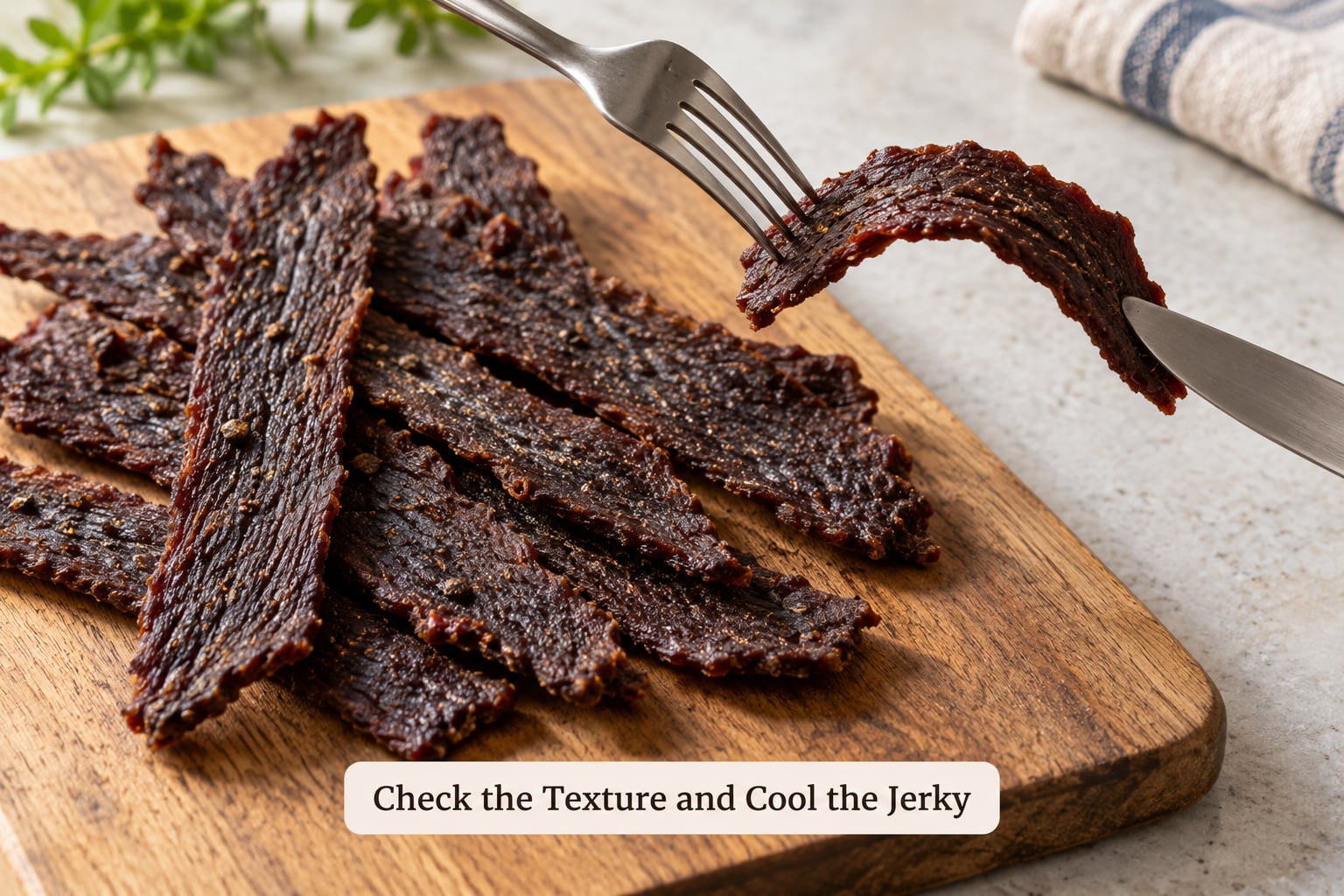
The doneness test is a bend, not a timer. Take one strip, let it cool for a minute, then curve it gently between your fingers or two tongs.
It is done when it bends into a smooth curve and the surface shows fine white cracks along the bend, without snapping or crumbling. If it snaps, it needs more time. If it bends like a rubber band with no cracks at all, it is finished. If it is brittle and dark at the edges, you have gone too far.
Jerky keeps hardening as it cools, so pull strips a touch earlier than they feel ready. The finished texture should be dry and flexible, with a deep mahogany or reddish-brown colour and a strong beef and soy aroma.
Cool the whole batch on the racks, at room temperature, away from sunlight, before you touch it or pack it. Warm meat packs in moisture and goes soft in storage.
Once cool, store it airtight. A zip bag or screw-top jar keeps jerky good for one to two weeks at room temperature, a vacuum seal stretches that to about a month, and the refrigerator or freezer adds weeks or months. If any visible fat remains on the pieces, refrigerate them.
Common Jerky Mistakes and How to Fix Them
- Uneven slicing. Thick and thin strips dry at different rates, so the thin ones burn while the thick ones stay chewy. Flash-freeze the meat 20 to 45 minutes before cutting, and use a sharp knife in one continuous motion.
- A fatty or tough cut. Fat will not render in a drying oven, so it goes greasy and rancid, and connective tissue stays rubbery. Buy the leanest grade available and trim every visible piece of fat and silver skin.
- Overcrowded pans. Touching strips have no airflow between them, so they dry in stripes. Set strips on wire racks with clear space between each one, and use a second sheet rather than doubling up.
- Too much heat. Above roughly 180°F the surface sets and browns before the moisture leaves the centre, leaving a tough shell around a chewy middle. Use the lowest setting your oven offers, crack the door, and let the cavity settle into the 135 to 150°F range.
- Marinade puddles left in the pan. Liquid trapped under the meat steams rather than dries. Drain for 15 minutes and blot the strips before arranging them, and skip basting once the bake begins.
- Over-drying. Once strips snap instead of bending, they are past the point of no return and the batch is best used as jerky powder. Start checking at 3 hours and pull early pieces as they finish.
- Skipping the safety step. USDA guidance for jerky is to bring the meat to 160°F (71°C) before the slow drying stage, which kills pathogens that survive a low-temperature dry. Sear or roast the strips in a hot pan, or blast them in a 275 to 300°F (140 to 150°C) oven for about 10 minutes, then let them cool before the main bake.
- Packing jerky while warm. Warm strips sealed into a container release trapped moisture and turn soft. Cool the full batch uncovered on the racks first, then pack.
One tip ties most of these together: log the temperature, the door position and the total bake time on a scrap of paper after your first batch. Ovens vary a lot, and the second batch always comes out better than the first because you know where your own machine sits.
Frequently Asked Questions
What temperature should I use for oven beef jerky?
Use your oven’s lowest setting, which is usually 170 to 175°F (77 to 80°C), and prop the door open with a wooden spoon so the cavity settles into the 135 to 150°F (57 to 65°C) range ideal for drying. Higher settings brown the surface before moisture leaves the centre, which gives you a tough shell and a chewy middle.
How long does beef jerky take to make in the oven?
Plan on 4 to 8 hours of drying after trimming, slicing, marinating and the short safety pre-roast. Six to eight hours is the honest number for most home ovens. Start testing texture at the 3-hour mark, because published three- to four-hour recipes are the most common reason beginners pull chewy strips too early.
Do I need a dehydrator to make beef jerky?
No. A home oven works well, though it runs hotter and less evenly, so you rely on temperature control, a cracked door and careful checking. A dehydrator holding 145°F (63°C) gives more even results with less babysitting in roughly 3 to 6 hours. The oven wins on cost and what you already own; the dehydrator wins on consistency.
What is the best cut of beef for homemade jerky?
Lean, whole-muscle cuts dry evenly and stay tender. Top round, eye of round, bottom round, sirloin tip, flank steak and skirt steak all make good jerky, with bottom round usually the best value. Avoid anything heavily marbled, and trim every piece of visible fat and silver skin because fat does not render at oven drying temperatures.
Should I marinate beef jerky before baking?
Yes, and 24 to 48 hours in the refrigerator is the sweet spot. Turn and massage the strips every 6 to 8 hours so the seasoning reaches all sides. Under 8 hours the flavour stays light, and past 72 hours a salty marinade can leave the surface mushy. Drain and blot the strips well before they go on the rack.
How do I store homemade oven beef jerky?
Cool the batch completely on the racks, then seal it airtight. An airtight jar or zip bag keeps it good for one to two weeks at room temperature, a vacuum seal stretches that to about a month, and the refrigerator or freezer adds weeks or months. If any visible fat remains on the pieces, keep them in the refrigerator.
Conclusion
Start with a lean, uniformly sliced batch and set your oven to the low end of the 170 to 175°F range. Bring the strips to 160°F for safety, then dry them slowly for six to eight hours, checking the texture every half hour after the third hour.
Write down what worked on the first batch, especially your oven’s real temperature and your strip thickness, and lean on those numbers next time. Once you know how to make beef jerky in the oven, you have a cheap, high-protein snack that travels anywhere and keeps for weeks.