
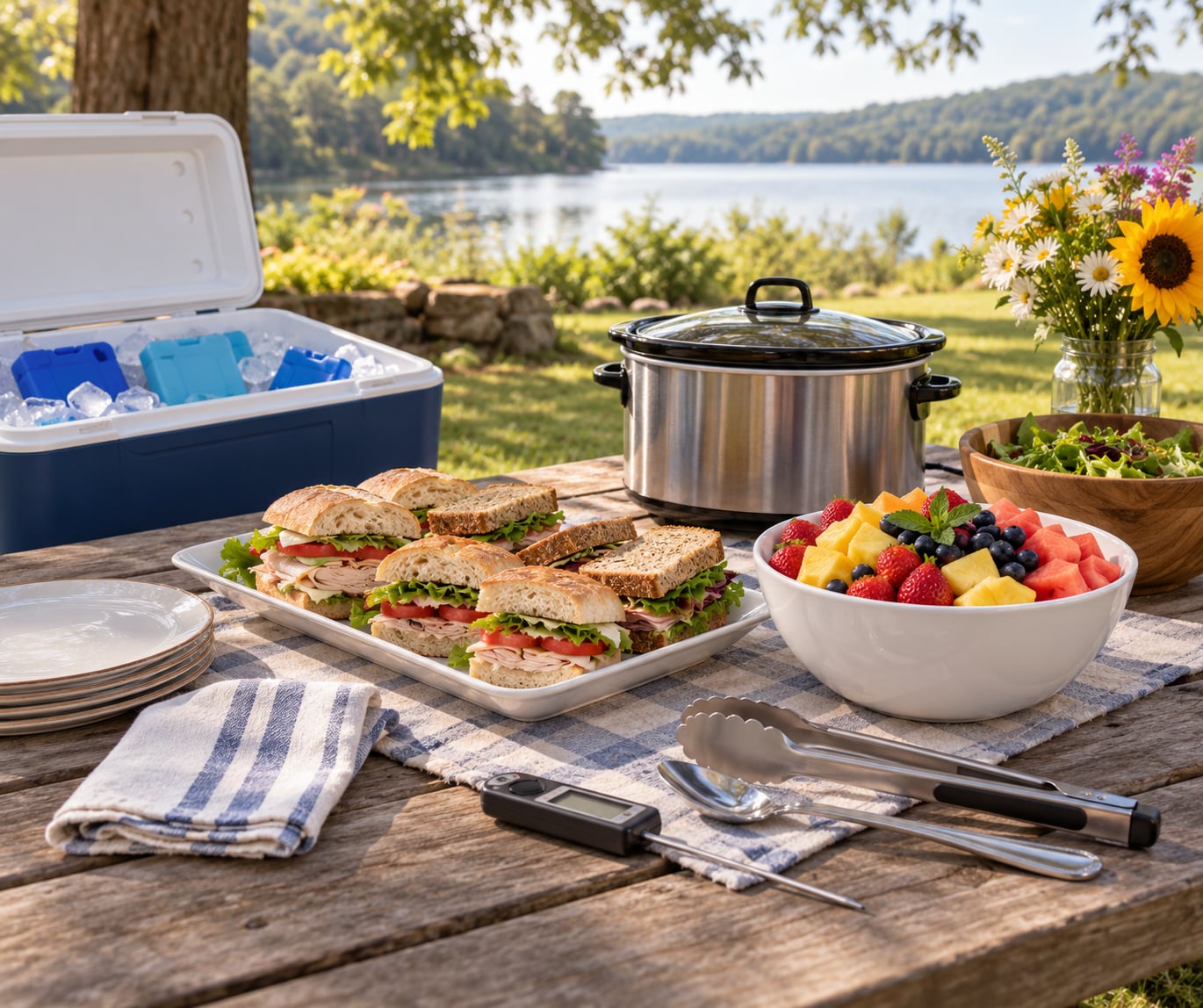
Food safety tips for picnics and potlucks come down to three numbers: keep cold food at 40°F or below, keep hot food at 140°F or above, and give perishable food no more than two hours in the danger zone between 40°F and 140°F. Above 90°F outside, that window drops to one hour.
The clock starts when food leaves your refrigerator or cooler, not when it lands on the serving table. Drive time, setup time and the first twenty minutes of grazing all come out of the same two hours, which is the part almost every host gets wrong.
The CDC estimates that roughly 1 in 6 Americans gets sick from contaminated food each year, and shared buffets are where careful habits break down. These food safety tips for picnics and potlucks are built on USDA and FDA consumer guidance, last reviewed in 2026, and are written so you can follow them without a lab coat.
Table of Contents
- Food Safety Tips for Picnics and Potlucks at a Glance
- 1. Keep Cold Food Cold From the Kitchen to the Table
- 2. Keep Hot Food Hot Until Guests Serve Themselves
- 3. Separate Raw Foods From Ready-to-Eat Foods
- 4. Check Internal Temperatures Instead of Guessing
- 5. Follow the Two-Hour Rule for Food Left Out
- 6. Reheat and Cook Food Thoroughly
- 7. Label Every Potluck Dish
- 8. Protect Guests From Allergen Cross-Contact
- 9. Chill Leftovers and Discard Food Safely
- 10. Clean Up Surfaces, Hands, and Serving Gear
- Frequently Asked Questions
- Conclusion: Start With Temperature Control
Food Safety Tips for Picnics and Potlucks at a Glance
| Tip | Safe number | Where it matters most |
|---|---|---|
| Keep cold food cold | 40°F or below | Transport and cooler |
| Keep hot food hot | 140°F or above | Buffet and warming tray |
| Limit time in the danger zone | 2 hours, or 1 above 90°F | Service and buffet line |
| Separate raw from ready-to-eat | Separate utensils and boards | Grill and buffet setup |
| Check with a thermometer | Cook to the safe internal temperature | Kitchen, before leaving |
| Reheat leftovers | 165°F | Potluck carry-in and warming |
| Label every dish | Name, allergens, date made | Table setup |
| Guard against allergen cross-contact | One utensil per dish | Self-serve buffet |
| Chill leftovers fast | Refrigerate within 2 hours | Pack-down and cleanup |
| Clean hands and surfaces | Wash with soap and water | Before handling and after eating |
1. Keep Cold Food Cold From the Kitchen to the Table
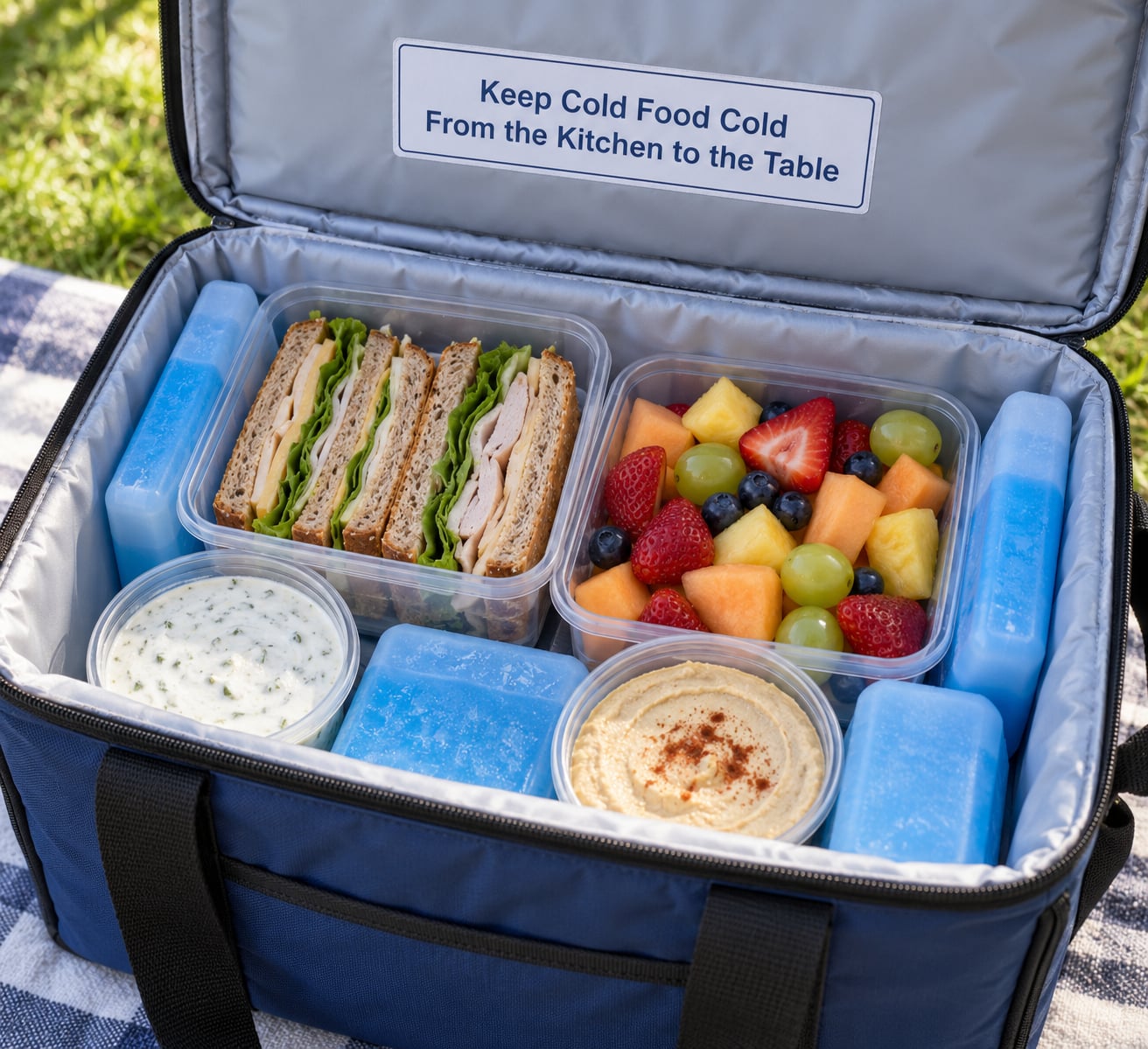
Chill the food, the containers and the cooler itself the night before. A cooler that starts at refrigerator temperature holds 40°F far longer than one loaded with warm leftovers on a warm morning.
Pack perishables last and unpack them first. I keep beverages in one cooler and sandwiches, cut fruit and dips in a second, mostly because every time someone cracks a soda the food cooler loses cold air.
Why food safety tips for picnics and potlucks matter most in summer heat
Heat is the multiplier. On a mild day a packed cooler can hold food safely for hours; on a hot day with the lid propped open and sun bouncing off the table, the same cooler gives up its margin in under an hour. Park the coolers in shade, keep lids closed, and refill them from a second chilled batch rather than topping up the empty one.
A few packing habits that actually work: use shallow containers rather than one deep bowl, freeze gel packs flat so they fit tight against the food, and put a food thermometer in the cooler so you can check the middle of the stack instead of guessing from the top.
For the gear side, our picks for coolers for picnics and tailgates and ice packs that hold their cold cover most of what a packed cooler needs.
2. Keep Hot Food Hot Until Guests Serve Themselves
Hot holding means 140°F or above, not merely warm. A casserole that leaves a 170°F oven and cools on the car seat for thirty minutes can drop into the 90s before it ever reaches the table.
Insulated carriers help, but only when you preheat them. Fill them with boiling water for ten minutes before the food goes in, and use a fuel chafing dish or a slow cooker on high for anything longer than about an hour of service.
Check the temperature twice: once right before you set the dish out, and again about thirty minutes into service. It is normal for a tray to lose 10°F in the first half hour and then stabilize, so an early reading tells you whether the carrier is doing its job.
Serve hot food in smaller batches and refill from the kitchen. A half-empty tray warms faster than a full one, and refilling keeps the second batch out of the danger zone until guests actually want it.
3. Separate Raw Foods From Ready-to-Eat Foods
Cross-contamination happens when juices, a shared board or a shared spoon moves bacteria onto food people eat without further cooking. Burgers and grilled chicken cooked on the grill are fine; a platter of raw burgers sitting next to the buns is not. These food safety tips for picnics and potlucks treat raw meat as its own category for a reason.
At a backyard cookout, cook raw meat on one side of the grill and move cooked food to the other, or use separate tongs and a clean plate. Never return cooked meat to the plate that held it raw.
At a potluck buffet, give every dish its own serving spoon or tongs and put them in the dish. A spoon that travels from a potato salad to a bowl of grapes is a shared spoon, no matter how clean it looks.
Marinades and grill juices get treated like raw meat. If you baste with marinade, boil it first, or keep a separate clean brush for basting.
4. Check Internal Temperatures Instead of Guessing
Color and time are unreliable. A food thermometer is the only tool that tells you when a thick potluck dish, a burger or a piece of poultry has reached its safe internal temperature.
Insert the probe into the thickest part, away from bone, and for ground meat stir the reading a couple of times. For a big casserole, check the center rather than the edge.
| Food | Safe minimum internal temperature |
|---|---|
| Poultry, ground poultry, stuffing | 165°F (74°C) |
| Ground beef, pork, veal | 160°F (71°C) |
| Beef, pork, lamb, veal steaks, chops, roasts | 145°F (63°C) plus a 3-minute rest |
| Fish and shellfish | 145°F (63°C) |
| Eggs and egg dishes | 160°F (71°C) |
| Leftovers and casseroles for reheating | 165°F (74°C) |
These are the USDA consumer figures. Resting matters too: a steak pulled at 145°F keeps cooking during the pause, which is why the number comes with a wait.
5. Follow the Two-Hour Rule for Food Left Out
Perishable food should not sit unrefrigerated longer than two hours, and no longer than one hour when the outdoor air temperature is above 90°F. Time in the car, time in a cooler that is no longer cold, and time on the serving table all count toward that limit.
You cannot reset the clock by putting a dish back on ice. Bacteria multiply in the 40°F to 140°F danger zone, and once two hours have passed there, the food has to go in the trash. That is not a call about how it looks or smells; only time and temperature decide.
Appetizer trays go first. A bowl of deviled eggs, a dip with a spoon in it, or a cheese plate that guests have been reaching into for an hour can be well past the limit even while the main dish is still being served from a warmer.
As a guest, you rarely know how long a dish has been out. When in doubt, skip the dish that has been sitting in the sun with no ice under it and pass on the tray a host picked up from their porch hours earlier.
6. Reheat and Cook Food Thoroughly
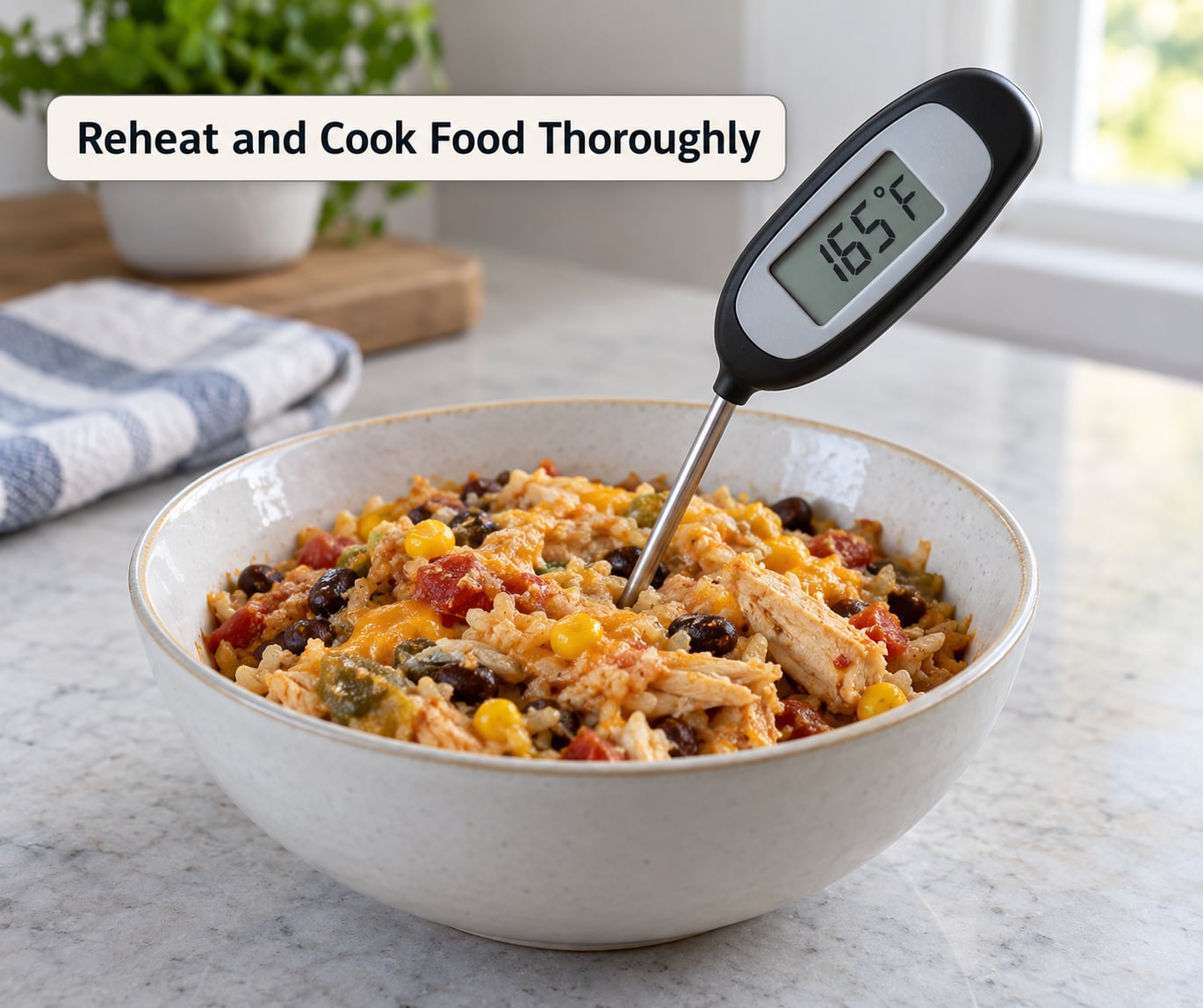
Bring casseroles and soups already cooked, then reheat them on site to 165°F. Partially cooking at home and finishing at the event leaves food sitting in the middle of the temperature range, which is exactly what you want to avoid.
Microwaves heat unevenly, so stir halfway through, check the center, and give the dish another thirty seconds if any part is still cool. The coldest spot in a reheated bowl is usually the middle, right under the lid.
Slow cookers and warming trays are holding equipment, not cooking equipment. A warm setting is not a validated safe holding temperature, and a crockpot left on warm overnight can hold food in the danger zone for hours without ever reaching 165°F. Reheat properly or bring a different dish.
If a hot dish cannot be kept hot on the way to the event, a common trick is to transport it cold in sealed containers and reheat it when you arrive. Gravy and soups freeze well and reheat better than most casseroles.
7. Label Every Potluck Dish
A small index card solves three problems at once: guests with allergies can decide quickly, first-time visitors know what they are eating, and you can see at a glance which dish has been sitting out longest.
Write four things on the card: the dish name, the major allergens it contains (dairy, eggs, nuts, peanuts, soy, wheat, shellfish, fish), any dietary label such as vegan or gluten-free, and the date it was made. For anything vegetarian or gluten-free, say what was substituted so nobody has to guess.
Tape the card to the container rather than to a disposable plate. If you are transporting a dish cold in a cooler, label it before it goes in so you can match it to the right container later.
8. Protect Guests From Allergen Cross-Contact
For most people, food allergy means a trace amount on a shared spoon, not a whole serving. Cross-contact at a buffet happens through shared utensils, cutting boards, serving spoons and tongs, and it is the reason a dish can be unsafe for one guest and perfectly fine for everyone else.
Put a dedicated utensil in every dish that contains one of the big eight allergens, and do not let guests bring their own spoon into a dish meant for someone with an allergy. If a guest tells you they have a serious allergy, ask which dish and plan for them before the food goes out, not after.
Serve allergen-free dishes first and cover them when they are not in use. Guests with allergies often end up taking small portions first so they are not choosing from a buffet that everyone else has already worked over.
9. Chill Leftovers and Discard Food Safely
Food that stayed cold or stayed hot the whole time goes back into the refrigerator within two hours, in shallow containers so it chills quickly. Divide a big casserole into single-serving dishes; a deep pan can still be warm in the middle hours later.
Food that sat in the danger zone past the limit does not get saved by refrigerating it later. Put it in the trash while you are packing up rather than carrying a dish home out of politeness, and let the host know you tossed it so nobody eats from it.
Cooked leftovers keep about three to four days in the refrigerator. If a dish has been out at a potluck since morning and nobody put it in a warmer, treat it as compost rather than lunch.
Two-day office and church potlucks need a different plan: bring the dish cold and refrigerate it overnight, then warm it to 165°F and serve for no more than two hours. If the refrigerator cannot hold it, bring a dish that does not need cooling at all. When the headcount is the open question, our office lunch planning guide by headcount works through the quantities.
10. Clean Up Surfaces, Hands, and Serving Gear
There is usually no running water at a picnic, so plan for it. Bring a jug of warm water, soap and paper towels, plus hand sanitizer as a backup for the moments when nobody wants to stop and wash.
Wash for at least 20 seconds before handling food, after using the restroom, after touching animals and after handling money. Sanitizer alone is not a substitute when hands are visibly dirty, especially with raw meat on them.
Set out a clean table surface rather than a blanket or the tailgate of a car, and wipe down any surface that touches food. Spills get cleaned right away; dried sauce is a cross-contamination surface waiting for the next dish.
Keep pets out of the food area entirely. Pack perishable trash into a bag and get it into a cooler with ice before it sits in the sun, and drain and dry coolers before you close them up.
Frequently Asked Questions
What is the 2 2 2 rule for food safety?
The 2 2 2 rule is a memory aid for picnics and potlucks: keep perishable food out of the danger zone for no more than 2 hours (1 hour above 90°F), get it back into a refrigerator or cooler within 2 hours, and reheat leftovers to 165°F. The clock starts when food leaves cold storage, so travel time counts.
Why do some sources say 41°F and 145°F instead of 40°F and 140°F?
Both are correct for their own setting. USDA consumer guidance uses 40°F for cold holding, 140°F for hot holding and 90°F as the outdoor trigger for the one-hour rule. The FDA Food Code, which governs restaurants and retail food service, uses slightly higher figures of 41°F, 145°F and 95°F. Home cooks should follow the USDA numbers.
Is it safe to eat food that sat out for four hours?
No, if that food was perishable and stayed between 40°F and 140°F for four hours, it should be discarded. The two-hour consumer rule is stricter than the four-hour rule used in some restaurant settings because home equipment and temperature control vary. If you are unsure how long a dish was out, throwing it away is the safe call.
Can I leave a slow cooker on warm overnight?
No. A warm setting is not designed to keep food at 140°F or above, and a crockpot switched off at bedtime leaves food sitting in the danger zone for hours. If you need to feed a group early, cook the food to its safe temperature first, then keep it above 140°F and serve it within two hours.
What can I bring to a potluck when I cannot keep food hot or cold?
Bring something shelf-stable: whole fruit, crackers, chips, nuts, bread and rolls, unopened jars of shelf-stable condiments, or packaged snacks. Avoid anything with dairy, eggs, meat, seafood or cut fruit, plus dips, salads and cream-based desserts. If the dish is a must, transport it cold and reheat it on site to 165°F.
Conclusion: Start With Temperature Control
Nearly every picnic foodborne illness traces back to food sitting between 40°F and 140°F for too long, and most of those are avoidable with a cooler, a thermometer and a watch. Temperature control is the whole ballgame; the rest is detail on top of it.
Before the guests arrive, do three things. Chill cold foods to 40°F or below and pack them last into an iced cooler. Heat hot dishes to 140°F or above and check them before they go out on the table. And track the clock from the moment food leaves your kitchen, because that is when the two-hour window really starts.
Everything else in these food safety tips for picnics and potlucks, from labeling to hand washing to how you pack up at the end, exists to protect that temperature. If you want a printable version, the table above is the whole checklist on one page.