
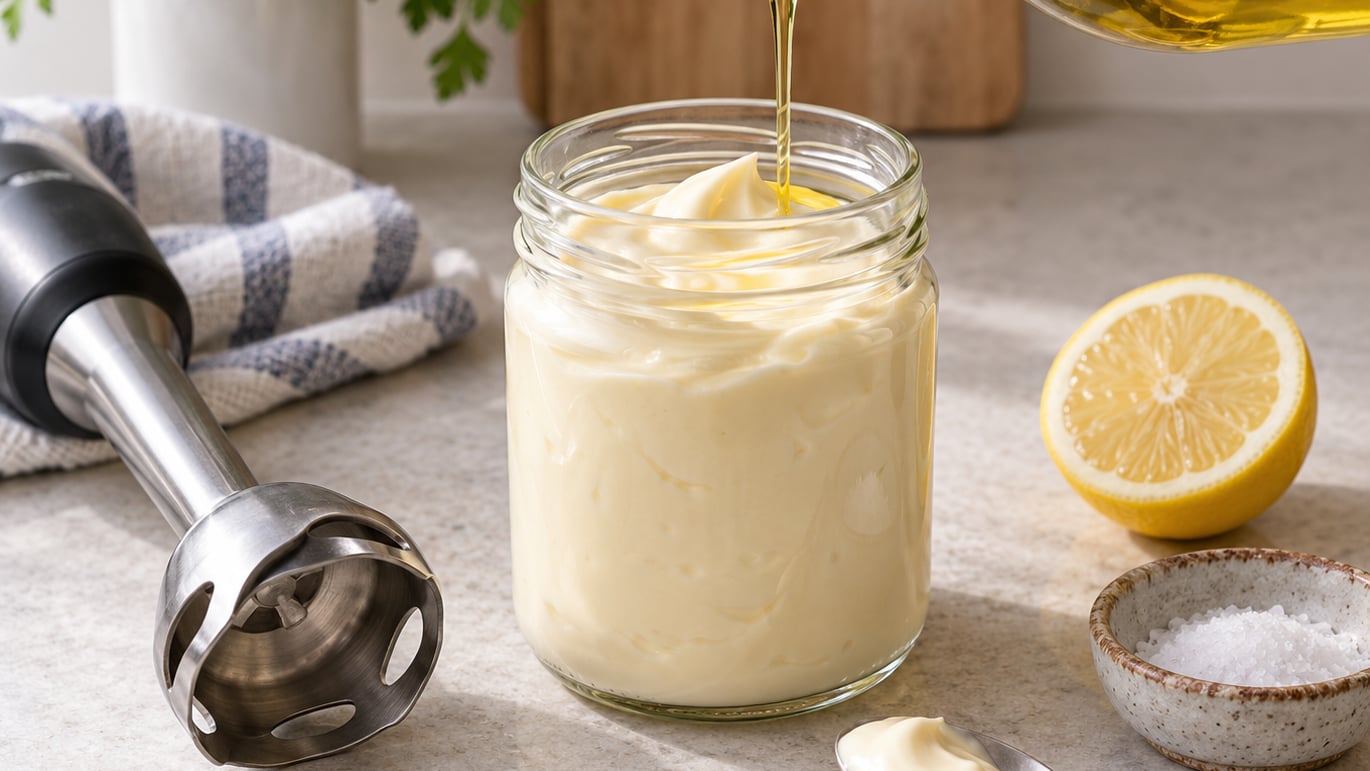
Homemade mayonnaise is an emulsion of egg yolk, a neutral oil, and an acid such as lemon juice, blended until it turns thick, glossy and stable. With an immersion blender and a jar, it comes together in about five minutes using one egg, one cup of oil, a tablespoon of lemon juice, a teaspoon of Dijon mustard and a pinch of salt.
The only hard part of this recipe is emulsification, which is just the process of suspending tiny droplets of oil in water so they stop separating. Once you know what a finished sauce looks like and how to rescue one that breaks, this stops being finicky.
Below is the base recipe with exact amounts, three ways to blend it depending on your equipment, how to tell it worked, and the fixes for the two problems that come up most: mayo that turns oily and mayo that stays thin.
Table of Contents
What You Need
The base recipe needs five ingredients. Anything beyond that is seasoning you add at the end.
- 1 whole egg plus 1 egg yolk — the yolks are the emulsifier, and the extra yolk gives you a thicker, more stable sauce
- 1 cup (240 ml) neutral oil — avocado, canola, grapeseed, sunflower or vegetable
- 1 tablespoon lemon juice — or 1 tablespoon white wine vinegar or distilled white vinegar
- 1 teaspoon Dijon mustard — its mustard proteins help hold the emulsion together
- 1/2 teaspoon kosher salt, plus more to taste
Room temperature is not a nicety here. Cold oil and cold yolks refuse to emulsify, so take everything out of the fridge about 20 minutes before you start.
Which oil to use
Reach for an oil that tastes like nothing. Extra virgin olive oil has compounds that fight the emulsion and can leave the finished mayonnaise tasting bitter and heavy, which is exactly what people describe when they say homemade mayo tastes wrong. If you only have olive oil in the house, a light olive oil blended with canola works far better than a peppery bottle.
Immersion blender, food processor or whisk
All three work. They differ mostly in speed and how much attention they demand from you.
- Immersion blender: 1 to 2 minutes of active time, needs a stick blender and a narrow jar or tall cup, the easiest of the three, yields about 1.5 cups
- Food processor: 5 to 10 minutes, needs a bowl and blade or the feed tube, moderate difficulty, yields about 1.5 cups
- Whisk: 12 to 15 minutes, needs a whisk and a wide bowl, the hardest of the three, yields about 1 cup
The immersion blender wins because you never have to stop and drip oil into a moving stream. Home cooks on cooking forums point to it as the most consistently successful method, largely because the blade does the emulsifying while your hand stays still.
The 3-ingredient version
You can make mayonnaise with three ingredients: 1 egg yolk, 1/2 cup neutral oil and 1 teaspoon lemon juice. It works because the yolk alone carries enough lecithin to hold that smaller volume of oil, but it will be thinner and looser than the full recipe, so add oil slowly and stop when it looks right. Add the mustard and salt back in whenever you can. They cost nothing and they are what makes the sauce taste finished rather than just emulsified.
Once the jar is empty, the mayonnaise earns its keep in ways that go past plain sandwiches. It is the base for chicken salad, tuna salad, potato salad, deviled eggs and crab cakes, and it turns into aioli or tartar sauce with a couple of extra additions. If you like building lunch that holds together, see how to make an overstuffed sandwich hold together.
How to Make Homemade Mayonnaise Step by Step
Total time is about five minutes with an immersion blender, including cleanup. Read the whole method once, set out everything, and do not walk away mid-pour.
Step 1: Gather and Measure the Ingredients
Crack 1 whole egg and 1 yolk into the bottom of a narrow jar or tall cup. The narrow shape matters more than people expect: a wide bowl gives the oil too much room to pool instead of emulsifying.
Add the tablespoon of lemon juice, the teaspoon of Dijon and the salt. Each of these three plays a different job. The yolk provides the lecithin that coats the oil droplets. The acid lowers the pH so the yolk proteins loosen up and stop repelling oil. The mustard adds its own emulsifying proteins and a sharpness that balances the fat.
Measure the oil into a separate container before you begin. Pouring straight from the bottle gives you no control over the rate, and rate is everything in this recipe.
Step 2: Blend the Egg Yolk Base
Blend the yolk, acid and mustard on medium speed for about 15 seconds, until the mixture is smooth and pale yellow. If it looks foamy and slightly thickened, you are ready for oil.
Skipping this step is the second most common reason homemade mayonnaise fails. Oil added to an unbroken yolk slides straight down the side of the bowl and pools at the bottom.
Step 3: Slowly Emulsify the Oil
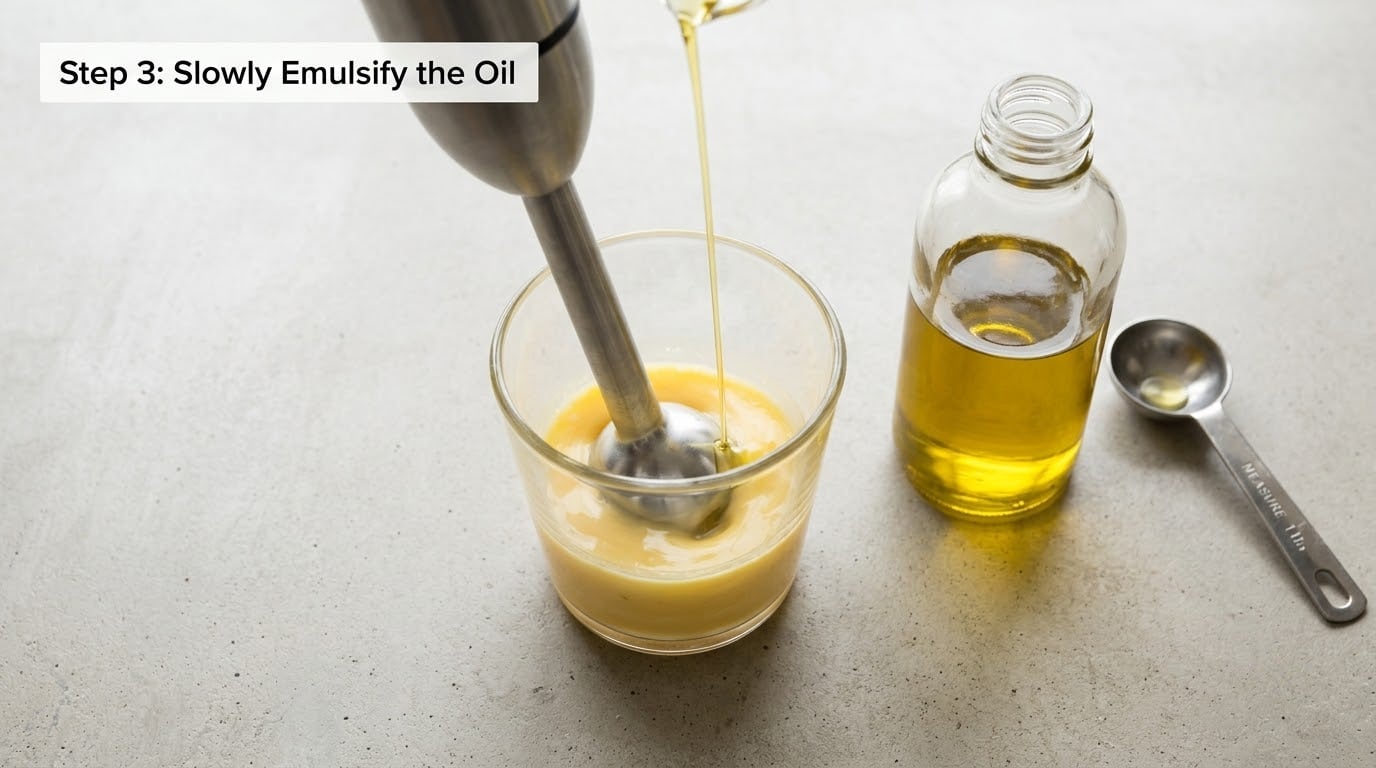
Set the blender into the jar and let it run for about 10 seconds before anything happens. Then keep the blade head down at the very bottom of the liquid and start pouring the oil in a thin, steady stream. That one instruction — hold the blender at the bottom and do not lift it — separates failures from successes more than any other tip in this recipe.
Watch the mixture climb the sides of the jar as you pour. Thickening from the bottom up means the oil is being broken into droplets rather than pooling. If the surface stays flat and clear, you are pouring too fast.
Keep the oil moving at that slow trickle until all 1 cup is gone, then blend another 20 seconds. When the sauce is done it will coat the back of a spoon, hold a soft peak when you lift the blender, and look glossy rather than matte.
Step 4: Season and Check the Texture
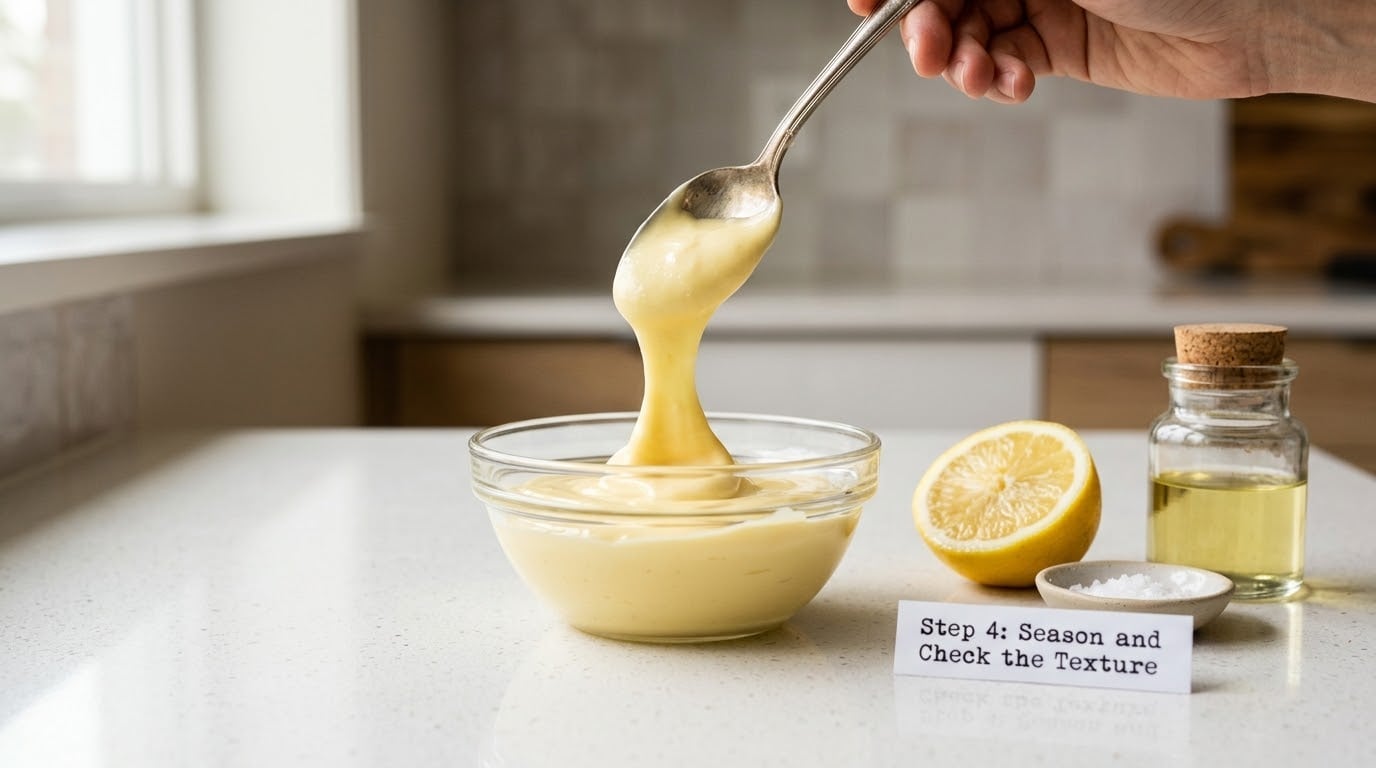
Taste with a clean spoon. Add salt a pinch at a time until the richness settles, and add a few more drops of lemon juice if the sauce tastes flat rather than sharp. An under-seasoned mayonnaise reads as greasy because fat is the only flavor on the tongue.
If it is thicker than you like, thin it with a teaspoon of warm water at a time. Water is gentler on the emulsion than more oil, and it is the standard move when the sauce turns out stiff.
Flavor variations that taste restaurant-grade
Restaurant mayonnaise tastes better mainly because it has more acid and more seasoning than most home batches. Once the base sauce works, changing the flavor takes seconds.
- Aioli: add 1 to 2 grated garlic cloves and a second tablespoon of lemon juice
- Tartar sauce: fold in 2 tablespoons finely chopped dill, gherkins or capers
- Chipotle mayo: mix in 1 tablespoon chipotle in adobo, plus a squeeze of lime
- Wasabi mayo: stir in 1 to 2 teaspoons of wasabi paste
- Ranch-style mayo: add 3 tablespoons buttermilk, 1 teaspoon dried dill, garlic powder and a pinch of paprika
- Herby spread: fold in a tablespoon of chopped chives, tarragon or basil
When the mayo is part of a sandwich, treat it like any other fresh spread and keep it cold on the way to work. How to make a sandwich that still tastes fresh at lunch covers the rest of the cold-chain side.
Step 5: Transfer and Store
Scrape the mayonnaise into a clean jar with a tight lid. Leave no headspace if you can help it, since air and a warm jar both encourage spoilage.
Refrigerate immediately and keep it below 40°F (4°C). Treat seven to ten days as the practical window in the fridge, which matches what cooks on cooking forums report about jars lasting one to two weeks before flavor or smell shifts. Commercial mayonnaise survives on the shelf because of preservatives and a high acid load; a homemade jar has neither.
Do not rely on smell alone, because you will not smell danger bacteria. Discard the mayo if it sits at room temperature for more than two hours, if the lid was left off, or if anything about it looks off: a pink or grey tint, visible separation that does not remix, or a sour, sulfurous smell. A thin layer of oil on top after a day in the fridge is normal; a whole jar of split liquid is not.
Freezing works for about two months in an airtight container, though the texture turns slightly grainy after thawing. Freeze it in small portions rather than one large jar so you only thaw what you need.
Is Homemade Mayo Safe? Raw Egg and Food Safety
Raw egg is the honest objection to this recipe. Unpasteurized eggs can carry Salmonella, and mayonnaise made at home is not heated, so the risk is real rather than theoretical. That is the reason store-bought mayo can sit on a shelf and yours cannot.
Three things reduce the risk. Buy pasteurized eggs, which are heat-treated in the carton and widely available in the refrigerated section. Or use a yolk-only version, which is milder in flavor. And keep the finished jar cold and use it within a week to ten days.
People at higher risk from foodborne illness, including pregnant people, young children, older adults and anyone with a weakened immune system, should use pasteurized eggs and follow the same cold-storage rules.
Common Mistakes
Every failure below is fixable. Even a split batch is not a lost batch.
How to fix broken homemade mayonnaise
Broken mayonnaise looks like a clear layer of oil floating on watery liquid. The emulsion has separated, which means the droplets clumped together and are no longer suspended. Pick the rescue that matches how far it went.
- Fresh yolk rescue: put a new egg yolk in a bowl and slowly pour the broken mixture into it while whisking constantly. This is the most reliable fix and the one cooks most often recommend.
- Extra yolk rescue: add one more yolk directly to the broken sauce and blend hard for 30 seconds. Works when the split is minor.
- Warm water rescue: for a sauce that is only slightly too loose, beat in a tablespoon of warm water, a little at a time.
The mayo stayed thin and never thickened
Almost always one of three causes: the oil went in too fast, the base was not blended before the oil was added, or the ingredients were cold. Next time start the blend, hold the tool at the bottom of the vessel and add a slow trickle. You cannot add oil too slowly, only too quickly.
The mayo turned greasy or bitter
Bitter and heavy usually means extra virgin olive oil. Greasy and thin usually means the emulsion never caught. Neither is a lost batch; start again with a neutral oil and be patient in step 2.
The mayo split again after a day in the fridge
A film on top is fine and sticks back in. Full separation means the batch was already on the edge when you jarred it. Thicken it with a fresh yolk next time, and if you regularly hit this, reduce the oil to 3/4 cup per yolk.
The mayonnaise tastes too sour
You either added the full tablespoon of acid twice or used a vinegar you did not enjoy undiluted. Start with half the acid, taste, then add the rest.
If you want the sharpness without any risk of over-salting the sandwich, a splash of vinegar and salt works as a shortcut side. How to make sub shop-style oil and vinegar at home is a good comparison for the acid side of flavor.
Frequently Asked Questions
Can I make homemade mayonnaise without an immersion blender?
Yes. A food processor takes 5 to 10 minutes: blend the yolk, lemon juice, mustard and salt until smooth, then drizzle the oil through the feed tube with the machine running. A whisk works too, but expect 12 to 15 minutes of steady arm work and a thinner sauce. The blender methods win mainly because they are faster, not because the other two fail.
Why did my homemade mayonnaise break or turn greasy?
The oil went in too quickly, or the yolk base was not blended smooth before the oil was added, or the ingredients were straight from the fridge. To fix a broken batch, pour the separated liquid very slowly into a fresh egg yolk while whisking, or beat in one more yolk for 30 seconds. Prevention is easier than rescue: hold the tool at the bottom and add a thin stream.
How long does homemade mayonnaise last in the refrigerator?
Seven to ten days is the practical window when the jar is sealed and kept below 40°F (4°C). Two weeks is the outside edge some cooks report. Discard it if it separates and will not remix, shows any pink or grey tint, develops a sour or sulfurous smell, or has been at room temperature for more than two hours.
Can I use vinegar instead of lemon juice?
Yes. White wine vinegar and distilled white vinegar both work at the same tablespoon measure, and they give a sharper, more classic pickle flavor. Avoid red wine vinegar and balsamic, which are dark and acidic enough to overpower the sauce. If you are cutting the acid, add it a half measure at a time and taste before adding more.
How can I make homemade mayonnaise thicker?
The simplest lever is egg ratio. One whole egg plus one yolk makes a noticeably thicker sauce than one yolk alone, and two yolks per cup of oil makes it thicker still. Other options: add oil very slowly at the end, chill the jar for 30 minutes, or fold in a teaspoon of softened cream cheese. Thickening with flour or starch makes it a salad dressing, not mayonnaise.
Is homemade mayonnaise safe to eat?
It is, with the right precautions. Raw egg carries a real Salmonella risk, so use pasteurized eggs, or a yolk-only version for a milder flavor, and refrigerate the finished jar at or below 40°F (4°C) and use it within seven to ten days. Pregnant people, young children, older adults and anyone immunocompromised should stick to pasteurized eggs.
Conclusion
Start by setting out one whole egg, one extra yolk, a cup of neutral oil, a tablespoon of lemon juice, a teaspoon of Dijon and salt, and let them sit out for 20 minutes. Blend the yolk base until smooth, hold the immersion blender at the bottom of the jar, and trickle the oil in slowly until the sauce thickens and turns glossy.
That is the whole method. Taste before you jar it and adjust the salt and acid, because a bowl of mayonnaise that is seasoned properly tastes noticeably better than anything from a squeeze bottle. Keep it cold, use it within about a week, and throw it out on any sign of separation or off smell rather than trying to rescue it a second time.