
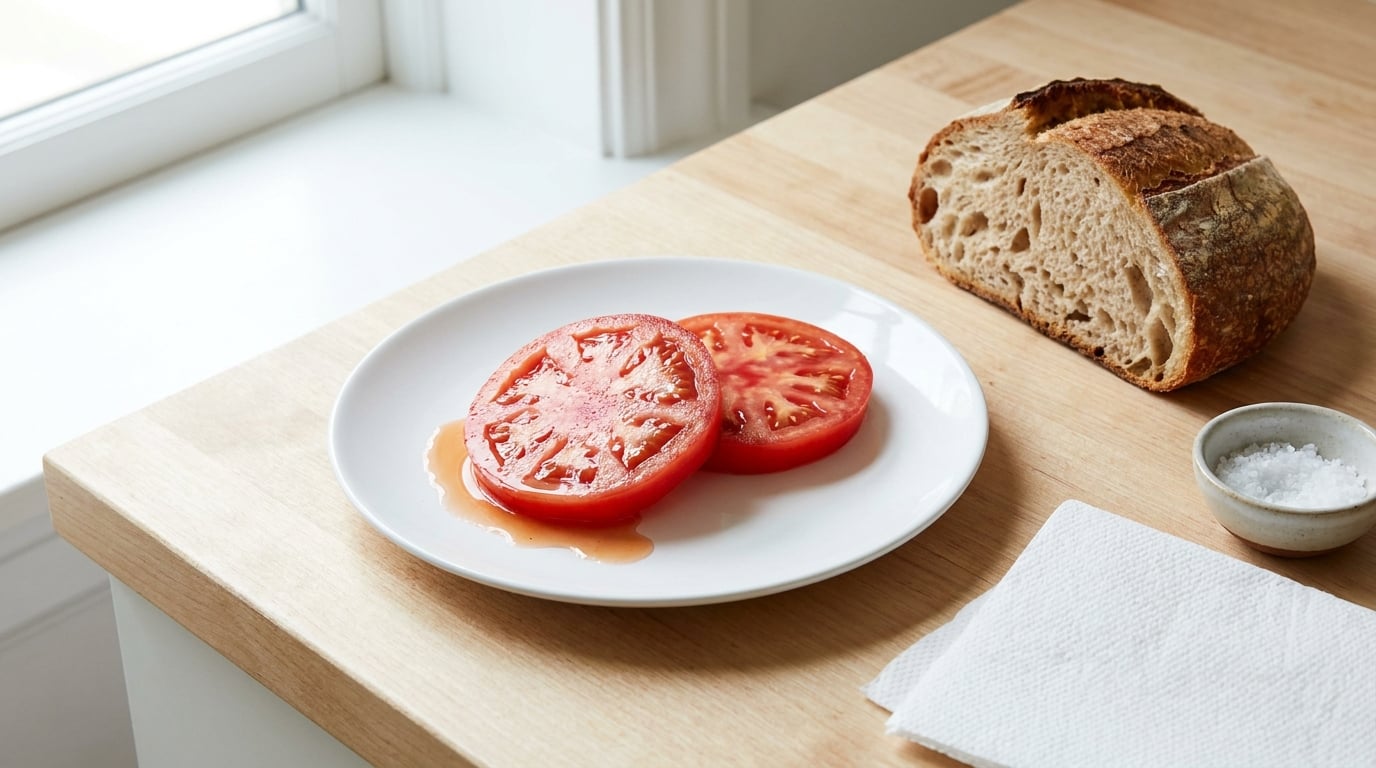
Why do tomatoes make sandwiches soggy? Because cutting a tomato breaks open the tiny cells that hold its water, and that juice spreads across the cut face and gets pulled into the bread. Bread is porous, so it drinks the liquid up fast and loses its structure within seconds. The fix is to remove most of that liquid before assembly, then give the bread a barrier it cannot soak through. Everything below works from that one idea.
I have ruined more tomato sandwiches than I care to admit, and it was never the tomato’s fault. It was mine for slicing it five minutes before eating. Resting the slices for a few minutes, blotting them dry, and spreading mayo on the bread first makes a bigger difference than any tomato variety ever did for me. Updated for 2026.
Table of Contents
- Why Do Tomatoes Make Sandwiches Soggy?
- Which Tomato Varieties Are Best for Sandwiches?
- How to Prepare Tomatoes So They Do Not Make Bread Wet
- What to Put Between the Bread to Block Moisture
- How to Assemble a Sandwich That Stays Crisp
- Common Tomato Sandwich Mistakes and Quick Fixes
- Which Sandwich Ingredients Add the Most Extra Moisture?
- How Long Will a Tomato Sandwich Stay Crisp?
- Frequently Asked Questions
- How do you keep tomatoes from making a sandwich soggy?
- Should you salt tomatoes before putting them in a sandwich?
- What type of bread stays crisp with tomatoes?
- Does removing tomato seeds really help?
- Is mayonnaise a good way to prevent a soggy sandwich?
- How long can a tomato sandwich be stored in the refrigerator?
Why Do Tomatoes Make Sandwiches Soggy?
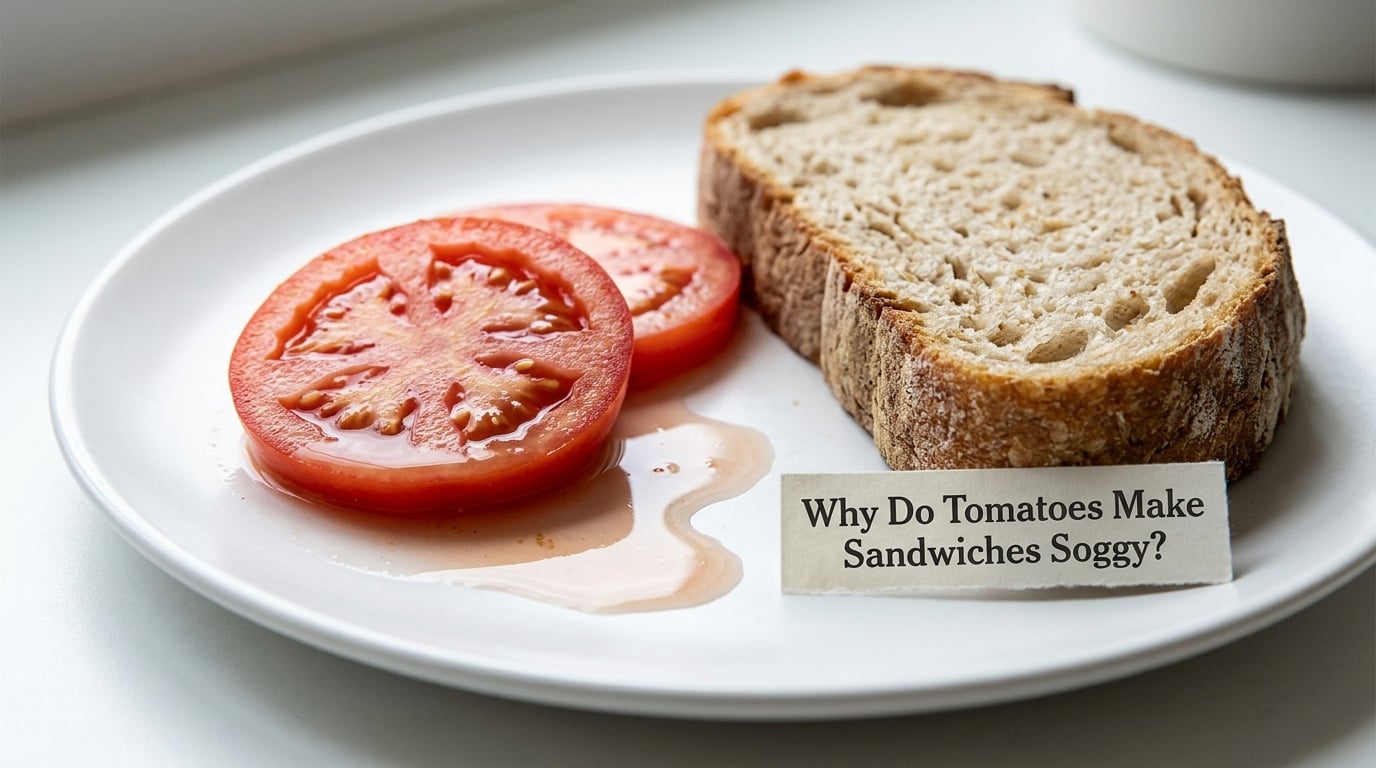
A tomato is roughly 95% water held inside fragile cells. The knife cuts through thousands of them at once, and the walls rupture. Water that was sealed in now sits loose on the surface, along with the gel around the seeds, which is the juiciest part of the fruit.
Why do tomatoes make sandwiches soggy the moment they touch bread?
Three things happen at once. The free juice spreads across the cut surface, the bread wicks it up through capillary action, and the salt you add pulls yet more liquid out of the remaining intact cells.
Osmosis is the plain version of what salting does: water moves across a membrane from where there is less salt to where there is more salt. Sprinkle salt on a tomato slice and the cells lose water to the surface because the salt concentration outside is now higher. That is why “salt it first” works, and why “never salt it” fails so badly.
The bread side of it is simple physics. An open crumb is a bundle of tiny tunnels, and liquid climbs them. A soft white sandwich loaf with a fine, open crumb drinks fastest. A dense sourdough or a toasted slice drinks much more slowly.
Then the structure goes. Wet starch loses the strength that let it hold a filling, so the bread compresses and the sandwich tears on the first bite rather than the second. Soggy is not just a texture complaint; it is a structural failure, and it happens faster than most people expect.
Which Tomato Varieties Are Best for Sandwiches?
You are choosing for seed load and firmness, not flavor. A tomato bred for sandwiches holds together better and releases less juice, because there is less of the loose seed gel to break down.
Seed load is the part growers argue about most. A supermarket slicing tomato will give up a noticeable share of its moisture within an hour of being cut, and a soft ripe one more than that, while a firm, low-seed type keeps most of its water in the flesh. That gap is why commercial sandwich cultivars are bred for low gel and thick walls, and why seedless, parthenocarpic tomatoes that set fruit with almost no seed cavity at all exist as a category at all.
In an ordinary supermarket, you are choosing between these groups:
- Firm, dense slicers. Roma, plum, and firm round tomatoes hold their shape and hold more solids. They are less sweet, but they are the safest bet for a sandwich that must survive a lunchbox.
- Beefsteak and similar large hybrids. Big fruit means a high ratio of flesh to seed cavity, so less gel per slice. Often the best compromise between flavor and leak resistance.
- Ripe vine or heirloom slicers. Best flavor, worst behavior. Softer flesh, thinner walls, more juice released. Fine if you eat the sandwich immediately.
- Cherry and grape tomatoes. Halve them instead of slicing. A smaller cut surface means less exposed water, and they go soggy surprisingly slowly.
Ripeness matters as much as variety. A hard, pale tomato is starchy and dry, which is why some people prefer it. A tomato that has been sitting until it is soft and heavy in the hand gives up its juice almost immediately. Buy firm, then ripen it on the counter only as far as the sandwich needs.
One more detail: leave the skin on. It is a thin seal around the slice, and a peeled tomato has nothing holding the flesh together.
How to Prepare Tomatoes So They Do Not Make Bread Wet
This is the part that does the real work. Every step below removes liquid that would otherwise end up in your bread.
The salt-draw method, step by step. Slice the tomato to about a quarter inch. Lay the slices in a single layer, not stacked, on a paper towel or wire rack. Sprinkle a light pinch of fine salt over them and leave it alone for 10 to 15 minutes at room temperature. You will see liquid beading on the surface and a faint darkening of the slices. Blot each slice firmly with a fresh paper towel, then season with salt and pepper. The second seasoning matters, because the first salt has already left with the water.
The window matters. Under 5 minutes and very little comes out. Past about 30 minutes the slices go limp and watery in the other direction, which is the complaint that makes people say salting ruins tomatoes. Fifteen is the sweet spot, and the visual cue is the one to trust rather than the clock.
Blot, do not just pat. Press the paper towel down and lift straight up. A gentle pat pushes juice around the slice instead of lifting it away. A second pass with a dry sheet catches what the first one left behind.
Remove the seeds if you are fussy. Cut the tomato in half, scoop out the seed cavities with a teaspoon, and cut the flesh into slices. You lose a little juice straight away, which is exactly the point. It is the single biggest reduction, and it is the step most people skip.
Use a press or a slotted spoon. A tomato press or a ricer pushes out the gel and skin, and what comes out is a thick, low-moisture paste that is excellent spread on toast. A slotted spoon pressed against the cut face does a smaller version of the same job.
Cut thicker than feels right. A thick slice has a lower surface-area-to-volume ratio, so proportionally less of it is exposed flesh. Thin slices leak; chunky slices do not.
Here is how the methods compare, since no single one of them is the answer on its own.
| Method | Time needed | Effort | How well it works |
|---|---|---|---|
| Salt and drain, then blot | 10 to 15 minutes | Low | Best single fix |
| Remove the seed gel | 3 minutes | Medium | Very good, less juice and fewer seeds |
| Press or mash, use as a spread | 5 minutes | Medium | Excellent, changes the sandwich |
| Pat dry only, no salt | 1 minute | Low | Helps, not enough on its own |
| Toast the bread | 3 minutes | Low | Good, slows absorption |
| Fat barrier on the bread | 30 seconds | Low | Good, does not dry the tomato |
| Greens fence around the tomato | 1 minute | Low | Good, keeps juice off the bread face |
| Pack the tomato separately | Extra container | Medium | Perfect result, less convenient |
What to Put Between the Bread to Block Moisture
A thin layer of fat is the cheapest fix on this list. Mayonnaise, butter, pesto, or a soft spread forms a membrane that water cannot pass through, and the bread underneath never sees the juice. This is the reason a BLT with mayo holds together and the same sandwich with only dry bread does not.
What works best:
- Mayonnaise. The classic. It is emulsified fat and water already, so it spreads evenly and seals the crumb.
- Butter. Works on toasted bread especially well, and adds a nutty note to a ripe tomato.
- Pesto. Oil-based, so it coats, and it is drier than mayo with more flavor in the direction you would take anyway.
- Creamy cheese or soft goat cheese. Thick enough to hold a slice off the bread face entirely.
- Avocado mash. A thick spread that behaves like mayo and beats a slippery avocado slice.
Thin dressings like vinaigrette or hot sauce do not work as barriers. They run straight through the bread.
Greens do a different job. A romaine leaf or a paper-thin slice of spinach under and over the tomato is a fence: the tomato rests on lettuce instead of bread, and the leaf catches what runs down. On caprese, letting mozzarella and basil flank the tomato on both sides is the same idea, and it is why that sandwich can be assembled ahead without turning to mush.
How to Assemble a Sandwich That Stays Crisp
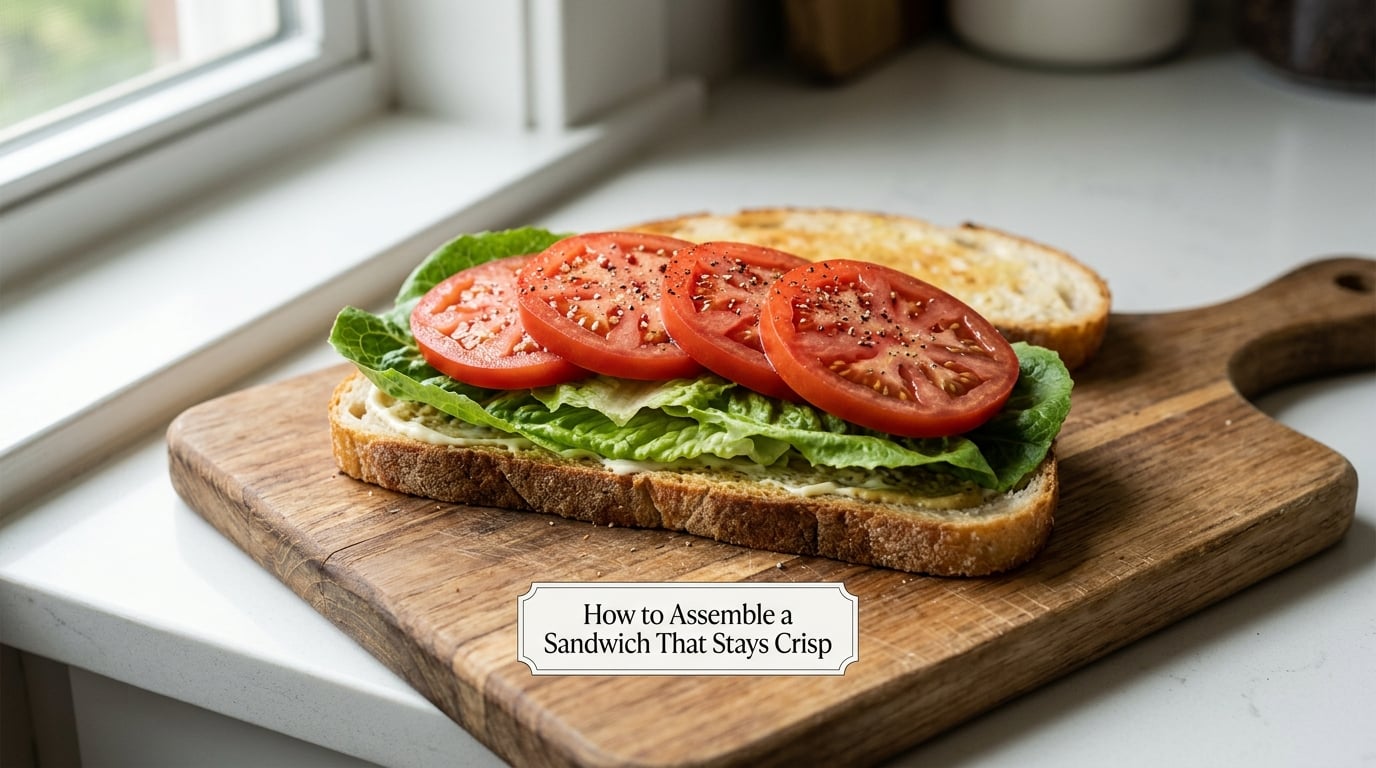
Assembly order decides how much juice ever touches bread. Build from the driest outer layer inward.
Toast and cool. Toast the bread until the surface is dry and slightly firm, then let it cool on a rack for five minutes. Toast that is wrapped while warm traps steam, and steam softens bread faster than tomato juice does.
Match the bread to the filling. The old rule of hard bread for hard fillings and soft bread for soft fillings works in reverse here. A soft ripe tomato on a thick slice of sourdough, a hearty grain loaf, a ciabatta, or a toasted kaiser roll gives you far more time than a soft white roll.
Spread the barrier first. Mayo or butter on both cut faces before anything wet goes down. It takes thirty seconds and it is the difference between crisp and damp.
Fence the tomato. Lettuce under and over, or cheese and basil on either side, so the slices sit on something dry rather than on the bread itself.
Season late. Salt and pepper go on right before you close the sandwich, ideally after the tomato has already given up its extra water.
Wrap for short storage. Parchment or wax paper breathes; plastic does not. If you must use a container, add a folded paper towel under the sandwich and keep it in the fridge rather than the counter.
One more move worth knowing, borrowed straight from deli counters: let the tomato sit cut-side down on a folded paper towel for a couple of minutes while you make everything else. The juice runs off the slice instead of into the bread, and it costs you nothing but a spare towel.
Common Tomato Sandwich Mistakes and Quick Fixes
Salting too early, in the sandwich. Salt applied just before eating keeps drawing water out while the bread sits under it. Salt earlier, on a draining surface, and season again at the end.
Skipping the dry step. Blotting looks optional and does not feel important. It is the difference between removing surface liquid and simply moving it around.
Thick slices through the middle of the tomato. The center of a tomato is where the seed gel and loose pulp collect. Cut around that core or scoop it out.
Stacking wet ingredients directly on bread. Lettuce or cheese under the tomato costs one layer and absorbs most of what runs.
Wrapping a warm sandwich. Condensation forms inside the wrap and softens the crust. Cool the bread and the filling separately before they meet.
Using a ripe slicer for a sandwich that has to wait. A sandwich eaten in five minutes can use a beautiful ripe tomato. A lunchbox sandwich needs a firmer one, or a half tomato added at lunchtime.
Leaving it in the fridge for days. Refrigeration firms bread up, then slowly stales it. Wet fillings speed both along.
Which Sandwich Ingredients Add the Most Extra Moisture?
Tomato is rarely the only problem. Once you have handled it, these are the fillings most likely to undo the work.
- Pickles and peppers. Brine travels. Drain them in a sieve for five minutes, or skip them entirely on a sandwich that must survive.
- Cured meat and deli turkey. Packaged ham and turkey hold a surprising amount of water. Blot the slices, and skip the wet packed varieties.
- Cucumber and tomato together. Two watery vegetables stack their problems. Salting cucumber the same way you salt the tomato fixes both at once.
- Mayonnaise and mustard in excess. A thin smear helps; a thick one turns into its own slick layer and squeezes out on the first bite.
- Soft cheese and burrata. Creamy and spreadable is a barrier, but burrata and ricotta leak whey. Blot or swap.
- Sauces and marinara. Any sauce you can pour is liquid you added on purpose. Use a thick, cooked-down sauce instead of a jarred one.
There is a fair counter-argument here. A slice of tomato bleeding into a good piece of bread is genuinely delicious, and plenty of regular sandwich makers will tell you the wet version is the better one. If your sandwich gets eaten straight away, leave it alone. Everything in this guide is for the case where the sandwich has to survive a commute.
How Long Will a Tomato Sandwich Stay Crisp?
A tomato sandwich eaten within about 10 minutes of assembly stays crisp. Past that, it softens noticeably, and the change is not gradual; bread goes from firm to damp in well under a minute once it has taken up liquid.
Refrigerating helps a little and hurts a lot. Cold slows the moisture migration, but the starch in bread firms in the fridge and then goes stale, so a two-day-old sandwich is dry and stiff rather than pleasantly soft. Cutting a tomato and storing it covered in the fridge gives you about three good days before the cut surfaces turn mushy.
| How it is stored | Crisp for | Notes |
|---|---|---|
| Assembled, eaten straight away | 10 to 15 minutes | Best flavor and texture |
| Airtight container with a paper towel | About 2 hours | The towel catches the run-off |
| Parchment or wax paper, room temperature | 2 to 3 hours | Safe for a morning start |
| Refrigerated in a container | 4 to 6 hours | Firm, then gradually stale |
| Tomato packed separately, added at lunch | All day | Best option for a lunchbox |
For a lunchbox, the separate-container answer wins every time. Pack the seasoned tomato halves in a small sealed pot, the bread and lettuce in the main box, and let your kid or your own self assemble at noon. It takes ten extra seconds and the sandwich is basically fresh. If that is not practical, the single best compromise is a half tomato on the cut side, added just before eating, with the drained slices layered in a lettuce fence.
Frequently Asked Questions
How do you keep tomatoes from making a sandwich soggy?
Salt the slices first and let them drain for 10 to 15 minutes, then blot them dry with a paper towel. Spread mayonnaise or butter on the bread as a barrier, rest the tomato on lettuce or cheese rather than on the slice of bread, and season only at the end. Assembled this way, a tomato sandwich stays crisp for two to three hours, or all day if you pack the tomato separately.
Should you salt tomatoes before putting them in a sandwich?
Yes, with a light pinch and a wait. Salt pulls water out of the tomato cells by osmosis, so the slices give up liquid on a plate instead of in your bread. Ten to 15 minutes is enough; you can see beads forming on the surface. Salting the tomato is not the same as seasoning it, so finish with a second pinch of salt and some pepper right before you eat.
What type of bread stays crisp with tomatoes?
Dense, sturdy loaves hold up best. Sourdough, hearty grain bread, ciabatta, and a toasted kaiser roll all resist moisture far better than a soft white sandwich roll, and toasting makes any of them slower to absorb liquid. The soft, fine-crumb rolls are the worst case because their open crumb acts like a sponge. Toast the bread, let it cool for five minutes, and you have bought yourself an extra hour.
Does removing tomato seeds really help?
It helps more than most other single steps. The gel around the seeds is the loosest, wettest material in the fruit, and it releases its water the moment you cut through it. Scooping out the seed cavities before slicing removes that gel along with the juice already holding it, so less liquid is left behind. On a very ripe tomato the difference is obvious, and on a firmer one it is still worth the extra minute.
Is mayonnaise a good way to prevent a soggy sandwich?
It is one of the most reliable barriers available, because it is already an emulsified mix of oil and water and it spreads into a continuous film over the bread. That film stops tomato juice from reaching the crumb, so the bread underneath stays dry and keeps its structure. Butter, pesto, and soft cheese work the same way. Thin dressings and hot sauce do not, because they run straight through.
How long can a tomato sandwich be stored in the refrigerator?
A day is the practical limit, and even then the bread will have firmed and gone a little stale in the cold. Refrigeration slows the moisture moving out of the tomato but does not stop it, and cut tomatoes keep about three days in the fridge on their own. For anything longer, store the components separately, keep the bread out of the fridge if you can, and assemble right before you eat.
Start with the salt-draw. Slice, salt, wait fifteen minutes, blot, then put a layer of mayo on the bread before the tomato ever touches it. Those two steps solve most of the problem on their own, and everything else in this guide is there for when the sandwich has to wait longer than a few minutes.