
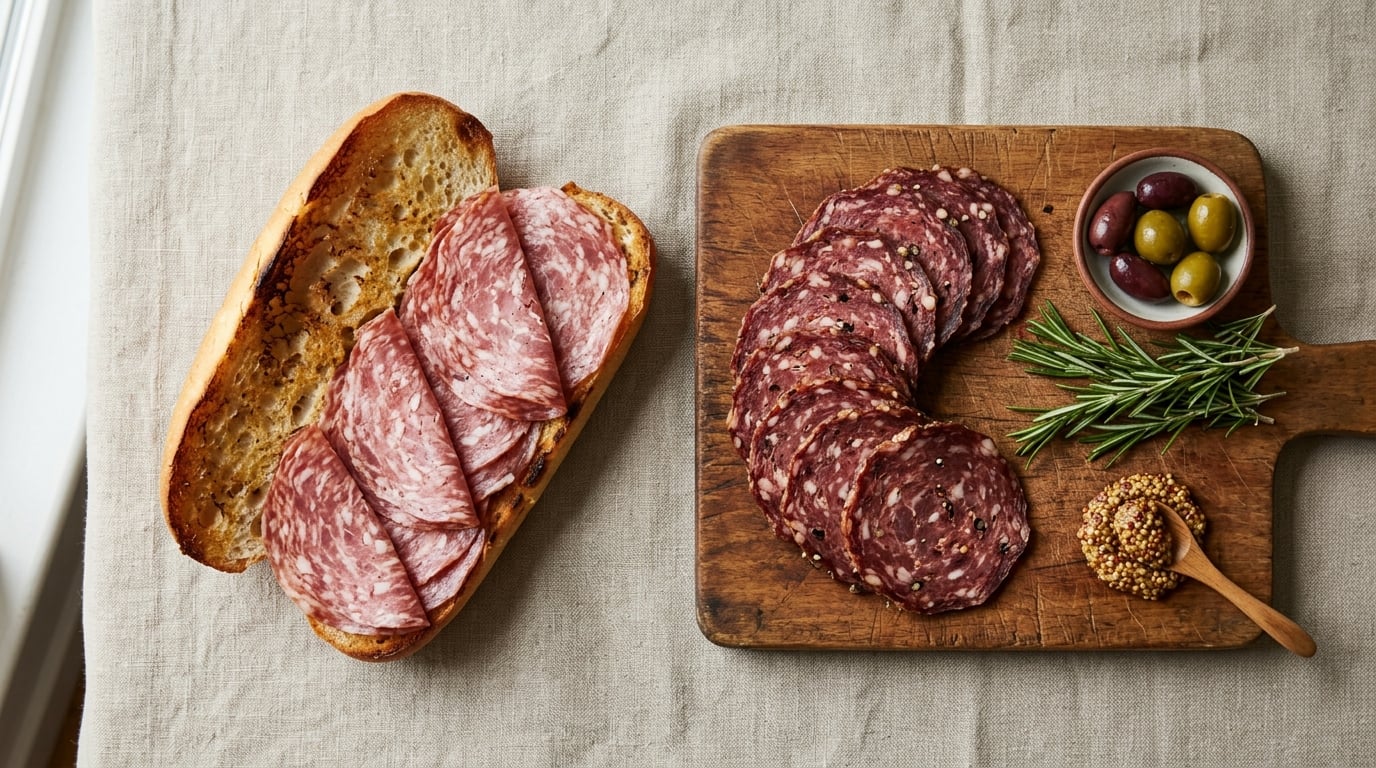
Buy Genoa salami for sandwiches and hard salami for charcuterie boards. That is the short version of this Genoa vs. hard salami comparison: Genoa is soft, fatty and mild, so it melts and spreads inside a warm sub, while hard salami is dense, dry enough to slice paper-thin, and holds its shape on a board or a cracker. The rest of this guide covers the flavor, texture, storage and label differences so you can pick the right one on purpose instead of guessing at the deli counter.
Both are dry-cured pork sausages, and that shared process causes most of the confusion between them. What separates them is how long each dries and how much fat and moisture it keeps along the way.
Table of Contents
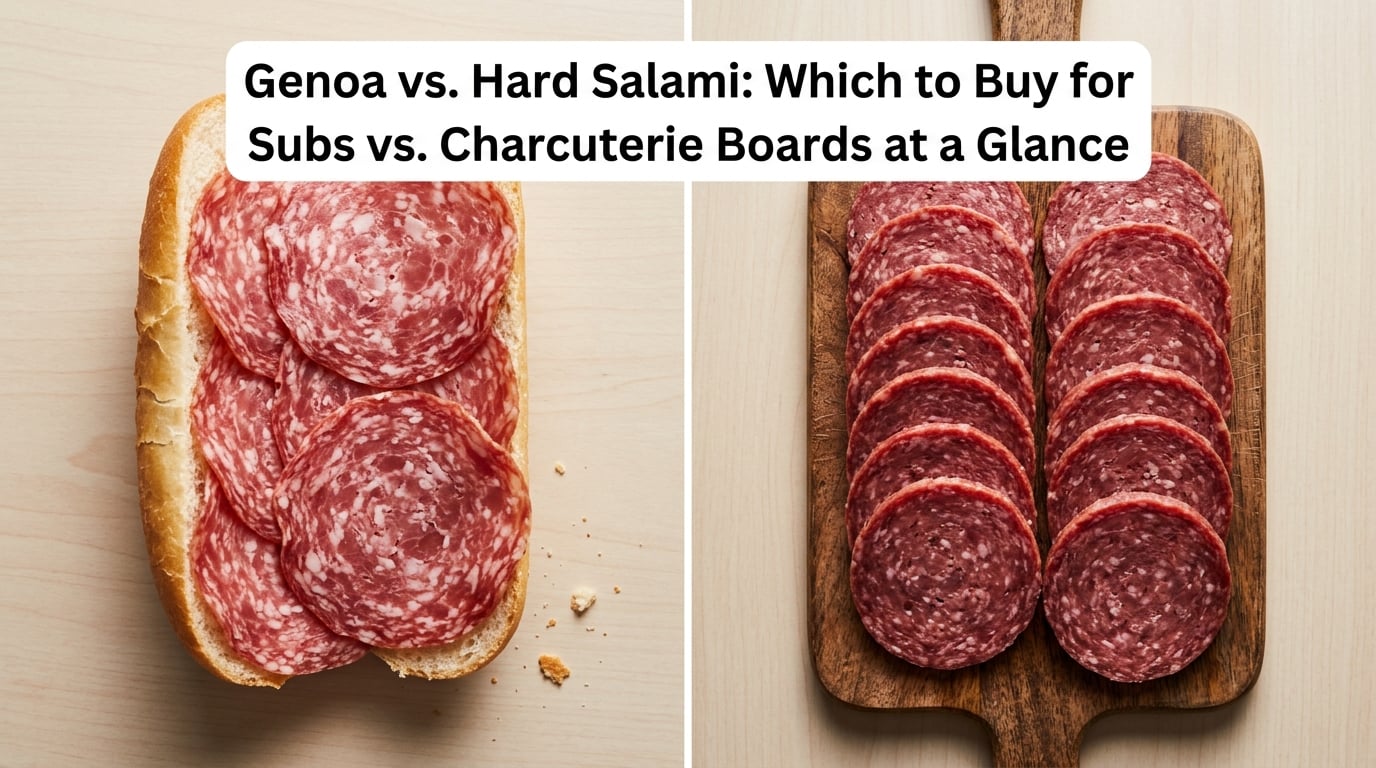
- Genoa vs. Hard Salami: Which to Buy for Subs vs. Charcuterie Boards at a Glance
- Flavor and Texture
- Which Is Better for Sandwiches?
- Which Is Better for Charcuterie Boards?
- Ingredients, Dietary Needs, and Serving Size
- How to Store and Serve Each Type Safely
- How to Choose at the Deli or Grocery Store
- Which Should You Choose?
- Frequently Asked Questions
- Is Genoa salami the same as hard salami?
- What type of salami melts best in a hot sub?
- Should I choose salami that is pre-sliced or sliced from a thick piece?
- Which salami holds up best on a charcuterie board?
- How long can opened Genoa and hard salami be refrigerated?
- What can I serve with both types of salami?
- Conclusion
Genoa vs. Hard Salami: Which to Buy for Subs vs. Charcuterie Boards at a Glance
| Category | Genoa Salami | Hard Salami |
|---|---|---|
| Texture | Soft, tender, slightly greasy | Firm, dense, dry, chewy |
| Flavor | Mild, garlicky, wine notes | Pork-forward, peppery or smoky, saltier |
| Grind | Medium to fine | Coarse |
| Fat and moisture | High fat, high moisture | Lower fat, moisture lost in drying |
| Smoke | Rarely smoked | Often lightly smoked |
| Origin | Liguria, Genoa, Italy | Germany and Central Europe |
| Color | Pale pink to rosy | Deeper red-brown |
| Best use | Italian subs, hot sandwiches, chopped salad | Charcuterie boards, antipasto, crackers |
| Ideal slice thickness | Thin, shaved slices | Thin coins, fanned |
| Slicing behavior | Soft, may tear or fold | Clean, firm rounds that hold shape |
| Serving temperature | Room temperature or cold | Close to room temperature for best flavor |
| After opening | Shorter, use quickly | Keeps longer, weeks rather than days |
| Typical sodium | Around 450 to 500 mg per ounce | Around 500 to 600 mg per ounce |
One note on the names, because it trips up a lot of people: hard salami is a category, not one single product. Milano and Felino are both dry salames sold as hard salami in the US, and they differ from each other in grind and heat. Ask the deli which style you are getting rather than assuming every hard salami tastes the same.
Flavor and Texture
Both styles begin the same way. Pork is ground, seasoned, packed into casing, then salted and hung or laid to dry. Beneficial bacteria and yeast ferment the meat, and the drying step concentrates the flavor while lowering the water content.
Genoa salami dries briefly and keeps what it started with. The result is a sausage with a high fat ratio, a soft bite and a clean, garlicky, faintly winey profile. It eats almost buttery straight from the wrapper at room temperature.
Hard salami dries longer and loses more moisture. The fat firms up, the lean tightens, and the slice holds a knife-cut edge without smearing. Flavor concentrates into something saltier and more assertive, often with smoke or cracked pepper on top of the pork.
Genoa vs. Hard Salami: The Short Verdict for Subs and Boards
Buy Genoa salami when the salami goes inside a sandwich, especially a hot one, and buy hard salami when the slices go on a board, a cracker or a platter. The exceptions are worth knowing: a cold sub built on soft bread can handle a firm slice, and a mixed board benefits from both, since tender slices and firm coins give guests two textures to move between.
Which Is Better for Sandwiches?
Genoa salami wins for sandwiches, and most of the reason comes down to heat and moisture. Warm provolone or a hot panini press softens Genoa’s fat, and the slices slump into the bread and bond with the cheese instead of sitting in loose layers. A cold chopped Italian sandwich gets the same benefit without any heat, because the fat stays soft enough to spread.
Hard salami works in a sandwich too, with two conditions. Slice it thinner than feels natural, and serve it on a sturdy roll, because a firm slice on a soft sub roll tends to slide and can tear a hole where it meets the moisture from tomatoes. The payoff is a sandwich that holds together well and tastes more like cured meat than like deli lunch meat.
Slice thickness matters more than most people expect. Genoa’s soft texture asks for paper-thin slices that drape. Hard salami can go a bit thicker without falling apart, which is why it survives a toaster or a press.
A quick build for a Genoa sub: toast and oil the roll, lay provolone down first so the meat melts against it, add Genoa plus capicola, and finish with shredded lettuce and tomato. The order matters. Cheese at the bottom catches the fat, and the bread gets a barrier from the oil instead of soaking through.
Which Is Better for Charcuterie Boards?
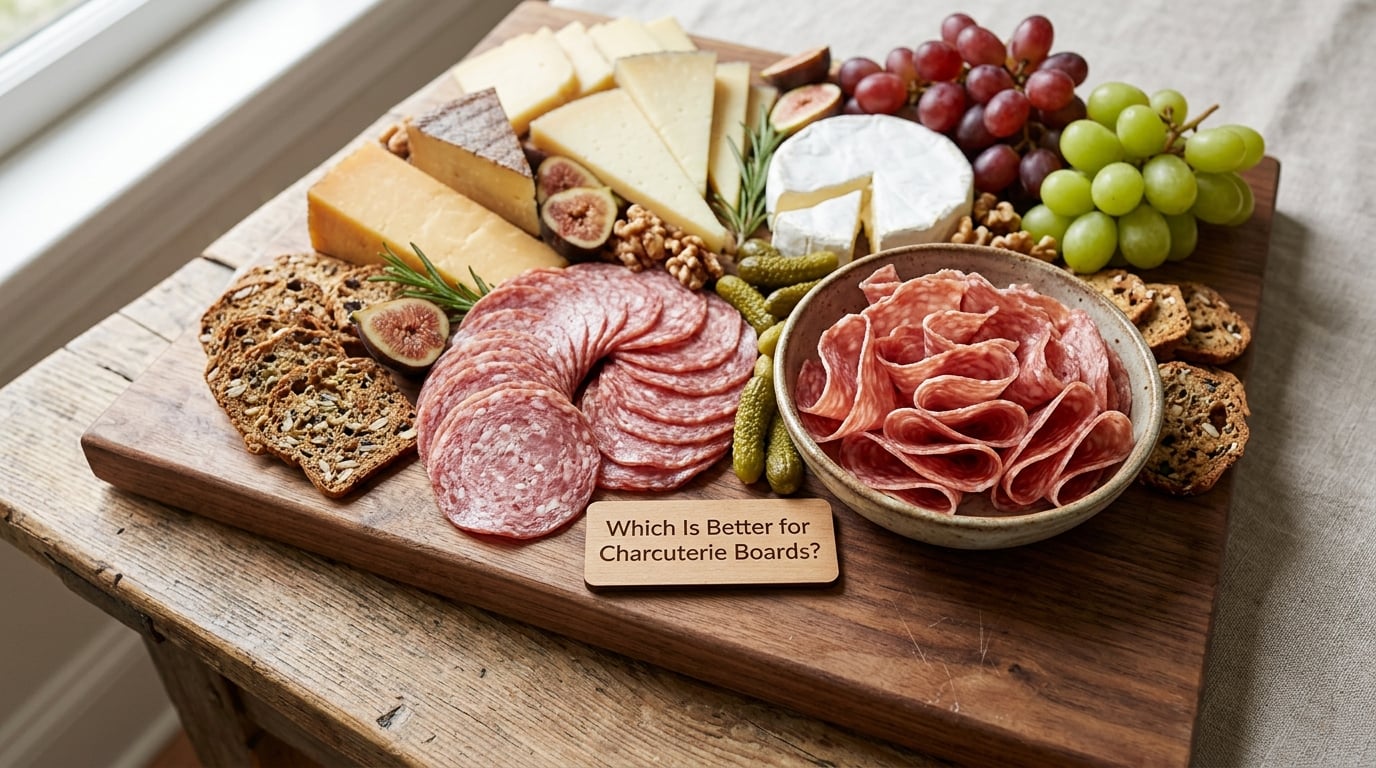
Hard salami holds up best on a charcuterie board. Firm coins fan in a curve without folding or smearing, they sit flat next to crackers without sliding, and they keep their shape as the board sits out over an evening of grazing. That stability is the whole game on a board.
Genoa earns its place on a board too, just in a different role. Thin folded slices or a small knot adds a soft, fatty contrast beside the hard salami, and its mild flavor lets delicate cheeses like a fresh goat cheese or a brie come through without competing.
A practical board build: rest the whole hard salami log at room temperature for 30 to 60 minutes before slicing so it cuts cleanly instead of crumbling, then slice on a bias with a sharp knife. Budget about two to three ounces per guest as an appetizer portion alongside cheese and crackers. Serve hard salami at close to room temperature; cold dulls the fat and flattens the flavor.
Board-friendly salamis beyond these two include soppressata for a coarse, spicy bite, Milano for a clean dry-salami character, and a mild pepperoni if you want a round shape that reads well visually.
Ingredients, Dietary Needs, and Serving Size
Traditional versions of both meats contain pork and differ mainly in curing and texture, not in whether they fit a special diet. Genoa is the higher-fat option, and hard salami is the drier, more concentrated one. Neither is low-sodium, and typical values land around 450 to 500 mg of sodium per ounce for Genoa and 500 to 600 mg for hard salami.
Labels vary enough that the package beats any rule of thumb. If sodium matters to you, compare the nutrition panel for the exact product and portion, and talk with a doctor or a registered dietitian about what is right for your own situation.
For serving size, a couple of slices of either type fits comfortably alongside a sandwich or a salad, and three to five rounds per person works for a party appetizer spread. The bigger difference shows up at the board: two to three ounces of meat per guest leaves room for the cheese and crackers around it.
If you want to cut sodium at the counter, uncured and dry-cured versions are the ones worth asking about, and you can ask the deli staff for the nutrition information for the exact item they are about to slice.
How to Store and Serve Each Type Safely
Always follow the use-by or best-by date printed on the package, and treat that date as the controlling guide rather than any rule of thumb about appearance or smell.
Keep both meats refrigerated at or below 40 degrees F until you are ready to use them. Genoa salami has more moisture and fat, so once opened it runs down faster and works best within a few days. Hard salami keeps far longer, often several weeks in the fridge if the cut face is pressed against plastic or sealed airtight.
Serving at room temperature for 30 minutes to an hour before serving improves both, especially hard salami. Keep the total time out of the fridge short, and do not leave the meat sitting on a warm board for the length of a party. Put the platter out, let guests work through it, and bring the rest back inside between services.
Neither salami is cooked during preparation, so the usual safe minimum internal temperature guidance for cooking meat does not apply here. If you add salami to a dish that is cooking and the meat has been sitting out past its date, discard it rather than trying to cook through it.
How to Choose at the Deli or Grocery Store
Read the label for the grind, the fat percentage, the casing and the best-by date, and use those four details to tell the categories apart. A package that says air-dried or dry-cured describes a hard style. A package that lists a high pork content and a short shelf life is describing something closer to Genoa.
At the counter, ask for the style by name: Genoa salami, Milano salame, or a mild soppressata. Deli staff use these words loosely, and specifying the name is the fastest way to get what you came for. If a label says nothing about curing, it is worth assuming the product is not a dry salami.
For pre-sliced meat, check the slice thickness against the use. Anything packaged in paper-thin slices works for a sub, and thicker-cut rounds are better suited to a board or a sandwich that gets pressed. Natural casing, collagen, and inedible casing all appear on these products, and the casing type has little to do with flavor.
Judge the physical qualities last. Genoa should look slightly glossy from its fat. Hard salami should look dry and matte with a firm edge, and it should snap rather than bend when you handle a slice.
Which Should You Choose?
For an Italian sub, choose Genoa. For a cold sandwich or a chopped Italian salad, Genoa again, since its fat stays soft and binds the bread. For a hot sub or a panini, Genoa is the safer pick for the same reason.
For antipasto platters, grazing tables, crackers, and charcuterie boards, choose hard salami. It slices cleanly, holds its shape, and lasts through a long party. If you only want to buy one thing, buy hard salami and pick a dry, uncured variety, since it tolerates both room temperature and the fridge better than Genoa does.
For a mixed board, buy both. Give hard salami the larger share since it handles the most pairings, and add a smaller cluster of folded Genoa slices for contrast. Pair Genoa with provolone, fontina, or a soft goat cheese. Pair hard salami with aged cheddar, gruyere, or a sharp Asiago, and reach for bolder drinks with the firmer meat, light sparkling or white wines with the softer one.
Frequently Asked Questions
Is Genoa salami the same as hard salami?
No. Both are dry-cured pork sausages, but they are different styles. Genoa salami is mild, finely ground, garlicky and soft because it dries briefly and keeps its fat. Hard salami is coarser, firmer, drier and saltier because it dries longer. Hard salami is also a category rather than one product, covering varieties such as Milano and Felino.
What type of salami melts best in a hot sub?
Genoa salami melts best because its high fat content softens with heat and spreads into the bread, bonding with melted provolone. Hard salami also heats well but stays firmer, so it works better when sliced thin on a sturdy roll. Put cheese directly under the meat so it melts against it, and oil the roll first to keep moisture from soaking through.
Should I choose salami that is pre-sliced or sliced from a thick piece?
Choose pre-sliced thin salami for sandwiches, where thin even layers matter most. Choose a thick piece or whole log for a charcuterie board, because you control the thickness and the cut stays clean. Let a whole hard salami sit at room temperature for 30 to 60 minutes before slicing so it cuts firmly instead of crumbling under the knife.
Which salami holds up best on a charcuterie board?
Hard salami holds up best. Its firm texture keeps rounds flat, lets them fan in a curve, and stops them smearing or sliding as the board sits out. Genoa salami still works on a board when sliced thin and folded rather than laid flat, and adds a soft, fatty contrast next to firm cheeses and crackers.
How long can opened Genoa and hard salami be refrigerated?
Keep both refrigerated at or below 40 degrees F and follow the date printed on the package. Genoa has more moisture and fat, so an opened package is usually best used within a few days. Hard salami is drier and keeps much longer, often several weeks, if the cut face is pressed against plastic or sealed in an airtight container.
What can I serve with both types of salami?
Both work with crackers, crusty bread, cornichons, mustard, pickles, and marinated vegetables. Genoa pairs best with provolone, fontina, mozzarella, and a soft goat cheese. Hard salami pairs best with aged cheddar, gruyere, sharp Asiago, and bolder cheeses. Fresh fruit such as figs or melon and a few nuts round out either version on a board.
Conclusion
Buy Genoa salami for subs and hard salami for charcuterie boards, then start by deciding which texture and serving occasion you actually want. That is the entire Genoa vs. hard salami decision, and the rest is preference. If you can only buy one, pick a dry uncured hard salami and start there.