
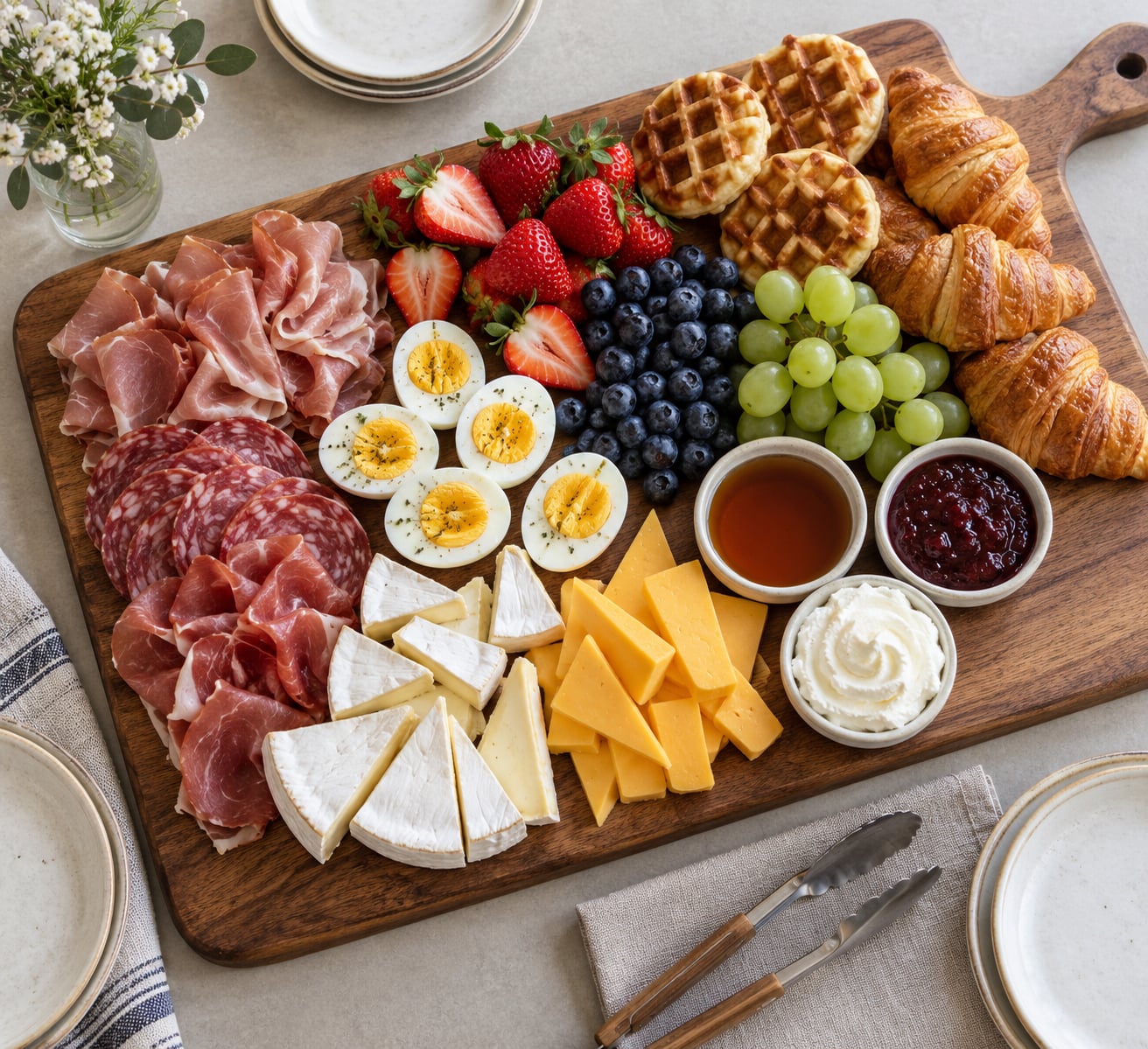
A breakfast charcuterie board is a deconstructed morning spread: cured meats, boiled eggs, cheeses, pastries, fruit and spreads arranged on one platter so guests serve themselves. Learning how to make a breakfast charcuterie board takes about 30 minutes of active work for four to six people, because nearly everything is either cooked ahead or bought ready. That is the whole point. You are not cooking a timed breakfast for a crowd, so you can stay in the room with your guests instead of hovering over the stove.
It also settles the oldest objection to the idea: charcuterie literally means cold cooked meats, so purists grumble about putting pastries next to prosciutto. Call it a breakfast grazing board or a brunch board and the argument disappears. It is a deconstructed morning spread, and nobody at your table cares what the French word means.
Table of Contents
- What You Need
- How to Make a Breakfast Charcuterie Board Step by Step
- Common Mistakes
- Frequently Asked Questions
- How much food should I put on a breakfast charcuterie board?
- What foods belong on a breakfast charcuterie board?
- How long can a breakfast charcuterie board sit out?
- Can I make a breakfast charcuterie board the night before?
- What are good vegetarian options for a breakfast charcuterie board?
- How do I keep a breakfast charcuterie board from getting soggy?
- Conclusion
What You Need
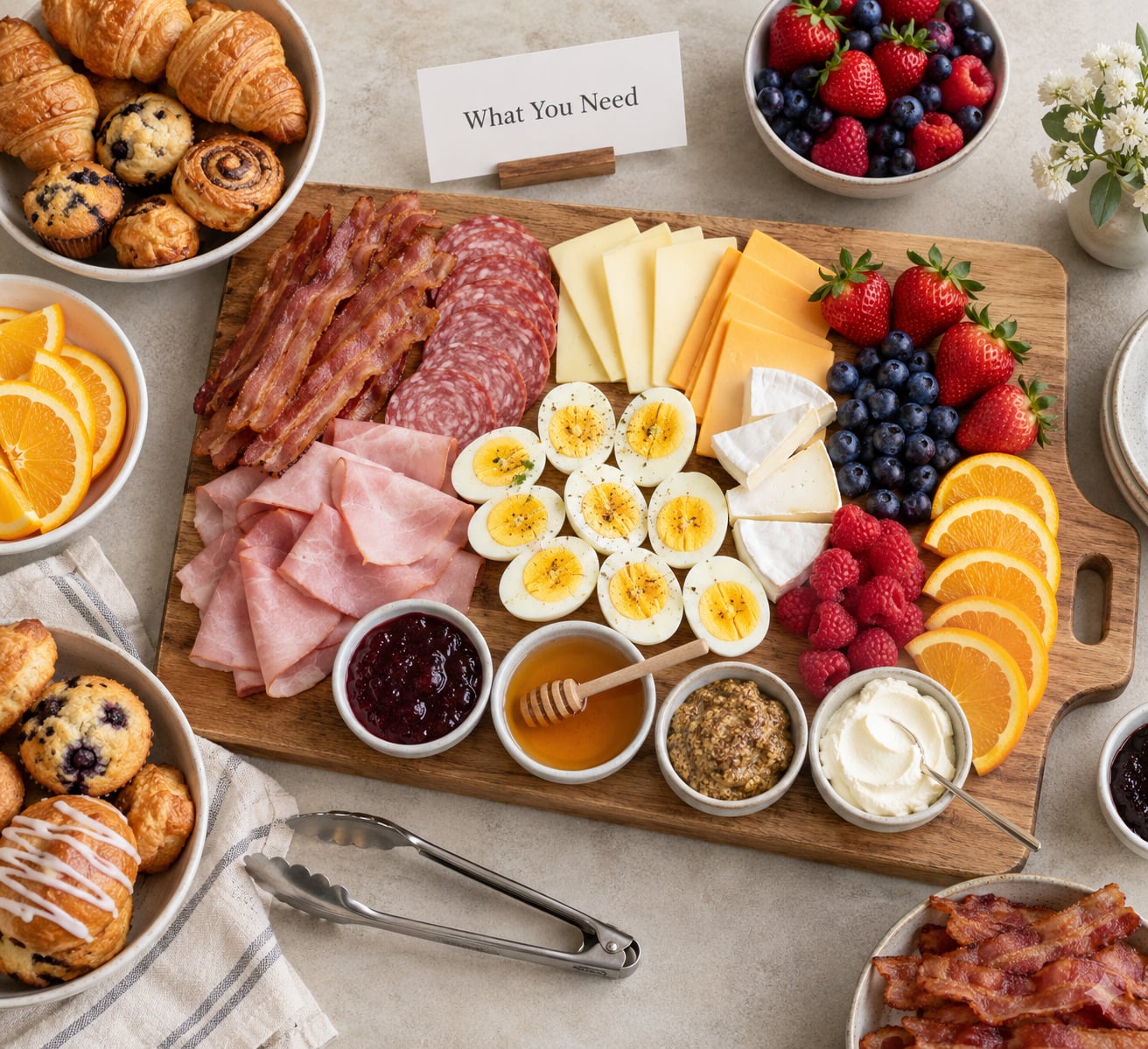
A 12-by-18-inch board comfortably feeds four to six people. For eight to ten, move up to roughly 16-by-24 inches, or use two boards rather than one crowded slab. If you are still shopping for the board itself, 10 Best Charcuterie Boards and Serving Platters covers the shapes and sizes that actually work for a crowd.
Here is the kit list, and roughly what four to six servings need:
- Board: one large wooden board, a sheet pan lined with parchment, or a large oval platter.
- Serving tools: two or three pairs of tongs or serving spoons, small plates for each guest, and a stack of napkins.
- Proteins: about 1 pound of sliced cured meat (prosciutto, salami, ham), 6 to 8 boiled eggs, and one extra protein such as smoked salmon, bacon or breakfast sausage links.
- Cheeses: two small wedges or blocks, roughly 6 to 8 ounces total. Brie, goat cheese, aged cheddar and smoked gouda all work well.
- Bakery and starches: one item such as mini bagels, silver dollar pancakes, mini waffles, croissants, cornbread muffins or sliced sourdough toast.
- Fresh fruit: about 2 cups. Strawberries, blueberries, raspberries, green grapes and sliced oranges give the best color contrast.
- Spreads and dips: three to four small bowls holding maple syrup, strawberry jam, whipped cream cheese, honey or Nutella.
- Garnishes: fresh mint or dill, a handful of nuts, capers or pickles, and small ramekins to keep the wet items off the wood.
- Labels: small tent cards or folded paper notes for meat, dairy, gluten-containing and spicy items.
Sort the food into two piles before you touch the board. Refrigerate until shortly before serving: boiled eggs, smoked salmon, prosciutto, salami, ham, all soft cheeses, whipped cream cheese, Greek yogurt, cut fruit and anything with dairy in it. Fine at room temperature briefly: sealed crackers, croissants, shelf-stable jam jars, whole fruit, nuts and sealed condiments.
How to Make a Breakfast Charcuterie Board Step by Step
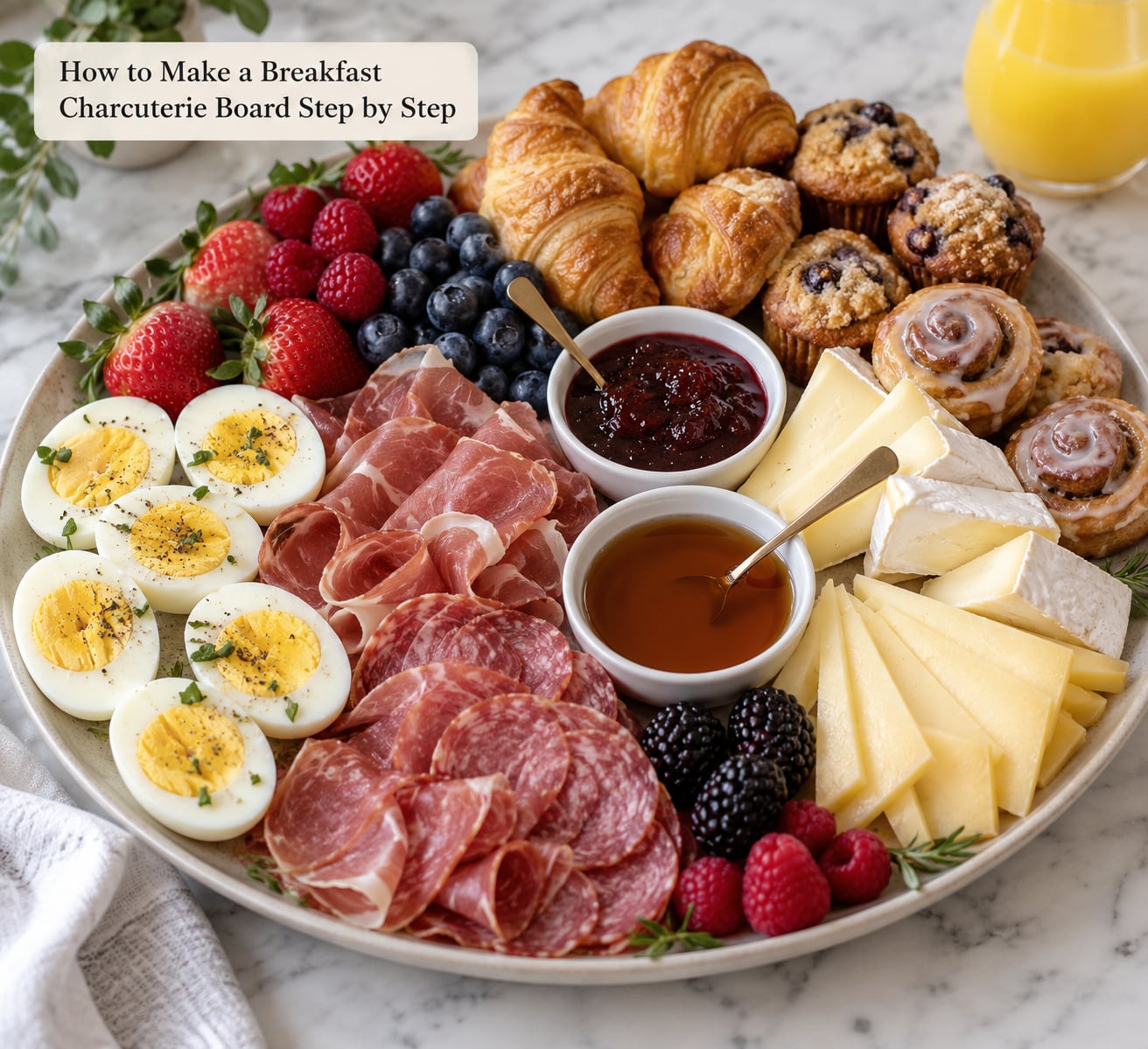
Step 1: Plan How to Make a Breakfast Charcuterie Board
Before you unpack anything, sketch six loose zones on the board in your head: proteins, cheeses, eggs, fruit, bakery and condiments. Deciding the zones first is what keeps the arrangement from turning into a pile in the middle of the wood.
Estimate portions before you arrange anything. Plan on 3 to 4 ounces of cured meat, 1 to 2 ounces of cheese and about 2 pieces of fruit per person, which is a reliable rule of thumb for a breakfast grazing board where guests pick at everything. Scale that up linearly: four to six people get the quantities listed above, eight to ten people get roughly double the meats, cheese and bakery, and about 3 cups of fruit.
Step 2: Choose a Balanced Breakfast Mix
A complete breakfast board needs at least one protein, two cheeses (or one cheese plus a spread), eggs, one fruit item and one bakery item. That is a floor, not a ceiling, and it is the single decision that separates a board people eat from a board they compliment. Store-bought cheeses do most of the work here, and 10 Best Cheeses for a Budget Charcuterie Board is a good place to pick two that contrast.
Balance matters more than variety. Two cured meats plus a cheese and a pastry reads as heavy by the second bite, so pair savory anchors with something fresh or sweet. Smoked salmon with whipped cream cheese and capers works. Prosciutto with brie and honey works. Bacon with sliced strawberries works surprisingly well.
Serving a mixed group means building in options rather than picking sides. Keep one clearly mild protein for children, one vegetarian protein such as eggs or avocado alongside the meats, and one mild cheese next to anything sharp or spicy. Do not add six proteins to cover everyone; add three and give people a place to build their own plate.
Step 3: Arrange Foods by Type and Color
Place your largest items first. A stack of mini waffles, a cheese wedge, a folded bundle of cured meat or a small stack of pancakes anchors a zone and gives the eye something to land on. Work outward from those anchors.
Group similar items instead of scattering them. All the eggs together, all the fruit together, all the meat in one or two neat folded stacks. Inside each group, alternate colors: pale brie beside dark berries, orange cheddar beside purple grapes, pink ham beside green avocado.
Leave gaps of roughly an inch between groups. Space is what makes a board look intentional, and it gives guests a clear path with tongs instead of a scramble. Dry and crisp items go directly on the wood; anything wet goes into a small bowl or ramekin so the surface stays dry and the board is not left stained.
Step 4: Add Spreads, Condiments, and Garnishes
Set three or four small bowls into the open space you deliberately reserved. Maple syrup, strawberry jam and whipped cream cheese are the reliable trio, and fig jam or cookie butter swaps in neatly if you want a different flavor profile.
Tuck garnishes into the gaps rather than scattering them on top. A small cluster of mint near the berries, a few chopped nuts beside the cheese, capers and pickles in one tiny bowl next to the smoked salmon. Garnish work should add color and a small flavor cue, not compete with the main items. If a spread smells strong enough to fill the room from three feet away, it will flatten everything else on the board.
Step 5: Label and Chill the Board
Put a small label on anything a guest might hesitate over: meat, dairy, gluten-containing items and anything spicy. Labels take ten seconds each and remove the guesswork at the far end of the table. It is also how you quietly handle dietary restrictions without making anyone ask.
Assemble the cold items up to two hours ahead and refrigerate the board, loosely covered. You can also build the whole board the night before, refrigerate it, and add hot items just before serving. Leave the fruit out of the overnight build if you can, so it stays bright rather than weeping juice onto the bread.
Follow the two-hour rule for perishable foods. Eggs, dairy, cured meats, smoked fish and cut fruit should not sit at room temperature longer than two hours, or one hour when the temperature is above 90°F. That limit is the same for a party as for a picnic, and a board out on a coffee table can hit it faster than you expect once everyone starts moving around it.
Step 6: Finish and Serve the Board
Add the hot items last. Warm bacon, warmed waffles or jammy soft-boiled eggs go on just before people sit down, and those items define how long the whole board should be out. Plan backward from that.
Set out tongs for the eggs and meats, small knives for the cheese and bakery, plates and napkins, and a trash bowl for the shells and packaging if you used whole fruit or unpeeled sausages. Cold items stay visible in the center and the cooler parts of the board; less perishable items such as sealed crackers, whole fruit and jam jars group near the outside edge.
The layout changes with the setting. On a countertop buffet, keep the bowls on the board and let people carry their own plates. At a table, set the board low enough that everyone can reach it and place the drinks at the far end so cups do not crowd the food. Coffee, a carafe of orange juice and one sparkling option for the adults finish the setup.
Common Mistakes
Overcrowding the board. More food looks messy, not generous. Fix it by cutting the item count instead of shrinking the spacing. Six well-arranged groups read better than eighteen competing piles, and anything that does not fit belongs in the kitchen.
Scattering instead of grouping. Random placement destroys the color contrast that makes boards photograph well. Fix it by arranging one complete group at a time and stepping back before you start the next.
Putting wet items directly on the wood. Syrup and jam soak into a wooden board, leave a sticky film and can make bread soggy by the end of the morning. Fix it with ramekins and a parchment liner under anything crumbly or wet.
Choosing a board that is too small. The most common failure. Under-buy the space and every item touches its neighbor. Fix it by measuring the guest count against board area, or by using a sheet pan for overflow. If the total spend is the concern, How to Build a Charcuterie Board on a $30 Budget shows a workable shopping list you can adapt for the morning version.
Leaving perishable food out too long. Cut fruit, eggs, cream cheese, smoked salmon and soft cheese are all time-sensitive. Fix it by staging the cold items last where possible and setting a mental two-hour clock.
Skipping a signature item. A board of ten equal items has no anchor. Fix it by choosing one homemade or standout component, whether that is a small stack of waffles, a candied bacon twist or a wheel of brie with honey, and giving it the center position.
For scaling, treat four to six guests as the base recipe and multiply. For a crowd of twelve, two boards beat one enormous slab every time, because you can put the hot item on one and keep the cold items untouched on the other.
For prep, the night-before list is short: boil and peel the eggs, fry the bacon, wash and dry the fruit, cut the cheeses, and set out the bowls. The morning list is shorter: warm the bakery, add the hot proteins, fill the bowls, arrange, and label.
Plan a heat source for the hot items. A low oven around 200°F holds cooked bacon, sausage and waffles acceptably for 20 to 30 minutes without drying them out badly. Anything longer than that and you want a warming tray instead.
Frequently Asked Questions
How much food should I put on a breakfast charcuterie board?
For four to six people, plan on 3 to 4 ounces of cured meat, 6 to 8 eggs, 6 to 8 ounces of cheese, one bakery item and about 2 cups of fruit per six guests. Scale those numbers up linearly for bigger groups and add three to four small bowls of spreads rather than more main items. If you are unsure, build the savory and sweet halves first and see what is missing.
What foods belong on a breakfast charcuterie board?
A breakfast board covers five categories: starches and bakery such as mini waffles, silver dollar pancakes, croissants or bagels; proteins such as bacon, sausage links, ham, prosciutto, smoked salmon or boiled eggs; cheeses like brie, goat cheese, cheddar and smoked gouda; fresh fruit such as strawberries, blueberries, grapes and sliced oranges; and spreads and dips such as maple syrup, jam, whipped cream cheese and honey.
How long can a breakfast charcuterie board sit out?
Keep perishable items, which means eggs, dairy, cured meats, smoked fish and cut fruit, at room temperature for no more than two hours. Above 90°F, cut that to one hour. Assemble cold items up to two hours ahead and refrigerate the board loosely covered, then add hot items just before serving so the clock starts as late as possible.
Can I make a breakfast charcuterie board the night before?
Yes, with one adjustment. Build the savory side, the cheeses, the boiled eggs and the ramekins the night before, cover and refrigerate. Hold the fruit back if you can, since it releases juice overnight, and add bakery and hot items in the morning so they are not soggy or cold. Expect about a 15-minute finish the next day.
What are good vegetarian options for a breakfast charcuterie board?
Skip the cured meats and lean on eggs, soft-boiled or jammy, plus smoked salmon as an optional addition. Fill the protein gap with avocado slices, roasted vegetable spreads, feta, olives and hard-boiled eggs. Greek yogurt with granola in small bowls works as a starter, and whipped cream cheese or nut butter covers the spread slot without any meat.
How do I keep a breakfast charcuterie board from getting soggy?
Put every wet item in a small bowl or ramekin rather than on the wood, and line the board with parchment paper. Keep syrup, honey and jam away from the bakery, keep yogurt in cups, and drain any fruit that releases juice. Add crisp items like bacon, waffles and toasted bread in the last few minutes so they keep their texture.
Conclusion
Start with three decisions: pick the board size for your guest count, choose a balanced mix with at least one protein, two cheeses, eggs, fruit and one bakery item, and decide where the six groups will sit before anything touches the wood. Then set the small bowls in the gaps, add the garnishes last, label anything a guest might hesitate over, and refrigerate until ten minutes before serving.
That is how to make a breakfast charcuterie board that looks like you tried hard and cost you about half an hour. Updated for 2026, and it works just as well for a holiday morning as for a Saturday with friends.