
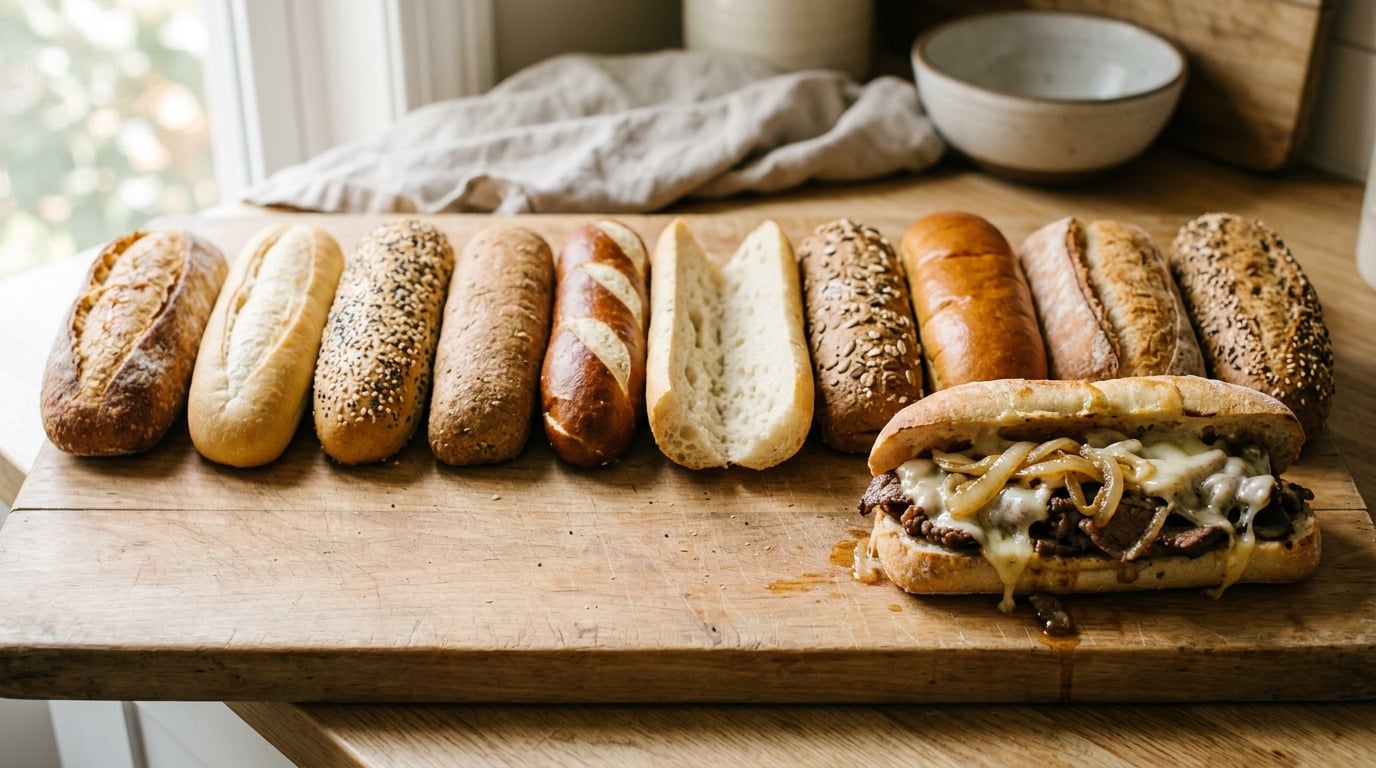
Outside Philadelphia, a cheesesteak is a sourcing problem before it is a sandwich problem. You need a long roll with a light, thin crust and an airy, chewy interior that soaks up meat juices without going soggy, and the roll has to be wide enough at the hinge to hold a serious pile of chopped ribeye and melted cheese. The best hoagie rolls for cheesesteaks if you don’t live in Philadelphia are the long Italian-style hearth-baked loaves, the French-style rolls, and a handful of sturdy stand-ins that most grocery aisles actually stock.
I have made cheesesteaks in three states and the failure is always the same one. Cheap thin rolls tear at the hinge, short rolls spill filling onto the plate, and crusty rolls fight the meat. A Philadelphia-style Italian roll solves all three, but it is not in every supermarket. So this list runs down ten bread types you can realistically find, with an honest note on what each one does well and where it gives out.
Everything here is judged the same way, whether the roll comes from a bakery case or a bag in the bread aisle: crumb, crust, length, and whether it holds up under a hot griddle. Updated for 2026, and prices change constantly, so I am not quoting any.
Table of Contents
- Best Hoagie Rolls for Cheesesteaks if You Don’t Live in Philadelphia at a Glance
- 1. Philadelphia-Style Italian Bread Rolls
- 2. French-Style Hoagie Rolls
- 3. Soft Kaiser Rolls
- 4. Sturdy Ciabatta Rolls
- 5. Potato Rolls
- 6. Whole-Wheat Hot Dog Rolls
- 7. Whole-Grain Hot Dog Buns
- 8. Sourdough Hoagie Rolls
- 9. Sprouted-Grain Rolls
- 10. Pita Rounds
- Frequently Asked Questions
- How should I store hoagie rolls after opening the package?
- Can I freeze cheesesteak rolls before using them?
- How do I warm rolls without making them tough or chewy?
- What size roll should I buy for a full cheesesteak?
- Can I use a low-carb or gluten-free roll for a cheesesteak?
- How can I find good hoagie rolls outside Philadelphia?
- Conclusion
Best Hoagie Rolls for Cheesesteaks if You Don’t Live in Philadelphia at a Glance
The short version: long Italian bread for authenticity, French-style for an airy chew, kaiser for a soft sturdy pocket, ciabatta for a crusty stand-up sandwich. Use the table to narrow the list before you drive to the store.
| Roll | Best feature | Texture | Ideal filling | Main drawback | Easiest to buy |
|---|---|---|---|---|---|
| Philadelphia-style Italian | Closest match to the real thing | Light crust, airy chewy crumb | Full ribeye load, onions, cheese | Thin, so generous fillings tear it | Ethnic grocery, in-store bakery |
| French-style | Narrow profile, big airy crumb | Crackly shell, open interior | Cheesesteak cut into sections | Too narrow for a true long sandwich | Widely available everywhere |
| Soft kaiser | Sturdy, slightly sweet, wide | Pillowy center, soft top | Overstuffed sandwiches | Sweeter than an Italian roll | Any grocery bakery case |
| Ciabatta | Crisp exterior, big bubbles | Crackle outside, open crumb | Hot filling served immediately | Can turn tough and hard to eat | Deli and bakery sections |
| Potato roll | Absorbs meat juice very well | Soft, moist, slight sweetness | Juicy cheesesteak with peppers | Thin skin tears if overfilled | Supermarket bread aisle |
| Whole-wheat hot dog roll | Nuttier, denser crumb | Firm, hearty, less airy | Cheese and onions, not a huge load | Needs warming to soften | Easy to find, many sizes |
| Whole-grain bun | Everyday durability and flavor | Firm, mildly nutty, lightly sweet | Standard chopped beef filling | Sweeter and grainier than Italian | Widespread grocery stock |
| Sourdough hoagie | Real chew with mild tang | Chewy, lively crumb | Sharp cheese, savory beef | Can be too sour or too fresh | Bakeries, some grocers |
| Sprouted-grain roll | Soft with mild whole-grain flavor | Soft, moist, slightly dense | Lighter fillings, deli meat | Holds moisture, goes soft fast | Health aisles, bakery cases |
| Pita round | Folds instead of splitting | Soft, chewy, pocketed | Chopped beef with onions, cut small | Not a traditional long sandwich | Everywhere, cheap by the piece |
One more note before the list. Cook the beef to a safe internal temperature: 145°F (63°C) for intact pieces, and if you chop or mince it as most cheesesteak cooks do, treat it as ground meat and take it to 160°F (71°C). The bread choice does not change that step.
Seeded or unseeded, and which size actually matters more
Unseeded, for the record. The traditional roll is plain, and seeds add a chew on every bite that competes with the meat. Plenty of people disagree, and one r/Sandwiches commenter liked a crusty seeded roll enough to call it how cheesesteaks should be done while admitting it is not traditional. If you like seeds, buy them. Just know what you are signing up for.
Size matters far more than the seeds, the brand, or the flour. A 12-inch roll holds a real serving of chopped ribeye. An 8-inch roll is fine for a moderate filling and better for children, because it can be cut in half and eaten without a mess. Anything shorter is a slider, not a cheesesteak. Check the length on the bag before you commit, and if the label does not say, judge it by how it looks next to your cutting board.
1. Philadelphia-Style Italian Bread Rolls
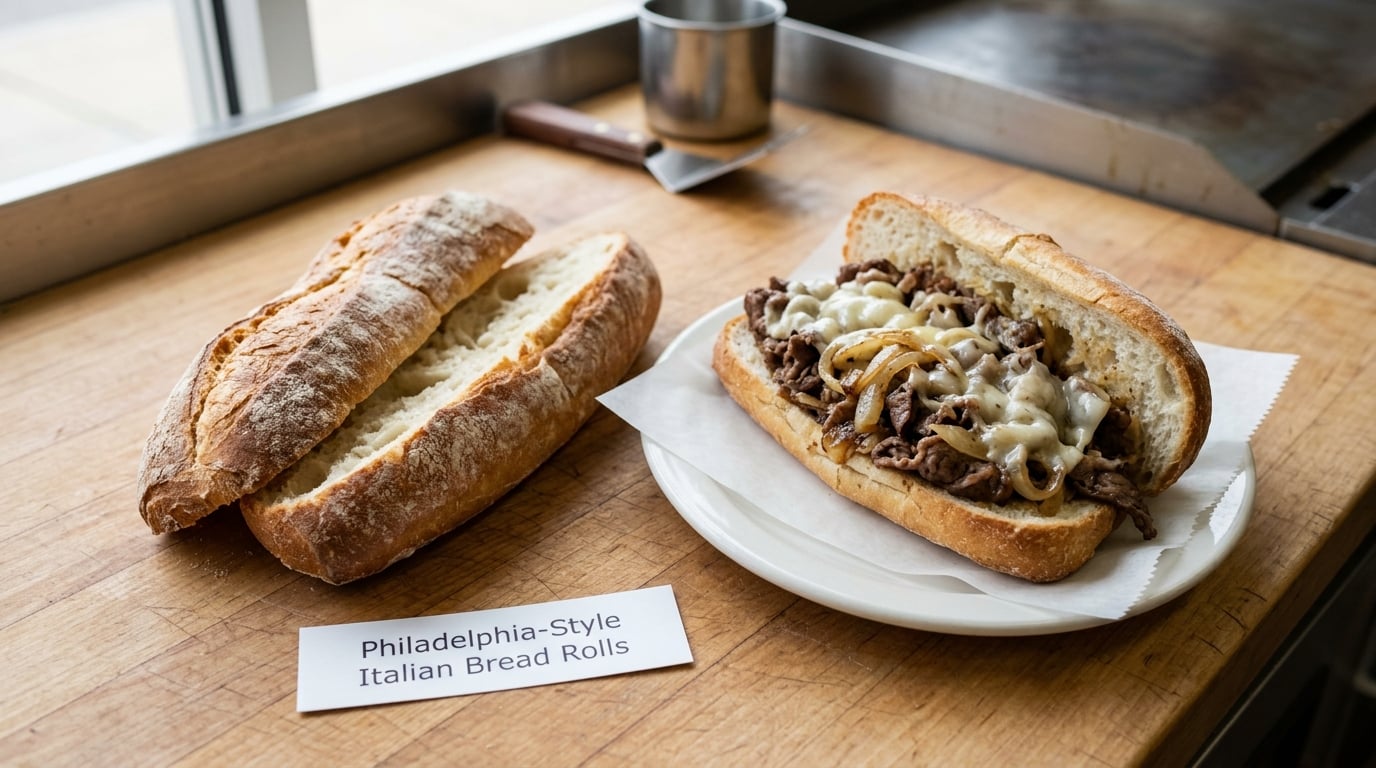
Philadelphia-style Italian bread is the answer, and the other nine items on this list are ways to approximate it. The defining qualities are a pale, flour-dusted crust that is thin enough to soften on contact and a crumb with irregular air pockets that stretches and soaks up juice. Those pockets are why the sandwich survives being eaten over a plate instead of in a wrapper.
The catch is availability. Outside the Delaware Valley, this bread shows up at Italian groceries, in-store bakery cases with an Italian name on the sign, and at specialty importers. A search on the bakery case for anything labeled hoagie, Italian, or Philly-style is the fastest way to find it. One r/askportland thread about sourcing rolls outside Philly is worth reading: a commenter points out that the bakery cases at Winco and an Asian grocery, Hong Phat, carry unexpectedly good sandwich rolls, and that both worked well for cheesesteaks. That is the whole hunt in a sentence.
How to pick a Philadelphia-style roll in a bakery case you have never shopped
Pick up the bag and look through it. You want pale, unsliced or center-sliced loaves with a soft, compressible feel. If the crust snaps hard between your fingers, it will stay crunchy no matter how long you warm it.
Buy a small quantity your first time. Fresh bread degrades faster than the shelf life on the bag suggests, and the difference between day one and day four in a cheesesteak is noticeable. If you want to keep a supply, freeze the whole bag and thaw what you need overnight in the fridge.
Handling tip: split the roll with a serrated knife, warm the cut faces on a dry griddle for about 20 seconds until the inside feels warm and slightly springy, then spread the filling. Heavy toasting dries the crumb and makes the hinge crack. Light warming is the whole technique.
How to prep any store-bought roll so it behaves like a Philly roll
Five steps, in this order, and most of the structural complaints about store-bought bread disappear.
- Split the roll lengthwise with a serrated knife, cutting all the way through the bottom crust, but stop short at the far end so it stays hinged.
- Widen the hinge by pulling the two halves gently apart at the center. You want a pocket, not a flat slice.
- Warm the cut faces on a dry griddle for 20 to 30 seconds each. Warm, not toasted.
- Drain the meat well before it goes in. A slotted spoon and a paper towel beat a colander that lets juice run back onto the bread.
- Assemble last, press the top down gently to set the filling, and eat within a minute or two.
Step four is the one people skip. A slotted spoon, a pat with a paper towel and a two-minute wait keeps the bottom of the roll from turning to mush before the first bite. Most sogginess complaints in cheesesteak forums trace back to the filling, not the bread.
When to bake the rolls instead
When your town has no Italian bakery and no mail-order option you trust, baking is more realistic than it sounds and faster than a research mission across four grocery stores. Home bakers on r/Breadit point to a simple formula of 100 percent King Arthur bread flour, 64 percent water and 1 percent yeast, a lean high-hydration dough that bakes into a light, airy crumb. A sourdough starter discard loaf is the common off-label version, and it uses dough you would otherwise throw away.
Neither dough is a two-hour project, so the timing works against you: shape and proof the dough first, then cook the beef. Have the meat sliced and the onions ready before the dough goes in, and let the rolls cool on a rack so the crumb finishes setting. The one thing you cannot bake on short notice is patience, and a cheesesteak made at 9pm is worth more than a rushed one at noon.
2. French-Style Hoagie Rolls
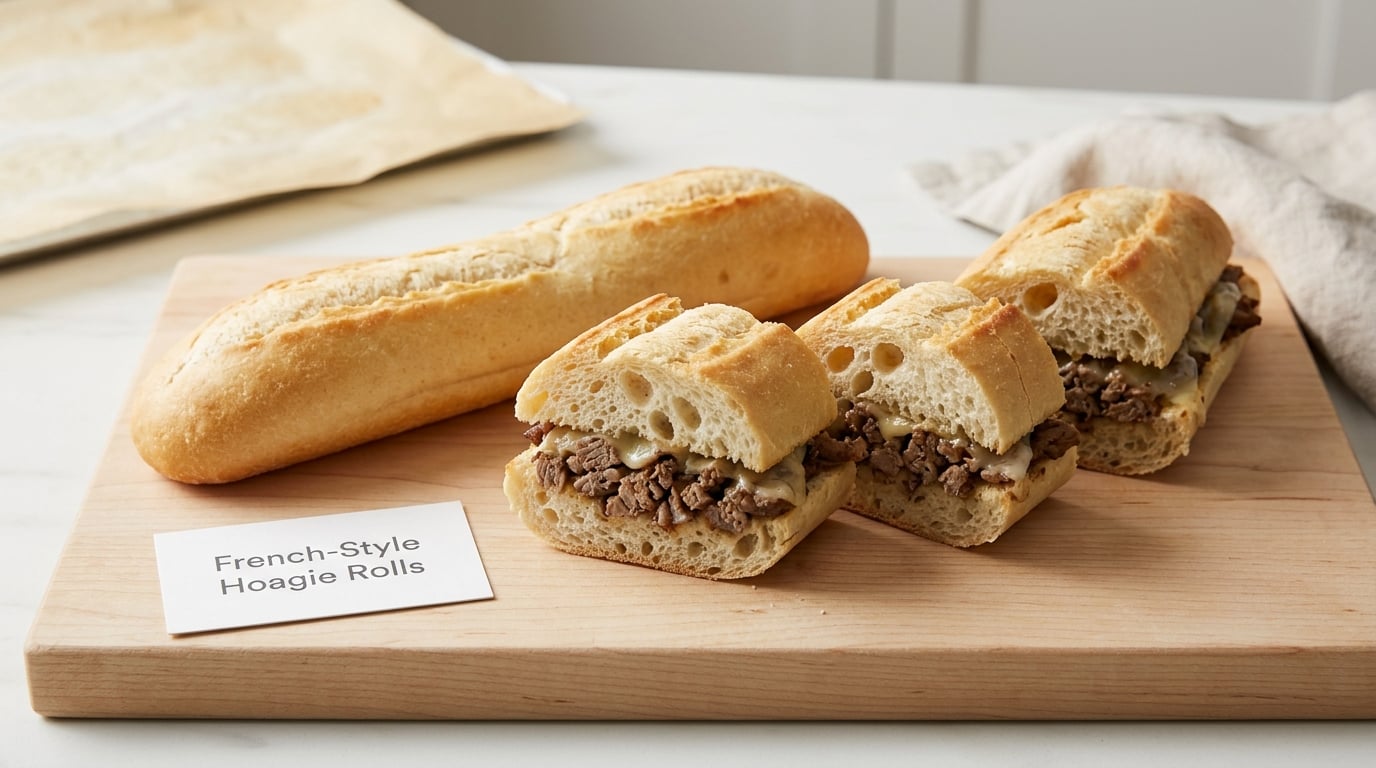
French-style rolls are the most practical substitute for Italian bread, and in most towns they are the roll already sitting in the bread aisle. The shell crackles, the crumb inside is wide and airy, and it is narrow enough that a full cheesesteak has to be cut into two or three sections, which is exactly how a long sandwich behaves on the way to a car.
That narrow profile is the whole tradeoff. You cannot load the same amount of beef as you would in a 12-inch Italian roll, so plan on one roll per person with a modest filling, or two rolls for a hungry eater. A r/tampabay thread about the best Italian hoagie rolls makes the mirror-image point: a popular Italian brand gets praise for the dough but complaints that the rolls run small. Length and width are the deciding measurements in this sandwich, more than the brand name.
Warm these gently too. A hard grill leaves the thin shell with no give and the first bite tears a strip off. Thirty seconds per side, cut face down, is plenty.
Sourcing is the easy part with French bread, which is exactly why it is on this list. A supermarket, a corner store and a bagel shop all stock them, and most sell more than one length. When a bakery case has both, take the slightly larger one. The narrow profile is the limiting factor, not the dough.
3. Soft Kaiser Rolls
A kaiser roll is the sturdiest sandwich bread in most grocery stores, which makes it the best fallback when you have a big pile of filling and no good Italian loaf. The top domes slightly and the crumb underneath is dense enough to support weight, so a properly loaded cheesesteak stays in one piece from the first bite to the last.
It also has a mild sweetness from the dough, usually from a little sugar or milk. That reads as a small pleasant difference in a plain beef-and-cheese sandwich, and it becomes obvious the moment you add hot peppers or a sharp cheese like Cooper Sharp or provolone. Buy the plain variety rather than the seeded or herb ones if the sandwich is the point.
The kaiser is wider and shorter than a hoagie roll, so it is closer to a thick sub. One of these is a full sandwich. Two makes it a meal.
4. Sturdy Ciabatta Rolls
Ciabatta brings a crackling shell and large irregular holes to the table, and it handles heat well. Put the split face on a hot griddle and the outside crisps while the inside stays open and soft, which is a genuinely good contrast against melted cheese and onions.
It is a step away from a cheesesteak, and the reason is chew. A full ciabatta roll with a complete ribeye filling is a lot of texture per bite. Some people love it, and one r/Sandwiches commenter described a crusty seeded roll with Cooper Sharp as how cheesesteaks should be done, while admitting it is not traditional. Fair enough. Bread preference is personal, and this one is the most divisive entry on the list.
Use ciabatta for a small, hot sandwich eaten on the spot. Avoid it for a large one you plan to carry, and never reheat it twice, since the second heating dries the crumb and hardens the crust.
5. Potato Rolls
Potato rolls are soft, moist and faintly sweet, and their crumb is unusually good at wicking up liquid. A cheesesteak puts out a surprising amount of juice, especially with onions and peppers in the pan, and a bread that drinks that up keeps the sandwich from dripping.
The downside is structural. Potato dough produces a thinner skin than a standard roll, so overfill and the bottom tears before you get it to the table. Load these a little lighter than you load a kaiser, and assemble them last. Also mind the two soft sides: both halves soak equally, so a roll left face-down on a board gets damp in seconds.
Availability is the best part. These sit in the standard bread aisle in nearly every supermarket, and they cost a fraction of what a specialty Italian loaf commands. For a family of four on a weeknight, a bag of potato rolls gets the job done without a sourcing errand.
6. Whole-Wheat Hot Dog Rolls
Whole-wheat hot dog rolls are a genuinely different option, and the reason is flavor and structure rather than tradition. The crumb is denser, nuttier, and sturdier than a white roll, with a long flat shape that opens easily and a hinge wide enough for a full serving of beef. They are sold in nearly every grocery store in several lengths, which also makes them the easiest roll to find in a specific size.
Two things to know. The denser crumb does not absorb juice as fast, so give it a longer warm in the pan to soften the whole way through, otherwise you get a cold center under hot cheese. And the flavor is earthier, so pair it with sharp cheese and onions rather than a delicate filling. Provolone or Cooper Sharp cut through the wheat taste. The sandwich is less about replicating a cheesesteak and more about being a good beef sandwich with better bread than the default.
7. Whole-Grain Hot Dog Buns
Whole-grain buns are not the same thing as whole-wheat bread, and the difference matters here. A whole-grain bun is usually built from a mix of white flour and a small amount of wheat, oat, or other grains, often with a touch of sugar or honey. The result is a firmer crumb than a pure whole-wheat roll, a mild nuttiness, and a slightly sweet finish. The color is browner and the texture is denser, but the crumb stays closed and pliable instead of turning grainy.
That balance is why these work well for a moderate filling. They do not collapse under a heavy load, they hold sliced onions and peppers in place, and they need less warming than a whole-wheat roll. They are the most boring entry on this list and also the most forgiving one, which is worth something on a Tuesday.
Skip the seeded versions if you want the sandwich to taste like beef and cheese. Seeds add a chew on every bite and they fall onto the plate while you eat.
8. Sourdough Hoagie Rolls
Sourdough rolls are the best pick on this list when you want a sandwich with a point of view. Mild fermentation adds a faint tang, and the crumb is livelier and chewier than a standard hoagie roll, which means it does not go soft as fast under hot filling. Sharp cheese and savory beef handle the acidity very well, and the result tastes deliberate rather than plain.
Two warnings. A loaf straight from a bakery can be aggressively sour, and that sharpness competes with a cheese that is already tangy. Pick a mild or medium sourdough and let it be the background note. Second, very fresh sourdough has a crumb that is still setting, so it can feel gummy in the middle. Buy it a day or two after baking, or warm it a little longer to finish the crumb.
Fermented dough also improves after freezing, so a sourdough roll thawed overnight and warmed is often better than one used on purchase day.
9. Sprouted-Grain Rolls
Sprouted-grain rolls are soft, mild and lightly textured, and they appeal to people who want the grain content without the dense chew of wheat bread. The flavor is subtle, closer to a mild whole-grain roll than to a hearty one, so the sandwich tastes mostly like the filling.
Moisture is the issue. Sprouted dough holds water, and these rolls go soft faster than white bread, especially in a humid kitchen. A roll that sat open for an hour on a counter will feel heavy and damp when you pick it up. Keep them in the closed bag until you use them, and skip a second warming.
They do best with lighter builds, like sliced beef, a slice or two of cheese, and sautéed onions, rather than a full chopped ribeye pile. They are not a Philly roll and never will be, but they hold a decent sandwich together and suit a cook who wants a lighter bread.
10. Pita Rounds
Pita is worth including because it solves the availability problem completely. Every grocery store carries it, it is inexpensive, and it folds instead of splitting, so a filling that would fall out of a hoagie roll stays exactly where you put it. The pocket is the feature. A round pita opened along the seam, filled with chopped beef, onions and cheese, and folded twice is a reliable weeknight cheesesteak.
The limits are real. You are making a folded pocket sandwich, not a long hoagie, and the sauce and cheese stay in one spot rather than spreading along the length. Traditional presentation disappears, and any purist at the table will notice. A pocket also holds less than a 12-inch roll, so expect a smaller sandwich or use two.
Warm it briefly so the pocket is pliable, and press the seam closed with the warm folded side facing down on the pan. That single move stops the most common pita failure.
What to skip at the shelf
A few things look like hoagie rolls and behave badly. Pre-sliced sandwich bread from the shelf-stable aisle is too soft and too even; it compresses under a warm filling and never springs back. Plain hot dog buns are too small and too sweet, and they split lengthwise before you finish filling them. Baguette slices have the right flavor and none of the right structure, since there is no hinge to open and the crust fights every bite.
Also skip any roll that is already hard at the bagged edge, and skip heavily seeded crusts if the sandwich is the point. The rolls worth buying feel slightly compressible through the bag. If nothing in the aisle feels compressible, go to the bakery case and ask what the Italian bakery ships in.
Frequently Asked Questions
How should I store hoagie rolls after opening the package?
Keep the bag closed, or transfer the rolls to a bread box, a paper bag, or a resealable bag with a folded towel inside. Plastic alone traps condensation and softens the crust, so a paper bag or bread box is the better choice. At room temperature, rolls stay at their best for roughly two days. Beyond that, freeze them in the bag, never in a sealed container, and thaw overnight in the refrigerator rather than on the counter.
Can I freeze cheesesteak rolls before using them?
Yes, and rolls freeze better than most bread. Freeze them in a single layer inside the bag for the first two hours, then lying flat in a freezer bag or wrap so they do not touch. Thaw in the refrigerator overnight, or warm a frozen roll directly on a griddle for a few minutes per side. Avoid the microwave, which heats unevenly and leaves a tough edge. The crumb firms up slightly in the freezer and relaxes as it warms.
How do I warm rolls without making them tough or chewy?
Split the roll, then warm it cut-side down on a dry griddle or skillet for about 20 to 30 seconds. The goal is warmth, not toast. Heavy browning dries the interior and makes the hinge crack when you try to open it. If you steam, wrap the roll in a damp towel and warm it gently, which softens without drying. Skip the microwave and skip a second warming, both of which drive out moisture the crumb needs.
What size roll should I buy for a full cheesesteak?
For one hungry person with a normal serving of chopped ribeye, buy a 12-inch roll. An 8-inch roll works for a modest filling and is better for children or for cutting a sandwich into sections. Anything under 8 inches produces a sandwich that is mostly ratio: meat, cheese and bread in proportions nobody wants. If you are feeding a group, an 8-inch roll cut in half is easier to eat than a 12-inch roll cut into three.
Can I use a low-carb or gluten-free roll for a cheesesteak?
You can, with one adjustment. Low-carb and gluten-free rolls are usually denser, stiffer and thinner, so they do not split cleanly and they hold heat and moisture differently from wheat bread. Warm them gently and lay the filling in the middle rather than trying to hinge the whole roll. Cheese and beef are naturally low in carbohydrates, so the sandwich works well on this style of roll. It will not taste like an Italian roll, and it will not fall apart the way wheat bread does.
How can I find good hoagie rolls outside Philadelphia?
Check in this order: the in-store bakery case, an Italian or ethnic grocery, a specialty bread importer, and a mail-order bakery. In-store bakery cases are the first place to look because the staff can tell you what the local Italian bakeries ship in. Regional chains and ethnic grocers are the second stop, and members of the r/askportland community specifically recommend the bakery cases at Winco and Hong Phat. Mail order is the fallback, and rolls shipped from Philadelphia usually need a refresh in a low oven before use.
Conclusion
Buy the Philadelphia-style Italian roll when you can find one. It is the only bread on this list that needs no explanation, and the pale flour-dusted loaf with an airy crumb is the thing a cheesesteak was built around.
Buy the French-style roll when you need something in the next ten minutes. It is everywhere, it is airy, and cutting the sandwich into sections solves the narrow profile.
Buy the kaiser or a sturdy ciabatta roll when the filling is large. Those two are the sturdiest, they take a heavy load without splitting, and they reward you with a sandwich you can actually carry.
One last instruction that matters more than the brand: warm the roll gently, fill it lightly on a first attempt, and cook the beef to 160°F (71°C) if you chop it. The best hoagie rolls for cheesesteaks if you don’t live in Philadelphia are the ones that survive a hot griddle and a full serving of ribeye, and those three choices all do.