
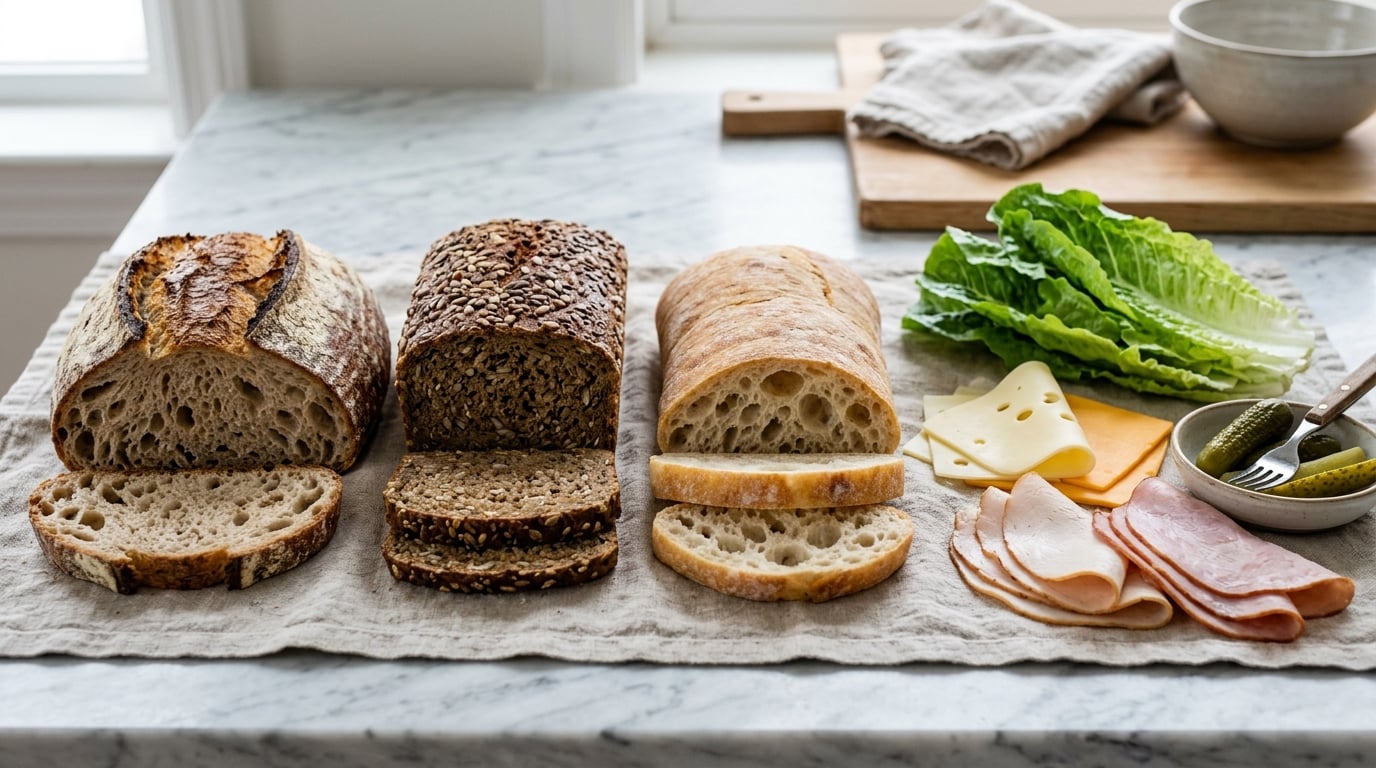
There is no single best bread for deli sandwiches. The right choice depends on the filling: rye carries pastrami, corned beef and other cured meats without buckling, sourdough handles turkey, roast beef and grilled sandwiches, and ciabatta suits Italian cold cuts plus anything you press.
Match the crumb structure to what goes inside and the sandwich survives the trip to your desk. Mismatch it and you get a soggy bottom slice, a top slice that slides off, and mustard on your shirt. That is the whole argument, and it is worth a few minutes at the counter.
At our shop we assemble hundreds of these a week, and the bread is usually what people notice last and complain about first. Updated for October 2026.
Table of Contents
Sourdough vs. Rye vs. Ciabatta at a Glance
The table below scores all three on the things that decide whether a loaded deli sandwich holds together. Read the moisture row first, since that is where most sandwiches fail.
| Criterion | Sourdough | Rye | Ciabatta |
|---|---|---|---|
| Flavor | Mild tang, gentle acidity | Sharp, earthy, faintly sour | Very mild, slightly yeasty |
| Crumb structure | Open, irregular, chewy | Compact, tight, dense | Large open holes, soft |
| Crust | Thick, crisp, sturdy | Thin to medium, firm | Thin, brittle, crackly |
| Resists wet fillings | High | Highest | Lowest once loaded |
| Strength under a heavy stack | High | High | Low, crumb falls out |
| Best deli fillings | Turkey, roast beef, ham, grilled cheese | Pastrami, corned beef, smoked salmon, roast beef | Italian cold cuts, capocollo, pressed sandwiches |
| Main drawback | Can be too chewy for soft fillings | Dries out, can taste dusty | Fragile and easily crushed |
| Best preparation | Cold, toasted, or grilled | Cold or lightly toasted | Pressed or warm |
Sourdough for Deli Sandwiches
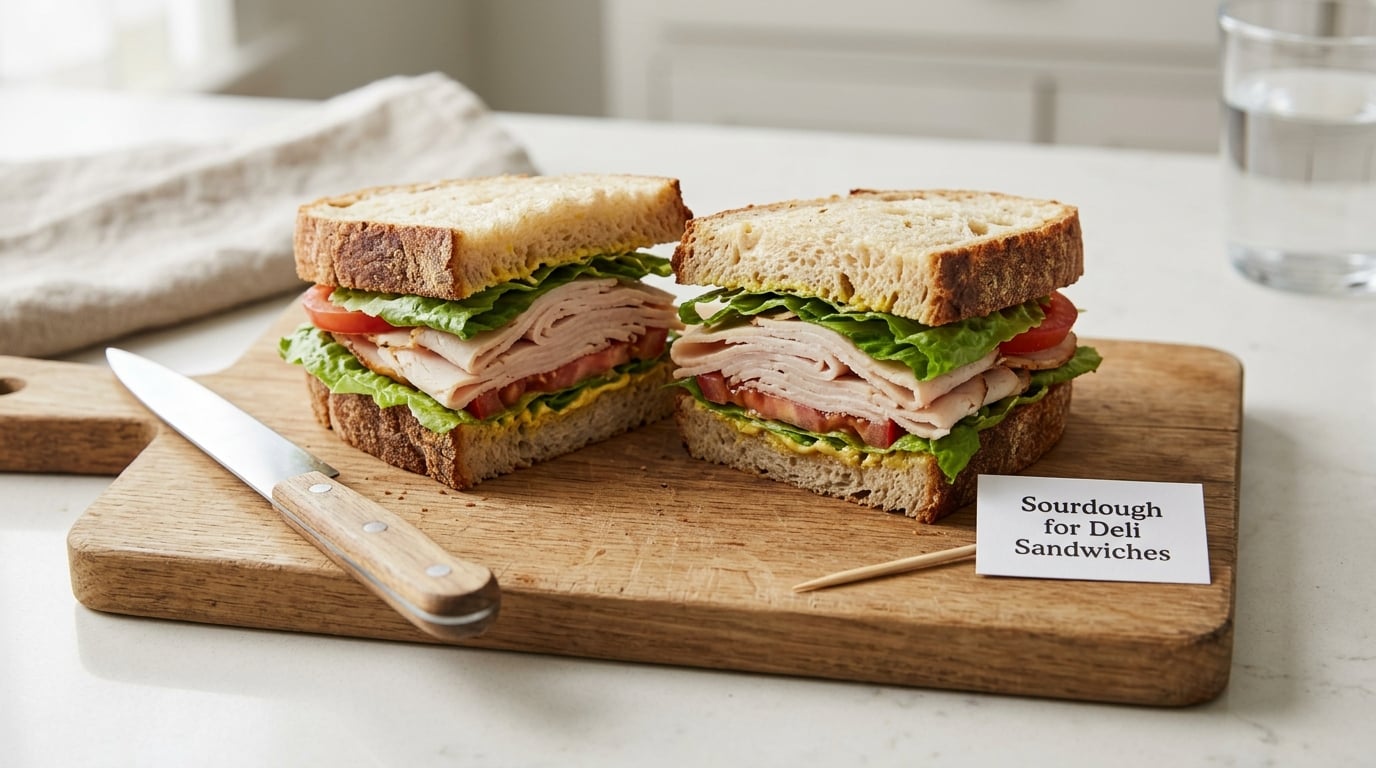
Sourdough is the safe all-rounder of the three. It has real flavor but not aggressive flavor, a thick crust that acts as a moisture barrier, and a chewy open crumb that soaks up dressing without losing its shape.
That open crumb is the useful part. A tight sandwich crumb saturates fast when tomato or pickle brine hits it. Sourdough’s irregular holes distribute moisture through the slice rather than pooling it in one spot, which buys you ten or fifteen extra minutes before the bottom turns soft.
The tang comes from lactic and acetic acid produced as the starter ferments, and it does quiet work in a sandwich: it cuts the fat of mayo and aioli, and it makes roast beef taste more like itself. Against a mild filling like plain turkey and Swiss, the acidity is the thing that makes the sandwich taste finished rather than flat.
Sourdough is our default for turkey and Swiss, roast beef with horseradish, ham and cheese, and anything going on a griddle. Toasted, it turns into a genuinely good grilled cheese, because the crumb is dense enough to survive melted cheese and butter without collapsing.
Sourdough vs. Rye vs. Ciabatta: Flavor and Tang
All three can be described as tangy, which is where most comparisons go wrong. Sourdough’s acidity is a background note, ry’s is the headline, and ciabatta barely registers.
Rye is fermented longer and differently, and it tastes earthier and sharper, closer to a sour loaf than to a tangy one. Ciabatta is short on sour flavor and long on a faint yeasty sweetness, which is exactly why it disappears under strong fillings like prosciutto or hot peppers.
The practical consequence: choose sourdough when the filling is mild and you want the bread to have a say. Choose rye when the filling is already loud and you want the bread to match it rather than compete.
Sourdough vs. Rye vs. Ciabatta: Texture and Structure
Sourdough gives you the sturdiest chew of the three. It compresses under a heavy stack and springs back, and a double slice of it will carry more deli meat than the same weight of anything else here.
Rye’s crumb is the most compact, so it barely compresses at all. It is the only one of the three that will reliably hold a towering pastrami and cheese stack without bending, and it does not shed crumbs when you cut into it.
Ciabatta has the softest, most open interior and the thinnest crust. That combination is light and pleasant in a pressed sandwich and genuinely fragile in a tall cold one, where the top slice often slides off the filling and crumbs fall out the side. Cut ciabatta thick and press it, or accept the mess.
Rye for Deli Sandwiches
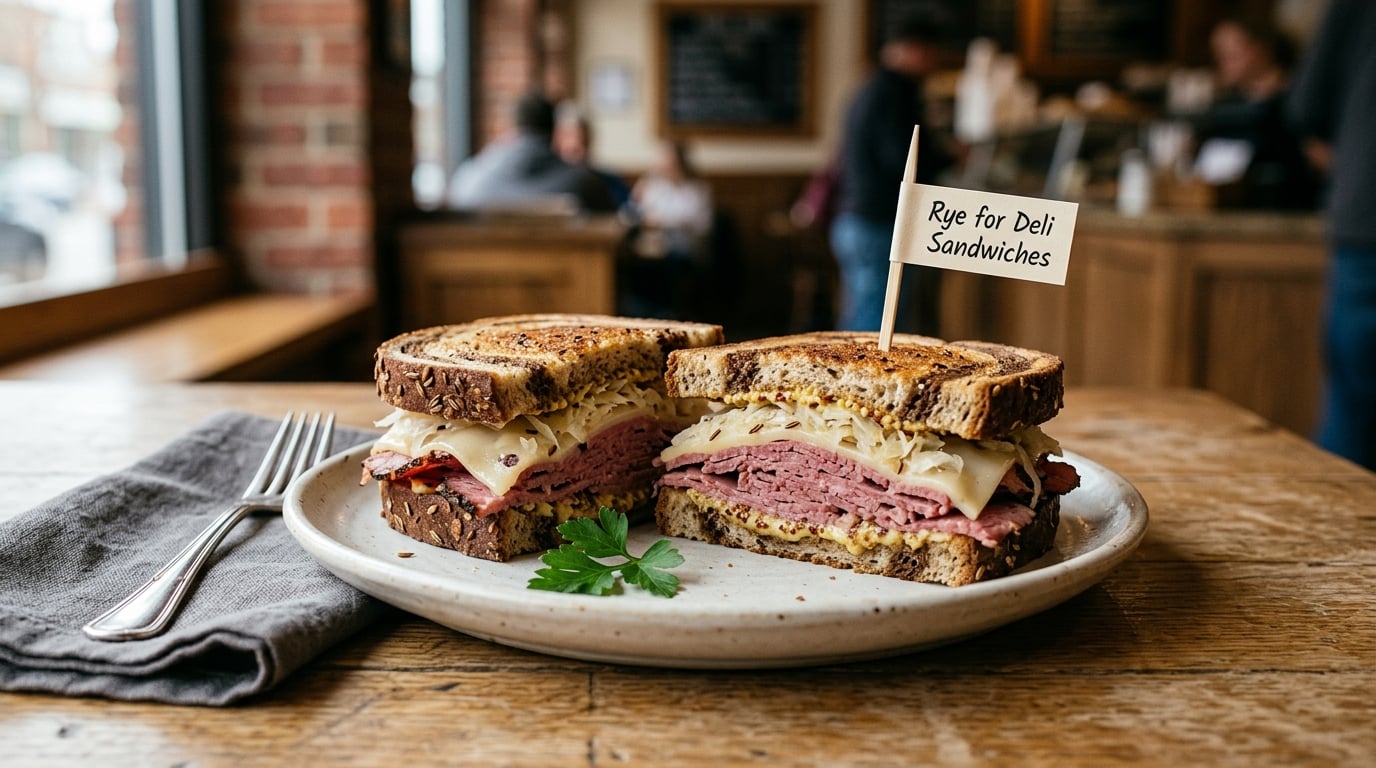
Rye is the strongest structural choice of the three, and the only one of the trio that will not fall apart under a pastrami stack. Its tight crumb, firm crust, and sharp earthy flavor were built for cured and fatty meats.
It is the correct bread for pastrami, corned beef, a Reuben, smoked salmon with cream cheese, roast beef, and Swiss with sauerkraut. The flavor runs in the same direction as the filling instead of fighting it, and mustard, which can overpower other breads, tastes balanced on it.
The honest drawback is dryness. A plain rye sandwiched with nothing but sliced cheese can taste dusty and dry within an hour, and some rye bakes dense enough to be hard work. The fix is easy: use a rye-wheat blend rather than a 100 percent rye loaf, add a creamy spread, and skip the second slice of pastrami until you’re sure you want it.
Rye comes in several styles, and they are not interchangeable. Plain rye is the most fermented and sour. Caraway rye adds rye seed and a lighter, slightly sweeter profile that many people find more approachable. Marbled rye swirls a darker molasses dough through it for a sweeter, softer crumb. Seeded rye adds crunch and stays moist longer, which helps with the dryness problem.
Ciabatta for Deli Sandwiches
Ciabatta is the crisp, mild option. A thin brittle crust, a large open crumb, and a flavor so light it disappears, which makes it the right carrier for Italian cold cuts and anything you intend to press.
Prosciutto, capocollo, salami, roasted peppers, and a hot Italian with pickled peppers all work well on it, because the bread stays out of the way and the press turns those big open holes into a crisp shell around the filling. A ciabatta panini is the best sandwich this bread ever makes.
Cold and loaded, it is the most fragile of the three. Crumbs fall out of the open crumb, the thin crust snaps when you bite, and tomato or mayo reaches the middle faster than it does in sourdough.
Why does ciabatta get so hard? Staling. The starch in the crumb gradually firms back up as moisture leaves it, and a thin crust has little left to soften it. To bring it back, run a slice or two under water for 20 seconds, lay it cut-side down on a baking sheet, and bake at 350F for 5 to 8 minutes. The crust crisps back up and the crumb softens. Wrapping the loaf in a damp towel for an hour before slicing helps, too.
Which Should You Choose?
Match the bread to the filling and the preparation. This is the short version of every rule above, laid out by the sandwich you are probably about to order.
| Sandwich | Best bread | Why |
|---|---|---|
| Turkey and vegetable | Sourdough | Sturdy under moisture, mild enough for turkey |
| Pastrami on rye | Rye | Only one that holds a heavy cured-meat stack |
| Reuben | Rye | Earthy flavor matches corned beef and sauerkraut |
| Tuna or egg salad | Sourdough | Chewy crumb holds a soft, moist filling |
| Grilled cheese | Sourdough | Toasts well, survives melted cheese and butter |
| Ham and cheese | Sourdough or rye | Sourdough for mild cheese, rye for Swiss |
| Roast beef and horseradish | Sourdough | Acidity cuts the horseradish sharpness |
| Italian cold cut | Ciabatta | Mild flavor, stands up to a press |
| Hot Italian or pressed | Ciabatta | Open crumb crisps without going hard |
| BLT | Sourdough | Sturdy enough for the bacon, resists tomato |
| Smoked salmon | Rye | Sharp flavor cuts the richness of the fish |
A few habits do more for a deli sandwich than the bread choice does. Toast the bread, even lightly, before a wet filling. Put mayonnaise or aioli on both slices as a moisture barrier, and put the tomato and pickles toward the center rather than against the bread. Drain brined fillings properly, and press the sandwich for 30 to 60 seconds if the filling is cool enough to hold it together.
Slice thickness matters too. Sourdough and rye can take a thick cut. Ciabatta cut thick or it disintegrates, and the thin crust needs to stay intact across the whole slice for the sandwich to stay in one piece.
Frequently Asked Questions
Which bread is best for a turkey deli sandwich?
Sourdough. It is the sturdiest of the three with a mild enough flavor that it does not compete with turkey, and its open crumb absorbs dressing without collapsing. Toast it lightly first, spread mayonnaise on both slices, and place the tomato in the center of the filling rather than against the bread. Rye also works well if you like more tang, but plain rye can read as dusty next to mild turkey.
Does rye work better than sourdough for pastrami?
Yes, and it is not close. Rye is the only one of the three with a crumb tight and firm enough to hold a tall stack of pastrami, and its sharp earthy flavor was developed alongside cured and fatty meats. Sourdough will work if you toast it, and the tang is welcome, but the open crumb and thicker crust make it more likely to compress. If the bread is very dense, a rye-wheat blend is easier to eat than 100 percent rye.
Should I toast ciabatta before making a deli sandwich?
Lightly, if the sandwich is cold. A quick toast firms the thin crust so it does not snap when you bite, and it slows moisture from tomato, mayo, and olive oil reaching the open crumb. For a pressed or panini sandwich, toast after pressing instead, since the press and the heat together are enough. For a cold sandwich with cured meats only, no toast is needed, the bread is already crisp on the outside.
Which bread stays least soggy with wet fillings?
Rye, followed by sourdough, with ciabatta last. Rye’s compact crumb has the least open space for liquid to sit in, and sourdough’s open crumb distributes moisture through the slice rather than pooling it. To help any of them: toast first, use mayonnaise on both slices as a barrier, layer wet ingredients in the center, drain pickles and peppers on paper towel, and avoid building the sandwich more than about an hour before eating it.
Can I use sourdough for a grilled cheese sandwich?
Yes, it is one of its best uses. The thick crust and chewy crumb survive melted cheese, butter, and heat without the sandwich collapsing, and the mild tang gives plain cheddar or Swiss more depth than white bread would. Medium-thick slices work best, and cook them on medium heat so the cheese melts before the crust burns. A thin-cut slice will toast unevenly, so save the thin slices for deli turkey.
How should I store deli sandwich bread at home?
Keep it at room temperature in a paper bag or a cloth-lined bread box, never in the refrigerator. Refrigeration accelerates staling, and a sealed plastic bag traps the crust condensation that makes a crisp crust turn soft and leathery. Freeze ciabatta or sourdough you will not use within two days, and refresh it in a 350F oven for 5 to 8 minutes. Cut bread goes stale fastest, so only slice what you need for the day.
Bottom Line
Pick one rule and the decision is easy. Sourdough for tang and structure, rye for bold fermented flavor, ciabatta for a crisp mild roll. Then toast the bread, spread mayo on both slices, and keep the wet ingredients in the middle.