
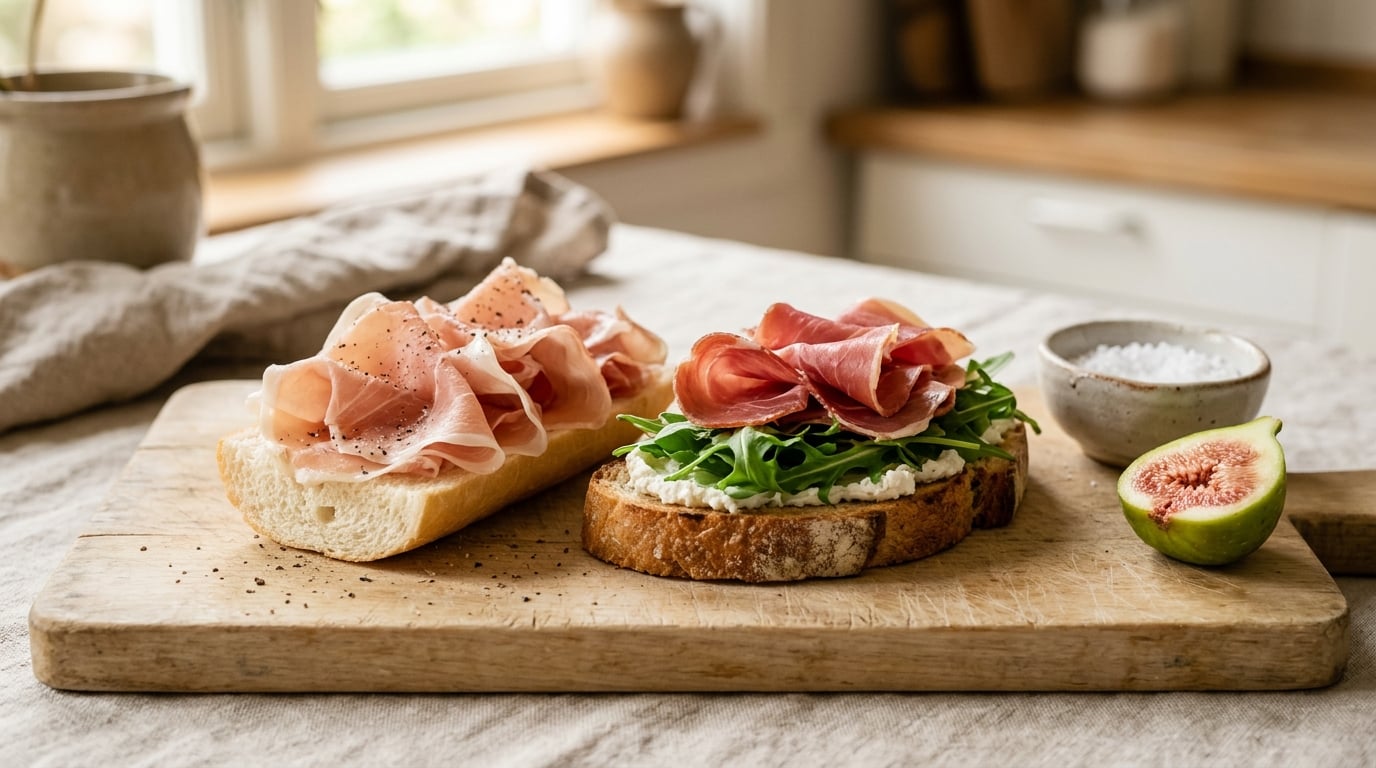
If you build sandwiches most days, a domestic prosciutto pack gives you the better value per ounce, and an imported DOP prosciutto earns its extra cost when you want more flavor per slice and use fewer slices. Origin matters far less than salt level, slice thickness, and what you actually paid per ounce.
That is the honest answer to the question, and it is not the one most prosciutto guides give. A lot of writing about prosciutto treats country of origin as a proxy for quality, which is a shortcut that mostly measures how much someone was willing to pay.
What actually changes your sandwich is more ordinary: whether the slice is thick enough to survive a loaded bread, whether the fat is marbled through the lean so it tastes like something, and whether the salt is high enough to notice but low enough that you still taste the cheese. Get those three right and a mid-priced domestic pack is a very good sandwich meat.
I spend a lot of time in the prosciutto aisle and the honest summary of the best prosciutto for sandwiches is this. Buy the domestic pack for volume lunches, lunchboxes, and mixed sandwiches with turkey or ham. Save the imported for the builds where the meat is the point, like a caprese or a burrata and arugula sandwich where a single slice has to carry the whole bite.
Table of Contents
- Best Prosciutto for Sandwiches: Domestic vs. Imported on a Budget at a Glance
- What Is the Difference Between Domestic and Imported Prosciutto?
- How Does Prosciutto Taste and Feel in a Sandwich?
- Which Type Is Usually More Budget-Friendly?
- How Do Domestic and Imported Prosciutto Compare on Nutrition?
- Which Prosciutto Works Best with Common Sandwich Ingredients?
- What Should You Look for When Buying Prosciutto?
- Domestic vs. Imported Prosciutto for Sandwiches
- Which Should You Choose?
- Frequently Asked Questions
- Is domestic prosciutto cheaper than imported prosciutto?
- Is imported prosciutto better for sandwiches?
- What is the most affordable prosciutto for everyday sandwiches?
- Does domestic prosciutto taste milder than imported prosciutto?
- How do I keep prosciutto from making my sandwich too salty?
- How long does prosciutto keep after opening?
Best Prosciutto for Sandwiches: Domestic vs. Imported on a Budget at a Glance
The table below compares the two categories on the things a sandwich eater actually notices. It is the fastest way to see where the two diverge and where they are nearly identical.
| Factor | Domestic (US-made) | Imported (Italian DOP) |
|---|---|---|
| Typical cost per ounce | Lower tier of the category, often a fraction of imported | Highest tier, frequently two to three times domestic per ounce |
| Flavor intensity | Mild to medium, sweet-cured, easy to layer | More concentrated, nuttier, longer finish |
| Salt level | Usually moderate, easier to season around | Often noticeably saltier, especially di Norcia |
| Texture | Softer, more uniform slices | Tender with more visible marbling |
| Slice thickness | Varies more within a single pack | More consistent, often slicer-thin |
| Cure and aging | Dry-cured, shorter minimums under US labeling | Minimum of 12 months under protected rules, often 18 to 36 |
| Label transparency | Ingredient list is short and easy to scan | DOP seal names the region, breed, and producer |
| Best sandwich styles | Lunchbox subs, turkey and ham builds, egg sandwiches, wraps | Caprese, burrata and arugula, fig jam and goat cheese, charcuterie |
The single most useful row is the first one. Once you convert a shelf tag into a per-ounce number, most of the prestige argument collapses on its own.
What Is the Difference Between Domestic and Imported Prosciutto?
Domestic prosciutto is dry-cured, air-aged pork produced in the United States, usually in the same style as the Italian original. Imported prosciutto is cured and aged in Italy under a protected designation such as Prosciutto di Parma, Prosciutto San Daniele, or Prosciutto di Norcia.
Both are made the same basic way. A fresh hind leg gets salted, then hung in a cellar where air and humidity slowly draw out moisture while enzymes break down muscle and fat. Nothing is cooked, which is what the word crudo means. The process takes months, and it is the slow part that gives prosciutto its sweetness and melt-in-the-mouth texture.
The real differences sit in the rules attached to each category.
- Cure time. Italian protected designations require a minimum of 12 months of aging, with many producers going well past that. US labeling rules set a shorter floor, so a domestic pack can legally be younger.
- Breed and feed. DOP specifications name the pig breed and, in many cases, the diet. This is one area where the imported label genuinely constrains the producer.
- Sourcing. Domestic producers can raise, cure, and slice the same animal in one country. Imported legs are cured in Italy and travel, so you pay for freight and for the shorter time the pack has before the slices dry out.
- Labeling. Imported packs carry a designation mark with a region, a consortium name, and a producer code. That seal is a genuine guarantee, not just marketing.
None of that means domestic is a compromise you have to accept. For a sandwich, a well-made domestic pack with good marbling and a moderate salt level will outperform an imported pack that has been sitting open and oxidizing since last month.
How Does Prosciutto Taste and Feel in a Sandwich?
Domestic prosciutto reads as mild, slightly sweet, and soft, with a clean finish that lets cheese and bread lead. Imported prosciutto arrives with more aroma at the moment you unwrap it, a deeper nuttiness, and a saltier, longer aftertaste that stays on your tongue after the bite.
Fat is the under-discussed part. Marbling is what carries flavor into the bread, and well-aged ham has more of it. Lean, dry slices taste like a salty nothing no matter how good the curing was, which is the single most common complaint I hear about budget packs.
Moisture matters just as much. Dry slices crack when you fold them into a sandwich, and they shatter instead of bending. A slightly wetter slice drapes over the filling and stays tender through the whole bite.
How to choose the best prosciutto for sandwiches by structure
Match the meat to the sandwich rather than the sandwich to the meat. A thick, heavily loaded sub needs a slice with enough body to register between the fillings, while a flat ciabatta or an open-faced toast lets a delicate slice shine because nothing is hiding it.
- Soft roll or sub with turkey, ham, and condiments: domestic. The other ingredients supply the flavor, and you want the cured meat to stay in the background.
- Ciabatta or baguette with mozzarella, tomato, and arugula: either works. Domestic keeps it lunch-appropriate, imported makes it the reason the sandwich is good.
- Open-faced toast with fig jam and goat cheese: imported. Nothing covers it, so the flavor has nowhere to hide.
- Breakfast sandwich with a fried egg on a buttered roll: domestic. The egg and the butter are doing the heavy lifting anyway.
- Wrap or panini with strong cheese and mustard: domestic for the value, imported if the sandwich is the point of the meal.
Which Type Is Usually More Budget-Friendly?
Domestic prosciutto is usually the more budget-friendly option, and the gap is large enough that origin rarely needs to be debated. An imported pack commonly runs two to three times the per-ounce cost of a comparable domestic pack, and at the top of the range a whole leg can cost more than a year’s worth of sandwich lunches.
You do not need a specific number to make the decision. Divide the shelf price by the weight in ounces, then divide again by the number of slices in the pack. That gives you a cost per slice, which is the only figure that matters when the meat is a layer rather than the main event.
A few things drive the imported premium beyond status. Longer minimum cure times tie up capital for over a year. Protected designations restrict the geographic area and the producer pool, which limits supply. Freight and cold handling add cost to every kilo. None of those are quality problems. They are cost-of-goods problems, and the value case for domestic exists because of them.
Comparing beyond the sticker pays off too. A slightly pricier pack with thicker, more uniform slices may cost less per usable sandwich than a cheap pack that tears and disappears. A larger pack is cheaper per ounce than a small one, but only if you will finish it before the slices dry out.
A note on how these prices move
These ranges are typical US shelf figures and they shift constantly. Regional differences, retailer pricing, package size, and brand all change the math, and the same pack can cost meaningfully more in one region than another. Treat any per-ounce number you see today as accurate for today only.
How Do Domestic and Imported Prosciutto Compare on Nutrition?
The nutritional gap between the two categories is smaller than the price gap. A one-ounce serving of prosciutto typically lands somewhere around 100 to 120 calories, 12 to 14 grams of protein, 6 to 8 grams of fat, and 500 to 700 milligrams of sodium, and the exact figures vary by brand and serving size.
Two variables move those numbers more than origin does. Imported prosciutto, particularly the saltier styles, tends to run higher on sodium. Cured pork carries a meaningful share of its calories from fat, and a pack with more visible marbling will be higher on that line as well.
Portion control does more for a sandwich than switching between categories would. Three to five slices is a normal amount in a lunch sandwich, and the sodium adds up far faster than people expect once you count the bread, the cheese, and the condiments. A 1-ounce serving is a useful reference point on the nutrition panel, and it is a realistic amount for most sandwiches anyway.
If sodium is a specific concern for you, check the label on the exact pack rather than relying on a general idea about imported ham, and talk to your doctor or a registered dietitian about what works for your own situation.
Which Prosciutto Works Best with Common Sandwich Ingredients?
Mild domestic prosciutto plays best with ingredients that already have strong opinions. Bolder imported prosciutto works best with quiet ones, where the cured flavor has room to lead.
- Turkey. Domestic. Turkey is already mild, and a lighter slice keeps the sandwich from turning into a salt pile.
- Ham. Domestic, with a thinner slice. Two cured meats stack salt quickly, so the domestic slice lets the ham flavor come through.
- Salami. Imported, or a thicker domestic slice. Salami is assertive enough that a bland prosciutto disappears next to it.
- Fresh mozzarella. Imported for a caprese. The milky, mild cheese needs a slice with real character to sit next to.
- Provolone. Either. Sharp provolone with a domestic slice is a solid, cheap combination that works on a roll.
- Tomato. Domestic. Tomato brings its own acid and sweetness, and a heavier imported slice overwhelms it.
- Arugula. Imported. Peppery greens and nutty aged ham reinforce each other, which is the whole point of that pairing.
- Mustard. Domestic. Mustard is sharp and salty, so keep the meat gentle underneath it.
- Mayonnaise. Either. Use it thinly on the bread rather than on the meat, so it seasons the slice without drowning it.
- Fruit such as fig jam, pear, or melon: imported. Sweetness and aged savoriness are the classic counterweight, and it needs a robust slice to register.
- Eggs. Domestic. A fried egg on a buttered roll is already a complete sandwich without help from an expensive slice.
One more build worth knowing: crisping the slices in a dry pan until the edges brown, then layering them on top rather than inside. It concentrates the flavor into the parts of the sandwich where your tongue actually lands, which solves the problem of tasting meat in only one bite out of four.
What Should You Look for When Buying Prosciutto?
Ten seconds of label reading in the aisle saves you from a disappointing pack. Here is the checklist I use.
- Read the ingredient list first. A short list of pork, sea salt, and nothing else is a good sign. Sugar and additives in large quantities signal a product tuned to be sweet and uniform, not deep.
- Check the protein source. It should say pork. This is where cheaper domestic and imported packs are genuinely comparable.
- Look for a cure claim. A stated number of months tells you the producer aged it deliberately rather than to the bare minimum.
- Check the country of origin and, on imported packs, look for the protected designation mark with its region and producer code.
- Read the serving size and sodium. Compare packs at equal weights, not equal slice counts, since slice counts are estimates.
- Look at the slices through the window. You want pink to deep rose color, visible white marbling, and even thickness.
- Check for tears and moisture spots. Uneven thickness means some bites are salt and others are nothing.
- Convert to a per-ounce figure before comparing any two packs, whatever their size.
- Decide between sliced and whole piece. Sliced is more expensive per ounce but saves time. A whole piece is cheaper per ounce and thinner, which makes it better for loaded sandwiches.
- Check the pack count versus the weight. A six-pack that weighs only a few ounces is usually a thick, dry, expensive slice dressed up as a value option.
Skip the terminology that does not change the eating experience. Cure-month prestige on a budget pack means less to a sandwich than slice thickness does, and a fancy outer sleeve is packaging cost you pay for in every slice.
Domestic vs. Imported Prosciutto for Sandwiches
Domestic wins on cost per slice, consistency of availability, and flexibility across sandwich styles. Imported wins on flavor concentration, marbling, and the moment when you unwrap the pack and it actually smells like something. Those are the only two axes that matter.
Taste intensity is the deciding factor in practice. If prosciutto is one layer among four, mild is the right call and you should buy on per-ounce cost alone. If it is the reason the sandwich exists, spend more and buy imported.
Consistency is the second factor. Imported packs tend to have more even slices, which matters when you are building a sandwich for someone else. Domestic packs vary more between units, and that inconsistency is the most common reason a cheap pack disappoints.
A quick rule for choosing in the aisle
Ask one question: how many slices is this sandwich going to need? If the answer is a few per day, buy the cheapest decent pack by weight and stop reading labels. If the answer is a special occasion where the meat is the headline, buy the imported pack and eat it thinly over something that deserves it.
Which Should You Choose?
Choose domestic prosciutto for inexpensive everyday sandwiches, mixed lunches, lunchboxes, and any build where turkey, ham, cheese, or condiments are doing most of the work. It is the right call for anyone making several sandwiches a week, and for families where the meat is a layer rather than the event.
Choose imported prosciutto for a smaller number of upgraded sandwiches, Italian-style pairings, and anyone chasing deeper flavor. Caprese, burrata and arugula, fig jam and goat cheese, and a charcuterie board all reward a slice with more age and more fat.
A few strategies stretch a better tier further. Buy the larger pack and compare per-ounce cost instead of per-pack cost. Slice thin and fold the meat where your teeth will land rather than spreading it flat. Use two slices lightly instead of four heavily. Crisp the slices in a dry pan and eat them as a topping, which concentrates flavor and reduces how many you need. And store the pack sealed and cold, using it within the window the label gives you, since slices that have dried out cost you the same per ounce and deliver far less.
Frequently Asked Questions
Is domestic prosciutto cheaper than imported prosciutto?
Usually yes, and by a wide margin per ounce. Imported DOP prosciutto commonly runs two to three times the per-ounce cost of a comparable domestic pack because of longer required cure times, restricted supply, and freight. Compare any two packs by dividing the shelf price by the weight in ounces, since package sizes differ enough to make the sticker price misleading.
Is imported prosciutto better for sandwiches?
It is better in flavor intensity, not in every situation. Imported prosciutto has more concentrated nuttiness, more visible marbling, and a longer finish, which matters on open-faced or Italian-style builds. In a thick sub with turkey, ham, and condiments, that same intensity is a liability and a mild domestic slice is the better choice.
What is the most affordable prosciutto for everyday sandwiches?
A domestic dry-cured pack with a short ingredient list, even slice thickness, and visible marbling. Judge it on cost per ounce rather than per pack, and on how many usable slices you get, since thin dry slices disappear in a loaded sandwich. Buying a larger pack lowers the per-ounce figure but only pays off if you finish it before the slices oxidize.
Does domestic prosciutto taste milder than imported prosciutto?
Generally yes. Domestic packs tend to be milder, softer, and moderately salted, with a clean finish. Imported prosciutto is more aromatic, nuttier, and saltier, particularly the di Norcia style. The milder domestic profile is why it pairs well with turkey, ham, tomato, and mustard, while the imported profile stands up better next to cheese, arugula, and fruit.
How do I keep prosciutto from making my sandwich too salty?
Use fewer slices, choose a domestic pack with a moderate salt level, and skip salted butter or heavily seasoned condiments on the same bread. Put a spread such as mayo, ricotta, or goat cheese directly on the bread so it buffers the salt, and add a sweet element like fig jam, honey, or a tomato slice to balance it. Crisping the slices in a dry pan also concentrates flavor so you need less of it.
How long does prosciutto keep after opening?
Follow the window printed on the pack, since brands differ. As a general guide, opened sliced deli-style meats stay good refrigerated for about three to five days, and prosciutto often carries a longer label window. Reseal the pack or transfer it to an airtight container, keep it consistently cold, and freeze it if you will not finish it in time. Slices that have darkened and stiffened are no longer worth eating.
Start by picking up the domestic pack with the lowest cost per ounce and the most even slices, and use it for the sandwiches you make on autopilot. Save one imported pack for a weekend build where the prosciutto is the point, and you will spend less on lunch without eating a worse sandwich.