
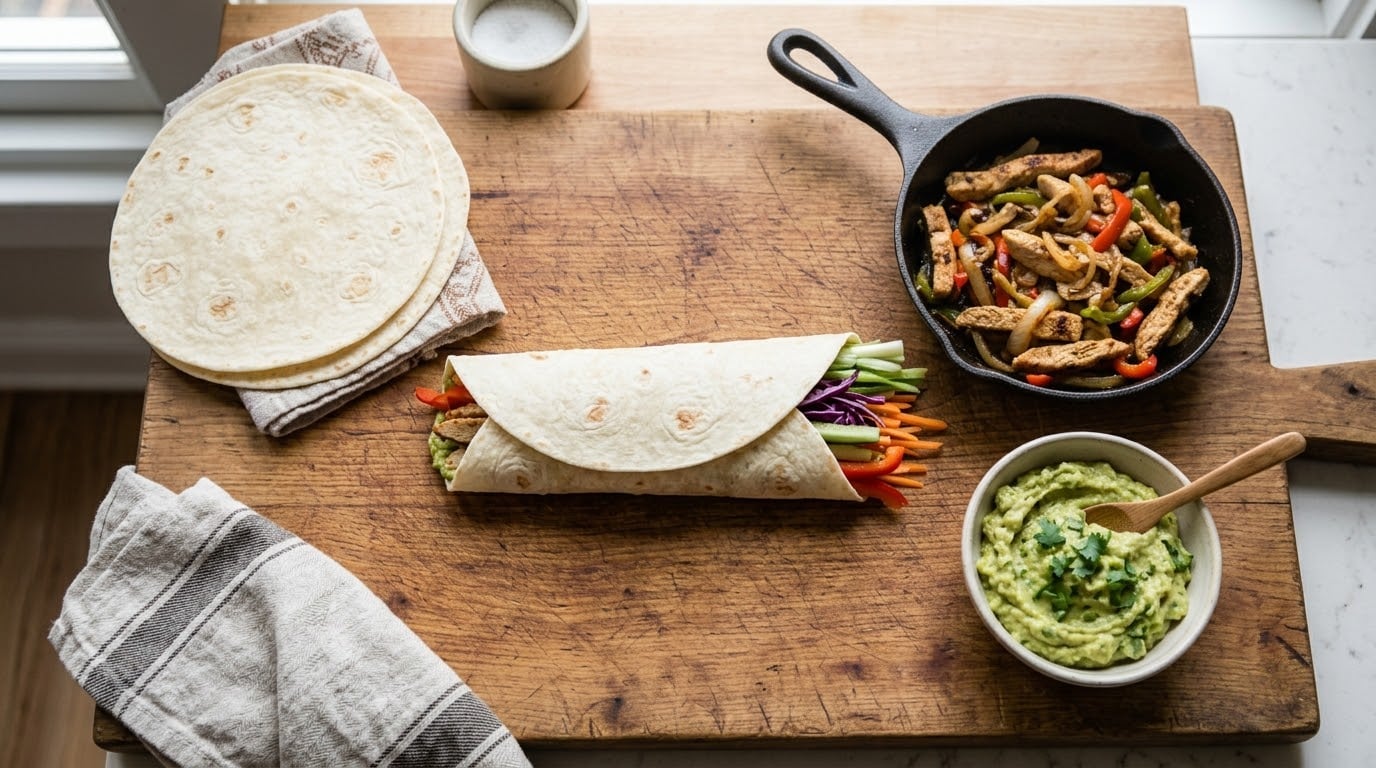
If you want to know how to roll a wrap so it doesn’t fall apart, three things decide the outcome: a warm tortilla, a sticky spread pushed all the way to the edges, and even tension while you roll. Warm it, glue it, lay the filling in a horizontal line instead of a mound, fold the side edges in, and roll toward you without stopping. It takes about five minutes, and a cold tortilla is the reason most wraps split.
Here is the whole method before the detail:
- Warm the tortilla until it bends without cracking. Ten to fifteen seconds in the microwave, or ten to twenty seconds a side in a dry skillet. Cold dough snaps.
- Spread mayo, hummus, or cream cheese edge to edge, then add about three quarters of a cup of filling in a tight horizontal line, leaving two inches bare at each end.
- Fold the side edges in about an inch, roll toward you with both hands pulling evenly, and finish seam-side down.
Table of Contents
What You Need
The wrap itself matters more than most people expect. A large flour tortilla is the easiest to roll, because it flexes without cracking and has slack in it for folding. Corn tortillas are stiffer and more fragile, and low-fat or gluten-free versions tear no matter how careful you are. If you are stuck with a fragile tortilla, warming it twice as long is a fair trade.
Size follows the job. An eight to ten inch tortilla makes one lunchbox wrap. A ten to twelve inch burrito-size tortilla is what you want for anything you plan to grill, bake, or eat over several sittings.
For the rest of the kit:
- A creamy spread that acts as adhesive: mayonnaise, hummus, cream cheese, almond butter, or avocado mash.
- Fillings totalling roughly three quarters of a cup for a standard wrap, more for a burrito-size one.
- A dry skillet, a gas burner with tongs, or a microwave for warming.
- A cutting board and a sharp knife, for cutting on a diagonal afterward.
- Parchment paper, cling film, or foil for transport, plus toothpicks if the wrap travels.
Step-by-Step: How to Roll a Wrap So It Doesn’t Fall Apart
Warm the Tortilla Until It’s Supple
A tortilla straight from the fridge or the package is stiff, and a stiff tortilla cracks the moment you ask it to curve. Heat relaxes it. Three methods work, and all three land in the same ten to twenty second window.
- Dry skillet: ten to twenty seconds a side over medium heat, flipping with tongs or your fingers.
- Gas burner: hold the tortilla in the flame with tongs and rotate it constantly for the same ten to twenty seconds.
- Microwave: ten to fifteen seconds wrapped in a damp paper towel. The towel is not optional. A bare tortilla comes out of the microwave stiff and drier than it went in.
Your checkpoint: the tortilla should fold in half over your fingers like a soft cloth, with no crack and no resistance. If you are rolling several at once, keep the finished ones in a covered warmer or a low oven while you work on the next one. A stack of six tortillas in a warmer with the lid on will steam-soften together, which is the fastest route for a family lunch.
How to Roll a Wrap So It Doesn’t Fall Apart When Adding Fillings
This is the step that decides whether the wrap holds, and it has nothing to do with your rolling technique. Spread the creamy base edge to edge, all the way onto the bare tortilla, before a single filling goes down. A bare strip has nothing to grip, and a bare strip is exactly where the end flap springs open in your hand. The spread is glue: it bonds the tortilla to the filling and the tortilla to itself.
Next, build a horizontal line rather than a mound. A tall center pile gets squeezed sideways as you roll and pushes filling out the sides. Spread the filling in a band running parallel to the near edge, about two inches in from each end, so two inches of tortilla stay bare on both sides. That bare space is what the side folds tuck onto.
Order matters more than most recipes admit. Put wet ingredients, salsa, sour cream, or dressed beans directly against the tortilla where they can soak in rather than sit in a pocket, and stack drier proteins and cheese on top. Then press down once, gently, to flatten the line into an even layer. A compacted filling holds its shape when the wrap moves; a loosely mounded one does not. A wrap that bursts open is a filling problem before it is a rolling problem.
Fold the Sides and Keep the Filling Inside
Fold the short edges in toward the filling, about an inch each, so they just reach the line. Press along each flap with your fingertips to set the crease and push out any trapped air. Air pockets are what expand the first time someone bites down.
Do not overfold. Tuck too far and the flaps overlap the filling, you get a thick lumpy end, and the roll will buckle as you turn it. The one-inch fold is enough to close the tube, and the checkpoint is simple: no filling is visible from above.
Roll Tightly Without Tearing the Wrap
Start at the near edge and roll toward you, not away. Rolling toward you lets you keep the flap you are wrapping in your sight line, and it puts the heavy side of the filling against your hands where you can control it.
Both hands work together, pulling with the same steady pressure at the same speed. That even pull is what people mean by tension, and it is the difference between a tight cylinder and a loose rag. Pulling hard with one hand while the other hand pushes makes the tortilla stretch unevenly and split along the seam.
If it opens up partway through, do not start over. Pinch the loose flap back against the roll with one hand, keep the other hand pulling even, and continue. The crease you made is still there and the layers are still aligned, so the roll closes normally. Restarting is what produces a torn tortilla.
Before the final turn, do a quick tension test: hold the filled tortilla up and let the weight of the filling hang from the bottom edge. If it pulls the wrap tight and the seam stays closed, it will survive the trip to the lunchbox. If the bottom gapes, you have put too much in it or the spread stopped short of the edge.
Seal the Finished Wrap
Finish the last turn, press the seam firmly with the flat of your hand, and set the roll seam-side down. The seam should sit hidden along the bottom, where fingers and gravity work against it rather than for it.
For eating right away, cut on a diagonal with a sharp knife in one motion. A clean angle grips far better than a straight cut, and a dull knife compresses the filling out the open end instead of dividing it.
For transport, wrap the roll in parchment paper or cling film with the seam down, then put it in a container or a lunch bag. If it is going in a lunchbox, push a toothpick through the seam about halfway along. Kids manage a toothpick far better than adults manage a burst wrap, and the toothpick keeps the seam from springing open on the way to school.
For a pan-fried or grilled burrito, seam-side down in a hot pan is the same principle: the seam sits against the heat and the flat surface, which crisps it and holds it. On a grill or in the oven, add a couple of toothpicks across the top before it goes in.
Common Mistakes That Make Wraps Fall Apart
Almost every failed wrap traces back to one of six things, and all of them are diagnosable before you take the first bite.
- The tortilla cracks on the first roll. It was cold, or it went stiff and dry in the microwave. Warm it in a dry skillet or wrapped in a damp paper towel until it bends without resistance.
- Filling squirts out the sides. A tall center mound, or wet ingredients like sour cream and extra sauce. Build a flat horizontal line, put wet ingredients against the tortilla, and hold the total to about three quarters of a cup.
- The end flaps spring open. A bare strip of tortilla with no spread to grip. Push the spread right onto the edges before adding any filling.
- The roll is loose and unravels when picked up. Uneven tension, or one hand pulling harder than the other. Roll toward you with both hands at the same speed and steady pressure.
- The bottom goes soggy by lunchtime. Wet fillings and a wrap sitting sealed on a plate. Keep moist ingredients against the tortilla, skip tomatoes and pickles in prep, and stand the roll seam-side up in the container.
- The seam bursts on the first bite. Overfilled, or the seam was never pressed closed. Remove a little filling and press the last turn firmly with a flat hand before the seam goes face down.
Two habits cause more blowouts than anything else. The first is treating more filling as generosity, when a heavy wrap is a wrap that splits under its own weight. The second is rolling with slack and then trying to fix it later, because a loose roll has no compression to hold it together.
Tips for Sturdy Wraps Every Time
Rolling the night before. Yes, and the method barely changes. Roll it, wrap it tightly in parchment or cling film, and refrigerate. Skip the crunchy and watery add-ons in a prep batch: lettuce, tomato, pickles, and raw onion all release moisture overnight. Meat, cheese, rice, and slaw hold fine. Eat within 24 hours, and reheat seam-side down in a dry skillet for a few minutes, or in the microwave for about 20 seconds. If the filling includes poultry or previously cooked meat, heat it to 165°F before packing it for a child.
Packing for lunch. Wrap it in parchment rather than foil if you want the texture to stay, since foil traps steam and softens the tortilla. Stand the roll seam-side up in the container so nothing rests on the closed edge, and keep an extra toothpick in the bag.
Choosing fillings that travel. Shredded cheese, sliced meat, rice, and beans are stable. Fresh lettuce, tomato, cucumber, and pickles give up water. Pickles sliced thin and tucked inside a meat-and-cheese wrap are fine, but a pickle chopped on top will make the wrap damp by noon.
Handling slippery tortillas. If your hands are wet, the tortilla sticks to them and buckles mid-roll. Dry your hands first, or use a light dusting of flour on a damp towel to pat it down. Warming also helps, since a warm tortilla is stickier than a cold one but far less prone to tearing.
Freezer and cooler transport. A foil-wrapped burrito holds its shape in a cooler far better than one in a paper wrapper, and foil is the only wrapper worth using if you plan to grill or bake it later.
Frequently Asked Questions
How do you keep wraps from falling apart?
Warm the tortilla until it bends without cracking, spread a creamy spread edge to edge as glue, and build the filling in a flat horizontal line two inches in from each end. Fold the side edges in about an inch, roll toward you with both hands pulling evenly, and press the seam closed face down. Most failed wraps trace back to a cold tortilla, a bare dry edge, or too much wet filling.
Why do my wraps always break?
Three causes cover almost every case: a cold or dried-out tortilla that cracks instead of bending, a spread applied only in the middle so the end flaps have nothing to grip, and wet fillings such as sour cream or extra sauce that squeeze out and blow the seam open. Warm the tortilla, push the spread to the edges, and put moist ingredients directly against the tortilla before rolling.
What size tortilla should I use for a wrap?
An eight to ten inch tortilla works well for a single lunchbox wrap. Go ten to twelve inches, burrito size, for anything you plan to grill, bake, or eat in halves. Larger tortillas have more slack for folding and are less likely to split at the seam. Flour tortillas flex more easily than corn, and low-fat and gluten-free varieties tear regardless of size.
How do I keep a wrap from getting soggy?
Keep moist ingredients against the tortilla and drier proteins and cheese on top, so the moisture touches only one layer. For make-ahead wraps, leave out lettuce, tomato, pickles, and raw onion, which release water in the fridge. Store the roll seam-side up in its container and reheat it dry in a skillet or for about 20 seconds in the microwave before you eat.
Can I make a wrap the night before?
Yes. Roll it fully, wrap it tightly in parchment paper or cling film, and refrigerate for no more than 24 hours. Choose fillings that hold: meat, cheese, rice, beans, and slaw. Avoid anything that releases water. Reheat seam-side down in a dry skillet for a few minutes, or in the microwave for about 20 seconds, and add a fresh toothpick if the seam has relaxed.
What do I do if a wrap splits while I’m rolling it?
Do not restart, because restarting is what tears it. Pinch the loose flap back against the roll with one hand, keep even tension with the other, and keep going. The crease you made earlier is still in place and the layers are still aligned, so the roll closes normally. If it splits at the same spot every time, the tortilla is too cold or too small for the filling.
Conclusion
Start with the tortilla. Warm it for ten to twenty seconds until it bends without cracking, spread a creamy base all the way onto the edges, then lay about three quarters of a cup of filling in a flat horizontal line with two inches bare at each end. Fold the side edges in an inch, roll toward you with both hands pulling at the same even speed, and press the seam down. That sequence, done in order, is how to roll a wrap so it doesn’t fall apart, whether it goes straight on the plate or into a lunchbox.