
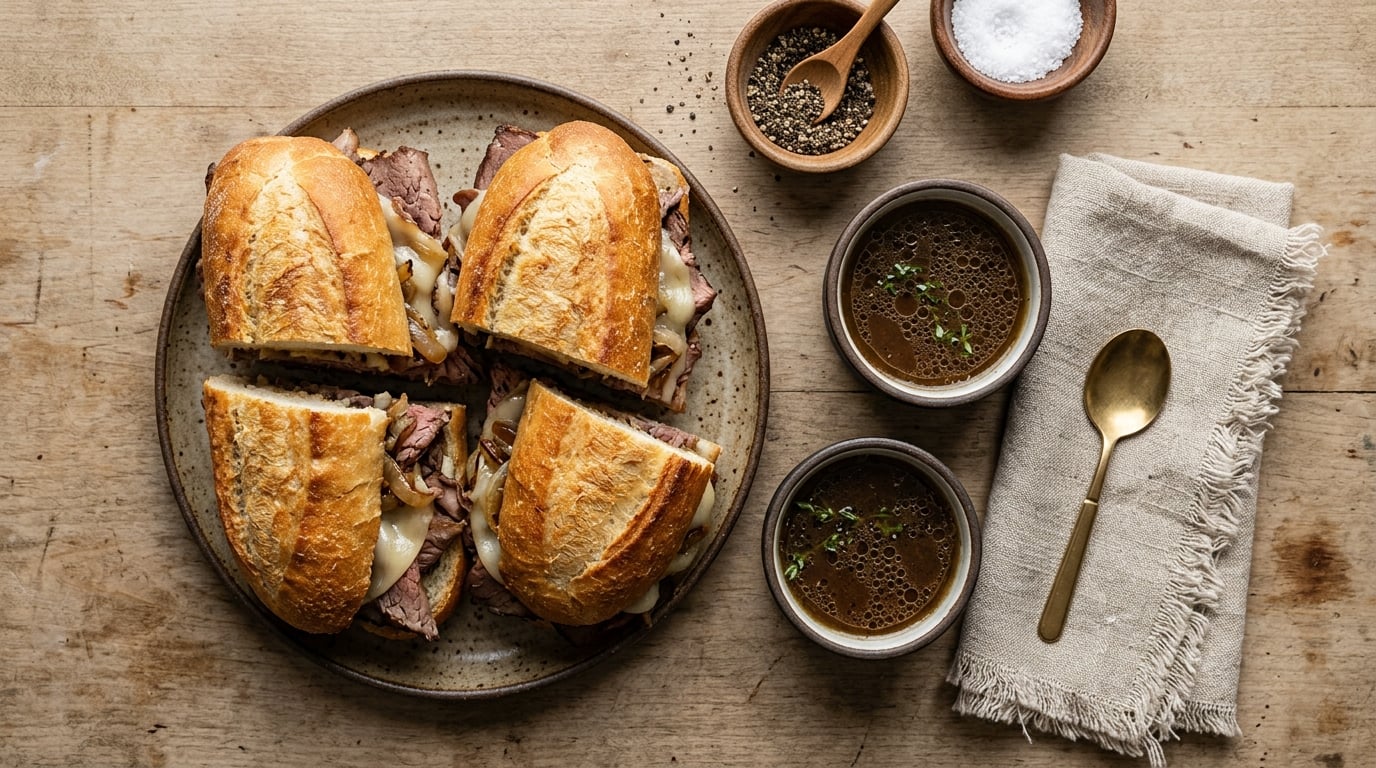
The best bread for French dip sandwiches is a dense, crusty French-style loaf — a demi-baguette, sourdough boule, or a compact ciabatta — buttered, toasted, and cut thick. Tight crumb and a sturdy crust absorb au jus without collapsing, while soft sandwich bread soaks straight through and drops the filling on the plate.
That is the whole trick, and it comes down to crumb density. A low-hydration loaf has less open air space for liquid to rush into, so it darkens and softens instead of disintegrating. An airy loaf drinks the jus in two seconds and stops behaving like bread.
I have assembled this sandwich more times than I care to admit, and the failures were never about the beef. They were always about the bread. So I broke down ten loaves and rolls that actually hold together, what each one does well, and the one adjustment each needs so you can pick the right one for the sandwich you are making.
Updated for October 2026.
Table of Contents
- Best Bread for French Dip Sandwiches That Won’t Fall Apart in the Jus at a Glance
- 1. French Bread with a Dense, Crackly Crumb
- 2. Sourdough Boule
- 3. Italian Sesame Bread
- 4. Ciabatta with a Dense Center
- 5. Whole-Grain Wheat Batard
- 6. Rye Bread
- 7. Pain de Campagne
- 8. Potato Bread
- 9. Brioche with a Firm Crumb
- 10. Dense Multigrain Loaf
- How to Keep French Dip Sandwiches From Falling Apart
- Frequently Asked Questions
- What is the best bread for French dip sandwiches?
- Should a French dip sandwich be toasted before dipping?
- How long should I soak a French dip in au jus?
- How do you keep a French dip sandwich from falling apart?
- Can I make French dip sandwiches ahead of time?
- What sliced bread is closest to traditional French dip bread?
- Conclusion
Best Bread for French Dip Sandwiches That Won’t Fall Apart in the Jus at a Glance
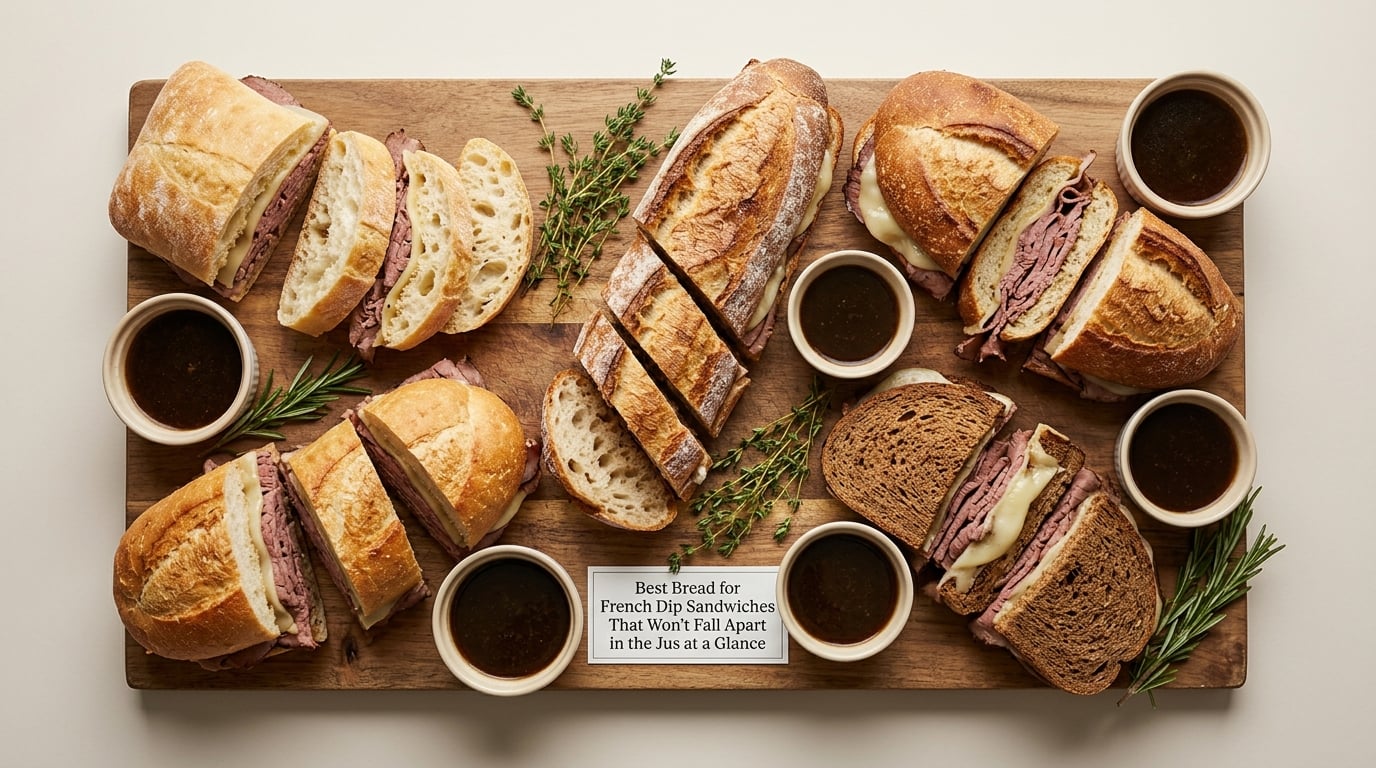
This table compares all ten options by the four things that actually decide whether a loaf survives dipping: how the crust behaves, how dense the interior is, how much juice it tolerates, and where it earns its place.
| Bread | Crust | Crumb | Soaking tolerance | Best for |
|---|---|---|---|---|
| French bread, crackly | Very thick, blistered | Tight, even | High with a short dip | The classic restaurant version |
| Sourdough boule | Firm, dark | Dense with open pockets | Very high | Big sandwiches, strong chew |
| Italian sesame bread | Thin, sturdy, oily | Firm, tight | High | Cheesy, deli-style dips |
| Dense ciabatta | Thick, blistered | Compact, minimal holes | High | Layering cheese under the broiler |
| Whole-grain batard | Craggy | Dense, nutty | Medium-high | Heavier, more filling sandwiches |
| Rye bread | Moderate | Firm, moist-resistant | High | Bold, malty jus |
| Pain de campagne | Rustic, thick | Dense country crumb | Medium-high | Rustic presentation |
| Potato bread | Thin, soft | Very soft | Low | Only as a last resort, very thin |
| Firm brioche | Sweet, eggy | Close, buttery | Low-medium | Rich, cheesier sandwiches |
| Dense multigrain | Craggy, seeded | Compact | Medium | Savory, seed-crusted looks |
One note before the individual breakdowns. You will see “soaking tolerance” rated high for a couple of these even though I still recommend short dips. A sturdy loaf is not an invitation to dunk it and let it sit. Every option here works best with a few seconds of contact.
1. French Bread with a Dense, Crackly Crumb
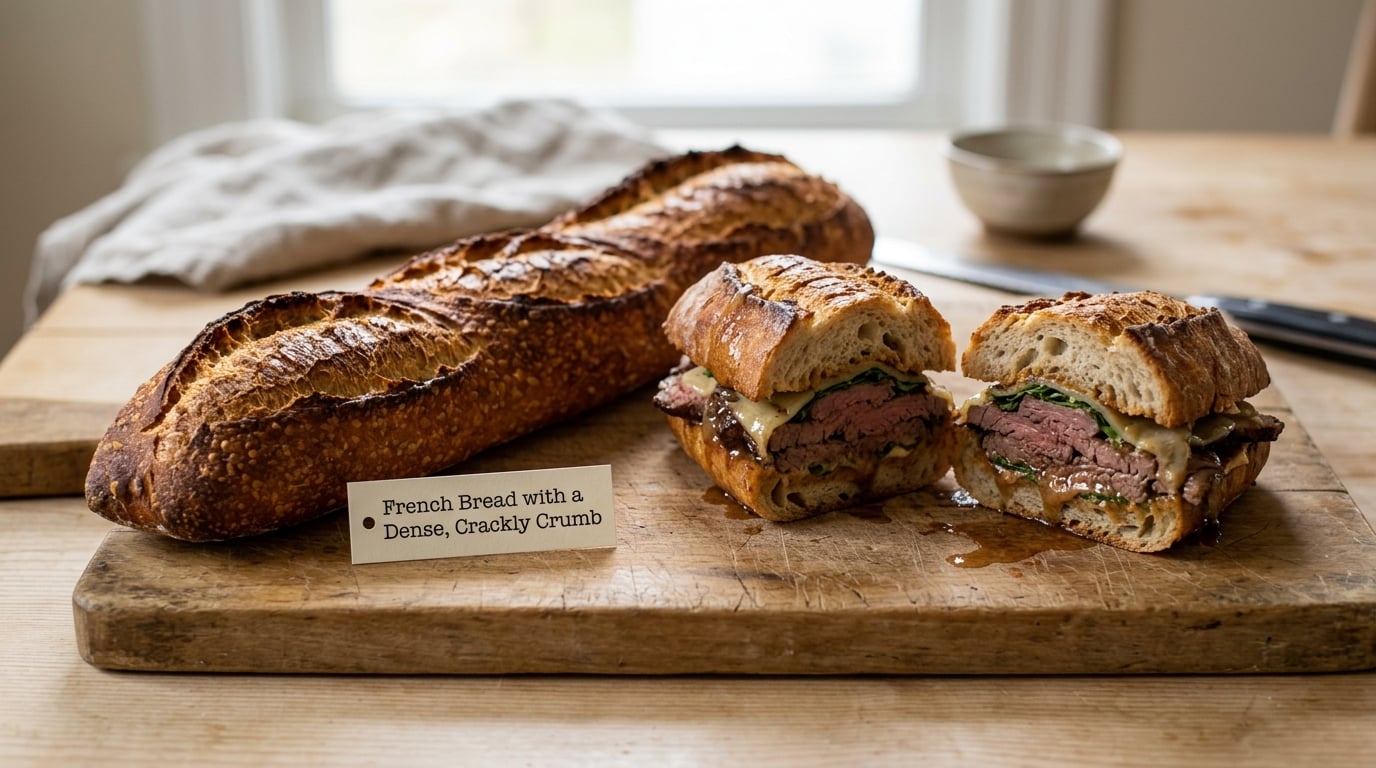
This is the loaf most sandwich shops are describing when they say “French dip.” A small baguette-style French roll, 6 to 8 inches long, with a blistered dark crust and an interior full of small, tight holes rather than one big cavern.
Pick the smallest one you can find. A demi-baguette has a higher bread-to-meat ratio than a full loaf, which means more surface area soaking up jus per bite but also more structural material holding it together. Cut it into halves, not quarters, and open it like a book so the flat face soaks while the crust stays dry on top.
Skip this one if you are using a very wet, thin jus with no body. Without a thickened sauce, the bottom slice will go soft before you get through it. Double-dip it only if your jus is reduced and glossy — a quick pass on each side, not a soak.
2. Sourdough Boule
Sourdough is the most over-tolerant bread in this whole list, and it gets that reputation honestly. The tang, the long fermentation, and the tight gluten network produce a crumb that chews rather than crumbles, even after it has been sitting in liquid.
It holds together through a dip where softer breads collapse, and the reason is structural: long fermentation builds a denser, drier crumb with less free air space. The open pockets that make a good slice of toast also give juice somewhere to pool instead of racing through.
The trade-off is flavor. A tangy loaf next to a rich, garlicky jus can fight it. If your beef is heavily seasoned, go for a mild sourdough or let the loaf sit cut-side up for 10 minutes before toasting to take the edge off. A dense boule is also the best choice here for a big sandwich you intend to eat one-handed.
3. Italian Sesame Bread
Italian bread is the underrated pick for anyone making a cheesier French dip. The crumb is firm and slightly oily from the dough, the crust is thin but sturdy rather than crackly, and the sesame topping gives you a grippy surface that stays textured even after it takes on juice.
It also browns beautifully under a broiler, which matters if you are laying provolone on the bread before assembling. Because the crumb is already tight, the cheese-heavy version still holds. A slice of soft Italian with melty cheese on top can collapse under the same weight that a sturdy French roll would shrug off.
Buy the long, squat loaves rather than the thin fiorentina-style sticks. The small square rolls work too, but give you less surface to toast and less room for beef. Sesame does not mean sweetness here — check the label, since a few brands add honey or sugar to the dough.
4. Ciabatta with a Dense Center
Ciabatta has a reputation problem, and it is mostly the airy bakery version from a fancy bread counter. Those large irregular holes are lovely for bruschetta and terrible for dipping, because the juice finds every gap and the slice tears along them.
What you want is the compact version — the denser, squarer loaf that is closer to a thick roll than an artisan batard. Its crumb is tight, its crust is thick and blistered, and it takes a short toasting without turning brittle. Toasting matters more here than with any other bread, because a crisp surface is what buys you the extra ten seconds in the jus.
Cut it with a serrated knife straight down the middle, then split each half into a top and bottom rather than digging out a pocket. Pulling out a pocket tears the top crust and gives the jus a runway straight into the middle. A ciabatta that holds together is a ciabatta you do not hollow out.
5. Whole-Grain Wheat Batard
A dense whole-grain loaf brings nuttiness and a long chew that plain white bread cannot, and it makes the sandwich feel more substantial. Wheat bran also firms up the crumb rather than weakening it, so a good batard actually holds its shape well.
Watch for two failure modes. A very dense, low-moisture wheat loaf can be brittle enough to crack when you cut it, and a loaf heavy with seeds can shed them into the jus. Test before you commit: press the cut face with your thumb. If it feels rock-hard and springs back with no give, pick a different loaf. If it compresses slightly and feels moist, it will absorb rather than shatter.
Cut it into thick slices and toast them well. Whole grain browns faster than white, so pull it a little early under the broiler. A thin coat of butter or olive oil before toasting helps a great deal here, since the bran on the surface drinks liquid faster than refined flour does.
6. Rye Bread
Rye is one of the least suggested and most structurally reliable options. Rye flour is unusually absorbent, which sounds like a weakness but works in your favor here, because it swells and sets rather than dissolving. The crumb stays firm and moist-resistant well past the point where a white roll would have gone to mush.
The flavor is the real consideration. Rye is malty and earthy, sometimes faintly sour. It pairs beautifully with a jus that has been built on beef broth and caramelized onions, and it clashes with a jus that leans hard on soy, Worcestershire, or heavy garlic. In that case the bread will taste wrong before it ever feels wrong.
Choose a dense, seeded rye rather than a soft, sliced supermarket rye, which is closer to a sweet sandwich loaf with color added. A seeded rye crust gives you extra grip, and the caraway or onion seeds add a savory note that works with roast beef. Avoid a very moist, refrigerated rye, which is fresh enough to go soft in the bowl.
7. Pain de Campagne
Pain de campagne is the rustic French country loaf, and it is what you want when the sandwich is the centerpiece of the table. The crust is thick and dark, sometimes heavily scored, and the interior is a dense, coarse crumb with a nutty, wheaty flavor that stands up to a rich jus.
The difference between a good one and a bad one is entirely density. A large, airy bakery boule has open pockets that let juice run through and out the bottom. A smaller, heavier, lower-hydration version holds together properly. Weight in the hand is a decent shortcut — heavier for its size usually means denser inside.
Do not dunk this one aggressively. The crust is thick enough to trap steam, and too long a soak turns the whole thing into a dense, wet brick in the center while the outside goes soft. A corner dip, or spooning jus over the cut face right before eating, preserves the contrast that makes this bread worth choosing at all.
8. Potato Bread
Potato bread sits on this list as a caution rather than a recommendation. Potato flour produces an exceptionally soft, tender crumb, which is wonderful for a dinner roll and the opposite of what you want here. The starch-rich dough has almost no structural resistance once liquid arrives.
It can still work in one specific situation. If you are making small, thin, open-faced style sandwiches with a light beef layer and a reduced jus with real body, a thin slice of potato bread will take the sauce without collapsing. The thinner the slice, the less it has to hold, and a lightly toasted cut face adds back a little structure.
Beyond that, do not load a potato roll with a thick pile of chuck and then dip it. This is the most common failure case: the bottom half turns to paste and the meat slides out onto the plate. If potato bread is all you have, toast it twice and eat it in halves rather than whole.
9. Brioche with a Firm Crumb
Brioche is the other main failure case, and the reason is the burger bun, not the loaf. Hamburger-brioche buns are made with a large amount of fat and egg, which gives a rich, custardy crumb with very little structural backbone. Dip one and it is a buttery sponge holding a puddle.
The denser, stand-alone brioche loaf sold at bakeries and many grocery stores is different. Its crumb is tighter, it is only mildly sweet, and it browns to a hard shell under the broiler that slows absorption. That version handles au jus reasonably well, as long as you expect it to eat more like a rich dinner roll than bread.
It shines with a cheesier, fattier filling — aged white cheddar, muenster, or a thin layer of soft cheese under the broiler. On a plain roast beef with a plain jus, the buttery sweetness is just noise. Toast it, butter it lightly, and keep the meat layer thin.
10. Dense Multigrain Loaf
Multigrain works when the loaf is compact. You get nutty, savory flavor that suits roast beef well, and the combination of flours usually produces a tighter crumb than a single-grain white loaf. The seeded crust also gives you a dry, grippy surface that resists the first seconds of contact with liquid.
The problem is the dry version, and there are a lot of them. A low-moisture multigrain that shatters when you slice it will not recover from any amount of jus. Pick up the loaf and feel for weight, then cut one end and look for large holes. Big holes mean air, and air means collapse.
Avoid the small, seeded rolls shaped for sliders. They are attractive but too small to hold a proper layer of beef. A 10- to 12-inch batard or loaf, lightly toasted with a little butter, gives you a surface sturdy enough to soak without saturating through. If you want seeds, get them on the crust only, not mixed heavily through the crumb.
How to Keep French Dip Sandwiches From Falling Apart
Bread choice gets you most of the way there. The rest is technique, and the good news is that most of it takes under five minutes.
Cut thick and split horizontally
Cut a half-inch slice at minimum, thicker for dense loaves. Then slice that piece horizontally to make a top and a bottom, and toast each face separately. A pocket cut from the top leaves a weak seam and gives the jus an open path straight into the middle of the roll.
Butter the cut faces before toasting
This is the single most useful step, and it is the one people skip. Butter, or a thin brush of olive oil, forms a fat barrier that slows absorption and adds flavor at the same time. Apply it to the cut face, not the crust, and do it before the bread hits the heat so the fat can set slightly.
Buttered bread softens when dipped without falling apart, because the buttered surface resists water in a way bare crumb does not. Leave the bread bare and you have a sponge.
Toast to a hard shell, not a golden edge
Give each face 2 to 3 minutes under a broiler, staying close enough to watch it, until the surface is genuinely crisp and dry all the way to the edges. A lightly toasted bread is a wet bread waiting to happen. A hard, fully crisp face is what buys you the extra ten seconds in the jus.
How long to dip the best bread for French dip
For a standard bowl of au jus, count 3 to 5 seconds. Turn it, count another 3 to 5, and eat it immediately. The bread should darken and soften slightly but still hold a shape when you set it down. A reduced, thickened jus can take 10 seconds. A thin broth-based jus should really only touch the corner.
Use the double-dip for thin jus
If your jus is thin and watery, dipping the whole sandwich guarantees a soggy bottom. Dip only the cut corner of each half, then spoon a little extra jus over the open meat at the table. You get the same flavor with a fraction of the liquid absorbed by bread.
Serve extra jus in a cup, not the bowl
Put the sandwich on the plate first and serve the jus alongside, or pour just enough to dampen the bottom. If the sandwich sits in a pool of juice while people eat, it will be a soggy bottom half regardless of what bread you chose. This is the part that trips up even good bread at a dinner table.
Let guests build it themselves
If you are feeding a group, toast the halved bread, put the beef and cheese on, and let everyone dip their own sandwich. It takes 20 seconds at the table and completely removes the race between serving and eating. Stacking sandwiches to soak in advance is the fastest way to produce a pile of wet bread.
Frequently Asked Questions
What is the best bread for French dip sandwiches?
A dense, crusty French-style loaf is best. A demi-baguette or French roll with a tight crumb and thick crust absorbs au jus without disintegrating, which is why sandwich shops serve it rather than soft bread. Sourdough boule, dense ciabatta, and Italian bread all work too. Toast and butter the cut faces first, then dip for only 3 to 5 seconds and eat right away.
Should a French dip sandwich be toasted before dipping?
Yes, and toast it further than feels necessary. Give each cut face 2 to 3 minutes under a broiler until it is crisp and dry all the way to the edges, not just golden at the rim. A fully crisp surface is what keeps the bread from absorbing the whole bowl of jus. A light toast is a wet sandwich waiting to happen.
How long should I soak a French dip in au jus?
Three to five seconds per side for a standard thin jus, then eat it immediately. A thickened or reduced jus can take up to 10 seconds. Longer than that and even a sturdy loaf turns soft in the middle while the crust goes limp. If your jus is thin, dip only a corner of each half and spoon the rest over the beef at the table instead.
How do you keep a French dip sandwich from falling apart?
Choose bread with a tight, dense crumb and a firm crust, then cut it thick and split it horizontally rather than making a pocket. Butter the cut faces before toasting so a fat barrier slows absorption. Toast until hard and dry, load the meat loosely, and dip for only a few seconds. Serving the jus in a separate cup keeps the bottom half from sitting in a pool.
Can I make French dip sandwiches ahead of time?
Partly. Assemble and toast the sandwiches up to a few hours ahead, cover them loosely, and refrigerate, then dip only when you are ready to eat. Never dip them ahead of serving, since the bread will absorb the jus and be soft before anyone touches it. Store the jus in its own container and reheat it gently so it does not reduce while the sandwiches wait.
What sliced bread is closest to traditional French dip bread?
A sliced French roll or demi-baguette from the bakery or deli section is the closest match to what sandwich shops use. Look for a small loaf with a dark blistered crust and a tight, evenly holeed interior. Avoid pre-sliced white sandwich bread, which soaks through almost immediately, and be wary of airy artisan rolls with large open pockets, which soak through and split.
Conclusion
If you want one answer: pick a small French roll or demi-baguette with a dark crackly crust and a tight, evenly holeed interior. That is the bread sandwich shops use, and it holds together better than anything else on this list.
Each loaf needs one small adjustment. Sourdough wants a milder profile if your jus is heavily seasoned. Ciabatta needs the dense bakery version, never the airy one, and it needs a hard toast. Italian bread wants cheese under the broiler. Rye and multigrain want a savory, broth-forward jus. Potato bread and soft brioche buns are the two to skip, and the airy boule is worth passing on too.
Density first, short dips second. Buy the denser loaf, butter and toast the cut face until it is genuinely dry and crisp, dip for 3 to 5 seconds, and serve the extra jus in a cup. That sequence fixes most of the soggy, sliding-apart sandwiches that get blamed on the beef.