
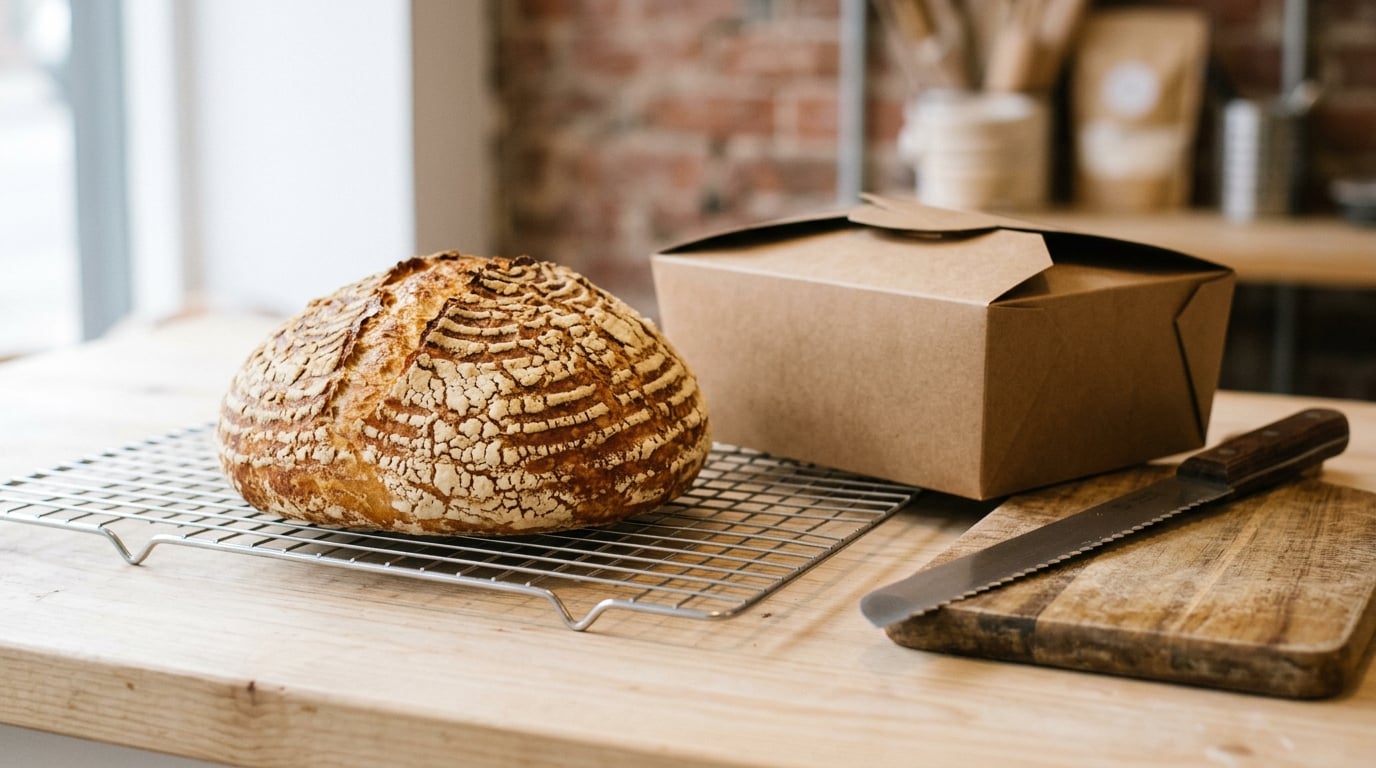
Dutch crunch bread is a soft white sandwich roll with a thin, sweet, crackly rice flour crust on top, and outside the San Francisco Bay Area it is genuinely hard to find. Most people meet it for the first time on a pastrami or Italian cold cut sandwich, decide no other roll will do, and then start hunting for it wherever they move next.
This guide covers what the bread actually is, why it became a Bay Area institution, how to track it down in a city that has never heard of it, and how to bake a close copy at home in an afternoon.
Table of Contents
- What Is Dutch Crunch Bread?
- Why Do Californians Love Dutch Crunch Bread?
- Dutch Crunch Bread vs. Tiger Bread, Milk Bread, and Garlic Bread
- Where Can You Get Dutch Crunch Bread Outside California?
- How to Order Dutch Crunch Bread When You Cannot Find It Locally
- How to Make Crispy Dutch Crunch Bread at Home
- How to Get the Best Results in a Sandwich
- How to Store, Freeze, and Refresh Dutch Crunch Bread
- Frequently Asked Questions
- Conclusion
What Is Dutch Crunch Bread?
Dutch crunch bread is a slightly dense white sandwich roll topped with a thin paste of rice flour, sugar, oil, water and a little yeast. In the oven that paste dries, cracks and browns into a hard, tiger-striped shell over a soft, compressible crumb that molds around deli fillings.
It descends from Dutch tijgerbrood, the striped roll sold in Dutch and British bakeries, and in the United States the same bread is usually called tiger bread or, in the UK, giraffe bread. Dutch crunch bread is not a separate recipe so much as a Bay Area way of building the topping: slightly heavier roll, a touch more butter or oil, and a thicker, harder crackle than most tiger bread.
Is Dutch crunch bread only in California? No. It is strongly associated with Northern California, especially San Francisco, but it exists in the Pacific Northwest, in parts of Texas and Florida, through a handful of mail-order sellers, and anywhere a baker is willing to make it.
Why Do Californians Love Dutch Crunch Bread?
Because it solves the exact problem a cold Italian deli sandwich creates: you need a roll soft enough to squeeze around salami and provolone, and firm enough that the filling does not fall out, with something to bite through on top. The crackle gives the sandwich an edge, the crumb absorbs cold cuts and oil without dissolving, and the whole thing survives the walk back to the car.
Regulars on r/sanfrancisco and r/bayarea describe it as a childhood default, the only roll worth ordering a deli sandwich on. Visitors treat a Dutch crunch sandwich as a required stop, while people in Los Angeles and the East Coast report it is few and far between, which is most of the reason this guide exists.
The supply chain behind it is mostly invisible, which is part of the mystique. San Francisco bakers who have written about it point to suppliers such as Raymond’s Sourdough, Costeaux French Bakery in Healdsburg, Mazzetti Bakery, Colombo’s, and Lou’s Cafe. Colombo’s reportedly sells out early in the morning. Mazzetti makes the roll for a select few customers rather than the general public. Ike’s Sandwiches deliberately bakes a softer version, which draws complaints from crunch purists and plenty of loyalty from people who would rather not cut the roof of their mouth.
Long before the current crop of sandwich shops, Galli’s Sanitary Bakery spent 107 years in the city and gets credited with the bread’s local takeoff. That history is why a Dutch named loaf feels like a San Francisco original rather than a trend.
What Makes Dutch Crunch Bread Taste So Good?
Every component pulls in a different direction, and removing any one of them flattens the result.
- Yeast gives the crumb an open, slightly sweet chew that a lean dough cannot fake.
- Butter or oil in the dough adds a faint richness. Too much and the crumb turns tight and cakey; too little and the roll tastes flat once the topping is on.
- Milk or a milk powder blend rounds out the flavor and softens the crumb without adding weight.
- Sugar feeds the yeast early and, more importantly, gives the topping something to brown.
- Rice flour does the structural work. It has no gluten, so the paste cannot stretch or rise with the roll underneath, which is exactly why it dries, cracks into stripes and stays crisp.
That browning is the Maillard reaction, a non-enzymatic reaction between sugar and amino acids at heat. It produces the golden color, the caramel sweetness and the toasted edge people describe as buttery even though no butter goes on the crust. Because the topping is nearly pure starch, it also browns faster than wheat dough would, which is why the roll can be pale and soft while the top is already deep brown and hard.
Texture changes after the oven too. A slice cooled for an hour or two has a clean, brittle crackle and a springy crumb. A slice from yesterday has a softened shell that bends but does not break. A slice run through a toaster or a hot oven gets its snap back within minutes, which is why so many people reheat it.
Dutch Crunch Bread vs. Tiger Bread, Milk Bread, and Garlic Bread
No competitor site publishes a comparison table for these, and the naming is genuinely confusing. Here is the short version.
| Type | Topping | Texture | Flavor | Best use | Easy to substitute? |
|---|---|---|---|---|---|
| Dutch crunch bread | Rice flour, sugar, oil, water, yeast paste | Hard crackle over a soft, compressible crumb | Sweet, toasted, faintly buttery | Cold deli sandwiches, pastrami, fried chicken | Closest match to tiger bread |
| Tiger bread (tijgerbrood) | Rice flour and water paste, usually thinner | Crisp, often lightly sweet shell | Milder, less caramelized | Open-faced sandwiches, spreads, snacking | Yes, this is the parent style |
| Milk bread | None, or a light butter or egg wash | Very soft, springy, uniform crumb | Rich, mildly sweet, dairy-forward | Soft breakfast and bánh mì builds | No, too soft and no shell |
| Garlic bread | Garlic, butter and cheese | Crunchy edges, soft middle | Savory, heavy, garlic-forward | Sides, not sandwich carriers | No, it shares no sweet profile |
Another name for Dutch crunch bread is tiger bread, or tijgerbrood in the Netherlands and giraffe bread in much of the UK. The giraffe name came from a 2012 letter from a young shopper to the UK supermarket chain Sainsbury’s asking for a bread less scary than a tiger, a request that became a public campaign. American supermarkets mostly never adopted the name, which is why people search for tiger bread or giraffe bread and never connect it to a Dutch crunch roll.
Where Can You Get Dutch Crunch Bread Outside California?
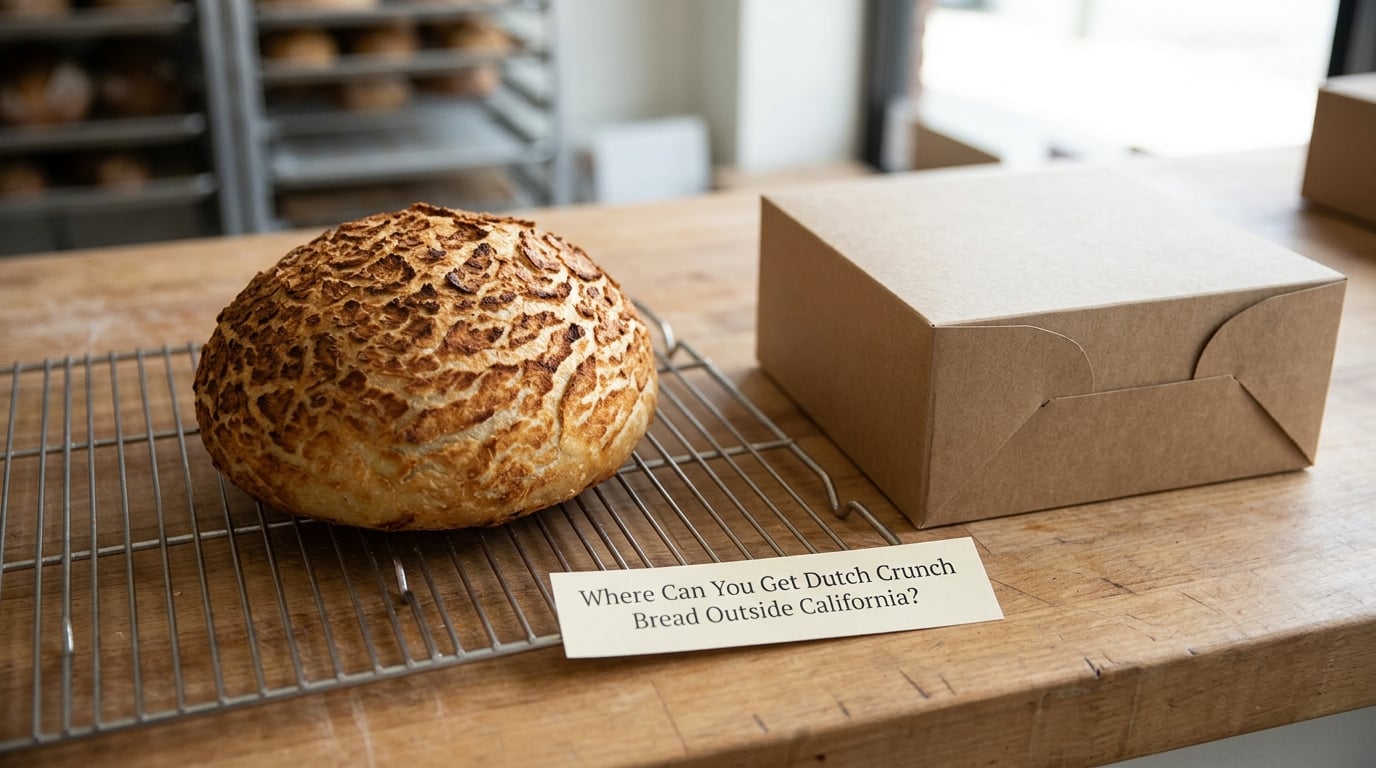
Start with the shops, not the search engines. Independent sandwich shops and neighborhood bakeries are far more likely to carry a crisp-topped roll than a grocery aisle is, and forum posters repeatedly note that grocery store versions are poor substitutes.
Search with specific terms rather than the generic name. Try the bread name plus your city, then the bakery names above plus your city or state, then phrases like tiger bread roll, craquelin bread, rice flour topped roll, or crackle top sandwich roll. Add a deli or sandwich shop name to a maps search and read recent reviews, since shops that have just started carrying it usually mention it.
Next, just ask. Call two or three independent bakeries and sandwich shops and describe the bread: a soft white roll with a hard, sweet, striped rice flour top. The person on the phone will know instantly whether they have it or a baker who can make it, and most will tell you which day the next bake lands. If you get a no, ask who their supplier is, because that answer often leads to the next call.
Two other options work outside the region. Regional suppliers that ship within a state or region can be searched by bread name plus shipping, and mail-order bakers sell rolls that can travel, though you pay for the speed of the trip in softness. And a home oven solves the problem permanently, which is where most out-of-state fans end up.
How to Order Dutch Crunch Bread When You Cannot Find It Locally
When you are ordering from a bakery you have never met, a short checklist prevents most disappointments.
- Ask in advance. Many small bakeries bake the roll to order rather than keeping it on a shelf, so a call saves a wasted trip.
- Confirm the minimum quantity. Wholesale bakers often have a case minimum that a single household cannot meet.
- Fix the slice thickness in advance. Ask for it unsliced and slice it yourself, or for a stated cut. A baker’s default is rarely what a sandwich shop wants.
- Ask what they can send to your address. Some bakers stay within their own region, and refrigerated or perishable items are subject to different rules than shelf stable bread.
- Ask about freshness and timing. Find out whether the bread is baked to order, and how quickly it leaves the building.
- Ask about replacements. What happens if the order arrives squashed or the crackle has softened.
Terms vary from seller to seller and change often, so treat all of this as a conversation rather than a policy. Confirm everything directly before you pay.
How to Make Crispy Dutch Crunch Bread at Home
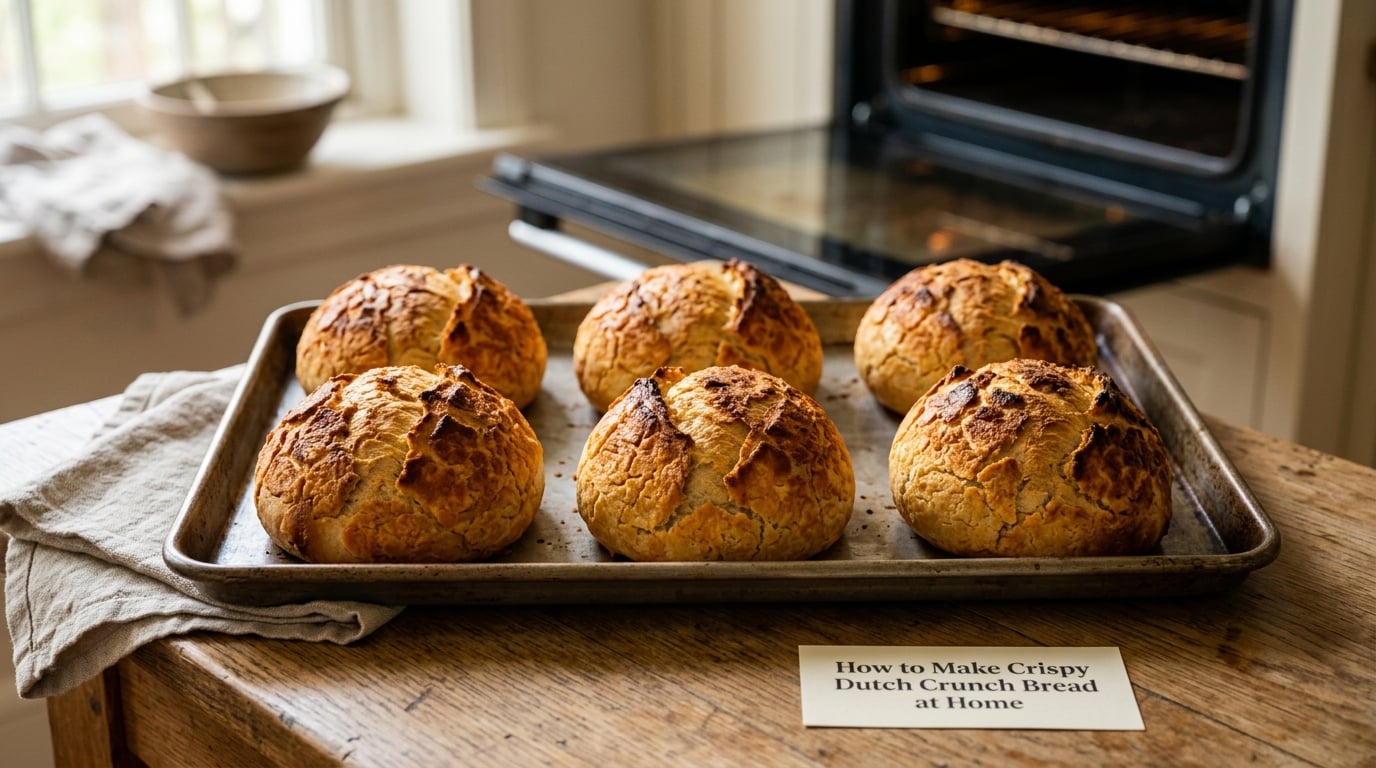
A home version is very doable in about four hours, most of it waiting. The dough is a simple enriched white roll; the topping is a five ingredient paste you can mix in a bowl.
Roll dough
- 500 g bread flour (100%)
- 350 g water (70%), lukewarm
- 60 ml milk, plus a little more if your flour is thirsty
- 35 g sugar (7%)
- 10 g salt (2%)
- 7 g instant yeast
- 30 g butter or neutral oil, softened (6%)
Mix flour, water, milk, sugar and yeast until shaggy. Rest 10 minutes, then knead in salt and butter until the dough is smooth and slightly tacky. Bulk proof about 60 minutes, folding once halfway, until it roughly doubles. Divide into 6 rolls, shape tightly, and let them proof 30 to 45 minutes until puffy and jiggly.
Topping paste
- 60 g rice flour
- 30 g sugar
- 15 g instant yeast
- 60 g water
- 20 g oil
- Pinch of salt
Whisk everything together until it is smooth and pourable, like thick paint. Rest it 10 minutes to hydrate so the rice flour does not leave a chalky taste. It should coat the back of a spoon and drip slowly off the edge.
Apply, bake, cool
Bake the dough at 220°C / 425°F for 6 to 8 minutes first, so the rolls set and the crust forms before the paste goes on. Pull them out, brush each roll generously with paste, working it into the scored top and letting some run down the sides. Return to the oven for 10 to 14 minutes more, until the tops are deep golden brown and the roll bottoms sound hollow when tapped.
Cool on a rack for at least an hour before slicing. The topping is still setting as it cools, and a cut too early gives you a shell that peels away in sheets. You are looking for a pale, tender crumb inside and a top that snaps when you press it, not a bend.
How to Get the Best Results in a Sandwich
Let the loaf cool completely, then use a serrated knife with a sawing motion. A warm loaf compresses and tears, and the topping shatters into loose flakes that end up on your shirt.
Choose the slice for the filling. Thick slices hold roast beef, fried chicken and pastrami without going soggy, since the extra crumb absorbs the juices. Thin slices suit cold Italian cuts and a bánh mì, where the bánh mì’s own crust provides plenty of texture and you want the bread to stay out of the way.
Toast with care. Thirty seconds in a toaster or a few minutes in a hot oven brings the crackle back on a day-old roll, but long toasting dries the crumb. If the roll is fresh from the oven, do not toast it at all.
Wet, salty fillings are the enemy of a good crust. Spread mayo or butter on the cut face rather than the top, and build the sandwich so the crispiest side stays facing outward. For hot fillings, warm the bread first, then add the filling just before eating.
How to Store, Freeze, and Refresh Dutch Crunch Bread
Store the loaf at room temperature in a paper bag or a loose cloth wrap. The paper lets moisture escape, which is what keeps the topping from going soft overnight. A sealed plastic bag does the opposite, and the crust will feel leathery by morning.
If you are keeping it more than a day, freeze it. Wrap rolls individually in plastic or parchment, then put them in a freezer bag and press out the air. They keep for a few weeks and thaw on the counter in about an hour, or you can go straight from freezer to toaster without thawing.
To refresh, put a roll on a baking sheet in a 200°C / 400°F oven for 5 to 8 minutes, until the top is crisp and lightly browned again. A toaster works too, though a thick roll may need to go in halved.
One thing to expect: the crisp topping softens as the loaf ages, whatever you do. That is a starch doing its job, and it is the main reason a fresh roll and a day-old roll feel like two different breads. Refreshing restores the crunch; it cannot restore the crumb.
Frequently Asked Questions
Is Dutch Crunch Bread the same as tiger bread?
It is the same family and often the same loaf. Dutch crunch bread descends from Dutch tijgerbrood, sold in the Netherlands as tiger bread and in much of the UK as giraffe bread. The Bay Area version is usually a slightly denser roll with a thicker, harder and more caramelized rice flour topping than a standard tiger bread, which tends toward a thinner, milder shell.
Is Dutch Crunch Bread a healthy bread choice?
Treat it like any other enriched white roll. The crumb is a refined white flour dough, so it is lower in fiber than a whole grain or seeded loaf, and the topping adds sugar along with the crust. Portion size matters more than the label: one roll on a sandwich with vegetables is a reasonable meal component. If you want more fiber, split the roll and add a whole grain side rather than looking for a crunch-topped alternative.
Can Dutch Crunch Bread be made gluten-free?
Partly. The rice flour topping contains no gluten, which is why it cracks and crisps instead of stretching, and a gluten-free loaf can be topped with it successfully. The challenge is the dough itself. A gluten-free bread formula needs binders and a very different proofing schedule, and the result rarely slices or holds a sandwich the way a wheat roll does. Expect a workable gluten-free roll, not an exact replica.
Does Dutch Crunch Bread freeze well?
Yes, better than most bakery rolls. Cool the loaf completely, wrap each roll individually, and freeze in an airtight bag with the air pressed out. They thaw in about an hour at room temperature, and you can also go straight from freezer to toaster. The topping holds its crunch reasonably well in the freezer; it is the crumb that dries out first, so refresh the roll briefly in a hot oven after thawing.
Why should Dutch Crunch Bread cool before being sliced?
Because the topping is still setting. The rice flour paste finishes drying and crisping as the loaf cools, and a warm loaf is soft enough that the crumb compresses under a knife. Slicing too early gives you torn, squashed slices and a shell that peels off in sheets. Waiting about an hour gives you a clean sawed cut and a crackle that snaps instead of bending.
Conclusion
Dutch crunch bread works because it does two jobs at once, a hard sweet shell and a crumb soft enough to wrap a cold deli sandwich, and Bay Area bakers spent decades getting that balance right.
Start with a phone call. Ask two independent bakeries or sandwich shops in your city whether they carry a crisp-topped roll or know who supplies one, and search the bakery names from California plus your own city. If neither turns up, bake the roll and the rice flour paste this weekend, let them cool fully, and you will never have to hunt for it again.