
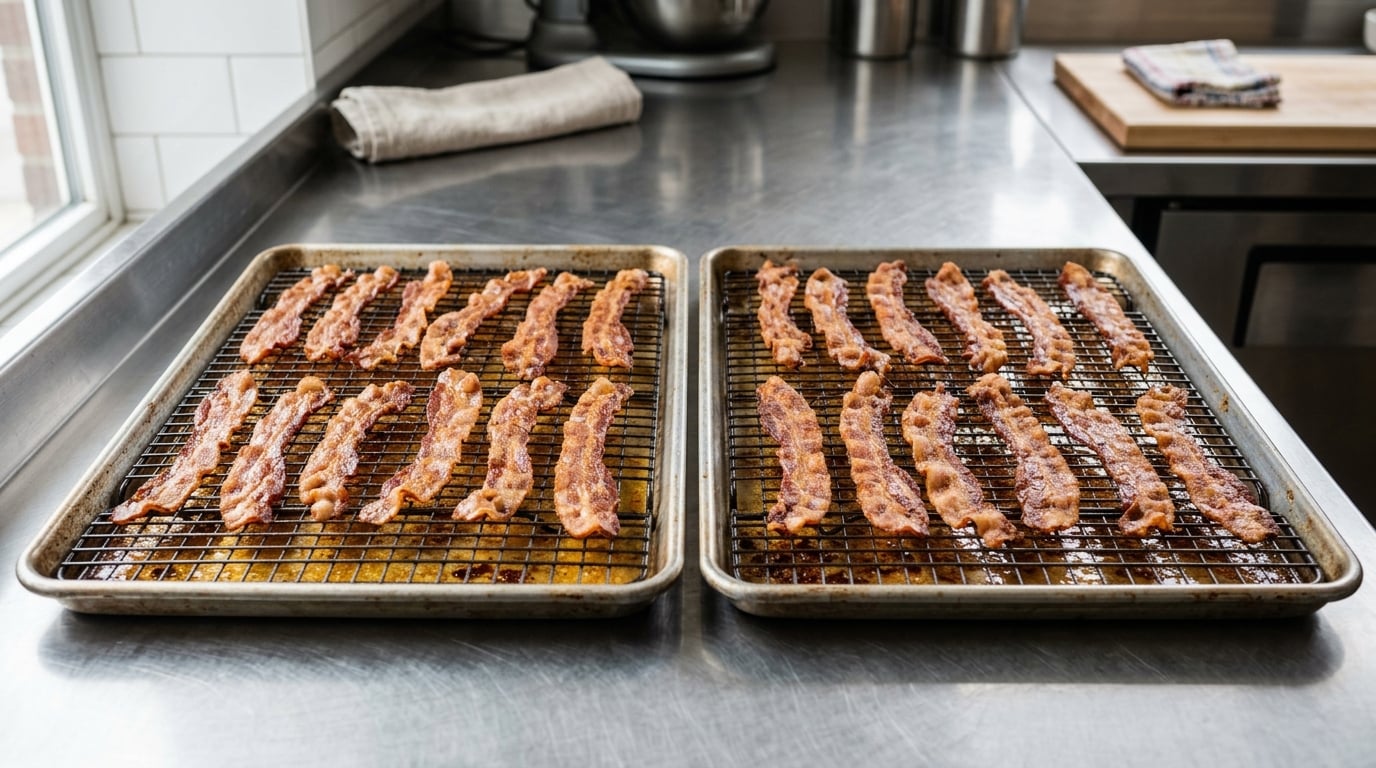
Bacon is the whole crunch of a BLT. When it goes limp inside the sandwich, no amount of good bread, ripe tomato, or mayo rescues it, and bulk prep makes the problem worse because the bacon sits longer before anyone takes a bite. The fix is one setup: a wire rack set inside a rimmed sheet pan, the oven at 400F, and enough space that no two strips touch. That is how you make crispy bacon for BLTs in bulk, and it takes about 20 minutes of oven time for a standard two-pound batch.
Budget two to three strips per sandwich, cook uncovered so the rendered fat falls away instead of pooling under the meat, and hold the finished bacon on a rack rather than in a pile. Everything below builds on those three points. This is the method we run at our counter, and it is the one we rewrote in 2026 when we started taking brunch orders for 60 sandwiches at a time.
Table of Contents
What You Need
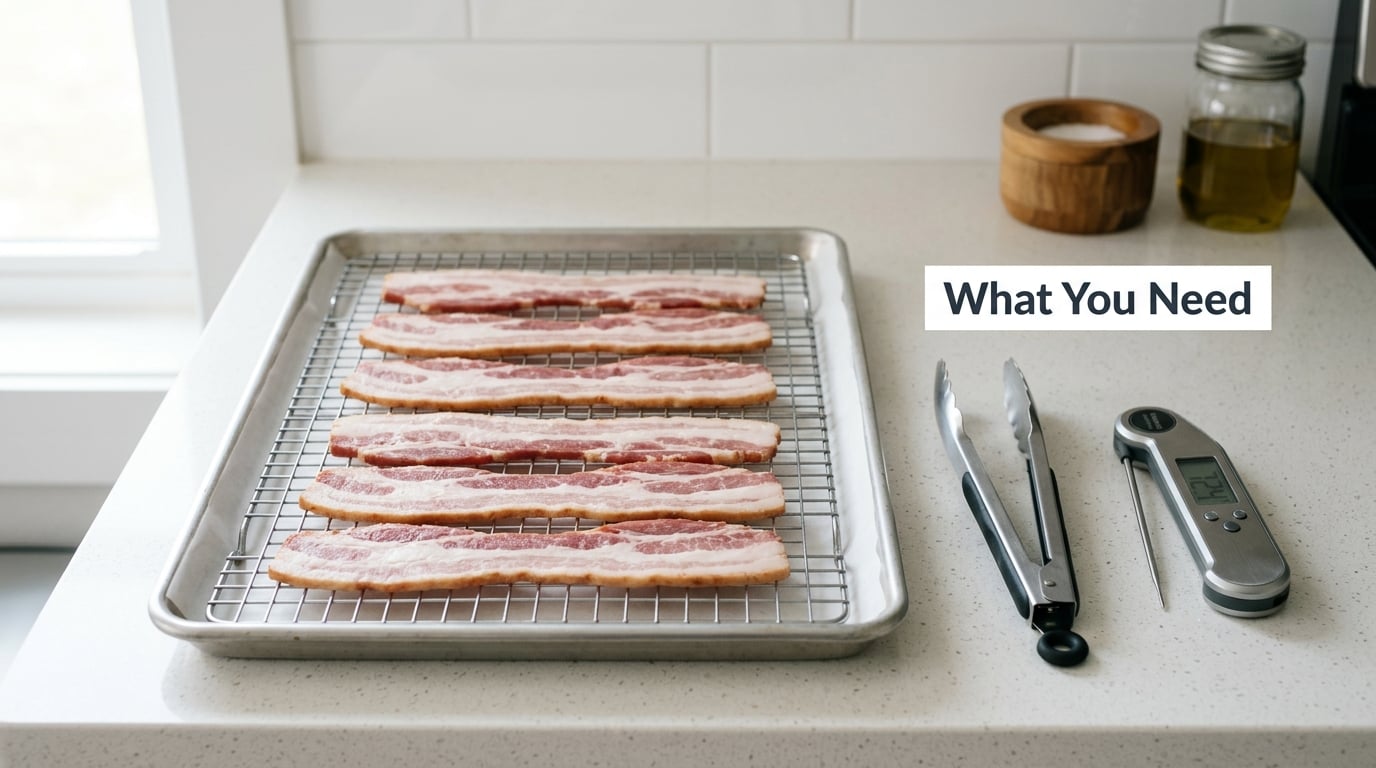
For a typical two-pound batch you need two full-size rimmed baking sheets (about 13 by 18 inches), two wire cooling racks that sit inside the pans without the sides touching, roughly two pounds of sliced bacon, and tongs. Add paper towels or a clean kitchen towel for draining, an instant-read thermometer, and whatever seasoning you plan to use.
A heavy rimmed pan matters more than people expect. A thin pan warps in the oven, and a warped pan dumps its rendered fat onto the oven floor, which smokes and can set off an alarm in a small kitchen. The rim catches the fat so you can pour it into a jar instead of scraping congealed grease off the floor later.
The single layer is the other thing that matters. Bacon that touches other bacon cooks in its own steam and never crisps underneath. If your batch is bigger than fits with a finger’s width between strips, it is two pans, not one crowded pan.
Step-by-Step: How to Make Crispy Bacon for BLTs in Bulk
Preheat and Arrange the Baking Sheets
Set the oven to 400F and let it run for a full 15 minutes with the pans inside. An oven that has not recovered temperature is the reason readers on cooking forums report nine-minute bacon one day and 45-minute bacon the next. Position one rack in the center and one in the upper third if you are running two pans, with at least four inches between them so hot air can move.
Line the pans if you want an easy cleanup, but skip it if you want maximum crispness. Parchment traps a thin film of rendered fat under the bacon and the underside steams instead of browning; a bare pan lets fat land on hot metal and flash off. Foil sits in the middle: better than parchment for release, but it insulates the pan and slows the bottom from crisping. Most of our line cooks use a bare pan with a light wipe of oil and a rack on top.
Seat the rack so it sits an inch or two above the pan floor, then lay the bacon in one uncrowded layer. Let the strips hang over the rack’s edge slightly, never over the pan’s edge, or you lose the fat and get a drip down the side.
Season the Bacon for BLT Crispiness
Season before the bacon goes in, not after. A light grind of black pepper, a pinch of smoked paprika, or brown sugar mixed into the fat are the versions that still taste good with lettuce and tomato. Skip heavy garlic or chili powders unless that is the point, because mayo and bread are mild and they will not carry the flavor.
You do not need oil or cooking spray. Bacon renders more than enough fat to crisp on its own, and added oil just raises the smoke point problem without changing the result. On salt, be restrained if the bacon is already salted, because BLTs get salt from the bacon, the tomato, and often the toast. A quarter teaspoon of flaky salt across a two-pound batch is plenty, and going heavier is the most common reason a self-cooked BLT tastes like a salt pile.
Cook Until the Edges Are Deeply Brown
At 400F, standard-cut bacon takes about 15 to 20 minutes on a rack. Thick-cut needs 22 to 30, and premium thick-cut runs 28 to 38. A convection oven cuts those numbers by roughly a quarter, and a commercial deck oven often runs faster than a residential one. Treat every number here as a range to check against, not a timer to trust blindly.
| Bacon cut | Residential oven at 400F | Convection at 375F | Doneness cue |
|---|---|---|---|
| Standard-cut | 15-20 minutes | 12-16 minutes | Edges deep brown, fat runs clear |
| Thick-cut | 22-30 minutes | 18-24 minutes | Edges mahogany, strip curls at both ends |
| Premium thick-cut | 28-38 minutes | 23-30 minutes | Firm, dark edges, less rendered fat left |
Rotate the pans halfway through if you are cooking more than one batch, and swap their positions. The upper pan browns faster in a residential oven, and swapping evens that out. If your oven only holds one pan, cook one pan to completion, move it to a rack, and slide the second pan in. The oven recovers within a few minutes, so expect the second batch to run a touch longer.
You do not need to flip bacon in the oven. A rack on a rimmed pan cooks both sides, and flipping costs you the flatness you want for a sandwich. Check the strips closest to the pan edge first, since they brown fastest, and start watching in the last two minutes. Bacon goes from perfect to burnt inside a very short window, and you cannot take that back.
It is ready when the edges are a deep brown rather than tan, the fat in the pan is clear rather than cloudy, and the strips have contracted and curled slightly. Pull the thinner pieces first if the batch is mixed.
Drain and Cool the Crispy Bacon
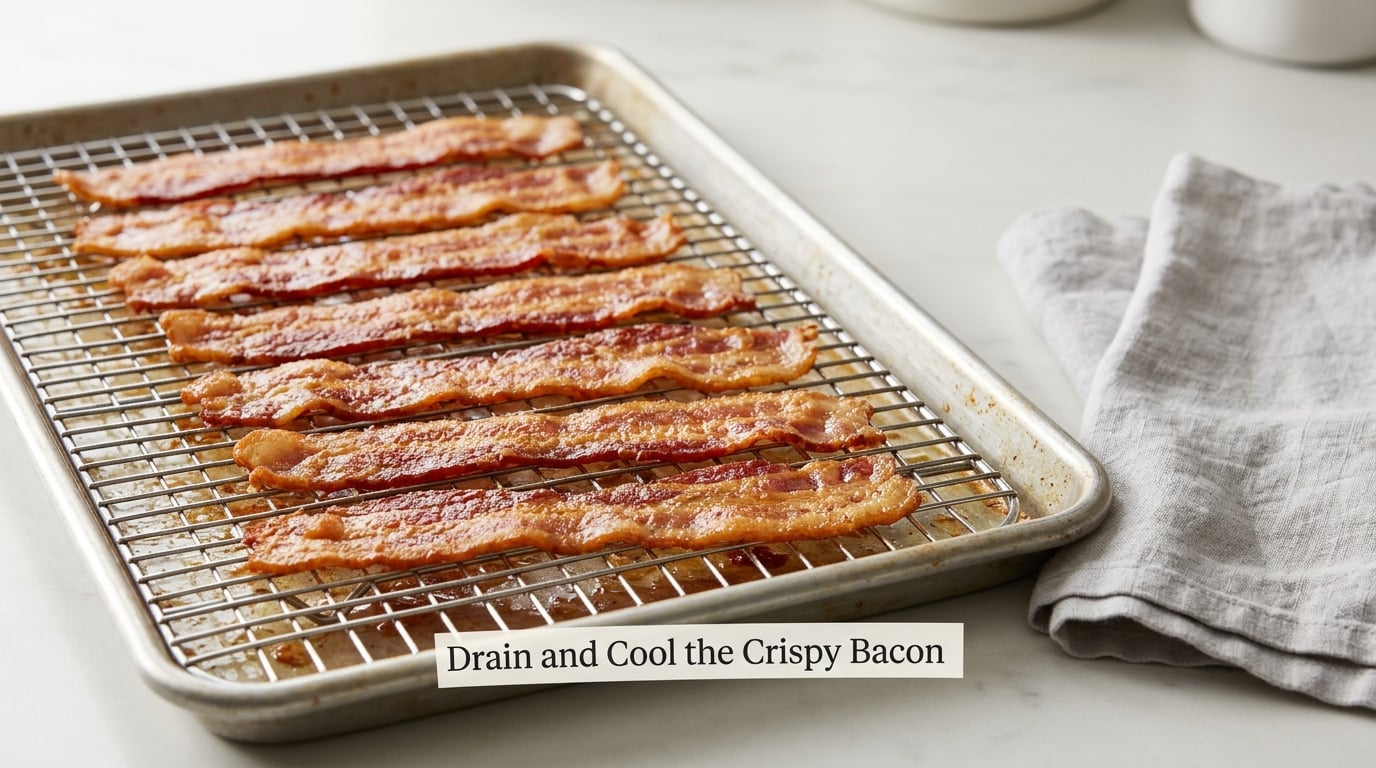
Move the hot bacon straight off the pan and onto a clean wire rack set over a second pan, or onto a spread-out kitchen towel. Both work. What you are avoiding is transferring it to a plate or a bowl, because trapped steam condenses and softens the underside you just worked for.
Handle the pan with dry oven mitts and expect a surprising amount of hot fat in it. Some cooks pour the grease into a heat-safe jar for later; it strains through a sieve, keeps for weeks refrigerated, and is good for eggs or potatoes. Do not pour it down the sink, where it congeals in the trap and causes the kind of clog a plumber charges real money to clear.
Let the bacon sit on the rack, not stacked, until it cools to room temperature. That takes about 10 minutes and it is the step people skip when they are in a rush, which is exactly how you end up sealing warm bacon into a container and finding soft strips an hour later.
Keep Crispy Bacon for BLTs Crisp Until You Assemble
For a hold of 30 to 60 minutes before service, leave the bacon in a single layer on the rack with air moving around it. Do not cover it. Do not slide it into a pile. Warm air and a little movement are what keep the surface from absorbing moisture.
If you need to transport it, set the strips in a single layer inside a food-safe container lined with paper towels, and leave the lid cracked rather than sealed. Paper towels wick the surface moisture that turns crisp bacon into bendy bacon. In the fridge, cooked bacon keeps about five days at or below 40F, though the texture is best in the first two.
| Holding method | Crisp after 30 minutes | Crisp after 2 hours |
|---|---|---|
| Single layer on a wire rack, uncovered | Yes | Yes, if the room is cool |
| Stacked in a covered container | Mostly | No |
| Sealed airtight with paper towels | Yes | Soft |
Assemble the BLTs last. Mayo on the toast, lettuce as a barrier over the bacon, the tomato sliced thin and patted dry, and a short trip from counter to table all protect the crunch. If bacon did soften during holding, a hot oven or a warm skillet brings it back in a few minutes; more on that below.
Common Mistakes
Crowding the pan. Strips touching strips cook in steam and stay chewy underneath. The fix is a finger’s width of space between every strip. If your rack cannot hold the batch with space, split it across two pans and cook in waves.
Cooking low and slow. A 300F or 350F oven renders fat gently and bakes the surface instead of crisping it. That is fine for chewy bacon and wrong for a BLT. Push the oven to 400F and shorten nothing; the high heat is what drives off surface moisture and browns the sugar in the meat.
Stacking warm bacon. Piling strips straight from the pan traps steam, and steam is the enemy of every crisp surface. Spread them on a rack, and if you are short on racks, use a second sheet pan with a layer of paper towels.
Over-salting. Bacon, tomato, and buttered toast each bring salt, so a heavily seasoned batch makes the finished sandwich hard to eat. Season with a light hand, and add salt at the table if it needs it.
Loading two pans and walking away. A home oven running two pans at once holds less heat than you think, and the top pan browns before the bottom one renders. Rotate at the halfway mark, keep the door closed, and pull the faster strips first. In a pinch, one full pan at a time beats two mediocre ones.
Wet toppings and slow service. Bacon can be cooked perfectly and still arrive limp if it sits on a saucer under a pile of tomatoes. Build to order, drain the tomato, and put the lettuce between the bacon and the tomato so the crisp layer stays dry.
Two alternative setups are worth knowing. The double baking sheet method uses an inverted second pan or a heavy sheet over the bacon to weigh it flat, which helps with thick-cut strips that curl and slide; take the weight off for the last three to five minutes so the underside can crisp. An air fryer at 400F handles eight to twelve strips in 8 to 12 minutes, which is fast but means five or six cycles for a real batch, so it suits a small run rather than service for fifty.
Frequently Asked Questions
How much bacon do I need for 100 people?
Plan on two to three strips per sandwich, so 100 people eating BLTs need roughly 200 to 300 strips, or 13 to 20 pounds of bacon. At three strips each, expect about 300 strips and six full sheet pans at the standard 40 to 45 strips per pan. Add a 10 percent buffer for strips that break, plus bread and fillings.
Is it better to cook bacon in the oven at 350 or 400?
Go with 400F for BLT bacon. A 350F oven renders fat slowly and browns the surface gently, which produces chewy bacon rather than crisp bacon. At 400F on a rack, standard-cut finishes in 15 to 20 minutes and thick-cut in 22 to 30. Use 350F only if you specifically want bacon that bends without snapping.
Do you flip bacon when cooking in the oven?
No, not when it is on a wire rack inside a rimmed sheet pan. Hot air circulates around the strips and both sides brown, and leaving them alone keeps them flat for the sandwich. Flipping is only useful on a bare pan or griddle, where the underside sits in rendered fat and needs a nudge.
How long does cooked bacon stay crispy?
On a wire rack in a single layer with air moving around it, cooked bacon stays crisp for several hours. Stacked in a covered container, it starts softening within 30 to 60 minutes. Refrigerated in a sealed container it keeps about five days, but the best texture is in the first day. Never seal warm bacon.
How do I crisp up bacon that went soggy?
Spread the strips in a single layer on a rack and return them to a hot oven at 400F for 3 to 5 minutes, checking every minute. An air fryer at 400F does the same in 3 to 4 minutes, and a warm skillet with no oil works in about a minute per side. Paper towels underneath help pull off the moisture that made it soft.
Is it better to cook bacon on foil or parchment?
For crisp bacon, a bare rimmed pan with a wire rack beats both, because the fat falls away and the underside stays dry. Parchment traps a film of fat under the bacon and softens it. Foil releases better than parchment but insulates the pan. Use foil or parchment for cleanup when you are cooking more than you care to watch closely.
Conclusion
Heat the oven to 400F, set a wire rack inside a rimmed sheet pan, and lay the bacon out in one uncrowded layer with space between every strip. Watch for deeply brown edges and clear fat starting in the last few minutes, then pull the pan and move the bacon to a rack to cool before anything touches it. That cooling and holding step is what separates bacon that crunches in the sandwich from bacon that droops. Build the BLTs last, keep the tomato dry, and put the lettuce between the bacon and the tomato so the crisp survives the trip to the table.