
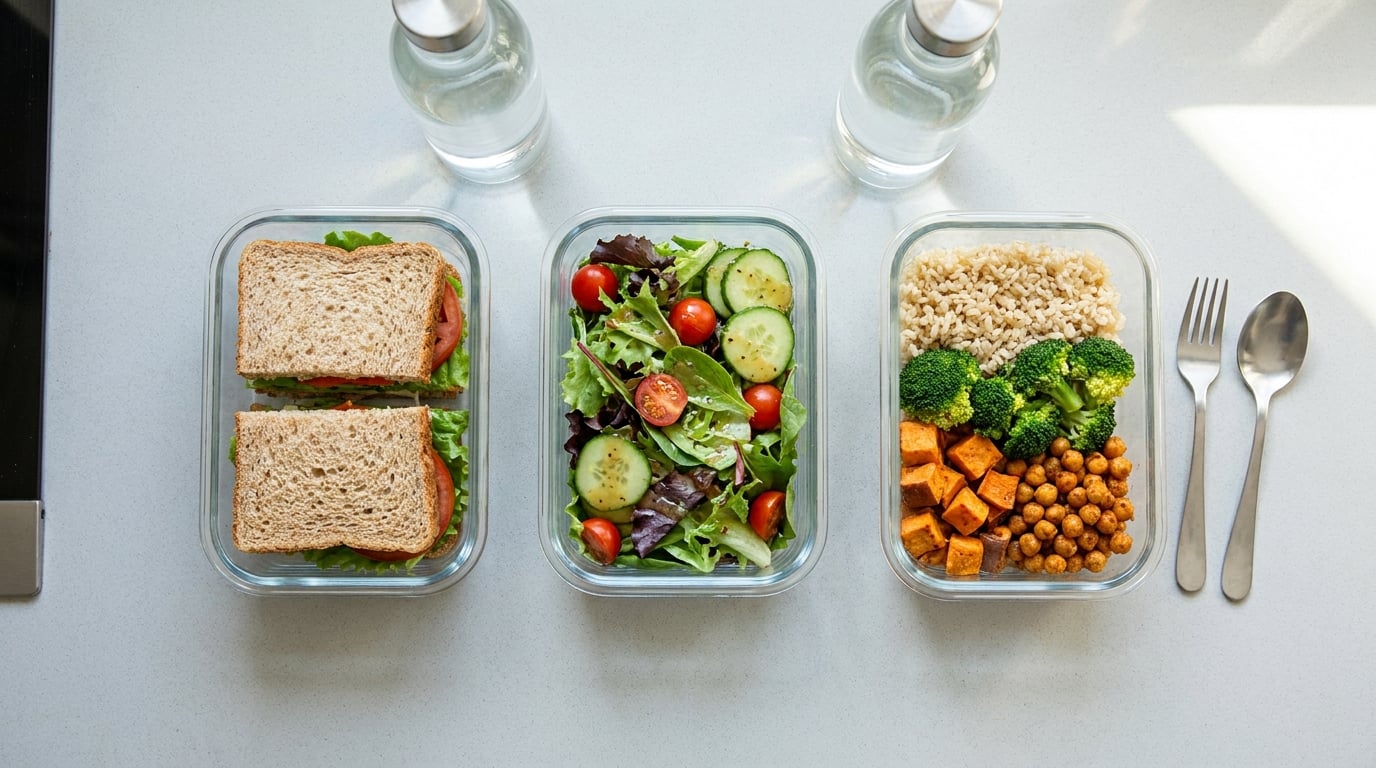
If you pack lunch three or more days a week, the grain bowl holds up best across a full work week, the sandwich wins when there is no microwave, and the salad wins on prep speed and cost. The gap between them is not spoilage. It is texture, and that is the thing most meal preppers never learn to diagnose.
I packed one of each for five consecutive work weeks, three containers per format rotating through the same ingredients, and took notes on what was still worth eating on a given day. The pattern was boringly consistent, which is the best kind of pattern. A sandwich goes soft on day two. A salad wilts on day three. A grain bowl is genuinely fine on day five if you pack the sauce separately and skip the cucumber.
Everything below is my own kitchen testing unless I say otherwise. Where I quote a safe storage window or an internal temperature, that is USDA and FoodSafety.gov guidance, and I have linked the thinking rather than the source list. Day numbers are texture verdicts from my kitchen, not safety cutoffs.
Table of Contents
- Sandwich vs. Salad vs. Grain Bowl at a Glance
- Which Meal-Prep Lunch Holds Up Best Over Several Days?
- Which Option Is the Most Filling?
- Which Is the Best for Nutrition and Variety?
- Which Is Quickest and Most Affordable to Prepare?
- How Do Storage, Reheating, and Food Safety Compare?
- Sandwiches, Salads, or Grain Bowls: Which Tastes Better Reheated?
- Which Should You Choose?
- Frequently Asked Questions
- Bottom Line: Start With the Lunch You Will Actually Eat
Sandwich vs. Salad vs. Grain Bowl at a Glance
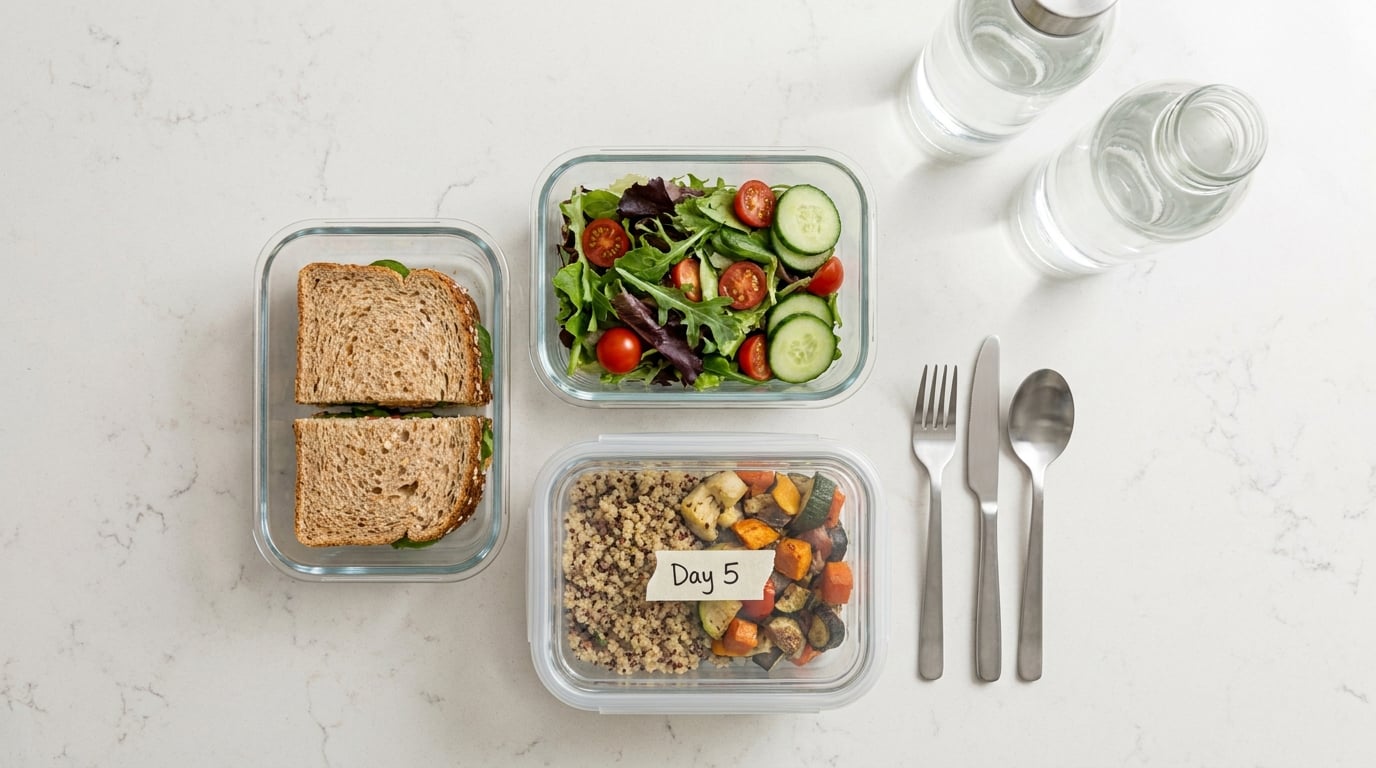
This table is the whole comparison. Everything after it is the reasoning and the fixes.
| Criterion | Sandwich | Salad | Grain Bowl |
|---|---|---|---|
| Best quality | Days 1 to 2 | Days 1 to 3 | Days 1 to 5 |
| Typical failure | Soggy or stale bread | Wilted greens, watery bottom | Sappy grains, dry toppings |
| Active prep time | 10 to 15 min a day, or batched on Sunday | 10 to 15 min a day | 30 to 40 min once, then 2 min a day |
| Cost per serving | Low to mid, driven by bread and deli meat | Lowest, driven by produce and beans | Mid, driven by the grain and protein |
| Portability | Excellent, eats standing up | Fair, needs a fork and a level surface | Good in a divided container |
| Staying power | Moderate, dries out by 3 pm | Low unless it carries protein and fat | Highest, starch plus protein plus fat |
| No microwave needed | Yes, the safest cold option | Yes, if the dressing travels separate | Yes, if the grain is not overcooked |
| Reheat result | Mediocre, bread goes chewy | Poor, greens collapse | Good, reheat only the grain half |
| Freezes | Poorly, bread turns to paste | Not really | Well, if sauce and fresh toppings are separate |
| Dietary flexibility | Gluten-free is the hard part | Easy, but easy to under-fuel | Easiest of the three to adapt |
| Container fit | Airtight, square, bread protected | Divided or wide, dressing separate | Two or three compartment |
| Most likely flaw | Texture, day two | Texture, day three | Flavour fatigue by Thursday |
One note before the detail: holding up means the lunch is still genuinely enjoyable on day five. It does not mean safe. Those are two different questions and conflating them is how people end up throwing out perfectly edible food.
Which Meal-Prep Lunch Holds Up Best Over Several Days?
Sandwich vs. Salad vs. Grain Bowl: Which Meal-Prep Lunch Holds Up Best After Assembly
Short answer: the grain bowl, by a clear margin. Grains and roasted proteins are structurally forgiving. They cool, they sit, they reheal reasonably, and nothing about them collapses the way bread or a leaf does.
Here is what each one actually does across a Monday to Friday week in my kitchen.
Sandwich, Monday to Friday
- Day 1, eaten at lunch: Best version of the format. Bread has structure, filling tastes like itself.
- Day 2: The turn. If the filling was wet, tomato or deli meat released water into the bread overnight and the bottom slice is now a sponge. The top slice is fine.
- Day 3: Bread has either gone soggy-then-dry or stale, depending on the moisture. Filling flavour flattens.
- Day 4: Most people stop eating it here. That is the honest ceiling for a prepped sandwich eaten cold.
- Day 5: A texture experiment. Some people enjoy it. I do not.
The fix is moisture management, not fresher bread. Barrier-style spreads such as butter, soft cheese or a thick hummus layer slow water moving out of the filling. Lettuce or a paper towel under the wet ingredient absorbs what gets through. And packing the bread outside the container until the morning you eat it does more than anything else.
Salad, Monday to Friday
- Day 1: Crisp, bright, and the reason you packed it.
- Day 2: Leaves soften. Tomatoes start releasing water into the bowl.
- Day 3: The bottom layer sits in a puddle unless the container had a rack or you drained it. This is the day most prepped salads get tossed.
- Day 4: Cucumber and pepper turn rubbery. Delicate herbs go black.
- Day 5: Only sturdy salads survive. A chickpea or lentil salad with a vinaigrette on the side is still fine. A mixed-green salad is not.
The rule I follow: if the salad contains a lot of water, it needs a barrier. Dry-roast the vegetables, salt the cucumber and drain it, and pack the dressing in a separate small container. A paper towel under the greens buys you a day.
Grain bowl, Monday to Friday
- Day 1: Excellent, reheated or cold.
- Day 2: Grains firm slightly as they cool. A drizzle of oil or any sauce at assembly fixes it.
- Day 3: The point at which a poorly built bowl turns bland. It is not spoiled, it is just tired.
- Day 4: Still good if the base was seasoned at batch time and the fresh toppings were held back.
- Day 5: The only one of the three I still look forward to opening.
Salt fatigue is the real grain-bowl risk, and it sneaks up. A salty dressing on Monday is noticeably heavy by Thursday. The fix is to season the base components with salt and pepper at batch time, then put all the punch in the protein marinade and the sauce added fresh. The systems approach long-running preppers describe makes the same point: neutral sides, flavoured proteins, so nothing clashes when you mix and match all week.
Which Option Is the Most Filling?
The grain bowl fills you up the longest, then the sandwich, then the salad. The ranking is about staying power through the afternoon, not about how much food is in the container.
Fillingness comes from three things working together: protein, fibre, and fat. Carbohydrate alone gives you a spike and a dip. A lunch with all three tends to hold steady until dinner.
- Grain bowl: Rice, quinoa or farro plus a real protein plus something fatty such as avocado, tahini, feta or seeds. Best combination of the three formats because you can layer all three elements deliberately.
- Sandwich: Moderate. Bread is starch without much fibre unless it is whole grain, and a meat-and-cheese sandwich dries you out by midafternoon. Adding hummus, avocado or a bean spread changes the picture.
- Salad: Lowest as usually built, because greens alone are thin. Add chickpeas, lentils, tuna, egg, chicken or tofu and it competes. A salad of lettuce and cucumber with ranch is the weakest lunch of the three.
Volume tricks the brain for about twenty minutes. If you want a genuinely lasting lunch, put a palm-sized portion of protein in it. That advice applies to all three formats and to any appetite, and a registered dietitian is the right person for a plan shaped to your own needs.
Which Is the Best for Nutrition and Variety?
The grain bowl is the most flexible, but the container matters far less than what goes in it. A bowl of white rice with sweetcorn is a poor lunch, and a sandwich packed with six kinds of vegetables is a good one.
Each format handles the food groups differently.
- Vegetables: Easiest in a bowl or a salad because there is no structural limit. A sandwich can hold a lot, but wet raw vegetables are exactly what ruins the bread.
- Fruit: Mostly a salad and bowl thing. Apples and pears go in a bowl, and a dried or fresh piece on the side keeps a sandwich from feeling like a cafeteria item.
- Whole grains and legumes: Natural in a bowl, easy as a bean or hummus spread in a sandwich, awkward in a plain salad unless beans or grains are the base.
- Lean proteins: All three handle them. Deli meat is the fastest sandwich option, cooked chicken and roasted chickpeas suit a bowl, tuna, egg and beans suit a salad.
- Healthy fats: Olive oil, tahini, avocado, nuts and seeds. These are also what stop a lunch from leaving you hungry at 3 pm.
For dietary needs, the bowl is easiest to adapt. Gluten-free is a swap of the grain. Dairy-free is a swap of the sauce and cheese. Vegetarian and vegan are a swap of the protein. A sandwich can do all of this, but gluten-free bread is the weak link in both texture and keeping quality, and salads are the easiest to keep plant-based without thinking about it.
Variety is where sandwiches lose ground. The format rewards sameness, because the same build five times is the fast path, and that is exactly the fatigue meal preppers describe when they say sandwich prep is what makes them quit. The pattern most long-running preppers settle on is a rotation instead of one winner: a salad, a pasta salad, a bean salad, a sandwich and a grain bowl all coexisting across the same week.
Which Is Quickest and Most Affordable to Prepare?
The salad is quickest and cheapest, the grain bowl costs more but buys back the most time across a week, and the sandwich sits in between on both counts.
Prep time is easier to compare as a weekly total than as a daily one. A sandwich batched on Sunday takes under fifteen minutes a day. A salad takes ten to fifteen minutes a day, every day, which adds up fast. A grain bowl is a longer session, roughly half an hour to an hour of batch cooking on day one, then a couple of minutes to assemble each morning.
Batch potential separates them more than raw speed does. Grains roast in a sheet pan while the oven is already on. Chicken and beans cook in one pot and split three ways. Sandwich fillings like egg salad or chicken salad are literally leftovers from dinner, which makes them the cheapest format in terms of ingredients already in the house.
Equipment needs are modest for all three. A sheet pan and a set of containers handle the bowl, a colander handles the salad, and a knife and a lid handle the sandwich. The one real cost driver across all three is buying out. I do not put figures on the page because they change weekly, but the order is stable: legumes and seasonal produce make the salad the low end, bread plus deli meat plus cheese push the sandwich up, and a grain plus a decent protein plus a sauce on top of that lands highest.
Where the grain bowl pays back is at the end of the week. A single batch of rice, chicken and roasted vegetables can become a bowl on Monday, a wrap on Wednesday and a salad on Friday. The same components also make your extras from dinner stretch further, which is where the real savings tend to sit.
How Do Storage, Reheating, and Food Safety Compare?
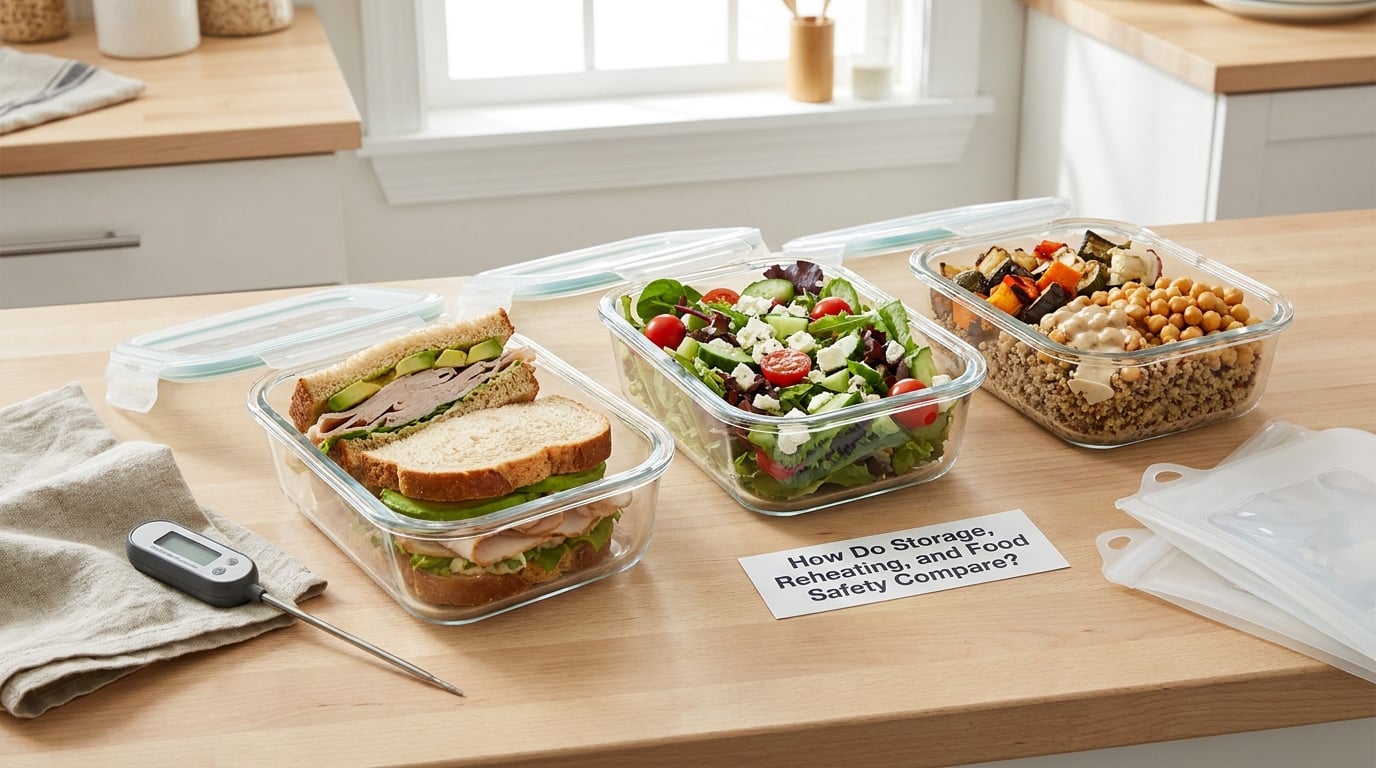
All three are perishable and all three belong in the fridge. This section is USDA and FoodSafety.gov guidance, not my kitchen notes.
- Refrigerate at 40°F or below, and use the top shelf. A home fridge is coldest near the back and top, not in the door.
- Cooked leftovers and prepped meals last three to four days in the refrigerator, per USDA guidance. A sandwich bought fresh from a deli that uses its own hot-hold procedure is a different case from one you assembled at home.
- Cook poultry to 165°F, ground meat to 160°F, and whole cuts and fish to 145°F, measured with a food thermometer in the thickest part.
- Reheat leftovers to 165°F.
- Cool fast. Get food into the fridge within two hours, and do not crowd it. A deep container on a warm counter cools slowly, which is the actual safety risk in meal prep, not the three days.
- Carry an ice pack if the lunch sits unrefrigerated, and take perishable items out within two hours otherwise.
The three formats differ mostly in freezing. A grain bowl freezes well if the grain, protein and roasted vegetables go in frozen and the fresh toppings and sauce go in when you eat it. A sandwich freezes badly because the bread turns to paste. A salad does not freeze at all; lettuce becomes limp and watery, which is worse than the day-three wilt.
Sandwiches, Salads, or Grain Bowls: Which Tastes Better Reheated?
The grain bowl wins on reheating, by a wide margin. A sandwich improves only if you have a toaster or a pan, and a reheated salad is a sad object.
Here is what each ingredient does.
- Bread: Microwaved bread turns chewy because the crust moisture migrates unevenly. A toaster or a dry pan is the only reliable route back to crisp, and even then day-old slices rarely fully recover. Wraps hold up better than sliced bread, which is why they travel better.
- Leafy greens: Do not reheat. Heat accelerates the collapse you spent three days avoiding. If you want a warm salad, put the greens in raw and heat only the protein and grain.
- Grains: The easy win. Reheat with a spoonful of water and a drizzle of oil, covered, and the day-old firmness disappears. Loose grains reheat far better than grain plus sauce, which is why I pack sauce separate.
- Proteins: Chicken and roasted vegetables reheat well. Anything breaded or heavily fried turns to leather. Proteins like chickpeas and beans only need warming through.
- Sauces: Thick emulsions separate under heat and go thin and watery. Whisk or shake them, and add them after reheating where you can.
Cold eating is the real test for a lot of people. A sandwich is fine cold. A grain bowl is fine cold if the grain was cooked to a slightly firm bite rather than mushy. A salad is at its best cold, provided the dressing went in at the table.
Which Should You Choose?
Match the format to the constraints you actually have, because that is what decides it.
- No microwave at work: Sandwich first, then grain bowl with a firm grain and no fresh herbs, then a sturdy salad such as chickpeas or lentils with dressing on the side. Skip anything crisp, since crunch goes soft in a bag by lunchtime anyway.
- Commuting or eating on the move: Sandwich and wrap. A closed container that fits a bag beats a bowl that needs a level table.
- Eating cold and only cold: Sandwich wins on reliability. A grain bowl is second if the grain is undercooked slightly. Greens sandwiches hold up better than greens bowls.
- Reheating at work: Grain bowl, reheated in two parts with the fresh toppings and sauce added after.
- Staying full through the afternoon: Grain bowl, built with protein, fat and a grain in equal measure.
- Budget: Salad or sandwich, leaning on beans, eggs, canned fish and seasonal produce. A sheet-pan bowl of rice, chickpeas and roasted vegetables is the version of the bowl that behaves like a budget option.
- Dietary restrictions: Grain bowl, because each component swaps independently. Gluten-free, dairy-free and vegetarian all work without rebuilding the meal.
- Kids: Sandwich for day one, because it is familiar and it survives a bag. Introduce the bowl as a deconstructed sandwich, which is how it is usually sold and how it usually goes over.
- A full work week and boredom: Do not pick one. Rotate all three from the same base components. That is what the people who stick with meal prep for months actually do.
One more constraint that beats all of these: texture. If you or someone you pack for will not eat anything with a crunch, the choice narrows to a grain bowl with a soft base or a sandwich with a soft roll, and any salad full of raw crunchy vegetables is out. That preference is real and it is not negotiable, which is worth more than any nutrition score.
Frequently Asked Questions
Which meal-prep lunch stays fresh the longest?
The grain bowl holds up longest, staying genuinely good for four to five days when the grain is cooked firm and the sauce is packed separately. A sandwich peaks at days one and two before the bread softens. A mixed-green salad usually turns by day three, though sturdy bean or lentil salads last the week. These are texture verdicts from my own kitchen testing, not food-safety limits.
How long can I meal-prep sandwiches, salads, and grain bowls?
USDA guidance says cooked leftovers and prepped meals keep three to four days in a refrigerator at 40F or below. Texture, though, is usually the real limit, and it is shorter: aim to pack sandwiches for the first two days, salads for three, and grain bowls for four or five. If you want to prep further ahead, freeze the bowl components instead of the whole assembled meal.
How do I keep meal-prep sandwiches from getting soggy?
Block the moisture instead of trying to prevent it. Spread butter, soft cheese or thick hummus on the bread as a barrier, put a dry leaf or a paper towel under any wet filling, and skip tomatoes until the morning you eat. The single biggest improvement is keeping the bread out of the container overnight and packing it fresh, or toasting it at work.
Can I freeze a sandwich, salad, or grain bowl?
Freeze the grain bowl and not the salad. A bowl with cooked rice or quinoa, roasted vegetables and protein freezes well if you hold the fresh toppings and the sauce back and add them after thawing. A sandwich freezes badly, because the bread turns to paste and wet fillings create ice. A salad does not survive freezing at all, and thawed lettuce is worse than day-three wilt.
Which option is easiest to reheat at work?
The grain bowl, and it is not close. Reheat the grain and protein together, covered, with a spoonful of water, for about a minute, then add fresh toppings and sauce afterward so they do not go soft. A sandwich reheat only works well in a toaster or a dry pan, and a microwave makes day-old bread chewy. Salads should be eaten cold.
Which meal is best for a five-day workweek?
Rotate all three from a single Sunday cook, because the format that survives day five is the one you will still open on Friday. Cook one grain, one protein and one tray of roasted vegetables, keep dressing and fresh toppings separate, and use the components for two bowls, one wrap and two sandwiches. People who prep for months tend to rotate formats rather than commit to one.
Bottom Line: Start With the Lunch You Will Actually Eat
Pick the grain bowl if you have a microwave or if you eat after a few hours, the sandwich if you have no heat at all, and the salad if your week is tight on time and money. In sandwich vs salad vs grain bowl terms, that is the decision, and the rest is just moisture control and how you season the base.
Prep the bowl first. Cook one grain, one protein and one tray of vegetables, keep the dressing and fresh toppings in separate containers, and assemble the rest of the week from the same base. A sandwich, a wrap and a bowl from one cook is the system that survives past week three, when sandwich fatigue usually wins.