
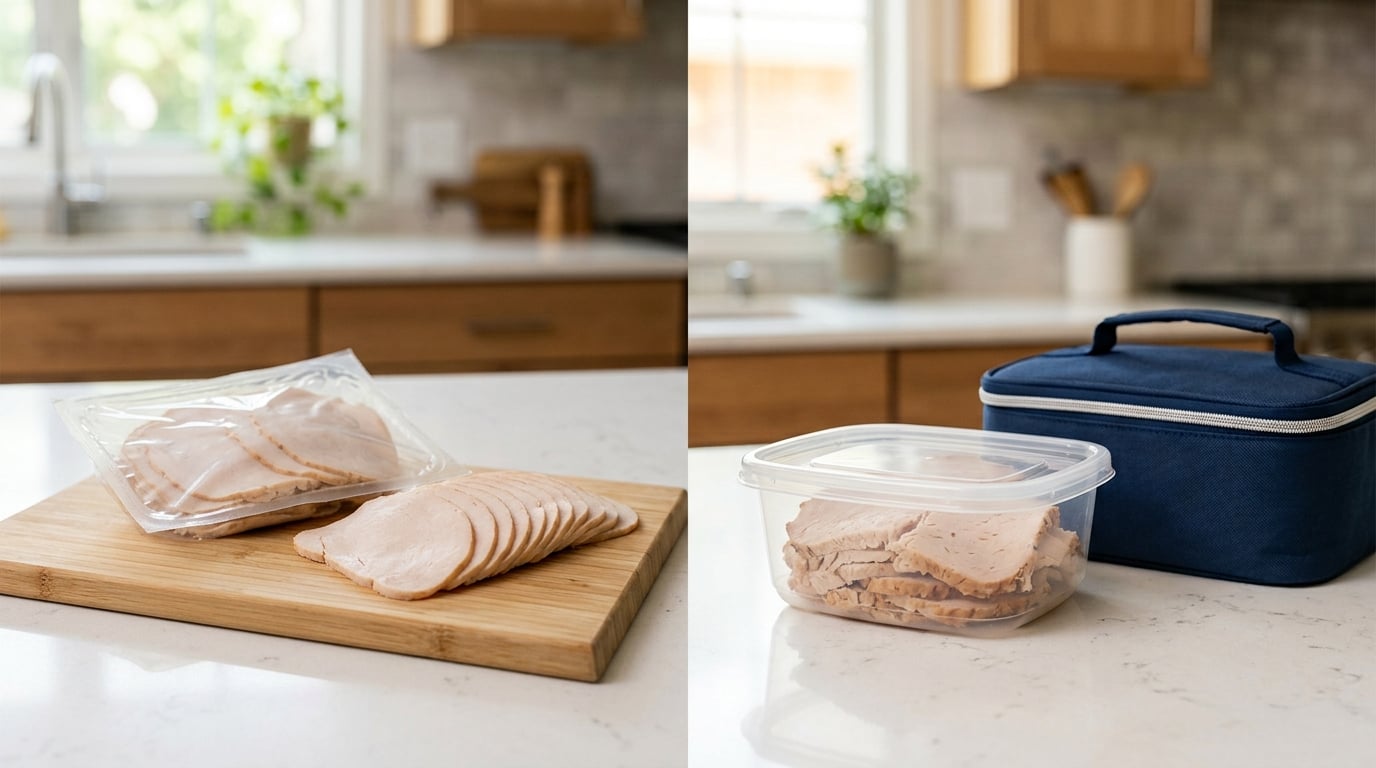
Short answer: pre-packaged sliced lunch meat wins on speed, price per pound and how long it keeps, while deli-counter meat wins on slice thickness, exact quantities and the way it handles in a sandwich. For most five-day lunch rotations I would buy pre-packaged meat as the default and pick up deli-counter meat when the week calls for thicker slices, different meats each day, or a specific sandwich that needs a proper stack of cold cuts.
Neither format is less processed than the other. Both come off the same kind of production line: cured with salt and a curing agent, sometimes bound with starch or phosphate, pressed into a log, then sliced. The counter is not a fresher or cleaner production method, only a different point in the same process.
Updated for October 2026.
Table of Contents
- Pre-Packaged vs. Deli-Counter Sliced Lunch Meat at a Glance
- Which Option Is More Convenient for Weekly Lunches?
- Which Option Costs Less Over a Week?
- Which Option Offers Better Portion and Protein Control?
- Is Deli-Counter Lunch Meat Fresher Than Pre-Packaged Meat?
- What About Ingredients, Labels, and Sodium?
- Which Is Easier to Store and Transport Safely?
- Which Should You Choose?
- Frequently Asked Questions
- Is pre-packaged sliced lunch meat cheaper than meat bought from a deli counter?
- How long should sliced lunch meat last in the refrigerator?
- Can you freeze deli-counter sliced lunch meat?
- Is deli-counter meat fresher because it is sliced when you buy it?
- Is pre-packaged vs deli-counter lunch meat better for weekly lunches?
- Conclusion
Pre-Packaged vs. Deli-Counter Sliced Lunch Meat at a Glance
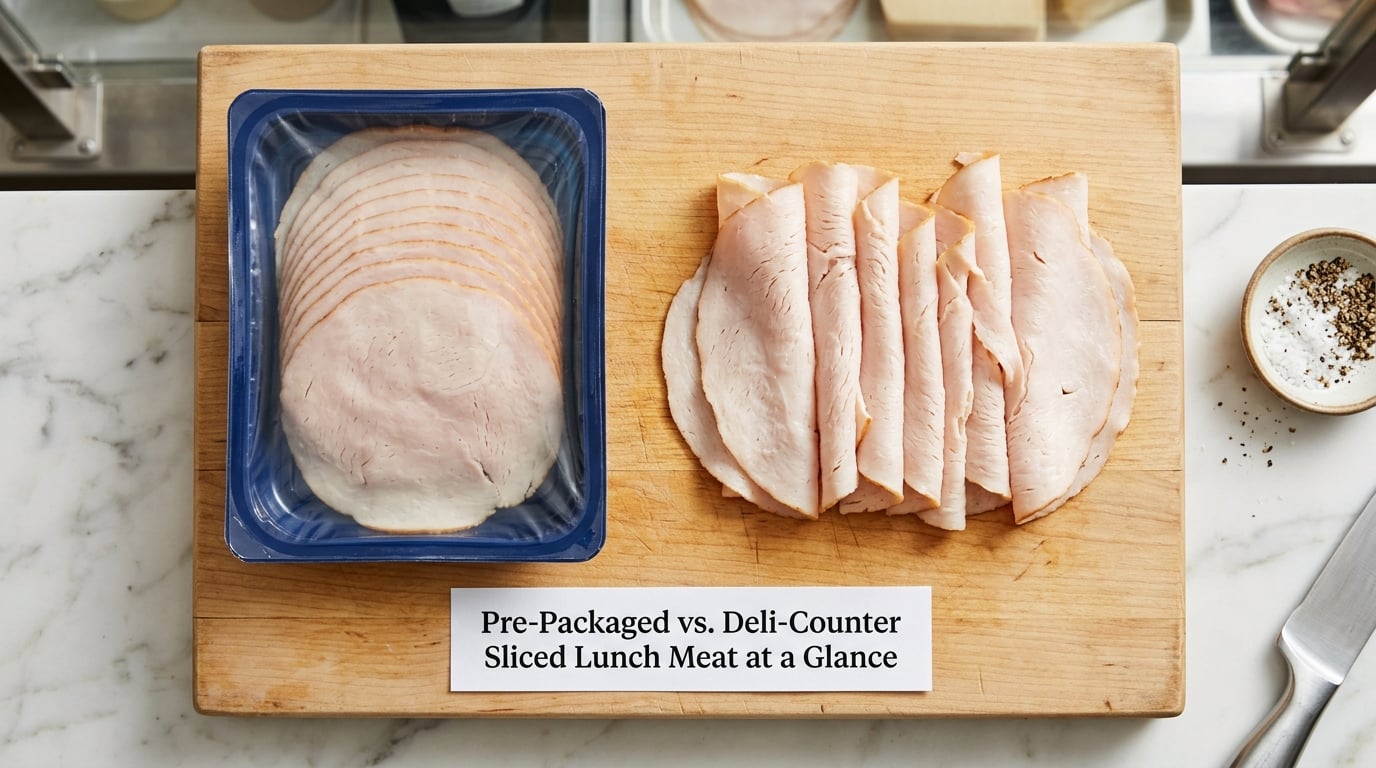
The table below covers the eight things that actually change your week: what you pay per pound, how long it keeps, what you can read on the label, how it stores, how it travels, and where each format earns its place.
| Factor | Pre-packaged sliced meat | Deli-counter sliced meat |
|---|---|---|
| Purchase cost | Lower per package; store brands push it lower | Higher per pound; deli minimums can apply |
| Cost per usable pound | Consistent, predictable | Varies with thickness, since thin slices yield more servings |
| Shopping time | Grab it from the refrigerated case, check out | Queue at the counter, specify weight and thickness |
| Slice thickness | Fixed by the manufacturer | You choose thin, thick or shaved |
| Portion control | Serving size printed on the label | Weighed at the counter to the ounce |
| Label access | Full ingredient and nutrition panel in hand | Ask the counter, or read the case label before ordering |
| Storage after opening | Resealable film; label governs the opened window | Store in a deli container; typically shorter |
| Best fit | Busy workweeks, school lunches, grab-and-go | Meal-prep batches, sandwich lovers, mixed variety |
Which Option Is More Convenient for Weekly Lunches?
Pre-packaged meat is the faster option, and not by a small margin. You open the film, take four or five slices, and you are done. The same job at a counter takes longer: you stand in line, ask for a weight, ask for a thickness, wait while it is weighed and sliced, and then find something to put the change in.
Packaging is the quieter advantage people overlook. A sealed package goes straight into the fridge and later into a lunch bag without a second container to wash. Counter meat comes home in a plastic deli container that has to go in the dishwasher and come back on the counter each morning.
The deli-counter side wins on customization. You can ask the slicer for a thinner cut for a wrap and a thicker cut for a stacked sandwich, and many counters will slice a package you bring from home rather than selling you a new one. People who pack lunch over on r/Frugal mention that trick repeatedly, and it costs nothing.
One more thing about prep time: a thick slice from the counter folds and holds its shape when the sandwich is assembled, while very thin packaged slices can slide out the moment you pick it up. Pressed, uniform slices also brown evenly if you toast them. If your week involves a lot of wraps and a lot of lunches eaten at a desk, that difference shows up fast.
Which Option Costs Less Over a Week?
Pre-packaged meat is cheaper per package almost everywhere, but the honest comparison is cost per pound of meat you actually eat, and that is where slice thickness takes over. Thin slices give you more servings per pound than thick ones, so a higher per-pound number at the counter can land in the same place as a cheaper package once you count sandwiches.
The variables that decide the weekly number are worth naming one at a time:
- Price per pound, not per package. A case of pre-packaged turkey may look pricier than one tray at the counter until you divide by the net weight.
- Store brands. The generic versions of turkey, ham and bologna in the refrigerated case are where pre-packaged meat does the most damage to a deli counter’s per-pound figure.
- Del minimums. Some counters will not slice or sell less than half a pound, which forces a buy you may not finish inside the opened window.
- Thin slicing as yield. Shaved or thin-cut meat stretches further per pound, and it covers a wrap better than a slab.
- Waste. Counter meat has a shorter opened window. Buy half a pound of turkey on Monday for a five-day week and you may be throwing the last of it out.
- How much the sandwiches actually use. Two slices on a roll and six slices in a stacked sub are different problems, and the deli is the better answer for the second one.
There is a third option that beats both formats on cost, and it is the one users keep rediscovering. A whole turkey breast roasted at home costs a fraction of a counter price per pound, and you slice it yourself for a week of lunches. The trade is your time and oven space, plus the fact that a home roast has no curing agent in it at all. On r/nutrition the argument is straightforward: if the small difference in additives between formats does not matter to you, buy the whole meat instead of negotiating between two kinds of processed cold cut.
If you want to do the math on your own week rather than trust a rule of thumb, do it this way: multiply the net weight of the package or tray by the number of sandwiches that weight will realistically fill at your usual slice count. That is your per-sandwich cost, and it is the only number that matters when you are packing five lunches.
Which Option Offers Better Portion and Protein Control?
The package wins on documentation, the counter wins on flexibility. A nutrition panel tells you exactly how many slices make a serving and what those slices contain in protein and sodium. Counter meat has no panel, only a weight on the receipt.
That said, weighing at the counter is genuinely useful for people who track macros. You can ask for three ounces rather than guessing at four slices, and for a person who wants a fixed protein amount in every lunch, that precision beats a label that assumes a certain slice count.
Be careful with slice counts, though. A serving on a nutrition panel is a defined weight, not a fixed number of slices, and the same meat cut thin from the counter can produce noticeably more slices per pound than the packaged equivalent. If you are counting pieces instead of ounces, you are not actually tracking anything.
The workable habit: use the label to set the target weight for a serving, then use the counter or the package to hit roughly that weight. For wraps and salads, weigh what you take. For sandwiches, read the serving size once and stop counting slices after that.
Is Deli-Counter Lunch Meat Fresher Than Pre-Packaged Meat?
A recent cut date makes counter meat feel fresher, and sometimes it is, but the cut date on its own does not establish quality. Sealed pre-packaged meat is sliced, packed and dated in a controlled plant, so it can be legitimately fresher in the ways that matter than a block that has been sitting in a case.
What to compare instead:
- Use-by versus sell-by. A use-by date is about quality; a sell-by date is about the store’s inventory window. Retail codes for these differ by state, so treat the printed use-by date on the package as the one that governs your sandwich.
- Case turnover. Meat that sells quickly gets turned over fast. Ask how often the case is emptied and restocked, or look for a case that looks well-served rather than one with product sitting in foil trays for days.
- Sealed shelf life. An unopened package keeps far longer than anything you bring home from the counter, which matters if you do not want to shop every week.
- Appearance. Color should be even and the surface should not look dull, grey or slimy. Dull or slimy counter meat is a deal breaker, and plenty of people on forums describe walking away from a case that looks like that.
- Smell. Off or sour odors mean the meat sat too long or too warm. Do not plan to mask it with mustard.
One texture note that gets misread as a quality signal: counter turkey often feels slimier than packaged turkey, and that is a function of moisture and the surface from the slicer, not a sign of spoilage. The firmer, drier feel of packaged slices comes from pressing and from how the product is handled on the way to you.
What About Ingredients, Labels, and Sodium?
This is the widest gap between the formats, and the one people care about most. A package shows you everything. At a counter, the case label is often the only written source, and a recurring complaint on allergy forums is that counter staff will not print or hand over a full ingredient list for something they just sliced.
A 60-second label check, in the order that matters for a weekly rotation:
- Serving size and servings per container. This sets the baseline for every number that follows, and it is how you get real per-sandwich math rather than a package-total impression.
- Sodium per serving. Processed deli meat is sodium-dense by nature of the curing and salting, so compare this number across the two or three brands you would actually buy rather than searching for a low-sodium outlier.
- Curing agents. Look for sodium nitrite, sodium nitrate, or celery powder extract, which converts to nitrite in the body. “No added nitrites” does not mean nitrite-free, because celery powder is a natural source of the same compound.
- Fillers and binders. Modified food starch, carrageenan, maltodextrin, dextrose and sodium phosphate show up in many of the better-known brands. They are legal and permitted, and the amount is small, but they are on the list if you care.
- Allergens and cross-contact statements. For a child with an allergy, this is the line that matters most, and it is one the package gives you and the counter often does not.
Front-of-package claims get read as stronger than they are. “No artificial flavors” and “no trans fat” describe what is absent, not what is present. “No fillers” has no legal definition for cold cuts. “Uncured” is accurate about nitrite but the meat still gets salted. “Natural” on a cold cut tells you about the ingredients list, not about sodium, texture or how it was produced. None of these claims are lies, and none of them answer the question most people are actually asking.
So: is deli-counter meat less processed? No. It is the same product, sliced later. What it gives you is a different cut and a different price, and what it costs you is the label you would have used to make the decision.
Which Is Easier to Store and Transport Safely?
Pre-packaged meat is easier to store and harder to reason about safely. The resealable film, the printed opened-storage window and the factory seal all work in your favor, and the unopened shelf life is long enough to buy a two-week supply once. Counter meat is a shorter window in a container you have to trust, which is why buying only what you will eat inside that window matters.
On safety, there is one real difference between the formats and it is worth being plain about. Consumer Reports reported that counter-sliced cold cuts are more than five times as likely to be contaminated with listeria monocytogenes as pre-packaged cold cuts, and the mechanism is the shared deli slicer, which can transfer bacteria between products, plus the open case itself. That is a processing-environment difference, not a judgment about the meat. Pre-packaged meat is not risk-free, and the CDC treats both as ready-to-eat foods that pregnant people, adults over 65 and anyone immunocompromised should treat with extra care.
Practical guidance for the week:
- Refrigerate promptly. Get counter meat into a fridge at or below 40°F (4°C) as soon as you get home, and do not leave it on a counter while you unpack the rest of the groceries.
- Follow the label. USDA and CDC guidance commonly allows about three to five days for sliced deli meat after opening, and a use-by date on the package overrides anything you assumed.
- Carry it cold. A lunch bag that is not going into a fridge all day needs an ice pack, and a separate container keeps the meat from sitting against a warm lunchbox wall.
- Freeze in single portions. Separate slices with parchment, label the container with the date, and thaw in the fridge rather than on the counter. This works for both formats and turns a two-portion buy into four lunches.
- Reheat to 165°F (74°C). If you are packing meat for someone in a higher-risk group, hot food reheated to 165°F is the version those guidelines recommend.
Cutting boards and knives are the other place cross-contamination happens, at home rather than in the store. Use a clean board for the meat, and wash the knife handle, which is usually the part people skip.
Which Should You Choose?
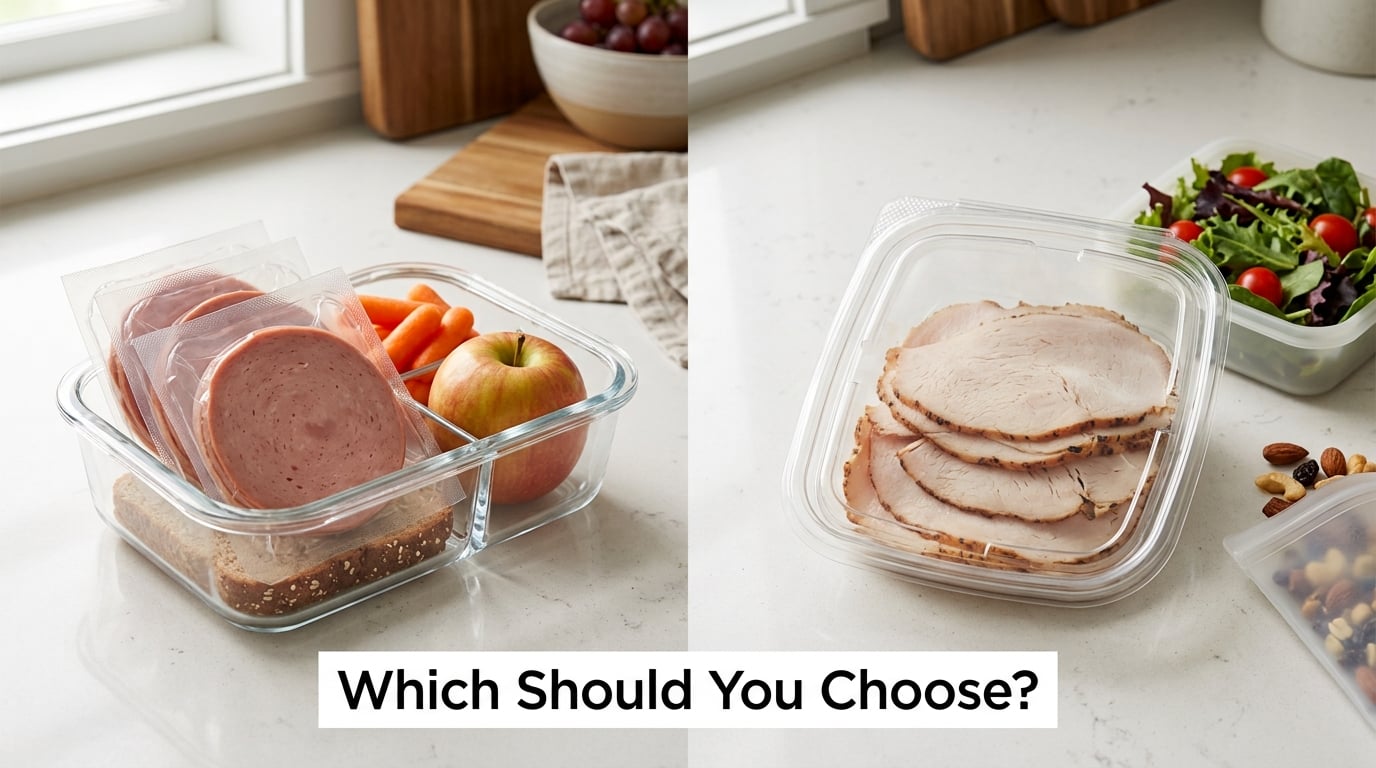
Match the format to the week in front of you rather than to a permanent preference. These are the combinations that work most often:
- Busy workweeks, one person, grab-and-go: pre-packaged. You get a sealed package that survives the fridge, a printed serving size, and a lunch that leaves the house in ninety seconds.
- Budget-first households: pre-packaged store brands, plus the home-roast option if you have oven time. A whole breast roasted and sliced yourself costs less per pound than either format and skips the curing agents.
- Families, especially with school lunches: pre-packaged, because the label answers the allergy question and the package survives being packed at 7am.
- Sandwich-focused weeks: deli-counter. Ask for thick-cut and let the slicer run a few extra slices so the sub has structure, and ask for thin-cut if the week is wraps.
- Anyone tracking sodium, nitrites or protein by weight: pre-packaged, and read the panel rather than trusting the front of the package.
- People who want a charcuterie board or a mixed spread: deli-counter, because you can buy three meats in small quantities instead of opening three packages to use one slice of each.
- Pregnancy, over 65, or immunocompromised: pre-packaged sealed product, eaten promptly or reheated to 165°F, and skip counter-sliced meat during an active advisory.
How Do You Choose Between Pre-Packaged and Deli-Counter Meat for Weekly Lunches?
Run the same five steps each week and the choice takes about a minute. Compare unit price and realistic yield, using the pounds and the slices you will actually eat. Check the nutrition panel and ingredient list, and if you are at the counter, read the case label before you order. Factor in preparation time, which is really a question about whether you are packing lunch at 7am or the night before. Buy only the quantity that fits inside the opened storage window, and get it into the fridge straight away.
If the two options come out close on all five, take the pre-packaged one. It is the lower-risk default, and the difference in taste is a preference rather than a quality signal.
Frequently Asked Questions
Is pre-packaged sliced lunch meat cheaper than meat bought from a deli counter?
Not always. Pre-packaged meat is usually cheaper per package, while deli-counter meat costs more per pound but can be sliced thinner, which yields more servings from that pound. Compare the cost per usable pound: divide the net weight by the number of sandwiches your usual slice count will actually fill.
How long should sliced lunch meat last in the refrigerator?
Follow the package label first. USDA and CDC guidance commonly allows about three to five days for sliced deli meat after opening, and the printed use-by date overrides any general rule. Keep the package sealed or in a deli container at or below 40°F, and discard any meat that develops an off odor.
Can you freeze deli-counter sliced lunch meat?
Yes, if it has not started to spoil and the product suits freezing. Separate portions with parchment paper or freezer-safe wraps so slices do not fuse together, label the container with the date, and thaw it in the refrigerator rather than on the counter. Freezing is the easiest way to make a smaller counter buy cover more than one week.
Is deli-counter meat fresher because it is sliced when you buy it?
A recent cut date can make it taste fresher, but the cut date alone proves neither safety nor quality. A sealed package is sliced, packed and dated in a controlled plant, so it can be the fresher product. Judge both by smell, color, case turnover and the use-by date, and skip counter meat that looks dull or slimy.
Is pre-packaged vs deli-counter lunch meat better for weekly lunches?
Pre-packaged wins for a five-day work rotation because it is faster, cheaper per package, reseals properly and comes with a full nutrition and ingredient label. Deli-counter wins when you want to choose the slice thickness, buy an exact weight, or pick up small quantities of several meats. Neither format is less processed than the other.
Conclusion
Pre-packaged meat is the better default for weekly lunches: faster to buy, cheaper per package, resealable, easier to transport, and the only one of the two formats where you can read the full ingredient and nutrition panel before you commit. Deli-counter meat is the better pick when slice thickness, exact quantities or sandwich structure matter more than speed, or when you want three or four meats in small amounts.
Start by comparing unit price against realistic yield, then check the labels, then buy only what you will eat inside the opened storage window. And if the additives are the part that bothers you most, roast a whole turkey breast at home and slice it yourself. It costs less per pound than either format and it is not processed at all.