
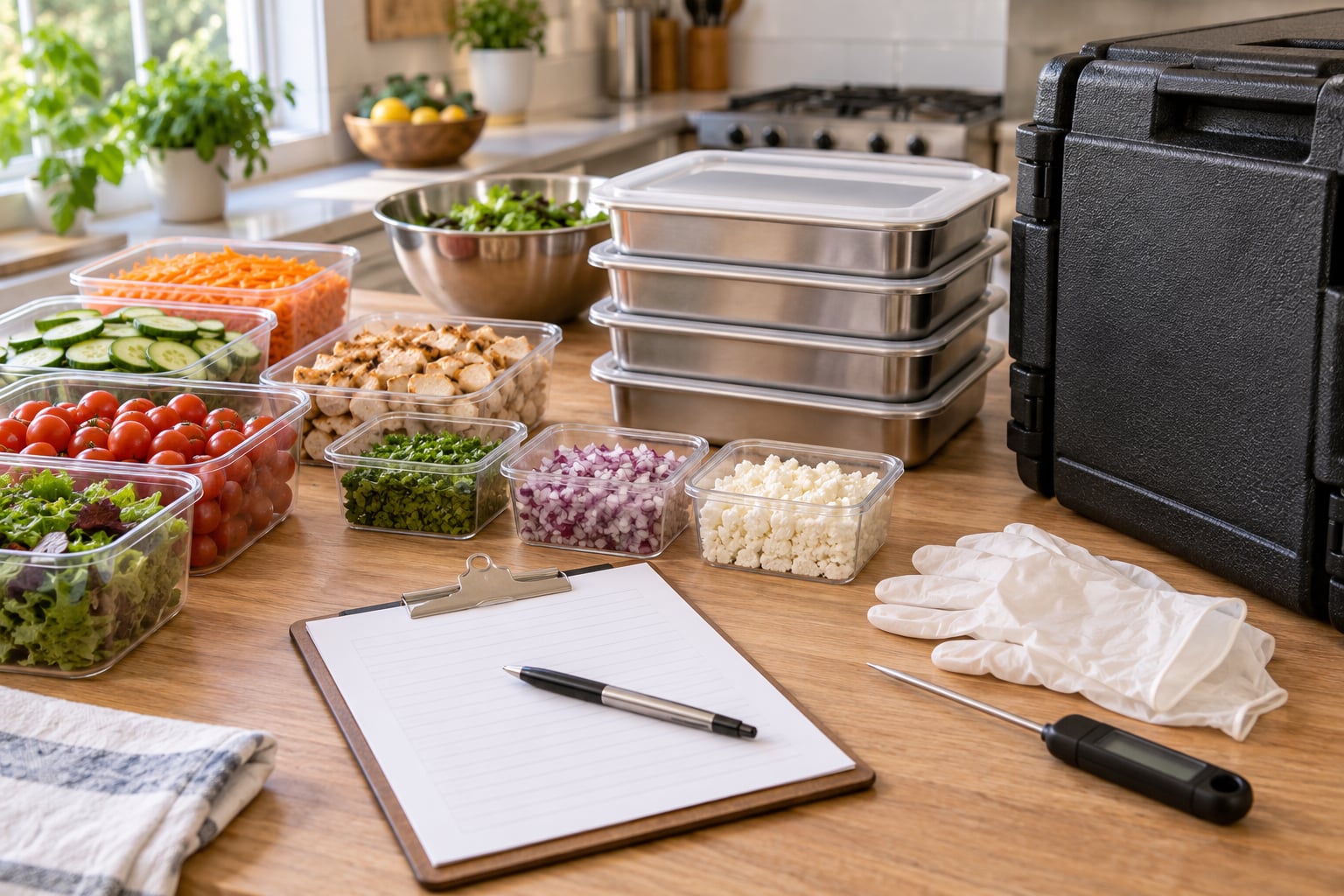
Starting a catering business from home comes down to four things: a legal permit that covers what you plan to cook, a menu small enough to repeat without mistakes, a food-safety system you can write down, and a way for customers to find and pay you. Most first-time operators get stuck on the first item, because rules differ by county and by state, and nobody wants to run a business that gets shut down mid-event.
The good news is that a home kitchen can carry a real catering business if you treat it like a small licensed operation rather than a hobby that occasionally feeds friends. Here is how to start a catering business from home, step by step, including what to have in place before your first paid order.
Table of Contents
- What You Need Before You Sell a Single Tray
- Step-by-Step: How to Start a Catering Business From Home
- How to Start a Catering Business From Home: Choose a Focused Menu
- How to Start a Catering Business From Home: Check Local Rules
- How to Start a Catering Business From Home: Build a Safe Production System
- How to Start a Catering Business From Home: Set Prices and Packages
- How to Start a Catering Business From Home: Find and Fulfill Your First Orders
- Common Mistakes to Avoid
- Frequently Asked Questions
- Can I legally start a catering business from my home?
- Do I need commercial equipment to start a home catering business?
- What should I sell first when starting a catering business from home?
- How much liability insurance should a home catering business carry?
- How do I price catering orders for small events?
- Can I prepare and store food in my home kitchen for catering orders?
- Where to Begin This Week
What You Need Before You Sell a Single Tray
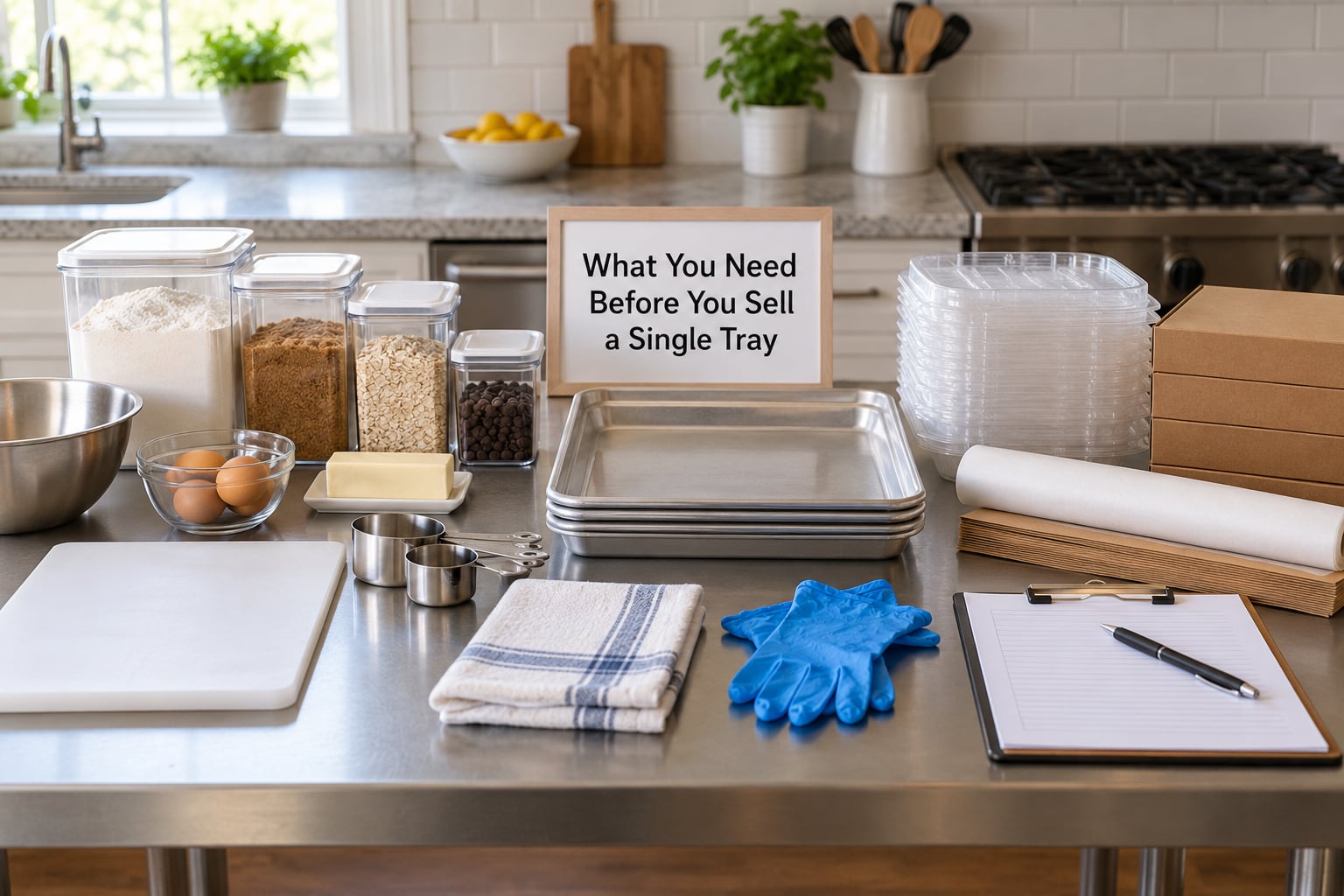
Most beginners underestimate paperwork and overinvest in equipment. Get the paperwork settled first, because no amount of good sandwiches substitutes for a valid permit.
- A defined menu. Every dish you sell needs to fit inside what your permit allows. A short menu is easier to inspect, easier to cost, and far easier to produce at 6 a.m. on a Saturday.
- Suitable home equipment. You need reliable refrigeration that holds temperature, a thermometer you can check, a food processor or good knives, sheet pans, and shelving that keeps raw meat off the floor and away from finished food.
- A written food-safety procedure. Receiving, storage, prep, cooking, cooling, packing and transport, with a probe thermometer in your hand and a log you actually keep.
- Business records. A registered business entity, an EIN from the IRS, a business bank account, a bookkeeping system, and a sales tax registration if your state requires one.
- Insurance. General liability coverage is the minimum most venues, offices and event clients will ask to see proof of. Many clients also ask about product liability.
- Permits and food-handler training. A home food operation permit from your local or state health authority, plus a food handler card. Many jurisdictions also ask for a manager-level food safety certification.
- Packaging that holds heat. Insulated carriers, sealed catering pans, labels that name the dish, the date and the allergens, and a bag or box that keeps trays from sliding.
- Transport. A clean vehicle with a flat cargo area you can keep at temperature, plus a way to keep hot food hot and cold food cold during a 30-minute drive.
- A way to take orders. A simple order form with a menu, per-person pricing, a deposit policy, delivery windows and a contact person. A landing page is enough at the start; a full website is not required.
Step-by-Step: How to Start a Catering Business From Home
How to Start a Catering Business From Home: Choose a Focused Menu
Pick one specialty and stay in it for your first three months. Sandwich platters, office lunch drop-offs, breakfast spreads, family meal packages and dietary-specific meals all work, because each one has a repeatable recipe and a predictable order size.
Test your choice against four criteria. Can your kitchen produce the volume without cutting corners? Can you make it identically at 6 a.m. and again the following week? Does it fall inside the food list your permit covers? And do people within a short drive already ask you for it?
Platters are a good starting point because they travel well, hold texture better than layered dishes, and portion cleanly. If you go that route, our guide to building a deli platter at home that looks catered walks through the arrangement and labeling details that make a home-made tray read as professional.
Checkpoint: you can cook your full menu for a mock order of ten people in one session, plate it within your delivery window, and cost it to the cent. If you cannot, shrink the menu.
How to Start a Catering Business From Home: Check Local Rules
Your county or city health department is the authority here, and your state revenue department handles sales tax. Start with the health department because that answer determines your whole menu.
Ask them directly: does my permit allow the specific dishes I want to sell, does it cover delivery and off-site events, how many sales per year am I allowed, what training do I need, and does a health department professional inspect my kitchen before I start or after?
Also confirm with your city or county zoning office, or your HOA, that a home food business is permitted at your address. Some states limit how much direct-to-consumer sales you can make from home, and some require a separate license for preparing food for delivery.
Rules vary by state and change, so treat anything you read online as a starting point and confirm the specifics with your local health department and tax authority. A twenty-minute call now is cheaper than a permit revoked later.
Checkpoint: you hold a current permit, a food handler card, and written answers to the questions above.
How to Start a Catering Business From Home: Build a Safe Production System
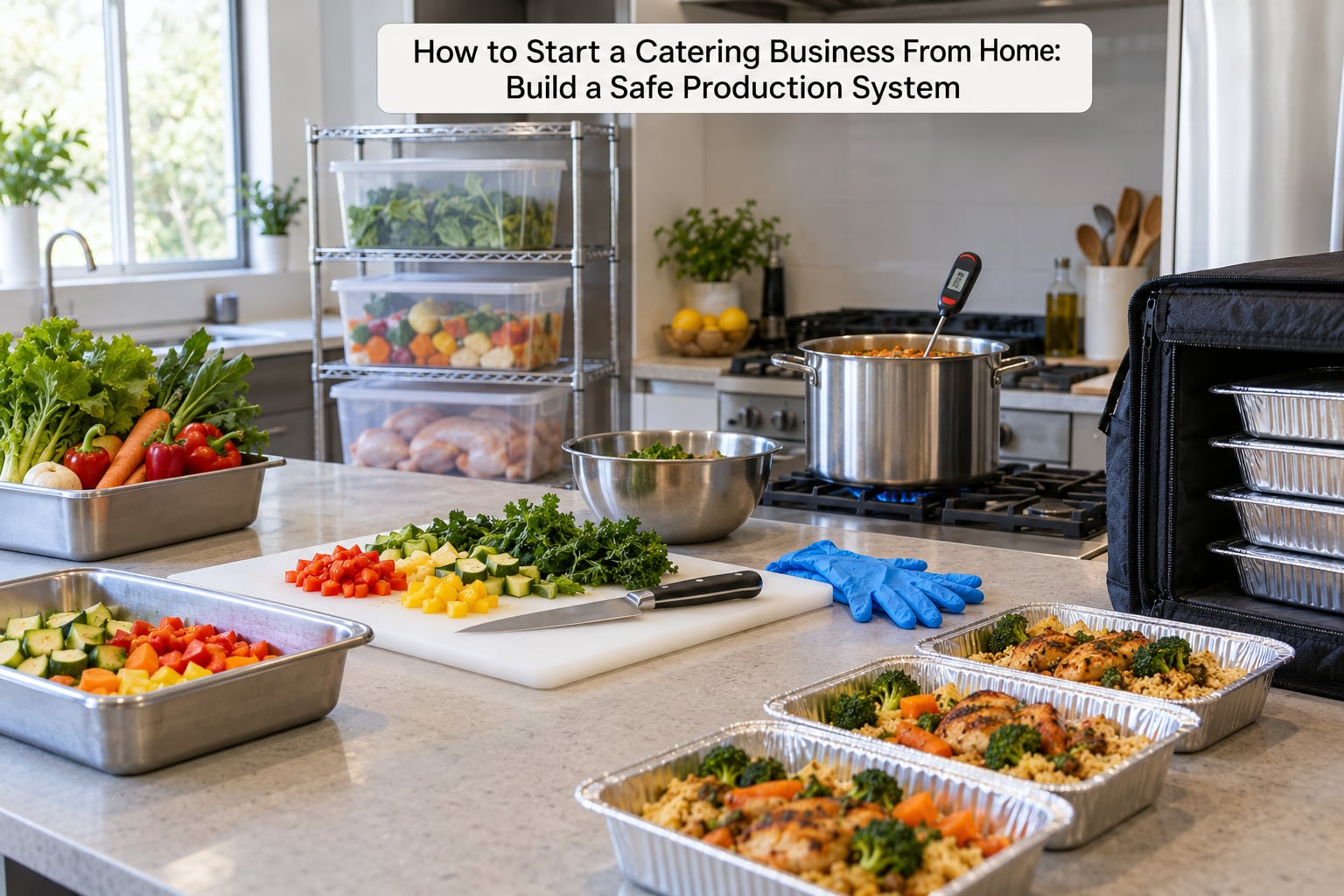
Think of your kitchen as a one-way road: receive, store, prep, cook, cool, pack, transport. Food should never travel backward. Keep raw poultry, raw ground meat and raw seafood on the lowest shelf, and keep finished food above and away from them.
Buy a digital probe thermometer and use it every service, without exception. Poultry must reach 165°F (74°C) at the thickest part, ground meat 160°F (71°C), and whole cuts of meat and fish 145°F (63°C). Take the reading, write it down.
Hot food should move into insulated carriers still hot, and cold food should leave your refrigerator at 41°F (5°C) or below and stay there. If a drop-off runs long, the safe move is to discard perishable trays rather than serve them warm and unrefrigerated.
Package in food-safe containers, label every tray with the dish name, the preparation date, the allergens it contains and the client’s name, and seal lids before anything leaves the kitchen. For larger events, keeping food warm at the venue matters, and a basic chafing setup is worth comparing before you buy anything.
Checkpoint: you can run a full order start to finish without moving backward through the flow, and every tray leaves with a label.
How to Start a Catering Business From Home: Set Prices and Packages
Price from your costs upward, not from what a competitor charges downward. For each dish, total the food cost and the packaging cost, then add your labor hours at a rate that pays for the hours you actually work, your share of utilities, insurance, permits and vehicle costs, and delivery time.
Then add your profit. A common starting point in home food businesses is to aim for roughly three times your ingredient cost in menu price, but treat that as a starting figure and check it against your own labor. If a dish takes you four hours for ten dollars of food, the math is broken no matter what the multiplier says.
Sell in packages that are easy to order: per-person platters at set quantities, half-trays and full trays, family bundles, and office drop-off for ten, fifteen or twenty people. Publish the per-person price so a client can decide without calling you. When you test prices, look at three competitors in your area and note what their packages include, then decide whether you are competing on value, on specialty, or on reliability of delivery.
For per-person sandwich trays in particular, the math gets easier once the assembly is dialed in. Our walkthrough on how to price sandwich platters for catering breaks the cost per serving apart so you can adjust portions without guessing.
Checkpoint: every menu item has a price that covers food, packaging, labor, overhead and profit, and a deposit requirement attached to it.
How to Start a Catering Business From Home: Find and Fulfill Your First Orders
Your first ten clients rarely come from advertising. They come from people who already know how you cook. Put a referral request in front of past cooks, and treat a compliment with a menu link and a card.
Join local neighborhood groups on social media, church and school community groups, small business networking groups, and local business accounts on professional networks. Office managers and small-company owners are worth approaching directly, because a weekly drop-off becomes recurring revenue while weekend events stay unpredictable. Setting a serving table up at a community or nonprofit fundraiser is a good way to let people taste before they commit.
Put one page online with your menu, per-person pricing, service area, availability and an order form. A Google Business Profile with real photos and reviews does more for local searches than a fancy website that sits empty.
Then make the fulfillment boring and reliable. Take orders at least a week out where you can, require a deposit, publish a cancellation policy, confirm the order in writing, agree on a delivery window with a 15-minute grace period, and ask for allergens in writing at the time of booking so you can decline work you cannot do safely.
After the event, send a short message asking for a review while the tray is still fresh in their memory. If you plan any events where guests serve themselves, compare chafing dish setups for home catering before the day arrives rather than the morning of.
Checkpoint: your first order came with a deposit, a written confirmation and a delivery window, and you finished the event on time.
Common Mistakes to Avoid
Launching with a huge menu. Twenty dishes means twenty costings, twenty storage decisions and twenty chances to fail an inspection. Fix: start with three to five dishes, add one only after a month of clean orders.
Underestimating prep time. The day-of estimate almost never includes labeling, loading, driving, setup and cleanup. Fix: time a full mock order with a stopwatch and add a 25 percent buffer to every quote.
Ignoring permits until someone complains. Selling before your paperwork clears is the fastest way to lose the business. Fix: do not accept a paid order until the permit is in hand.
Taking orders without deposits. A cancellation with no deposit is a hole in your schedule you cannot refill. Fix: a deposit at booking, and a written cancellation policy up front.
Transporting food in ordinary containers. Hot trays go cold and cold trays warm up in a car. Fix: insulated carriers and a thermometer checked at pickup and at drop-off.
Vague allergen communication. Guessing about a serious allergy can hurt someone. Fix: collect allergen details in writing at booking, label every tray, and decline any order you cannot meet safely.
Reading a quiet month as a failed business. Catering demand is seasonal and referral-driven. Fix: track inquiries and repeat rate rather than one month’s revenue, and keep marketing active through the slow stretch.
Frequently Asked Questions
Can I legally start a catering business from my home?
Usually yes, but only under a home food operation permit that covers the specific foods you plan to cook and the way you deliver them. Some states cap direct sales, some require a separate license for off-site delivery, and some do not allow catering from a residence at all. Start by calling your county or city health department, then confirm sales tax registration with your state revenue authority.
Do I need commercial equipment to start a home catering business?
You do not need a commercial kitchen to begin, but you do need equipment that holds safe temperatures: a refrigerator that reliably stays at or below 41 degrees F, a digital probe thermometer, shelving that keeps raw meat below ready-to-eat food, and insulated carriers for transport. If you outgrow your kitchen, rented commissary space is a common next step rather than buying commercial equipment early.
What should I sell first when starting a catering business from home?
Sell something that travels well, portions cleanly and repeats well. Sandwich platters, office lunch drop-offs, breakfast spreads, family meal packages and dietary-specific meals fit that description. Start with three to five items, cook each one for a mock order of ten people, and cut anything you cannot produce consistently on a deadline. Narrow menus are easier to cost and easier to inspect.
How much liability insurance should a home catering business carry?
Most offices, venues and event clients ask for proof of general liability coverage before they will book you, so treat it as required rather than optional. Ask your insurance agent about product liability as well, since a claim about food you prepared is exactly the risk you carry. Ask any venue for its minimum coverage requirement in writing before you buy a policy, and keep the certificate current.
How do I price catering orders for small events?
Start from your costs: add food and packaging, then labor hours at a rate that pays for the time, then overhead such as utilities, insurance, permits and vehicle costs, then your profit. A common starting figure is roughly three times ingredient cost, but verify it against your own labor. Publish per-person package prices so clients can order without calling, and set a minimum order to cover your delivery time.
Can I prepare and store food in my home kitchen for catering orders?
You can, as long as your permit covers home preparation and storage, and you follow safe handling rules. Cook poultry to 165 degrees F, ground meat to 160 degrees F, and whole cuts and fish to 145 degrees F, and refrigerate perishables at or below 41 degrees F. Keep raw meat on the lowest shelf, label prepared trays with the dish and the date, and confirm with your health department whether prepared food may be held overnight for next-morning delivery.
Where to Begin This Week
Pick your five dishes and call your local health department. That single call tells you whether your menu is legal, what training you need and how long the permit takes, which are the three questions that decide your timeline.
While you wait, cook one full mock order of ten people, time every step, and price it with your real labor hours. Between those two tasks you will know what you are selling, whether you can make it, and whether it earns something worth repeating.