
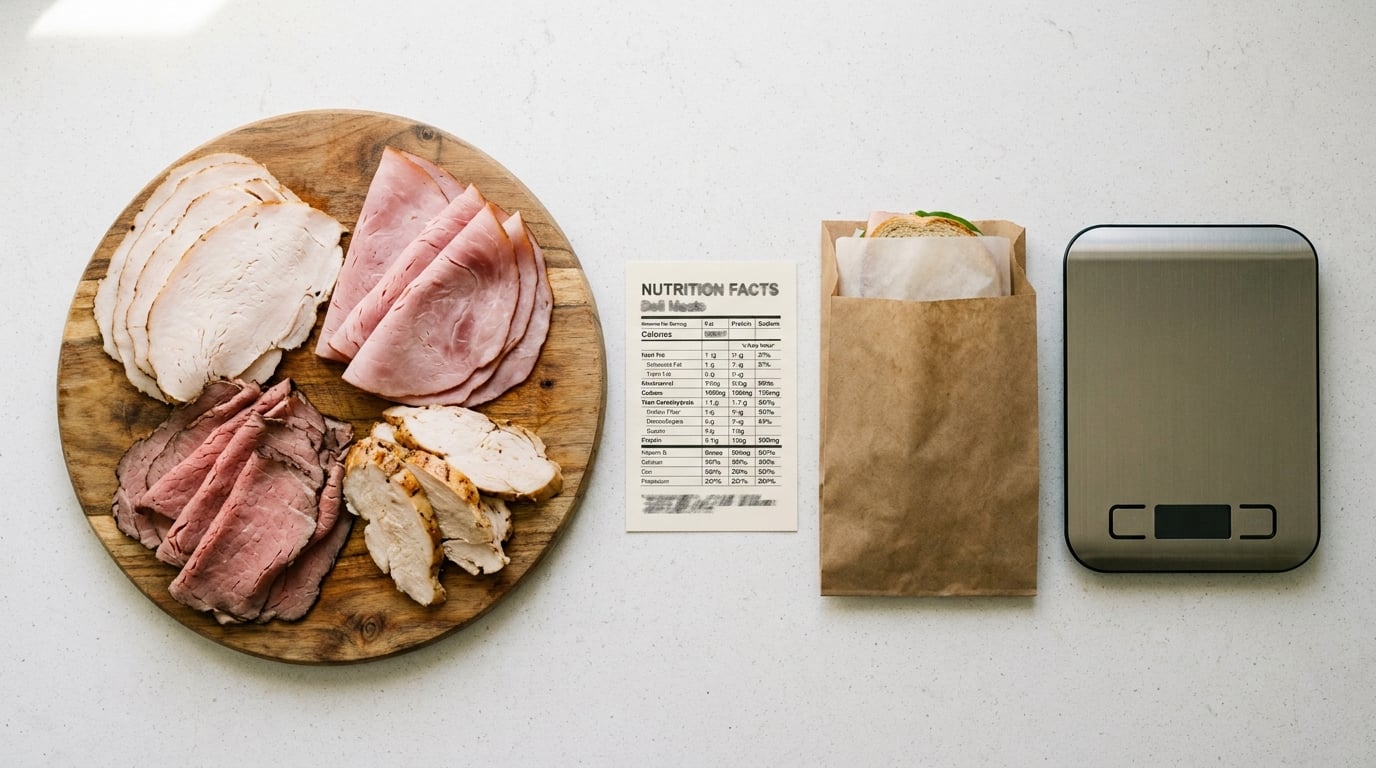
The best low sodium deli meats you can actually find in US supermarkets are the plain roasted ones that skip the curing step: no-salt-added turkey breast at roughly 26 to 55 mg of sodium per 2-ounce serving, oven-roasted chicken breast around 110 mg, and any package whose Nutrition Facts panel lands at or under 140 mg. That 140 mg line is the FDA’s legal definition of low sodium, and it is a much stricter bar than the “lower sodium” wording on the front of most lunch meat bags.
The catch is availability. The no-salt-added SKUs that get recommended online are the ones most chains do not carry in the packaged meat aisle, which is exactly the complaint that keeps coming up on r/LowSodium and r/Menieres. So this guide covers the whole picture: the options worth putting in your cart, the twelve picks that deserve a closer look, where each one tends to sit on the shelf, and how to read the label in ten seconds so you can verify it yourself.
One caution before we start. Sodium figures on deli meat drift. Brands reformulate, serving sizes get restated, and one Aldi thread reported a Land O’Frost turkey jumping by roughly 150 mg between versions. Treat every number below as a guide, then confirm the current package at the shelf.
Table of Contents
- Best Low-Sodium Deli Meats You Can Actually Find in US Supermarkets at a Glance
- 1. Applegate Naturals Oven-Roasted Turkey Breast
- 2. Hormel Natural Choice Lean Ham
- 3. Store-Brand Low-Sodium Oven-Roasted Turkey Breast
- 4. Wellshire Farms Sugar-Free Uncured Ham
- 5. Boar’s Head Naturally Antibiotic-Free Turkey Breast
- 6. Oscar Mayer Deli Fresh Rotisserie Seasoned Chicken Breast
- 7. Jimmy Dean Deli Meat Low-Sodium Variety Pack
- 8. Hebrew National Low-Sodium Kosher Salami
- 9. Jennie-O Turkey Store Turkey Ham
- 10. Private Selection Low-Sodium Oven-Roasted Turkey Breast
- 11. Turkey-Based Lower-Sodium Lunch Meat as a Category
- 12. Low-Sodium Roast Beef Cold Cuts
- How to Compare Sodium on a Deli Meat Label
- Frequently Asked Questions
- Where to start with low sodium deli meat
Best Low-Sodium Deli Meats You Can Actually Find in US Supermarkets at a Glance
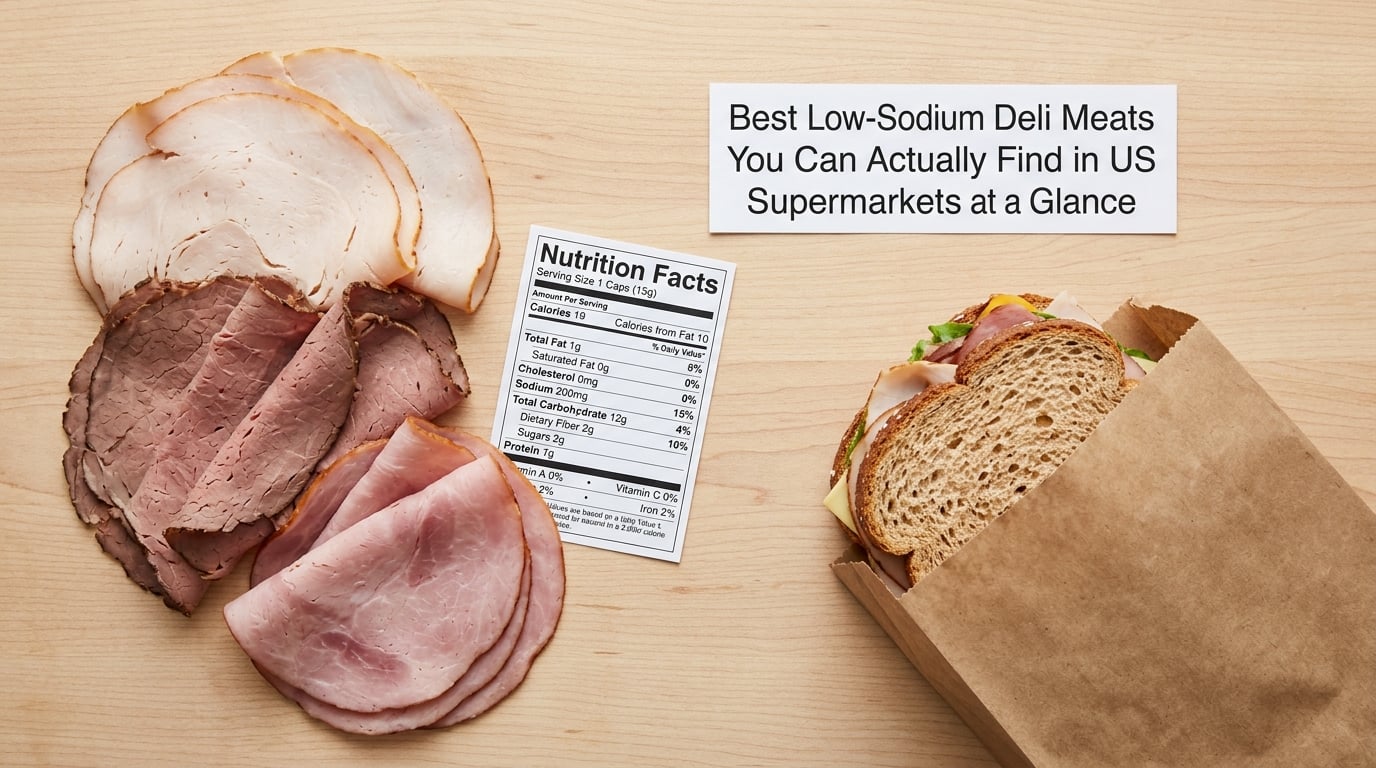
Sorted from lowest to highest, using figures that appear in current product data and label research. The column that matters most is the last one, because a 55 mg product you cannot buy is worth less to you than a 340 mg product on the shelf you shop at.
One note before you read it: this table is ranked strictly by sodium, so it includes a handful of natural-grocer brands that do not get their own section below. The twelve sections that follow pick up the products most readers will actually encounter in a regular supermarket.
| Option | Sodium per 2 oz | Where you will usually find it | Flavor and texture | Works best for |
|---|---|---|---|---|
| Plainville Farms No Salt Added Turkey Breast | about 26 mg | Kroger, Costco, regional chains | Mild, clean, dry-leaning; slices fall apart easily | A two-ingredient label, nothing else added |
| Dietz & Watson No Salt Added Gourmet Lite Turkey | about 50 mg | Deli counters, Whole Foods, specialty grocers | Delicate, thin-sliced, premium texture | People who want deli-counter quality without the salt |
| Boar’s Head No Salt Added Turkey Breast | 55 mg | Scarcer than the rest; ask the deli or check a larger market | Soft, moist, gently roasted | The lowest-sodium widely known deli brand |
| Mary’s Roasted Turkey (Whole Foods) | reported near zero | Whole Foods and its affiliated stores | Roasted, moist, slightly dense | Shoppers already making the Whole Foods trip |
| True Story Protein Toppers Oven Roasted Chicken Breast | about 110 mg | Natural grocers and their online shops | Lean, firm, chicken-forward | Low-sodium chicken that is not a cured cold cut |
| Applegate Naturals Oven-Roasted Turkey Breast | Check the panel; commonly under 300 mg | Target, Kroger, Whole Foods, Sprouts, co-ops | Clean roast flavor, smooth texture | The everyday sandwich meat that is widely carried |
| Butterball reduced-sodium turkey | About 37% less than standard | Walmart, Kroger, most mass-market meat aisles | Mild, standard sandwich texture | Households buying at volume |
| Hillshire Farm Ultra Thin Lower Sodium Oven Roasted Turkey | Lower than the standard line, still above 140 mg | Walmart, Kroger, Target, grocery deli cases | Thin, tender, mild | Thin-sliced club sandwiches |
| Store-brand low-sodium oven-roasted turkey | Varies by chain; read it | Walmart, Kroger, Aldi, H-E-B, Publix, Safeway | Comparable to national brands | Cheapest way to keep turkey in the rotation |
| Private Selection Low-Sodium Oven-Roasted Turkey Breast | Varies by location; read it | Safeway and its banners | Standard roast turkey, uniform slices | Shoppers who want the same brand name every trip |
| Wellshire Farms Sugar-Free Uncured Ham | Ham range; uncured is not a sodium claim | Walmart, Kroger, Target, Whole Foods | Sweet-savory, firm, distinctly ham | Ham sandwiches with no added sugar |
| Hebrew National Low-Sodium Kosher Salami | Lower than standard salami, still high | Walmart, Kroger, most mainstream chains | Spiced, firm, garlicky | Salami eaters who want to keep the category |
Two categories sit outside this list on purpose. Fresh-roasted deli turkey and chicken that the counter slices from a plain roasted breast usually land somewhere in that same 26 to 110 mg range without any low-sodium claim at all, and they are often the easiest option to find in a big grocery store. Salami, pepperoni, bologna, pastrami, and bacon belong to the other end of the shelf.
1. Applegate Naturals Oven-Roasted Turkey Breast
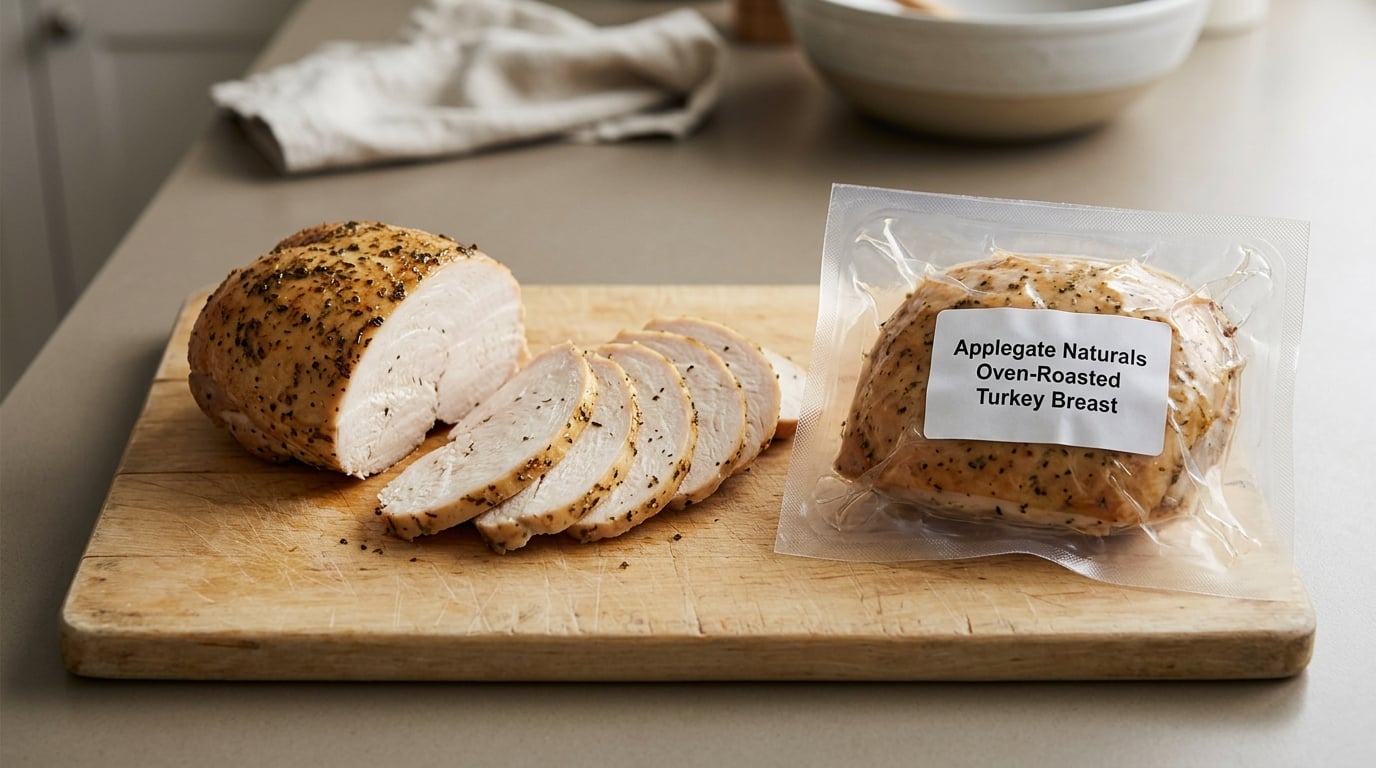
Applegate Naturals oven-roasted turkey breast is the workhorse of this whole list, because it is the low-sodium-adjacent option that virtually every mainstream chain carries. Target, Kroger, Whole Foods, Sprouts, and most co-ops keep a shelf-stable tub of it, which is more than most of the truly low-sodium SKUs can promise.
Read the panel when you pick it up. The line has varied across reformulations, and some versions sit well above 140 mg while others come in much lower. The flavor is a clean roast with no cure taste, and the slices hold together better than the no-salt-added options, which matters if you are building a lunchbox sandwich rather than a plate.
A slice or two in a wrap with lettuce, tomato, and a mustard made with no added salt is about as close to a neutral canvas as the deli aisle offers.
2. Hormel Natural Choice Lean Ham
Hormel Natural Choice lean ham shows up in the refrigerated case at Walmart, Target, and Kroger, and it is a reasonable middle ground when you want ham flavor without a heavy brine. The lean cut is less fatty than a traditional hickory-smoked ham, so the texture is drier and the salt hits differently.
Ham is a pork product that has to be cured, so its sodium floor sits above turkey’s. Compare the current package against a conventional ham in the same case. If the difference looks small, you are better off picking a roasted turkey and calling it a day.
It works well chopped over a salad, where the saltiness seasons the greens instead of landing in one concentrated bite.
3. Store-Brand Low-Sodium Oven-Roasted Turkey Breast
Every major chain sells its own low-sodium oven-roasted turkey, and for most households this is the practical pick. Walmart, Kroger, Aldi, H-E-B, Publix, and Safeway all carry a private-label version in some form, and the price difference against a national brand is real when you are buying a tub a week.
The catch is that store brands are not consistent across locations. A Kroger tub in one state and the same-named tub in another can have different recipes and different sodium totals, so there is no single number to memorize. Look for the 140 mg or less marker on the panel, and if the tub you picked up does not make it, put it back and take the plain oven-roasted version instead.
Texture-wise these run close to the national brands, sometimes slightly firmer. Nothing wrong with it in a sandwich.
4. Wellshire Farms Sugar-Free Uncured Ham
Wellshire Farms sugar-free uncured ham answers a different question than the rest of this list. It is for people who want ham without added sugar, not people chasing the lowest possible sodium count.
Uncured means the meat was not treated with synthetic sodium nitrite. Most cured ham gets that nitrate from celery powder instead, which converts to nitrite in the body, so uncured is a sourcing change rather than a health verdict. Worth knowing before you treat the word as a green light.
Availability is good at Walmart, Kroger, Target, and Whole Foods. Flavor is sweet-savory and distinctly ham, with a firmer bite than turkey. The ham range generally runs 300 to 400 mg per 2 ounces, so treat it as an upgrade in ingredients, not in sodium.
5. Boar’s Head Naturally Antibiotic-Free Turkey Breast
Boar’s Head is the brand shoppers ask for by name in low-sodium searches, and the honest answer requires two separate products. The No Salt Added turkey breast is the one at 55 mg per 2-ounce serving, and it is genuinely the lowest-sodium product from a widely known deli brand. That is the version worth hunting down.
The standard Naturally Antibiotic-Free turkey breast on the same tray is a different animal. It is a good, moist deli turkey that will run several hundred milligrams per serving, because it is seasoned and brined the way conventional deli turkey is. Premium positioning does not mean low sodium. Compare the panels.
Availability is the real problem, and r/LowSodium readers have complained about it directly: in many areas the no-salt-added versions simply are not on the shelf. The 55 mg product turns up more reliably at larger markets and natural grocers than at a neighborhood chain, so plan the trip around it rather than assuming.
6. Oscar Mayer Deli Fresh Rotisserie Seasoned Chicken Breast
Oscar Mayer Deli Fresh rotisserie seasoned chicken breast is the pick for someone who finds plain turkey boring. The seasoning is the point: paprika, garlic, and a browned exterior give it more character than any unseasoned roast in the case.
It carries a wider band of sodium than plain roasted chicken because the seasoning blend is part of the product. On a 2-ounce serving it commonly lands between 300 and 400 mg, which is above the 140 mg FDA line but well under the 450 to 750 mg range of standard cured lunch meat. Serving size is often listed at 3 ounces here, so convert before you compare it to anything else.
Walmart, Target, and Kroger carry it in the refrigerated section. The texture stays moist, which is unusual for a seasoned breast, and it holds up in a grilled chicken wrap with peppers.
7. Jimmy Dean Deli Meat Low-Sodium Variety Pack
The Jimmy Dean deli meat variety pack solves a household problem rather than a taste problem. A mixed household with one person limiting sodium and three people who do not can buy one tray instead of two, which is a real saving in both money and fridge space.
Do not treat the pack as a single sodium number. Roast beef inside a variety pack is usually saltier than the turkey or chicken in the same tray, so read each compartment’s panel separately. Sort what is inside by the figure on the packet and use the low end for the person who is counting.
It sits in the meat case at Walmart, Kroger, and most mass-market grocers. Texture is standard deli: uniform, slightly springy slices that hold up on a roll.
8. Hebrew National Low-Sodium Kosher Salami
For people who actually want salami, Hebrew National’s low-sodium kosher version is the realistic option. It is not low by the FDA standard and it was never going to be, since salami is a cured, spiced product. What the label means is that the sodium is lower than the standard version on the same shelf.
The seasoning is heavy: garlic, pepper, and a firm, dry texture that people who like salami tend to like immediately. That intensity is a plus in a sandwich, because it means a light hand on everything else.
Find it at Walmart, Kroger, and most mainstream chains. Use two slices rather than four, and pair it with mustard and sharp vegetables instead of cheese and mayo, which is where the rest of the sodium in that sandwich lives.
9. Jennie-O Turkey Store Turkey Ham
Turkey ham is the swap people make when they want the shape and saltiness of ham but not the saturated fat load that comes with pork. Jennie-O’s turkey ham is widely carried at Walmart, Kroger, and Target, and the mild seasoning makes it an easy sell to kids who will not touch a plain turkey sandwich.
Its lighter texture is both the pro and the con. It is noticeably less firm than real ham, so it can slide out of a tall sub if you are not careful, and it does not have that cured edge. In a wrap or a pinwheel it holds up fine.
Sodium usually sits in the middle of the deli range, closer to turkey than to ham. Check the panel; the serving size on this one is often 2 ounces, which makes it an easy direct comparison against the roast turkey options.
10. Private Selection Low-Sodium Oven-Roasted Turkey Breast
Safeway’s Private Selection line is the same idea as store-brand turkey in section three, applied by a specific chain. It is useful for shoppers who want the same brand name on every trip so they do not have to re-read five tubs each week.
Sodium varies by production run, so the “low sodium” name on the tub tells you very little on its own. Some packages in this line come in under 140 mg, others do not, and the label is the only reliable source. If the tub in front of you misses the mark, the plain oven-roasted turkey breast in the same case is the better buy.
Flavor is standard roast turkey, slices are uniform, and it prices below the national brands most weeks.
11. Turkey-Based Lower-Sodium Lunch Meat as a Category
Turkey is where most people should start, but the word turkey on a package tells you almost nothing by itself. A 2-ounce serving of turkey lunch meat can land anywhere from about 55 mg to over 500 mg depending on the product, which is a wider spread than the entire cured-meat range.
Here is how to sort the category. Breast is leaner and usually more heavily seasoned than thigh. Oven-roasted is the least processed form. Smoked turkey carries a cure and a smoke flavor along with the sodium. “Lower sodium” on the front means at least 25% less than the standard version of that same product, which still leaves products in the 340 to 370 mg range that would never qualify as low sodium.
Two other things decide the quality of the slice. Whole muscle turkey breaks apart under a knife in an honest way; chopped and formed turkey, where the meat is emulsified and re-formed, slices smoothly but eats more processed. And the serving size matters more than people expect, since many lunch meat packages list 3 ounces where the comparison products list 2.
Compare breast against breast on the same serving basis before you decide anything.
12. Low-Sodium Roast Beef Cold Cuts
Roast beef is the honest compromise on this list. It is richer and more strongly flavored than turkey or chicken, and it is almost always higher in sodium as a result, because the roast is brined before it is cooked.
Good low-sodium roast beef usually lands between 300 and 400 mg per 2 ounces. That is workable on a larger daily budget. It is a poor fit if you are operating on 1,000 to 1,500 mg a day, which is a frustration several people on r/LowSodium have described with these meat-based lunches in general.
To keep a roast beef sandwich inside budget, build the rest of it around the meat. Low-sodium bread, a single thin slice of cheese, lettuce, tomato, and mustard instead of mayonnaise. A fresh roasted turkey breast from the deli counter, sliced to order, is often lower and can stand in when the roast beef looks heavy.
Boar’s Head and several deli counters offer a no-salt-added roast line in some regions. Ask, because the counter staff usually knows which tray the store carries even when the front case does not advertise it.
How to Compare Sodium on a Deli Meat Label
Everything above comes down to four numbers and a serving size. The FDA regulates the wording on the front of the package, and the definitions are narrow enough to learn in a minute.
| What the package says | What it actually means |
|---|---|
| Low sodium | 140 mg or less of sodium per labeled serving |
| Very low sodium | 35 mg or less of sodium per labeled serving |
| Reduced sodium / lower sodium | At least 25% less than the standard version of the same product, which can still be well above 340 mg |
| No salt added | No salt was added during processing. It does not mean sodium-free, and celery powder curing still contributes sodium |
Here is the fastest way to use that table. Start with the serving size on the Nutrition Facts panel, not the picture on the front. If a package says 2 ounces and the one next to it says 3 ounces, the numbers are not comparable until you scale them. A 2-ounce serving at 110 mg becomes about 165 mg at 3 ounces.
Then read the ingredient list. Celery powder and sodium erythorbate show up in plenty of products with a natural or uncured halo, and both contribute sodium. That is not a reason to avoid them, but it is a reason to know the front of the package is not telling the whole story.
Finally, do the sandwich math. Here is where the sodium actually goes in a typical build, using figures you can verify on any package.
| Component | Typical sodium |
|---|---|
| No-salt-added turkey breast, 2 oz | about 55 mg |
| Standard deli turkey, 2 oz | 300 to 400 mg |
| Standard ham or salami, 2 oz | 450 to 750 mg |
| Two slices of bread | 250 to 400 mg |
| One ounce of cheese | 150 to 200 mg |
| One tablespoon of mayonnaise | about 90 mg |
That last table is the part most low-sodium guides skip, and it changes the advice. Fixing the meat while keeping ordinary bread, cheese, and mayo can leave you with a sandwich that is not meaningfully lower. A 55 mg turkey on a 300 mg roll with cheese and mayo is a 600 mg sandwich, which is most of a 1,500 mg daily blood pressure budget before lunch is over.
A practical rule: spend your sodium on the meat you will actually taste and pick up lower-sodium versions of everything else. No-salt-added deli turkey on no-salt-added bread with mustard, lettuce, and tomato is the cheapest low-sodium sandwich in the building, and it is the one I pack most often.
None of this is medical advice, and if you are managing kidney disease, heart failure, blood pressure, fluid retention, or a condition where salt triggers symptoms, your doctor or a registered dietitian should set the numbers for you rather than a label.
Frequently Asked Questions
Which deli meat has the least sodium?
Plain, no-salt-added roasted turkey breast is the least-sodium deli meat you can find. Products in that category report roughly 26 to 55 mg of sodium per 2-ounce serving, and several have only turkey and water on the ingredient list. Anything branded low sodium meets the FDA threshold of 140 mg or less per serving, so that label is a reliable shortcut when you are in the aisle.
What is the best low sodium deli meat to buy?
It depends on which store you shop at. If your chain carries a no-salt-added turkey breast near 55 mg, that is the best buy available to you. At Walmart, Kroger, or Aldi, the store-brand low-sodium oven-roasted turkey is usually the strongest option, since the ultra-low-sodium specialty SKUs are rarely carried there. Check the panel for 140 mg or less and compare on the same serving size.
Where can I find low sodium deli meat?
Large chains, natural grocers, and the deli counter are your three options. No-salt-added and very low sodium SKUs turn up most often at natural grocers, co-ops, and bigger supermarkets, while the mainstream store brands sit in the meat aisle everywhere. If the packaged shelf comes up empty, ask the deli staff whether the store carries a low-sodium or freshly roasted tray, since counter staff usually know which tray is loaded even when the front case does not label it.
Is lower sodium deli meat actually low sodium?
Often not. Lower sodium and reduced sodium are the same regulated claim, and it only means at least 25% less than the standard version of that product. That frequently leaves a serving in the 340 to 370 mg range, which is more than double the 140 mg that low sodium requires. If the front of the package says lower sodium but the panel does not read 140 mg or less, it does not qualify.
What is the healthiest turkey deli meat?
An oven-roasted or no-salt-added turkey breast, the kind that skips curing and brining entirely, is the healthiest turkey option. Look for a short ingredient list, since products with turkey and water or turkey broth and no added salt are the least processed. Whole muscle turkey also beats chopped and formed, which is emulsified and re-formed. Any turkey labeled lower sodium should be read on the panel, because the claim alone does not make it low.
Which deli meat has the most sodium?
Salami, pepperoni, bologna, pastrami, and bacon sit at the highest end, with a 2-ounce serving commonly running 450 to 750 mg. They are cured, spiced products, and the seasoning and brine push the sodium well past anything on the low-sodium end of the aisle. If you want the flavor, keep portions to two slices and build the rest of the sandwich around vegetables and a no-added-salt condiment.
Where to start with low sodium deli meat
Go to the store you actually shop at and turn the first tub over. If the panel reads 140 mg or less per 2 ounces, that is your starting point for the week, and everything else on this list is a swap from there.
Start with the meat, then fix the bread, the cheese, and the condiment. That second half is where most of the sodium has been hiding all along, and it costs you nothing to change.