
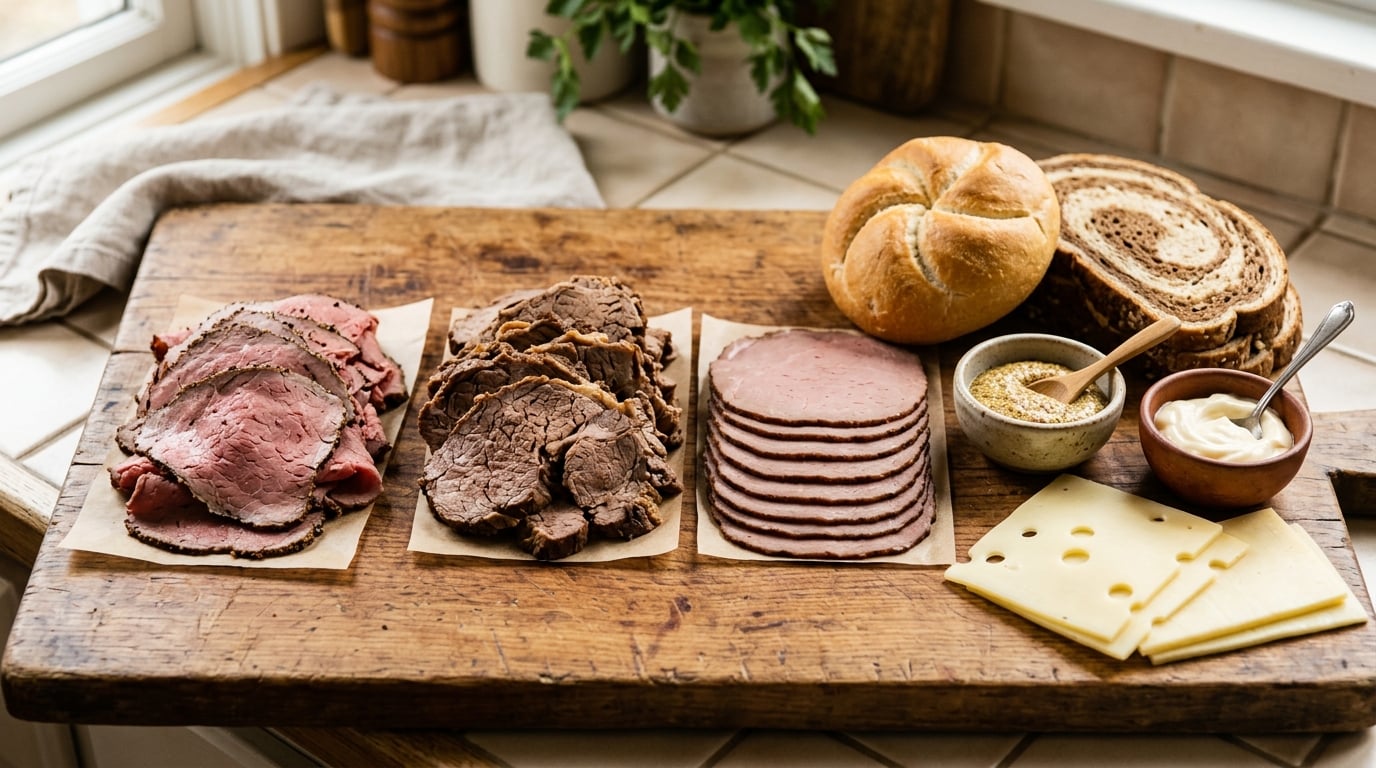
When you are choosing the best roast beef for sandwiches, the deli counter wins on consistency and speed, homemade wins on flavor and control, and the pre-packaged cold cut wins on price, storage life and zero effort. There is no single best source, because the three options fail in completely different places.
Here is the honest split. If you want a sandwich that tastes like a good sandwich shop and you need it today, buy it sliced at the counter. If you cook for a household and want control over seasoning, doneness and the cost per sandwich, roast your own eye of round and slice it cold. If you want a lunch that survives in a fridge for a week, buy the package.
Table of Contents
- Best Roast Beef for Sandwiches: Deli Counter vs. Homemade vs. Pre-Packaged at a Glance
- Flavor: Which Roast Beef Tastes Best?
- Texture and Sandwich Performance
- Convenience: Fastest Option vs. Best Control
- Cost: What You Will Usually Spend
- Freshness and Food Safety
- Which Roast Beef Is Best for Different Sandwiches?
- Which Should You Choose?
- Frequently Asked Questions
- What is the best roast beef for sandwiches overall?
- Is homemade roast beef cheaper than buying it at the deli?
- Which roast beef is best for a hot sandwich?
- How do I keep roast beef from becoming dry in a sandwich?
- Can pre-packaged roast beef taste as good as deli meat?
- How long should leftover roast beef be refrigerated?
- Conclusion
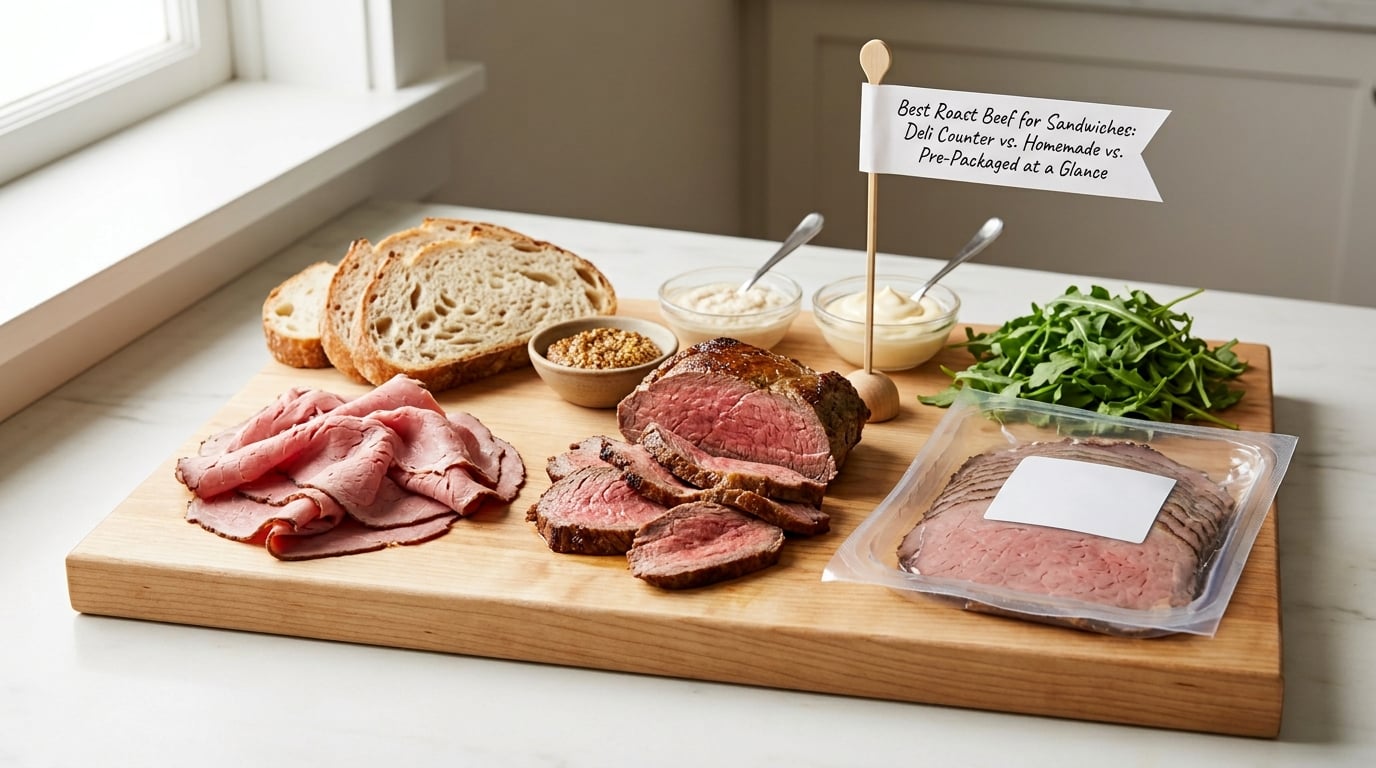
Best Roast Beef for Sandwiches: Deli Counter vs. Homemade vs. Pre-Packaged at a Glance
| Factor | Deli Counter | Homemade | Pre-Packaged |
|---|---|---|---|
| Flavor | Good, mildly seasoned, consistent | Best overall, you control the salt and rub | Even, mild, cured flavor that fades when reheated |
| Texture | Silky, machine-thin, uniform | Silky if chilled and sliced thin, uneven otherwise | Uniform, slightly springy, holds its shape |
| Color | Uniformly rosy | Rosy center if pulled early, brown crust | Evenly pink, from curing |
| Cost per sandwich | Highest | Lowest over a whole roast | Lowest for a single sandwich |
| Portion control | You choose the weight, they slice it | You weigh slices yourself | Fixed slices, one per layer |
| Effort | None | A few hours plus slicing | None |
| Storage life | Shortest, use within a few days | Long, freezes well | Longest, unopened shelf life |
| Best for | Deli-style cold sandwiches, hot subs, parties | Meal prep, club sandwiches, French dip, batch lunches | Lunchboxes, office lunches, travel |
Read that table as a set of tradeoffs, not a scorecard. Every row has a loser, and the loser is usually a different option in each row.
Flavor: Which Roast Beef Tastes Best?
Homemade roast beef tastes best when it is seasoned deliberately and pulled early. The rub you choose matters more than anything a deli or a plant applies, and the crust you build with real heat is the part your sandwich misses most when you buy pre-sliced.
Deli counter meat is rarely bad. It is usually a lean round roast, brined lightly, cooked gently in a water bath or a low oven, then chilled and sliced, which gives you a clean, mild, slightly mineral flavor with almost no spice in it. That restraint is exactly why it disappears into a sandwich with mustard or horseradish.
Pre-packaged roast beef is a cured meat, and curing is the whole point of it. The salt, the nitrite and sometimes a little sugar keep it stable and give it a consistent edge. Reheated, it turns a little softer and flatter in flavor, which is why a sandwich built on it is better cold than hot.
Best roast beef for sandwiches starts with the right cut
Eye of round is the best cut for roast beef sandwiches because it is lean, dense and almost fat-free, so it stays tender when served cold. Top round is the second choice, with a little more juiciness. Avoid heavily marbled cuts such as tri-tip and ribeye, because chilled fat turns hard and waxy and ruins the texture of a cold sandwich.
Most store-bought deli roast beef is made from eye of round or top round, which is why the homemade version behaves the same way when you buy the right cut. Top loin and top sirloin work well, with a deeper beefy taste and a slightly chewier bite, if you do not mind a marbled edge.
What to ask the deli slicer
Five questions turn an ordinary counter purchase into a good one. Ask them plainly; counter staff answer these all day.
- Which cut is this roast beef? Round cuts mean a cold, deli-style sandwich, rib cuts mean a hot one.
- Can you slice it thinner than usual, or take it home and use a sharp slicer?
- Is there end meat on the loaf, or is it all center slices? End cuts are darker and chewier.
- Was it cooked in a bag or a water bath? If so, expect milder flavor and a slicker surface.
- Can you sell me the unsliced end piece? Slicing it yourself is the cheapest way to get deli-thin at home.
Texture and Sandwich Performance
Texture is where the three options separate most clearly. Deli meat is silkier than anything you can buy in a package, and homemade can match it, but only if you chill the roast hard before cutting and use a very sharp blade.
Fat is the deciding variable in a cold sandwich. Marbled fat that is delicious hot turns waxy and hard in the fridge, so lean round muscle is the right target. Deli and pre-packaged roasts are both chosen for that leanness, which is why they behave predictably on rye or a Kaiser roll.
Hot sandwiches are more forgiving. A hot sub or a French dip hides texture almost completely, and a fatty cut that would be wrong cold turns tender and rich once it hits the heat. For those, the pre-packaged slices reheat better than most people expect, and deli meat is the easy pick.
Dryness shows up most in homemade lean roasts. A dry brine of kosher salt pulled back from the seasoning overnight, plus a short rest in the pan drippings before slicing, keeps the center juicy. Many home cooks say the pink center they can hold onto is the main reason they stopped buying the counter stuff.
Slicing thin at home without a deli slicer
Chill the roast until it is firm enough to handle without warmth, then slice across the grain rather than along it, cutting away from you at a shallow angle. A long thin slicing knife with a hollow edge does more than a chef’s knife here, and a sharpening steel between every few cuts keeps the slices even.
Nobody slices as evenly as a commercial machine. Home cooks with a meat slicer say it is worth the counter space and the money for that reason alone, and a few of them describe eating the slices straight off the blade before they ever reach bread. A puffy sandwich is a better use of a few thicker slices anyway.
Convenience: Fastest Option vs. Best Control
Pre-packaged roast beef is the fastest by a wide margin. You open the package, layer slices on bread, and you are done in four minutes with no knife skill and no cleanup.
The deli counter sits in the middle. You spend a few minutes waiting and paying, and then you own perfectly sliced meat with no work at all, which makes it the most convenient option for a full day of sandwiches or a group.
Homemade gives the most control and demands the most of you. A roast needs seasoning the night before, oven time with occasional basting, a cool-down, and refrigerator space while it firms up. Once it is sliced, though, you have portions you control by weight, which is the one thing the other two never give you.
Thread after thread in r/Cooking and r/AskCulinary puts the honest version of this: once the roast is in the oven it is about ten minutes of actual work spread over several hours. The real cost is not labor, it is planning around a whole cut of beef that needs eating.
Cost: What You Will Usually Spend
Per pound, the ranking is simple and stable: homemade is the least expensive, pre-packaged sits in the middle, and the deli counter is the most expensive, with name-brand counter meats noticeably higher still. Prices swing by region and by season, so treat the order as the guide rather than any single figure.
Per sandwich, the gap narrows. Homemade only wins if you actually eat the whole roast, and a three-pound roast is a real commitment for a one or two person household. Pre-packaged can be the cheaper sandwich for a single serving or a couple of days of lunches, because you are not paying for meat you will not use.
One more cost hides in homemade: a sharp slicing knife, and a slicer if you plan to do this monthly rather than once a year. For a family that eats roast beef sandwiches weekly, a slicer pays for itself quickly, because it is what lets you buy the inexpensive round cuts and still get deli-thin results.
How many sandwiches one pound of roast beef makes
One pound of roast beef makes roughly ten to twelve cold sandwiches at a normal deli thickness of two to three ounces per sandwich, and closer to twenty on a thin-sliced sub where a quarter ounce is enough. A three-pound roast therefore feeds about thirty regular sandwiches or sixty thin ones.
That math is the single most useful number for the homemade decision. Count how many sandwiches your household eats in a week, multiply by the servings, and you know almost immediately whether a whole roast is realistic for you.
Freshness and Food Safety
All three options are cooked before you buy them, so the main safety question is how the meat was handled afterward, not whether it is raw. Deli counter meat is refrigerated, sliced on a shared slicer, and best used within a few days. Pre-packaged meat arrives sealed and travels best.
Refrigerate roast beef at 40°F or below and use deli or homemade slices within three to four days, or freeze them in single-sandwich portions for a couple of months. Pre-packaged slices follow the same rule once the package is opened.
For reheating, whole cuts of beef should reach 145°F (63°C) internal temperature for food safety, and most sandwich meat is reheated well past that. If you are reheating a home roast that you pulled medium rare for cold slicing, that is a different situation, so cook it to temperature rather than judging by color.
Keep the cold chain unbroken. Do not leave sliced roast beef on a counter while you build sandwiches, and return it to the refrigerator within two hours.
Reading the label on a package of roast beef
Three lines on the package do most of the work. Check the sodium per serving, which for cold cuts is often high enough to matter for anyone eating sandwiches several times a week.
Then check the ingredient list for added water or solution, since a package that lists water, salt and flavoring ahead of the beef is a diluted product. Finally, look at the curing agent, which will be sodium nitrite, sodium nitrate, or cultured celery powder, and note the difference between cured and uncooked. The order of those details tells you more about the texture than the brand name does.
Which Roast Beef Is Best for Different Sandwiches?
For a classic cold deli-style sandwich on rye with horseradish, counter meat is the answer, because the uniform thin slices sit flat and soak up the dressing without turning the bread soggy. Homemade matches it closely enough that few people notice the difference.
For a hot sub, Italian beef, or a French dip, all three work, and the pan drippings or jus matter more than the source. This is the one case where a fatty cut like tri-tip is a good idea, because it stays tender under heat.
For club sandwiches and layered cold sandwiches, homemade wins on portion control, since you can weigh what goes on each layer and keep the proportions even across eight sandwiches instead of six.
For lunchboxes, office lunches and travel, pre-packaged is the practical pick. It travels without a cooler for part of the day, stores flat in a fridge door, and needs no decisions.
Regional styles also ask different things. A North Shore sandwich wants thin rare beef with a heavy coat of dressing, a Reuben wants chopped rather than sliced meat, and a banh mi wants slices firm enough to survive pickling, which is closer to the pre-packaged end of the scale.
Which Should You Choose?
Choose the deli counter when you need it today, when the sandwich is for other people, or when slice consistency is the whole point. Ask the five questions above, buy a quarter to half pound, and skip the premium name unless it is a special day.
Choose homemade when you cook for a household, when sodium and additives matter to you, or when the flavor difference is worth an afternoon and a sharp knife. Buy eye of round or top round, dry brine it, pull it at 125°F to 130°F, chill it overnight, and slice it across the grain as thin as your knife allows.
Choose pre-packaged when the sandwich has to travel, when you are buying one or two portions, or when the week is too busy to plan a roast. Read the label, skip the highest-sodium option if you can, and eat it cold where the curing flavor is at its best.
A practical middle path works too. Buy the unsliced end piece from the counter, slice it yourself at home, and you get most of the deli experience with a thinner bill and a pink center you control.
Frequently Asked Questions
What is the best roast beef for sandwiches overall?
For most home cooks, a homemade eye of round is the best roast beef for sandwiches because it combines the best flavor, full control over doneness and the lowest cost per sandwich once a whole roast is used. The deli counter is the better pick for consistency and speed, and pre-packaged cold cuts win on storage life and portability.
Is homemade roast beef cheaper than buying it at the deli?
Per pound, yes, and the gap widens if you slice the meat yourself. The catch is volume: a three-pound roast is a commitment, and unused meat spoils. For a household of four or more that eats sandwiches most days, homemade comes out ahead. For one person buying a single sandwich, the counter is usually the cheaper total.
Which roast beef is best for a hot sandwich?
Any of the three work well when the meat is hot, because heat and juice hide slice texture. This is the one case where a marbled cut such as tri-tip or top sirloin is a good choice, since fat that turns waxy when cold turns rich and tender when heated. Pre-packaged slices also reheat better than most people expect.
How do I keep roast beef from becoming dry in a sandwich?
Lean round roasts dry out from overcooking more than anything else. Dry brine the roast with kosher salt the night before, cook it low and slow and pull it at 125°F to 130°F, then rest it before slicing. Chill it fully before cutting, and slice across the grain. A thin coat of mayonnaise or horseradish sauce in the sandwich adds moisture too.
Can pre-packaged roast beef taste as good as deli meat?
Not quite, and the difference is mostly seasoning and slicing. Pre-packaged roast beef is cured, so it carries salt and a consistent flavor, but it lacks the crust and seasoning depth of a home roast. Its real advantage is uniformity, since every slice is identical, which is why it works better for packed lunches than for a sandwich you want to impress with.
How long should leftover roast beef be refrigerated?
Keep sliced deli or homemade roast beef at 40°F or below and use it within three to four days, whether it came from the counter, your kitchen or an opened package. For longer storage, freeze slices in single-sandwich portions with a layer of parchment or plastic between them, and thaw them in the refrigerator overnight rather than on the counter.
Conclusion
Start with the time you have, not the flavor. Need it today, buy it sliced at the counter and ask which cut it is. Cook for a household and want the best flavor at the lowest cost per sandwich, roast an eye of round and slice it cold yourself. Packing lunches all week, buy the pre-packaged cold cut and read the label.
Whichever you pick, the sandwich is decided by three things: a lean round cut, a thin cold slice, and a good bread. Get those right and the source stops mattering very much.