
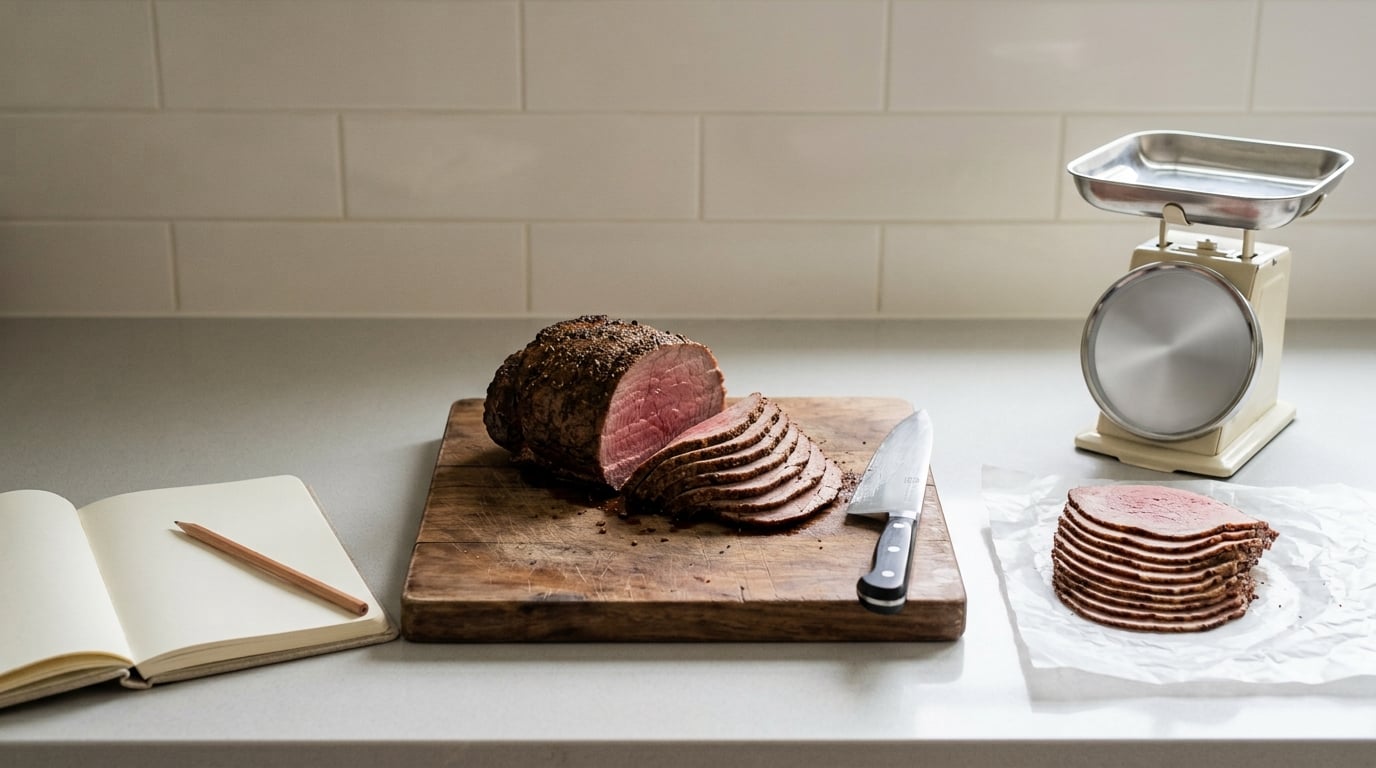
Yes, for most households it is. Buying the whole cut at a grocery meat case and slicing it yourself typically costs 40 to 70 percent less per pound than buying the same meat sliced at a deli counter, and that spread widens where deli labor is expensive. All figures in this guide are typical US prices in dollars; they vary a lot by region and store, so run your own local numbers through the math below. Prices change over time.
The exception matters, though. If you pack two or three sandwiches a month, the equipment and the Sunday afternoon of cooling, slicing and cleaning will eat the savings. The break-even sits somewhere around five to eight sandwiches a week for a household, once you have a knife, and closer to fifteen if you are buying an electric slicer with the meat.
We watch customers ring up deli meat all day at Hillcrest Sandwich, so this is not a theoretical question for us. It is the same arithmetic every shopper is trying to do, just done out loud. Below is the whole breakdown: what each pound actually costs at four different sourcing routes, how many sandwiches a pound turns into, and exactly where the deli markup comes from.
Table of Contents
- Lunch Meat Costs: Deli Meat vs. Cook and Slice Your Own
- What Affects the Price
- Ways to Save
- Frequently Asked Questions
- Is cooking and slicing your own lunch meat cheaper than buying deli meat?
- How much does homemade lunch meat cost per serving?
- What equipment do I need to make lunch meat at home?
- Is homemade lunch meat cheaper if I only make small portions?
- How long does homemade lunch meat stay fresh, and can it be frozen?
- Which types of meat are most economical to make into lunch meat?
- Bottom Line
Lunch Meat Costs: Deli Meat vs. Cook and Slice Your Own
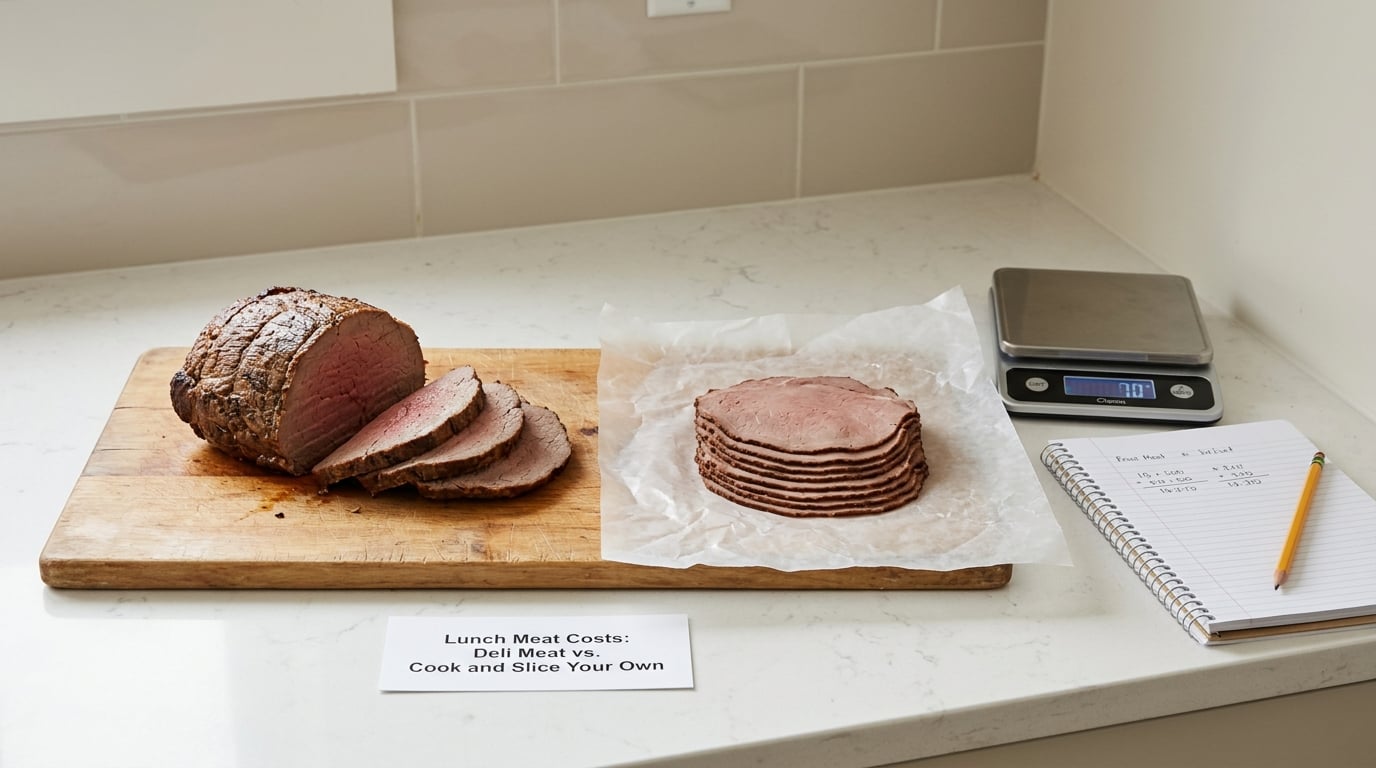
Is it cheaper to cook and slice your own lunch meat? Usually yes, by a wide margin, because the deli counter sells you the same muscle plus labor you can do at home in minutes. The counter also quietly sells you shrink. A whole cut loses trim, fat and casing weight before it is ever weighed at the register, and you pay for the raw pound but receive fewer edible ounces.
| Meat | Deli counter, sliced | Pre-packaged brand | Store-brand chub or log | Raw whole cut, cooked at home |
|---|---|---|---|---|
| Turkey breast | 7 to 10 dollars per pound | 4 to 6 dollars per pound | 4 to 6 dollars per pound | 3.50 to 5 dollars per pound |
| Ham | 6 to 9 dollars per pound | 4 to 6 dollars per pound | 3.50 to 5.50 dollars per pound | 3 to 4.50 dollars per pound |
| Roast beef (eye of round) | 9 to 15 dollars per pound | rarely pre-sliced | 6 to 8 dollars per pound | 4 to 6 dollars per pound |
| Corned beef, uncut | 10 to 16 dollars per pound | 5 to 8 dollars per pound | not common | 5 to 7 dollars per pound |
| Salami | 8 to 12 dollars per pound | 5 to 9 dollars per pound | 5 to 8 dollars per pound | buying the whole cured log is uncommon |
Those are ranges, not quotes. A reader in one r/Frugal thread reported pastrami at roughly 7.50 to 8 dollars a pound uncut and 15 to 16 sliced, which is close to a 100 percent markup. A reader in a smoking group posted that eye of round was 1.99 a pound at their Jewel and 14.99 a pound at the deli the same week. Somebody else buying at a GFS store paid about 5.39 a pound in bulk. That spread, roughly seven to one, is why generic advice annoys people. Substitute your own store’s numbers and the table still works.
A regional thread on a refugee board showed the same split in a different way: store brand averaging 12.99 a pound, turkey between 5.99 and 7.99, ham between 8.99 and 13.99, and pre-packaged lunch meat between 4.99 and 7.99. Notice that the pre-packaged number can sit below the deli number. Buying the sealed package on sale is sometimes the cheapest route, and pretending otherwise is how people end up annoyed at their own arithmetic.
How many sandwiches will 1 lb of deli meat make?
One pound is 16 ounces, so the answer is simply 16 divided by however many ounces you put in each sandwich. Most home sandwichers land between 2 and 3 ounces, which is 5 to 8 sandwiches per pound. That number drives everything else in this guide, because your real saving is per sandwich, not per pound.
| Ounces per sandwich | Sandwiches per pound | Deli counter at 9 dollars per pound | Home-sliced at 4.50 dollars per pound |
|---|---|---|---|
| 2 oz | 8 | about 1.13 dollars per sandwich | about 0.56 dollars per sandwich |
| 2.5 oz | 6.4 | about 1.41 dollars per sandwich | about 0.70 dollars per sandwich |
| 3 oz | 5.3 | about 1.69 dollars per sandwich | about 0.85 dollars per sandwich |
At two ounces a sandwich, a family packing ten sandwiches a week spends about 1.25 pounds of meat. That is where the math starts to feel real: two pounds a month at the counter is roughly 18 dollars, and the same two pounds cooked at home is closer to 9.
What Affects the Price
Five things sit inside a deli counter price, and once you understand them the markup stops looking mysterious.
The five cost drivers baked into a deli counter price
Slicing labor. Someone skilled runs the saw, and the counter prices that skill in by the pound. This is the single largest markup component and the one you eliminate entirely by doing it at home.
Trim and yield loss. A whole cut gets trimmed, fat cap removed, ends discarded. You buy that weight and do not eat it. A home cook who is willing to eat the trim loses much less.
Cold case holding. Unsold meat sits in the case for days before it is marked down or discarded. That spoilage risk is priced into every pound you buy.
Packaging. Interleaved paper, bands, labels and the labor to portion it. Small, but it is not zero, and you can skip it with a freezer bag or a sheet of wax paper.
Freshness turnover. A good counter sells through and discards. You would freeze yours and keep it, which removes the waste entirely.
Which cuts work and which fail
Lean, uniform muscle slices cleanly and looks like deli meat. Eye of round and top sirloin are the classic roast beef choices; top loin works too. Turkey breast is the easy one, and a whole breast cooks faster than a bird. Corned beef and pastrami need curing or smoking first, so compare the uncut price against a pre-packaged log rather than assuming raw is cheaper.
Chuck and brisket are the ones that disappoint. They have fat and connective tissue that make thin, even deli slices impossible, no matter how good your knife is. Emulsified loaves like bologna or turkey bologna cannot be reproduced at home at all, because the texture comes from the emulsification, not the cut.
Quantity, equipment and fuel
Buying a 4 pound eye of round instead of a 1.5 pound roast drops your per-pound price, because larger cuts run cheaper and trim better. A 150 dollar electric slicer adds roughly 1 to 2 dollars a pound to your first year of meat until it is paid off. A sharp 8 inch slicing knife costs about 20 to 30 dollars and amortizes faster, but it takes more skill and more time per batch.
Oven and stovetop energy is small, on the order of a few cents per pound for a few hours of cooking, and a countertop smoker is where fuel starts to matter. Freezer electricity is harder to see but real, especially if you keep a full chest of meat. Nobody mentions it and everybody pays it.
Labor time, cooling and freezer space
A 4 pound roast takes roughly three hours in the oven, then it has to cool below 40 degrees before you slice it, and an ice bath cuts that cooling time dramatically. Slicing and bagging takes 20 to 30 minutes. Cleaning the slicer adds another 10. Plan for about an hour of hands-on time per batch, which is why batching beats single sandwiches.
One r/Frugal poster framed it as less than an hour a week to save 30 to 40 dollars per use, which is the right way to think about it. Time is a real cost, but an hour spread over 12 sandwiches is five minutes each.
Does the slicer pay for itself?
Yes, if you slice enough volume. Here is the payback in months for slicers at three price tiers, assuming you save 4 dollars a pound versus the counter.
| Slicer price | 2 pounds a week | 4 pounds a week | 6 pounds a week |
|---|---|---|---|
| 80 dollars | about 5 months | about 2.5 months | about 2 months |
| 130 dollars | about 8 months | about 4 months | about 3 months |
| 200 dollars | about 12 months | about 6 months | about 4 months |
That is why one forum reader said a 100 dollar slicer breaks even in three to four months if you really save 10 dollars a pound, while another framed the same idea as six dollars a pound paying off the machine. Both are right. The variable that decides it is your local deli price, and you should find yours before you buy anything.
There is also a version of this decision where the answer is clearly no. If you use meat rarely, a knife wins and a machine sits in a cupboard collecting dust and, in a warm kitchen, growing bacteria in the carriage.
Ways to Save
Once you have decided to do it, the saving depends more on how you buy than on how you cook. These are the levers, in rough order of impact.
- Buy a larger economical cut. A 4 pound eye of round costs meaningfully less per pound than a 1.5 pound roast, and the trim is usable as cooking meat rather than waste.
- Choose a cheaper protein. Turkey breast and leg meat sit below deli roast beef per pound. If your family will eat it, switching protein beats any equipment decision.
- Compare unit prices, not package prices. Read the price per ounce on the label. A large family-size package that looks expensive is often the cheapest per pound in the case.
- Use the oven you already own. No extra appliance, no fuel upgrade. A conventional oven at 200 degrees takes a 3 pound roast to a sliceable temperature in about three hours.
- Start with a knife. A good slicing knife plus a cutting board covers everything except large volume. Move to a slicer only when you are slicing regularly and consistently.
- Slice only what the week needs. Cut a few sandwiches’ worth at a time rather than slicing the whole roast. This also cuts the risk of the whole batch turning before you eat it.
- Portion and freeze on the day you cook. Weigh out 2 to 3 ounce bags, label with the date, lay them flat. Vacuum sealing cuts freezer burn and pushes storage life out further.
- Turn the extra into other meals. Roast beef that did not become sandwiches becomes hash, quesadillas or a sandwich filling for guests. That is the step that keeps bulk buying from turning into waste.
- Time your purchase to the calendar. Ham prices drop hard after Easter and Thanksgiving, and turkey after November. Buying a freezer-sized amount then is the cheapest route on this whole page.
Frequently Asked Questions
Is cooking and slicing your own lunch meat cheaper than buying deli meat?
Usually, by 40 to 70 percent per pound, because you skip the slicing labor and the trim loss. The exception is very low volume: under about five sandwiches a week, equipment and cooling time outweigh the per-pound saving. Check the price per pound at your own deli and your own grocery meat case before deciding.
How much does homemade lunch meat cost per serving?
At 2 to 3 ounces per sandwich and a home cost of roughly 3.50 to 6 dollars a pound, a sandwich lands around 45 to 90 cents in meat. At the deli counter, the same sandwich costs about 1.10 to 1.70. Multiply by the number of lunches your household packs each week to see the monthly gap.
What equipment do I need to make lunch meat at home?
A sharp slicing knife and a cutting board handle most households, with a roasting pan and a meat thermometer for cooking. Add a cooling container or ice bath so the roast chills below 40 degrees before slicing, and freezer bags or a vacuum sealer for portioning. An electric slicer is optional and only pays off at regular volume.
Is homemade lunch meat cheaper if I only make small portions?
Small batches are where the saving disappears. A single 1.5 pound roast carries the same oven time, cooling time and cleaning as a 4 pound one, so you spread the fixed cost over far fewer ounces. Small households usually save more buying pre-packaged meat on sale than cooking their own, unless they share a batch.
How long does homemade lunch meat stay fresh, and can it be frozen?
Refrigerated below 40 degrees, sliced homemade lunch meat keeps about 3 to 5 days. Cooked, unsliced roasts keep a little longer. Freeze it after cooking, cool it fully first, portion into sealed bags and it holds 2 to 3 months for best quality, up to 4 months safely. Label every bag with the date.
Which types of meat are most economical to make into lunch meat?
Turkey breast and leg meat, ham, eye of round and top sirloin roast beef, and chicken breast are the practical picks. All slice cleanly and are widely available at per-pound prices well under the counter. Chuck and brisket are not economical because they refuse to slice thin, and emulsified loaves like bologna cannot be reproduced at home.
Bottom Line
Cooking and slicing your own lunch meat pays off for a household that packs five or more sandwiches a week, has an oven and a freezer, and is willing to spend an hour on a Sunday batch. A family of four eating 20 sandwiches a month saves roughly 40 to 80 dollars a month on deli beef or turkey, and that saving grows once the slicer is paid off.
For a one or two person household eating lunch a few times a month, pre-packaged meat on sale is usually the cheapest option, and the deli counter is fine for variety and convenience. There is no prize for doing this the hard way.
Start with one thing: go to the meat case and a deli counter this week, write down the price per pound for the same cut at both, then compare it to the sandwich table above. That single number decides the question, and it takes two minutes.