
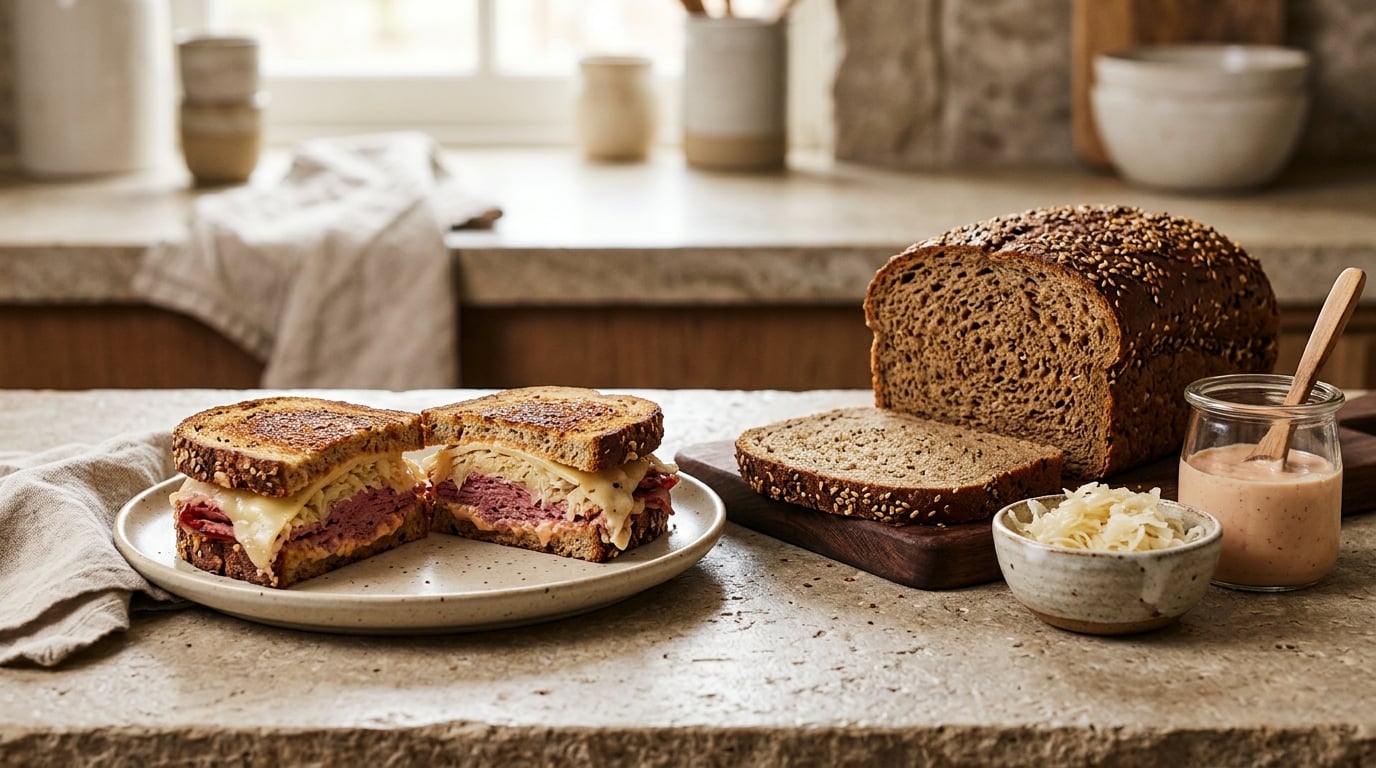
For most people the best bread for a Reuben sandwich is a dense, moist Jewish rye, and marble rye is the version you will find on a deli counter. Look for a crumb that feels slightly damp when you press the crust, a real rye flavor rather than white bread with caraway sprinkled on top, and a loaf sturdy enough that a slice does not buckle under sauerkraut and Russian dressing. That is the whole answer in three parts. The rest of this guide covers how to tell a genuine Jewish rye from a lookalike, where to find one, and how to store it so the loaf is still good on the day you build the sandwich.
One note before we start. The bread is the only layer of a Reuben that touches everything else, so it decides whether the sandwich holds together, whether the dressing soaks in or slides off, and whether the meat reads as balanced or muddy. No amount of good pastrami rescues bad bread.
Table of Contents
Best Bread for a Reuben and Where to Find Real Jewish Rye: Quick Guide
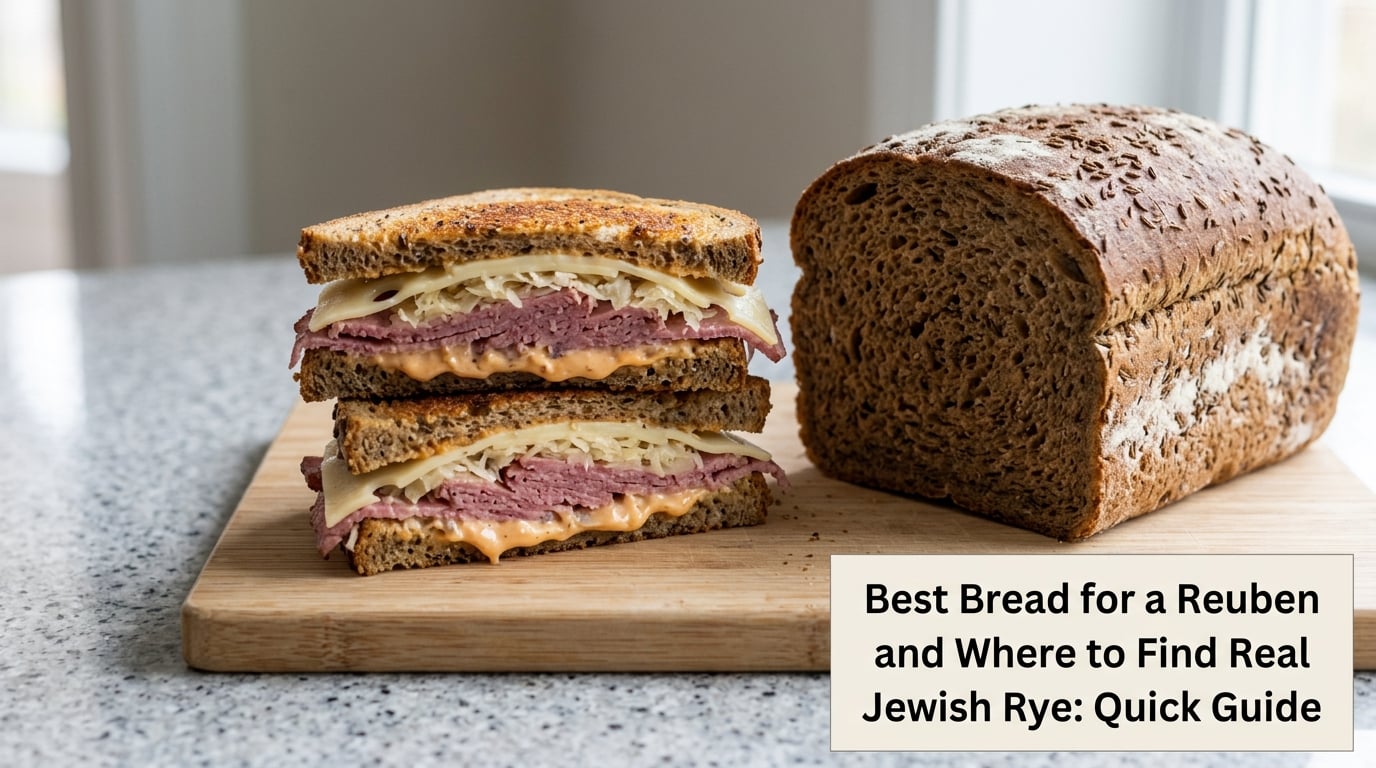
Buy a Jewish rye that is denser than the loaf you would pick for breakfast and moister than anything on the endcap. If you can get a marble rye, take it: that is a light rye dough and a dark pumpernickel dough swirled together, and the mix of a mild, sour crumb with a darker, molasses-sweet streak is exactly what a Reuben is built on. Seeded Jewish rye is the better choice for home cooks, because the seeds add crunch and signal that the loaf came from a bakery that bakes rye rather than a plant that bakes bread.
Seedless is the other defensible answer, and it is worth sorting out because people argue about it constantly. Katz’s in New York serves its pastrami on seedless rye, which is the most widely cited reference point in the country, and plenty of traditional delis do the same. The seeds add nothing structurally. What matters is that the loaf itself is real rye and that the crumb is moist enough to stay soft under a griddle press.
Here is how the main options compare. Pumpernickel is the darkest and sweetest of the group, built from a soaked rye batter baked slowly, and it is good but heavy. Marble rye is the deli default. Seeded and seedless Jewish rye are the same bread with a different top, so choose on crumb rather than topping.
| Bread | Flavor | Density and moisture | Caraway | Best for a Reuben |
|---|---|---|---|---|
| Marble rye | Mild, sour light rye with a dark sweet swirl | Medium dense, stays moist | Usually present, light hand | Cold deli sandwich, the classic choice |
| Seeded Jewish rye | Full savory rye with a mild sour tang | Dense and moist, holds shape | Yes, visible on top | Griddled or pressed Reubens |
| Seedless Jewish rye | Cleanest expression of the rye flavor | Dense, can dry out if overbaked | Yes, mixed into the dough or light on top | Any Reuben, and the deli benchmark |
| Pumpernickel or dark rye | Dark, sweet, molasses-like, heavy | Very dense, sometimes dry | Varies by bakery | Winter pastrami sandwiches, open-faced |
| Sourdough, country or rye sourdough | Bright acidity, crusty | Airy, chewy, less absorbent | Usually none | A third option when real rye is unavailable |
Two loaves to skip. Soft white sandwich bread has no structure at all and turns to paste at the first bite of sauerkraut. Very light multigrain or seeded wheat breads fall apart under a griddle press no matter what you put on them, even if the seed topping looks the part.
Best Bread for a Reuben by Texture and Sandwich Style
Texture matters as much as the type. You want a compact crumb with no big holes, a crust that is thin relative to the crumb, and enough moisture that the slice compresses slightly under your thumb instead of snapping. Bread that shatters when you press it is too dry, and bread that compresses like a wet towel is underbaked or soaked from bad packaging.
For a cold deli-style Reuben, sliced about three-eighths of an inch thick, a dense seeded or seedless rye works exactly as served. Slice it thinner than feels right. Cold meat and cold cheese do not glue themselves to bread, and a thinner slice keeps the whole thing from becoming a structural project.
For a hot sandwich with the cheese melted, the same loaf is right but the slice needs to be a touch thicker, around half an inch, so it survives the pan. Butter the outside lightly, put the slices butter-side down on a medium griddle, and press with a weight. A couple of minutes a side is enough. Take it off, wait about a minute before cutting, and the crumb rehydrates instead of shattering along the cut line.
Unsliced loaves cut yourself give you the most control. A bakery will hand you a whole round or a full sandwich loaf, and you can cut a half-inch slice with a serrated knife, which is the right thickness for a pressed sandwich. Buy the whole loaf if you will use it within two or three days; buy it sliced if you only need one or two servings.
One thing worth knowing: a very airy loaf is not wrong, it is just a different sandwich. A country sourdough will taste good and stay chewy, but it drinks less dressing and gives you less rye flavor. People have made Reubens on it happily for years. It is the third option, not the first.
What Makes Real Jewish Rye Worth Finding?
Real Jewish rye tastes like rye, not like bread with caraway on it. That single line comes from a well-known piece on what makes good rye, and it is still the test. If the aroma is sweet and bready with a sprinkle of anise-like caraway, you are probably eating flavored wheat bread. If the flavor is savory, faintly sour, and a little bitter, you are eating rye.
That flavor comes from the flour and the fermentation, not the seeds. Rye flour is more fragile than wheat flour, and traditional Jewish rye is leavened with a rye sour, a starter culture that some bakeries call a levain or a rye starter. That sour gives the loaf its tang and its keeping quality, and it is the reason a deli rye can sit on a counter for a day and still taste good. Commercially produced loaves often skip it and use a faster, shorter fermentation, which costs them the sourness.
Caraway is traditional, and it is the marker most people look for, including the home cooks who post about it. Two things are worth keeping straight. First, caraway appears in both seeded and seedless Jewish rye, so its presence does not tell you which you have, and its absence does not mean the loaf is not Jewish rye. Second, caraway is not required by any law or tradition, so a top-quality rye with a light hand or none at all is still a good loaf. Users on baking forums and sandwich threads consistently cite caraway as the deciding marker when choosing between supermarket loaves, and it is a useful shortcut, but it is a shortcut.
Then there is structure, which matters more than flavor in a wet sandwich. Rye has less gluten structure than wheat, so the crumb is denser and more fragile at the same time. It will not compress into a brick, but it can crumble if it is dry. A well-made rye strikes a balance: firm enough to hold a slice of corned beef and a forkful of sauerkraut, moist enough that the crumb gives when you cut into it. That combination is the entire reason delis have used rye for pastrami for a century.
The seeded and seedless split is a habit more than a rule. Katz’s serves seedless rye, and many old-line delis follow. Supermarket shelves and home bakers default to seeded. Both are correct; choose whichever is freshest and softest, because a soft seedless loaf beats a day-old seeded one every time.
How to Tell Whether Rye Bread Is Actually Jewish Rye
Most packaged loaves labeled Jewish rye are not really rye. That is the frustrating part for anyone who wants to buy the right bread. Here is the five-check aisle routine that saves time, and it takes about half a minute per loaf.
- Read the flour first. Rye flour should appear at the top of the ingredient list, often listed first. If enriched flour, bleached wheat flour, or unbleached wheat flour is first, it is a wheat loaf with rye flavoring.
- Count the ingredients. Real deli rye is short: rye flour, water, caraway seeds, salt, and yeast or a sour. A list of twenty lines with syrups, dough conditioners, and preservatives is industrial bread.
- Look for the caraway, but do not rely on it. Seeds on top or listed in the dough are a good sign. They are also found on many baked goods that are not rye at all.
- Squeeze the slice. It should compress slightly and feel dense, not spring back like a white loaf. A wet, gummy feeling means underbaked; a snapping crust means it is too old or too dry.
- Check for a sour or starter on the label. Words like rye sour, levain, starter, naturally fermented, or cold-fermented tell you the fermentation is doing the work rather than industrial yeast.
Bakery labels follow a pattern but the rules vary by country and even by state, so treat naming as a clue rather than a guarantee. Words like deli rye, Jewish rye, and corn rye on a bakery card generally signal a real rye dough. Marble rye signals the two-dough swirl. Pumpernickel signals a dark, soaked rye bake. Multigrain, five-grain, honey wheat, and health breads may or may not contain meaningful rye, and the percentage is often the only honest signal on the pack.
Watch for the marble rye trap too. A slice of marble rye can be mostly light rye with a decorative dark streak, so it can taste milder than the rye flavor you want. If the label says marble and the crumb looks mostly pale with a thin brown ribbon, keep looking.
And if a dense, moist crumb makes you wonder whether the loaf is raw, that is usually not the problem. Dense and moist is exactly what good rye looks like in cross-section. Underbaked rye shows up as a gummy, tacky, translucent layer right under the crust, and it tastes yeasty rather than sour.
Where to Find Real Jewish Rye
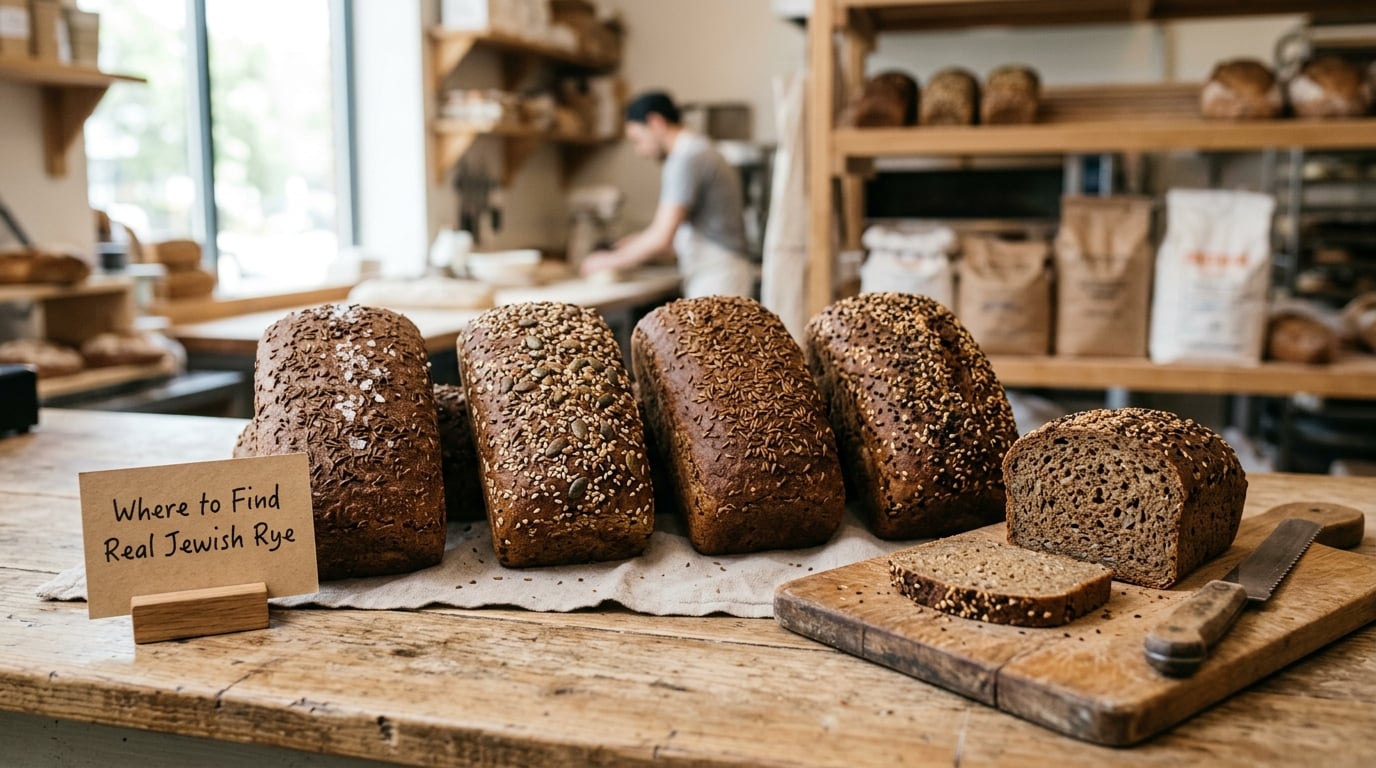
Four channels work, and they are not equal. Ranked by how reliably you will find genuine rye, they go: a Jewish deli or bakery counter, a dedicated neighborhood bagel shop, an independent grocer with a bakery, a supermarket bakery aisle, and finally an online bakery that ships. The last one is last because a rye is at its best within a day of baking and shipping compresses the crumb.
1. Jewish deli and bakery counter
This is the gold standard. A Jewish deli bakes rye on site and will sell you a whole loaf, and you can ask the counter what they are using that day and whether it is seeded or seedless. Katz’s is the famous benchmark for seedless rye, and Zingerman’s Bakehouse in Ann Arbor is the equivalent reference point for traditional seeded Jewish rye. If you have a deli counter within driving distance, go there first. Expect to pay more, and expect a loaf that is denser and wetter than anything from a shelf.
2. Neighborhood bagel shops and independent grocers
Bagel shops that also bake rye are the best-kept secret in this list. A plain rye from a good bagel shop is usually a real rye dough with caraway, sold the same day, and it costs less than an artisan mail-order loaf. Independent grocers with an in-house bakery are close behind. Ask whether the rye is baked that morning, because a day-old rye in a plastic bag is the single most common way a good loaf goes wrong.
3. Supermarket bakery and bread aisle
This is where the labeled loaves live, and it is also where the most disappointment is. Use the five-check routine and skip anything that lists wheat flour first. A kosher-style rye from an in-store bakery counter is usually better than the shelf-stable version, since it is fresher. Brands widely distributed in the United States include Oroweat, Pepperidge Farm, Levy’s, Heidelberg, LaRome, Mestemacher, and Rotellas, and the quality spread inside that list is enormous, which is exactly why the ingredient list matters more than the brand name.
4. Online mail-order bakeries
Mail order is the answer when you have no Jewish bakery or deli within reach, and for that problem it is a genuinely good option. Zingerman’s, Davis Bakery and Deli, Reinecker’s Bakery, and The Brot Box all ship Jewish rye. Order it for a weekend rather than a weekday so it arrives fresh, slice it yourself rather than accepting machine slicing, and freeze half of it. Whole-grain or high-fiber versions from brands like Delba exist too, and they are worth trying if fiber content matters to you, though they trade a little of the classic open crumb for it.
Regional tradition affects what you will find. New York tends toward seedless rye and a slightly drier, sharper crumb. Cleveland and the upper Midwest favor a moister, denser loaf that holds a warm pastrami. Chicago sits between the two. Montreal-style rye is typically sour, round, and lower in caraway, and it makes an excellent Reuben if you can find one. Ask the counter which style they bake and buy accordingly.
How to Keep the Bread Fresh Without Making It Soggy
Real rye keeps longer than most bread because of its acidity, but it still degrades. A few habits cover it.
For a whole loaf, keep it in a paper bag or the paper wrapper it came in, or a crusty bread bag if you have one. Paper lets moisture escape so the crust stays crisp. Never leave a loaf sealed in plastic for more than a few hours; the trapped moisture softens the crust and makes the crumb gummy by the next day.
For sliced bread, cut the loaf yourself when you can, using a serrated knife. Machine slices compress the crumb and never quite recover. Store slices in a bread bag with the opening folded loosely, and if the bag is plastic, leave a corner unsealed. Expect sliced deli rye to be at its best within two days.
If a loaf has gone dry, the fix is quick. Wet a paper towel, wring it out until it is barely damp, wrap the loaf or the slices in it, and leave them for an hour. The crumb rehydrates without turning gummy. Stale rye also revives well in a low oven or toaster, which is useful because griddled bread is part of the plan anyway.
For longer storage, slice the whole loaf, wrap the slices in foil or a freezer bag, and freeze them. Thaw at room temperature for an hour or toast them straight from frozen. Avoid freezing a whole unsliced loaf if you plan to slice it, because you will be fighting a knife through a frozen crumb.
Now the food safety side, because Reubens are built out of sliced deli meat. Keep sliced corned beef and pastrami refrigerated at or below 40°F and use them within three to four days of opening, or freeze them for longer. Keep your refrigerator at 35°F or below. Store the assembled sandwich in the refrigerator, and eat it within a day, since the bread absorbs dressing and the crust softens as it sits. The same goes for a whole loaf that has had meat on it: it is not a bread-storage situation anymore.
Frequently Asked Questions
Can I use pumpernickel for a Reuben?
Yes, and it is often a good choice for a pastrami version. Pumpernickel is darker, denser, and slightly sweeter than light rye because it is made from a soaked rye batter baked slowly, which gives it a molasses-like depth. The tradeoff is that it can be dry and heavy, so slice it a little thinner than you would a Jewish rye and keep an eye on it during the griddle press. A sliver of pumpernickel alongside the rye also works nicely.
Does a Reuben have to be toasted?
No. A cold Reuben served on deli-counter rye, sliced thin and assembled just before eating, is the traditional version and needs no heat at all. Toasting or griddling is a matter of preference rather than correctness, and it mainly changes the Swiss cheese and the crust. If you do heat it, butter the outside lightly, press the sandwich under a weight, and let it rest about a minute before cutting so the crumb does not shatter.
Is marble rye the same as Jewish rye?
They are related but not identical. Marble rye is made by combining two doughs, usually a light Jewish rye and a dark pumpernickel, and swirling them together before baking, which creates the marbled cross-section. A plain Jewish rye is a single dough. Because the marbling comes from a separate dark dough, some marble rye can read as milder in flavor than a straight seeded or seedless rye, so read the label to see whether real rye flour leads the ingredients.
What is the best rye bread for a Reuben from the grocery store?
Whichever loaf has rye flour listed first, a short ingredient list, and a crumb that feels dense and slightly damp when you squeeze it. Widely distributed brands include Oroweat, Pepperidge Farm, Levy’s, Heidelberg, LaRome, Mestemacher, and Rotellas, but the quality inside that group varies a lot, so judge the label rather than the brand. A loaf from the in-store bakery counter is usually fresher than the shelf-stable version, and freshness matters more to a Reuben than any label.
How do I keep a Jewish rye loaf fresh?
Keep a whole loaf in a paper bag, a paper wrapper, or a crusty bread bag so the crust stays crisp, and avoid sealing it in plastic for more than a few hours. Slice it yourself with a serrated knife when you can, since machine slicing compresses the crumb. Plan to eat the loaf within two days. If it dries out, wrap it in a barely damp paper towel for an hour, or freeze the slices and toast them straight from frozen.
What can I use if I cannot find real Jewish rye?
A dark rye is the closest substitute, since it keeps the caraway and the savory rye flavor that carry the sandwich. Sourdough works as a second option, because its natural acidity supplies some of the tang that rye provides, and a country sourdough will still hold up under a griddle press. A marbled or honey wheat loaf is a last resort and will taste noticeably different. Whichever you use, slice it thinner and add the dressing last so the bread stays intact.
Conclusion
Start with a dense, moist Jewish rye from a Jewish bakery or deli counter if you have one nearby, and go for a marble rye or a seeded loaf rather than anything pale and soft. Check that rye flour leads the ingredient list so you are not buying flavored wheat bread, slice it yourself, and assemble the Reuben just before you eat it. The bread is a five-minute decision, and it changes everything above it.