
Most gluten-free bread crumbles in a sandwich because the crumb is dense and dry rather than springy, and a dense crumb cracks where a wheat slice would bend. The ten styles below are ranked by how they handle folding, moisture and heavy fillings, and the whole guide is organized around that single question. Updated for October 2026.
If you only read one section, make it the seeded loaf at number one. It has the best overall combination of slice size, bend without crumbling and a neutral enough flavor to take on turkey, tuna, egg salad and vegetables without tasting like cardboard.
One thing to say up front: I don’t have a celiac diagnosis. I eat gluten-free by preference and have celiac friends who corrected me often enough that I got picky about it fast. The star ratings I quote come from retailer listings, not from my own scores, and prices change constantly, so treat the ratings as a starting point rather than a verdict.
Table of Contents
- Best Gluten-Free Bread for Sandwiches That Doesn’t Crumble at a Glance
- 1. Seeded Gluten-Free Sandwich Bread
- 2. Classic White Gluten-Free Sandwich Bread
- 3. Whole-Grain Gluten-Free Sandwich Bread
- 4. Potato-Based Gluten-Free Sandwich Bread
- 5. Rice-Based Gluten-Free Sandwich Bread
- 6. Cassava-Based Gluten-Free Sandwich Bread
- 7. Multigrain Gluten-Free Sandwich Bread
- 8. Dense Gluten-Free Country-Style Bread
- 9. Soft Gluten-Free Brioche-Style Sandwich Bread
- 10. Small-Batch Gluten-Free Sourdough Sandwich Bread
- Why Gluten-Free Bread Crumbles in the First Place
- Which Style to Buy for the Sandwich You Actually Eat
- Frequently Asked Questions
- What is the best gluten-free bread for sandwiches that will not fall apart?
- Does gluten-free sandwich bread get stale faster than regular bread?
- Is toasted gluten-free bread better for sandwiches?
- Which gluten-free bread is best for turkey and deli meat?
- Which gluten-free bread brands do celiac readers recommend most?
- What allergens should I check for in gluten-free sandwich bread?
- Conclusion
Best Gluten-Free Bread for Sandwiches That Doesn’t Crumble at a Glance
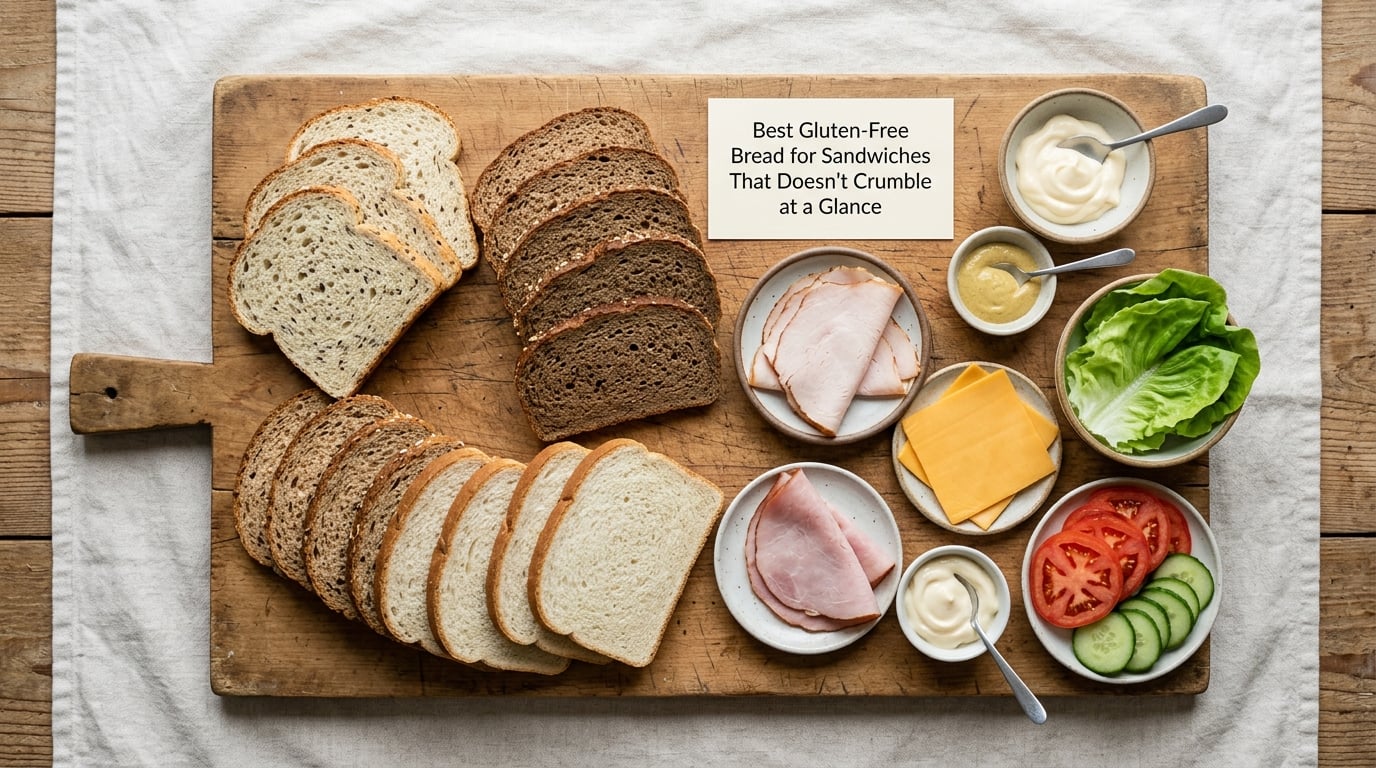
The quick answer is that the best gluten free bread for sandwiches depends on what you put in it. A wet, heavy filling like tuna salad needs a denser loaf, while a nut butter and jam sandwich only needs something soft and flexible. Here is how the ten styles compare side by side.
| Bread type | Best sandwich use | Crumb structure | Flavor profile | Check the label for |
|---|---|---|---|---|
| Seeded sandwich loaf | Turkey, chicken, tuna, vegetable | Dense, high-crumb, holds weight | Nuttier, visible seeds | Sesame, sunflower seeds |
| Classic white sandwich loaf | Egg salad, chicken salad, jam and cheese | Soft, moderate density | Mild, faintly sweet | Milk, eggs, wheat starch |
| Whole-grain loaf | Roast beef, grilled vegetables, cheese | Heavy, tight, sliceable | Nuttier, faintly sweet | Milling process varies by brand |
| Potato starch loaf | Deli meat, grilled cheese, panini | Flexible, springy, moist | Neutral, mild potato note | Milk, eggs |
| Rice flour loaf | Lettuce wraps, simple cheese, school lunch | Light, fine, sometimes gummy | Very neutral, occasionally grainy | Soy, rice, eggs |
| Cassava starch loaf | Grilled sandwiches, warm pressed fills | Pliable, good browning | Very neutral | Cassava, often eggs |
| Multigrain loaf | Hummus, roasted vegetables, turkey | Medium density with seed bite | Nutty, savory, complex | Seeds, and many grains |
| Country-style dense loaf | Pulled pork, roast beef, thick sliced cheese | Very dense, firm, sturdy | Mild, bakery-style | Long ingredient lists typical |
| Brioche-style loaf | Chicken salad, turkey and cranberry | Plush, high fat, soft | Sweet, buttery | Milk, eggs, butter |
| Small-batch sourdough | Grilled or toasted open-faced builds | Firm, chewy, airy in places | Tangy, sour, crusty | Milk, eggs in some bakes |
A note on the table: crumb structure matters more than most shoppers think. A slice with a tight, slightly gummy crumb will bend into a U and spring back. A slice with a dry, open crumb will snap in half the moment you fold it, no matter what is in the filling.
How to Compare Gluten-Free Sandwich Bread
Read the ingredient list before the front of the bag. The first three ingredients tell you the base flour or starch, and everything after that is usually texture management. If a loaf leads with tapioca starch, potato starch, or brown rice flour and then lists xanthan gum or psyllium seed husk, you are looking at a bread engineered to stay soft. If it leads with whole grain sorghum flour or buckwheat, expect more density and more nuttiness.
Next, look at the slice count and the loaf weight together. A 20-ounce bag with 20 slices gives you larger slices than a 16-ounce bag with 24 slices, and slice size is the thing sandwich eaters complain about most. A few community members on r/glutenfree and celiac.com describe Aldi’s gluten-free white bread as unusually full-size, which matches what you see in the bag rather than what the label promises.
Check the crumb before you buy a second loaf. Slices with visible seed flecks or grain fragments tend to hold together better because the pieces interrupt the crack lines. Slices that are uniformly white and very soft tend to be the ones that turn to paste when you bite them.
Finally, check the allergen line. Many gluten-free loaves are made on shared equipment with wheat, milk, eggs, soy, or sesame, and the word gluten-free says nothing about any of those. If someone in the house has a wheat allergy rather than celiac disease, look for the certified gluten-free seal instead of relying on the ingredient list alone.
1. Seeded Gluten-Free Sandwich Bread
Seeded loaves are the best all-around choice because the seeds act like rebar in the crumb. They give the slice a slightly gritty chew and a structural reinforcement that plain white gluten-free bread lacks, which is exactly what you want when a slice has to carry tuna or chopped celery.
Expect a firmer crust than a plain white loaf and a flavor that leans savory rather than sweet. If you are building a sandwich for someone who is sensitive to texture, tell them about the seeds first, because the bite is noticeably grittier. Toasted, the seeds turn nutty and the crust firms up nicely. Raw, the loaf is denser than a potato-based bread but far more forgiving under a heavy filling.
My go-to use is a turkey and provolone sandwich with tomato and a thin layer of mayo. The mayo matters more than it sounds like it should. A thin fat barrier keeps the tomato juice from reaching the crumb and starting the collapse. For serving, I cut the loaf only after it has cooled, because a warm seeded loaf compresses and a fully cool one slices clean.
Store it at room temperature in its original bag, never the refrigerator. The refrigerator is the single fastest way to make a seeded loaf go stale, and the crust turns hard enough that slicing shaves off crumbs you would rather eat.
2. Classic White Gluten-Free Sandwich Bread
Classic white gluten-free bread is the compromise pick: softer and milder than the seeded and whole-grain styles, and more fragile than a potato-based loaf. It compresses under a heavy filling, but less than a dense loaf does, because there is more open crumb to absorb pressure.
It suits the sandwich combinations people actually make on autopilot: egg salad, chicken salad, jam and cheese, a cheese and cucumber sandwich. Egg salad is the honest test of a white loaf. Too much moisture in the filling and the slice goes soft and tears; not enough and the sandwich dries out before you finish it.
Where this style struggles is a wet filling sitting directly on the bread with nothing between them. A tomato or a pickle slice is enough to start the weakening. Either toast first, which dries the surface, or spread a thin layer of butter, mayo, or cream cheese on the cut face as a barrier.
It is also the style most often stored badly. Buy it when you plan to use it within a few days, and freeze what you do not. White gluten-free bread that has been thawed and refrozen twice has the texture of a kitchen sponge, and no amount of toasting brings it back.
3. Whole-Grain Gluten-Free Sandwich Bread
Whole-grain gluten-free bread is for readers who want fiber and a nuttier flavor without giving up sandwich structure. Sorghum, millet, buckwheat, teff, amaranth, and quinoa all count as whole grains here, and none of them is related to wheat, so all are safe for celiac readers.
Compared with the light white and rice styles, a whole-grain loaf is noticeably heavier and slightly drier. That density is the point: it resists compression. A roast beef and horseradish sandwich or a grilled vegetable and cheese sandwich will stay intact on a whole-grain slice where a white slice buckles.
The tradeoff is that a dry, dense crumb needs a moisture barrier just like the white style. Mayonnaise, hummus, or a soft cheese does the job. Skip the barrier and you will find yourself chewing a very firm sandwich, especially on day three of the loaf.
One labeling note worth knowing: the word whole grain on the front of the bag does not tell you whether the grain was milled or cracked. It does not need to. What it tells you is that a real grain is in there, not just a starch blend, and that is the part that adds fiber and flavor.
4. Potato-Based Gluten-Free Sandwich Bread
Potato starch and potato flour produce the softest, most flexible gluten-free crumb of the ten styles. That flexibility is why potato-based loaves are the ones that bend into a deep U without a crack forming along the top edge, which makes them a strong pick for a packed lunch.
They handle deli meat, grilled cheese, and pressed sandwiches well. A panini pressed on potato-based bread is a good case: the slices compress together slightly, the interior stays flexible rather than shattering, and the outside picks up color from the press. A potato-based slice also survives a thick layer of shredded cheese, since the cheese melts into the crumb instead of soaking through it.
Check the label carefully here. Potato-based loaves frequently contain milk, eggs, or both, and the tender crumb means they are often enriched with milk solids to soften it. If you are avoiding dairy or egg, this style is the one most likely to rule you out.
Freezing is a good fit for this style. Toast the slice, let it cool completely, then freeze it flat. A reheat straight from frozen gives you a slice with a crisp shell and a soft center, which is the closest a packed lunch gets to a fresh one.
5. Rice-Based Gluten-Free Sandwich Bread
Rice-based bread is the lightest of the ten in color and usually the least flavorful, and that neutrality is genuinely useful. If your sandwich filling is the point, a rice flour loaf lets the filling taste like the filling.
It performs best with simple builds: a slice of cheese with tomato, a lettuce wrap, aPB and J for a kid who is fussy. It is less suited to wet or heavy fillings, because the light crumb has less material to hold and any moisture in the filling reaches the slice quickly. Sandwiches that get eaten over a few hours, in a hot car or on a warm desk, are where this style shows its limits.
There is a texture issue specific to rice flour. Depending on the brand, it can turn slightly gummy as it cools, and a crumb that was soft in the bag can feel tacky and pasty after toasting. Some people find this off-putting, others do not notice it at all. If you dislike gummy textures, test a slice before committing to a whole loaf.
Also check for soy. Rice bread is the single most common place a soy or tamari-type ingredient shows up, usually in a small amount for flavor or browning.
6. Cassava-Based Gluten-Free Sandwich Bread
Cassava starch and cassava flour make a very neutral loaf that browns well, which is its distinguishing feature. When you toast it, you get real color and a genuine crust rather than the pale, soft exterior that plagues some white gluten-free breads.
That browning makes it a good pick for grilled sandwiches and anything served warm. A grilled ham and cheese on cassava-based bread gets a proper toasted surface and holds together through the press, and an open-faced melted cheese on a slice gets the crunch that lighter crumb styles cannot deliver.
Slicing is one of its better qualities. Cassava-based slices tend to be pliable enough to cut with a dull knife without tearing, which matters if you are the person in the house doing the sandwich assembly every morning.
Fillings that work: melted cheese with tomato, deli turkey with a light mayo, a warm nut butter and apple slice. Avoid anything that sits wet for a long time. The crumb is absorbent, and a lunchtime tuna salad will leave you with a soft patch and a dry edge.
Most cassava-based loaves carry eggs, and some carry milk. Read the line rather than assuming, especially if the sandwich is going to a school that restricts allergens.
7. Multigrain Gluten-Free Sandwich Bread
Multigrain gluten-free bread sits between the seeded and whole-grain styles: a moderate density with a combination of seeds and pseudo-grains that adds texture without the heaviness of a dense country loaf. It is the most interesting thing to eat of the ten, which matters when your lunch is the same every day.
It takes hummus and roasted vegetables particularly well, because the savory, nutty crumb stands up to strong flavors instead of disappearing under them. Turkey and cream cheese works. Nut butter and honey works, with the caveat that the seeds can make a sticky filling feel crunchier than expected.
This is the style most improved by toasting. Raw, the mixed grains can read as slightly dusty. Toasted, the seeds crisp, the crust firms, and the slice becomes noticeably more rigid, which is exactly what a lunchbox sandwich needs at 11:30 after a morning in a backpack.
The label is longer than for other styles, and that is normal. Multigrain loaves often stack up eight or ten ingredients from five or six grain sources. Nothing about the length is a warning sign by itself; what matters is that the grains are named and the binders are familiar.
8. Dense Gluten-Free Country-Style Bread
Country-style gluten-free bread is the answer when the filling is the heavyweight: pulled pork, roast beef, thick sliced cheese, a sandwich stacked four slices deep. Its density is the feature. It does not compress, it does not bend, and it does not need to, because it is going to be pressed and eaten as a wedge rather than folded.
Slice it thick, ideally with a serrated knife and a sawing motion. A thin cut of a dense loaf has too little internal structure to stay in one piece, which is the same reason a dense loaf makes a bad PB and J. Two-thirds of an inch is a reasonable minimum.
Moisture is the issue. A dense crumb with no moisture barrier dries the filling and dries itself. Pull a spread on both cut faces, or assemble with a moist filling on one side and serve the other face with butter. Cold butter or cream cheese on a dense slice does more structural work than you would expect.
If you toast a dense country loaf, toast it lightly. Full toaster darkness drives off the moisture the crumb needs and turns the surface into something closer to a cracker, which is the complaint community members make most often about heavier gluten-free loaves.
9. Soft Gluten-Free Brioche-Style Sandwich Bread
Brioche-style gluten-free bread is plush, sweet and higher in fat, and it makes an indulgent sandwich that tastes more like a bakery loaf than a health-food loaf. It works for chicken salad, turkey with cranberry, and a nut butter with sliced fruit.
The sweetness is the main consideration. On a savory filling like egg salad or a BLT, it registers as a dessert note and slightly flattens the filling. On a sandwich with fruit, jam, or a sweet cheese, it disappears completely. Pick your pairing to match the loaf rather than the other way around.
Softness under moisture is the drawback. A brioche-style slice has less internal resistance than a seeded or multigrain slice, so a wet filling compresses it and the bottom slice turns translucent. Assemble it close to eating time, and put the wet ingredient on the top slice where possible.
Allergens are also worth a close read. Brioche-style loaves nearly always contain milk, eggs, and butter, which puts most of them outside a dairy-free or vegan diet. If that is your situation, the potato-based style gives you the soft, flexible crumb without the fat load.
10. Small-Batch Gluten-Free Sourdough Sandwich Bread
Small-batch gluten-free sourdough is the flavor pick. If the point of the sandwich is the bread rather than the filling, this is the style that most resembles a wheat bakery loaf, with tang, a real crust, and a crumb that is chewy rather than spongy.
Its crumb is firmer and less flexible than the other nine, so it does not wrap. Plan around that: grilled sandwiches, toasted sandwiches, open-faced builds, and pressed paninis are what this loaf is for. A cold folded sandwich made with it is likely to crack at the fold line.
Toasting is not optional here in the way it is for the softer styles. A toasted sourdough slice develops a rigid shell that handles almost any topping. Untoasted, the crumb is good but the exterior is soft enough that a tomato slice will leave a mark.
Balance the acidity with something rich. The tang pairs with cream cheese, butter, brie, or a fatty cured meat, and it clashes with a very sharp vinegar dressing. A roasted pepper and mozzarella sandwich on toasted sourdough is a good example of the sweet spot: the loaf tastes like bread, and the filling stays legible.
Two practical notes. Small-batch loaves are the ones most often sold in a short shelf window, so buy them when you plan to eat them within a couple of days. And freeze half on the day you open the bag, because sourdough-style bread loses its character fastest of the ten.
Why Gluten-Free Bread Crumbles in the First Place
Gluten is a protein network. When dough rises, that network stretches and traps gas, and it is what lets a wheat slice bend around a thick filling and spring back instead of cracking. Take the gluten out and the loaf has to build that structure from starches and added gums instead, and those do not stretch nearly as well.
That is why almost every gluten-free loaf contains at least one of these: xanthan gum, psyllium seed husk, guar gum, modified cellulose, or modified food starch. They are doing the job gluten used to do. Loaves with two or three of them tend to be more flexible than loaves with one, and that is a quick thing to check on the label.
Starch does not age the way gluten does, and that cuts both ways. It is less prone to the hard, stale crust wheat bread develops, but it also loses moisture faster once the loaf is cut, so a sliced gluten-free loaf goes from soft to dry in a shorter window than a wheat one.
The fix is mostly practical. Toast the slice, put a barrier between the bread and a wet filling, slice thicker, and keep the loaf out of the refrigerator. Those four habits solve most of the crumbling problem before you start shopping for a different brand.
Which Style to Buy for the Sandwich You Actually Eat
Matching the loaf to the filling is easier than it sounds. The wetter or heavier the filling, the denser and more moisture-resistant the bread should be. The lighter the filling, the softer and more neutral the bread can be.
- Grilled cheese: potato-based or cassava-based. Both brown well and compress without shattering under a press.
- Cold deli meat and turkey: classic white or seeded. Mild flavor, a crumb that bends, and a surface you can spread.
- Tuna or egg salad: seeded or whole grain. Density is doing the work here, and a light crumb will not survive the filling.
- PB and J, especially in a lunchbox: classic white. Soft, cheap to buy often, and forgiving with a kid who drops things.
- Hummus and roasted vegetables: multigrain. The savory crumb stands up to strong fillings rather than hiding behind them.
- Roast beef, pulled pork, thick cheese: dense country-style. Cut thick, spread both faces, and do not fold it.
- Open-faced and toasted builds: small-batch sourdough, toasted hard. The crumb is firmer, so it wants the shell.
- Chicken salad or turkey with cranberry: brioche-style. The sweetness matches the filling instead of fighting it.
One last practical note on lunchboxes. Freezing the slices flat and thawing them in the bag overnight keeps them softer than freezing them upright, and a slice brought to room temperature for twenty minutes before eating bends more easily than one straight from the fridge.
Frequently Asked Questions
What is the best gluten-free bread for sandwiches that will not fall apart?
A sturdy seeded or whole-grain loaf is usually the best choice, because its denser crumb resists moisture and compression. A potato-based loaf works well too, and its softer crumb bends around a filling without cracking. Whichever you pick, toast the slice and spread a thin layer of butter, mayo, or cream cheese on the cut face to stop a wet filling from reaching the bread.
Does gluten-free sandwich bread get stale faster than regular bread?
Often, yes. Gluten-free loaves lose moisture faster because they rely on starches, fibers, and binders instead of gluten, and sliced bread dries out from the cut face inward. Keep the loaf in its original bag or a bread box at room temperature, keep the clip closed once you have cut into it, and freeze what you will not use within a few days. Never store it in the refrigerator.
Is toasted gluten-free bread better for sandwiches?
Toasting improves structure because it dries the surface and forms a firmer shell, which helps a slice hold a wet filling and reduces bending. It also deepens the flavor and takes the edge off the slightly pasty texture some rice-based loaves have. Toast most gluten-free bread lightly, and toast it twice for a crunchier result on denser styles like country-style or multigrain.
Which gluten-free bread is best for turkey and deli meat?
A mild white or seeded loaf is the safest match, because both let the flavor of the meat come through without competing with it. Look for a crumb that is flexible but not fragile, and avoid very dense or very sour loaves unless you want the bread to be the point. Add a thin spread so the turkey juices do not soak into the crumb.
Which gluten-free bread brands do celiac readers recommend most?
The long-standing community favorite is Udi’s, which members on celiac.com call the best-tasting gluten-free bread and which is used at sandwich chains. Users also single out Aldi’s gluten-free white bread for slice size, and Sam’s Choice for flavor, with one long-diagnosed reader calling it easily the best gluten-free bread they have had. Editorial rankings often disagree with this, and texture preference explains much of the gap.
What allergens should I check for in gluten-free sandwich bread?
Milk, eggs, soy, sesame, and tree nuts all show up in gluten-free sandwich bread, and some loaves are made on equipment that also handles wheat. A certified gluten-free seal matters most if you have a wheat allergy rather than celiac disease, since the standard label only addresses gluten. For a school lunch, check the specific loaf each time, because formulas change between batches and brands.
Conclusion
Start with a seeded loaf if you eat sandwiches every day and want one that handles wet fillings. Move to a potato-based loaf if softness and flexibility matter more than density, and pick up a small-batch sourdough for grilled and toasted sandwiches where the bread is the main event.
Whatever you buy, toast the slice and add a spread before you build. That habit does more to stop a gluten-free sandwich from falling apart than the brand on the bag does.