
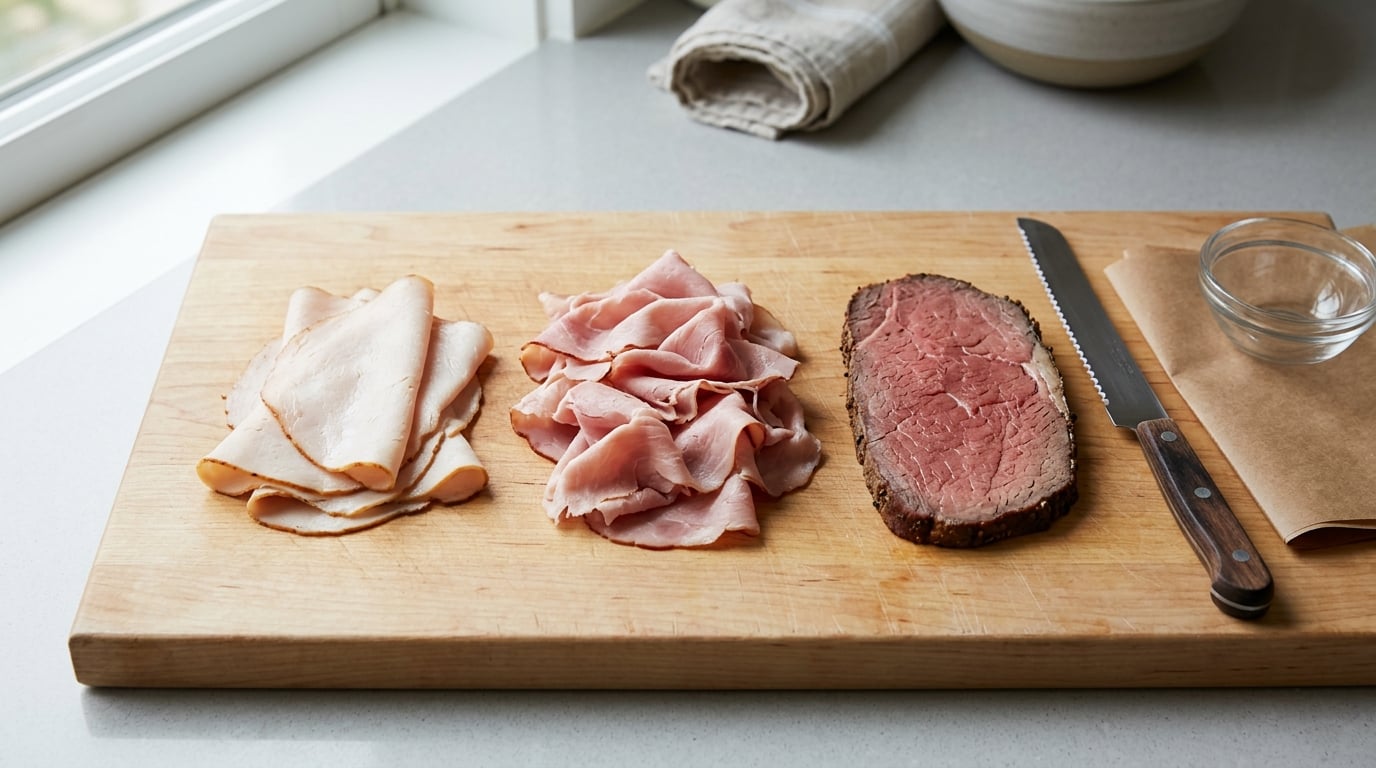
Shaved or very thin is the right cut for most cold sandwiches, and a slightly thicker cut earns its place on hot and pressed sandwiches where the meat has to survive heat and a heavy top slice. Past about 4 mm on a cured meat, you are out of sandwich territory and into platter, board, and cubing work. The right thickness is really a question of what you are building and how the bread behaves.
The confusing part is that the words on the deli sign do not mean the same thing at every counter. One shop’s “shaved” is nearly translucent, the next shop’s “shaved” is closer to a 2 mm slice, and most counters default to the thick side no matter what you ask. Ordering by number works better than ordering by name, once you know the numbers.
Table of Contents
- Deli Meat Sliced Thin vs. Shaved vs. Thick at a Glance
- What Does Thin-Sliced, Shaved, and Thick-Cut Deli Meat Feel Like?
- Thin-Sliced vs. Shaved Meat: What Actually Changes
- Thin-Sliced vs. Thick-Cut Meat
- Shaved vs. Thick-Cut Meat
- How Deli Meat Sliced Thin vs. Shaved vs. Thick Changes the Sandwich
- Which Cut Works Best for Common Sandwiches?
- How to Ask the Deli for the Cut You Want
- Food Safety and Storage for Deli Meat
- Which Should You Choose?
- Frequently Asked Questions
- Conclusion
Deli Meat Sliced Thin vs. Shaved vs. Thick at a Glance
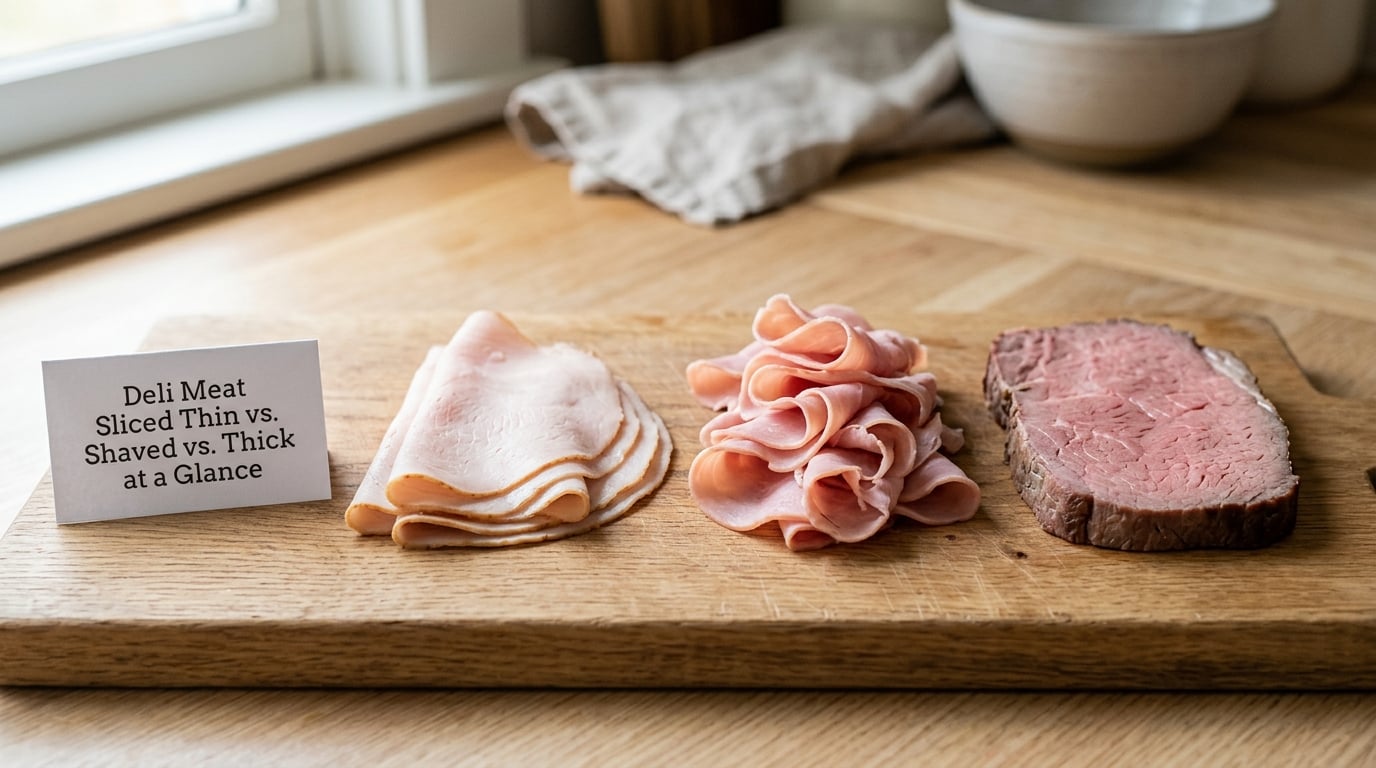
The table below is the whole comparison on one page. Everything after it is the reasoning behind these numbers.
| Criterion | Thin-sliced | Shaved | Thick-cut |
|---|---|---|---|
| Typical thickness | About 1.3 to 1.6 mm | About 0.5 to 1 mm | 3 mm and up |
| Look | Translucent, even, rectangular | Feathered, irregular, almost see-through | Opaque, dense, substantial |
| Texture | Tender, drapes without tearing | Silky, folds into loose ribbons | Firm, springy, holds any shape |
| Coverage per slice | Good on one slice of bread | Excellent, spreads across a whole slice | Poor, covers only the center |
| Structural strength | Moderate, holds a light top slice | Low, needs condiments to bind it | High, survives toasting and pressing |
| Best bread | Soft white, wheat, brioche | Rustic rolls, wraps, anything textured | Heavy rye, kaiser rolls, hoagie rolls |
| Ideal sandwiches | Turkey and ham clubs, melts, everyday cold cuts | Italian cold cut combos, snack plates, party platters | Cheesesteaks, Reubens, cubans, roast beef boards |
One practical note before you go further: the mm values are a shared reference, not a promise. Blade condition, meat temperature, and how sharp the knife is all move the result, which is why two counters can both honestly call their product “thin.”
What Does Thin-Sliced, Shaved, and Thick-Cut Deli Meat Feel Like?
Five words cover almost every cut you will meet at a deli counter: shaved, very thin, thin, medium, and thick. They run from roughly half a millimetre to four or more, and the differences show up in your hand before they show up in your mouth.
Shaved is the thinnest band, around 0.5 to 1 mm. Slices this thin are semi-transparent, wrinkle when you pick them up, and fold over a spoon. They drape rather than sit. If you hold a slice up to the light and can read a word through it, that is shaved.
Very thin sits just above it, closer to 1.2 mm. You still see light through it, but it has enough body to hold a fold without collapsing. This is the band most sandwich counters label 1 or 2 on their numbered chart.
Thin is the everyday band, roughly 1.3 to 1.6 mm. A slice at this thickness reads as a real slice of meat rather than a translucent film, but it still drapes over a rounded loaf without snapping. On a numbered chart it usually lands around 3 to 4.
Medium is about 2 mm. It holds a clean edge, bends once, and resists tearing. You can stack four or five of these and the sandwich still feels balanced rather than dense, which is why the counter sheets mention medium for two-slice sandwiches.
Thick starts around 3 mm and runs to 4 mm or more. It stays flat in the palm, springs back when you bend it, and has real chew. Past about 4 mm on a cured meat like ham or salami, you start running into the complaint sandwichers describe as chewiness and gristle, because the muscle and connective tissue have no escape route.
Slicer settings and meat variety complicate all of this. The same setting on a tender turkey breast produces something closer to shaved than the same setting on a dense roast beef does, and a gravity-fed machine pulls harder than a band saw, so a harder cut can come out thinner on one machine than the other.
Thin-Sliced vs. Shaved Meat: What Actually Changes
Shaved deli meat is meat sliced paper-thin, usually around 0.5 to 1 mm, so it drapes and layers across bread; thin-sliced meat is roughly 1.3 to 1.6 mm, still translucent and flexible but able to hold its own shape. They are the same family of cut at different points on the same dial, not two different techniques.
Where they genuinely diverge is consistency. A thin slice coming off a calibrated gravity-feed slicer is a predictable rectangle every time, so your sandwich looks the same on Tuesday as it did on Sunday. Shaved meat is typically run at the fastest speed or past the point where the cut stays clean, which produces feathered, irregular ribbons. Those irregular edges are why shaved meat covers more bread per ounce and why people love it on a roll.
Texture follows from that. Shaved meat folds into loose layers and spreads its seasoning across a wider surface, so a cured meat tastes more evenly distributed in the bite. Thin-sliced meat keeps a denser single layer, which concentrates the flavor in each mouthful and gives you a slightly more substantial bite without the chew of a thick cut.
Structurally, thin wins and shaved loses. A thin slice will support a lettuce leaf and a top slice of bread on its own. Shaved meat needs help: mustard, mayo, soft cheese, or a layer of something wet underneath so it does not slide off the bread.
One reader on r/Sandwiches ordered shaved ham, called the consistency excellent, and still found it finer than the cut they actually wanted, so they moved up to a setting of 1 to 2. That reaction is the common one. People ask for shaved by habit, then discover they wanted thin.
Thin-Sliced vs. Thick-Cut Meat
Thin and thick are the two ends of the useful range for a sandwich, and the decision is really about structure versus texture. Thin slices are quick, delicate, and easy to eat cold; thick slices hold their shape under heat and heavy toppings, and they deliver a chewier, meat-forward bite.
Coverage is the biggest practical gap. A thick slice covers the center of the bread and leaves the crust bare, so you need three or four of them to build a sandwich that eats evenly. Thin slices cover the whole slice of bread with one piece, so two to three is a full serving.
Balance goes the other way in a good way. A stack of thick cold cuts turns a sandwich dense, which is the complaint a regular poster on r/Sandwiches made about deli counter meat: the cut reads as meaty but the sandwich feels heavy, and a thinner cut gives a better bite. The same reader noted that staff seem to reach for the thick setting by default.
Use thick when the sandwich gets hot or the bread is heavy, and use thin for anything served cold on soft bread. That single rule covers the vast majority of decisions people argue about at the counter.
Shaved vs. Thick-Cut Meat
These two are the furthest apart of the three, and they suit opposite jobs. Shaved meat is tender, loosely folded, and spread-friendly; thick-cut meat is dense, springy, and chewy, and it exists to give a sandwich a backbone.
Portion size tells the story. Shaved meat stretches a few ounces across a whole roll, which makes a big-looking sandwich from a modest portion. Thick meat gives you the same weight in far fewer pieces, so the sandwich ends up taller and heavier on the plate.
Bread load is the deciding factor. A shaved pile on a sturdy roll needs nothing underneath because the meat stays low and spread out. A thick pile on the same roll can push the top slice off, especially once condiments go in, and the hoagie crowd is blunt about this: meat on a hoagie should be thin and fluffy, not thick.
Drip management favors thick. Shaved meat laid on a plate can weep onto the bread and make a soggy bottom within a few minutes, while a thick slice holds its own moisture until you cut into it. That is why cold cut platters and charcuterie boards are cut thicker, and why a roast beef sandwich that must be carried across a room is better off with thicker pieces.
How Deli Meat Sliced Thin vs. Shaved vs. Thick Changes the Sandwich
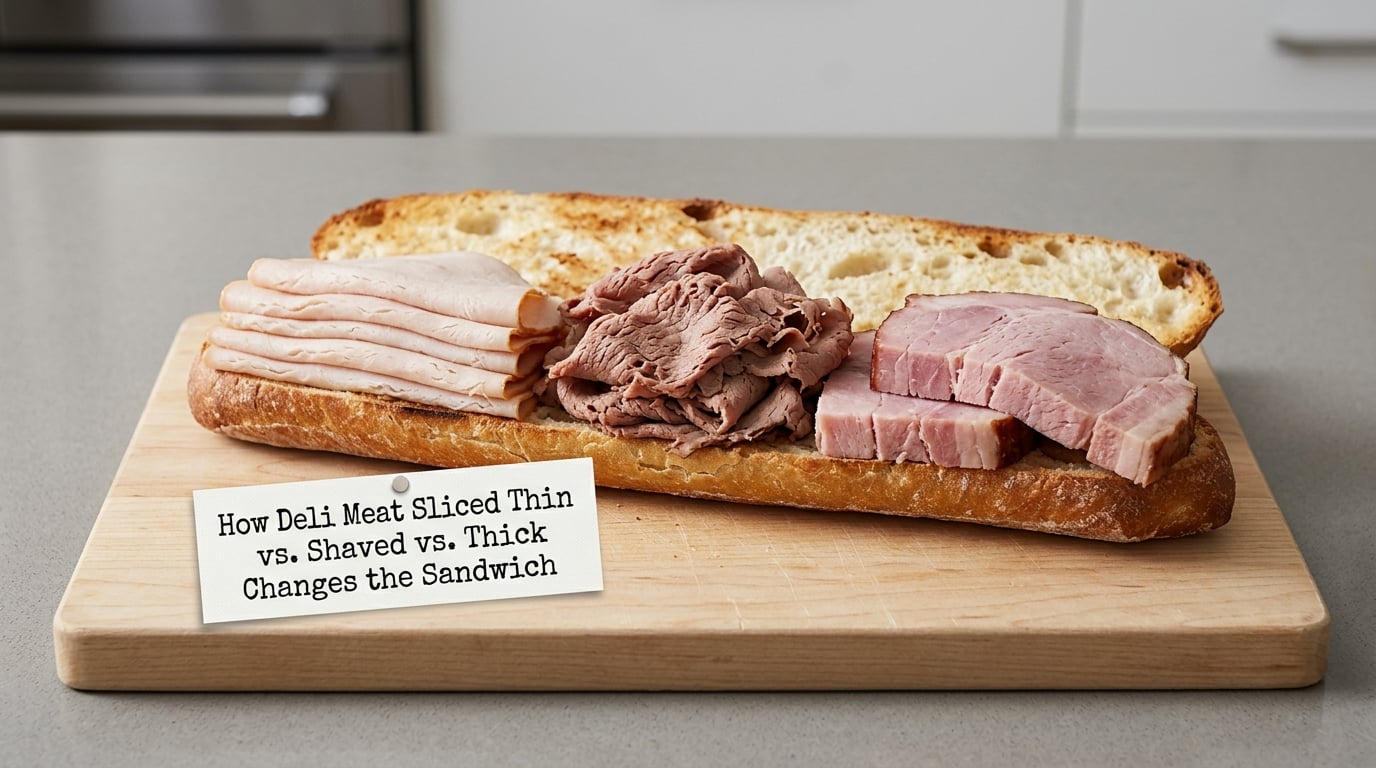
Thickness is not a detail you set and forget. It changes what bread you reach for, what holds the layers together, and whether the sandwich survives the walk to the table.
Bread. Soft white bread and brioche collapse under a thick slice but handle thin or shaved perfectly. A sturdy kaiser, a hoagie roll, or a thick-cut loaf wants a cut with more body, because the bread needs something to push back against. Going thin on a dense roll is fine; going thick on a soft slice is a recipe for a squashed sandwich.
Condiments. This is where the sliding problem gets solved. Shaved meat has almost no friction against the bread, so a dry pile slides out from under the top slice the moment you tilt it. A thin spread of mustard, mayo, or soft cheese underneath does two jobs: it glues the meat to the bread and it carries the flavor into the folds. Thick cuts need far less help here.
Toppings. Pickles, tomatoes, and lettuce all match a thin meat better. A pickle slice is thin, so a thin meat slice sits at the same level and the top of the sandwich stays flat; stack thick meat with thick toppings and the top slice rides up. Cheese is the piece most people get wrong. Slice it one setting thinner than the meat, which sounds backwards but is what delis do: a thin slice of provolone drapes over thin turkey, while a thick slice of Swiss on thick ham makes the sandwich taller without making it better.
Hot versus cold. This is the rule most guides skip. Cold sandwiches want shaved or thin pieces. Hot sandwiches want a hair thicker, but still thin, so the meat keeps its structure through the heat. Heat and pressure firm up thin meat and dry it out fast, so a shaved pile in a press collapses into a dense mat, while a slightly thicker cut holds a recognizable shape. That is the consensus in the r/KitchenConfidential thread on deli meats, and it is the reason a cheesesteak or a Reuben is not built from paper-thin meat.
Handling. “Holds together when you pick it up” is the deciding factor regular sandwichers keep coming back to. Shaved and thin meat are fragile until they are dressed, so dress them last, close them last, and pick them up with two hands. A thick-cut sandwich can be carried one-handed and set down without drama.
Which Cut Works Best for Common Sandwiches?
This is the table I wish every deli had on the wall. The counter column is the exact phrasing to use, since naming the cut is more reliable than naming the number.
| Sandwich | Best cut | About | Say this at the counter |
|---|---|---|---|
| Everyday turkey or ham on white bread | Thin | 1.3 to 1.6 mm | A 3 on the turkey, thin please |
| Turkey and ham club | Thin | 1.3 to 1.6 mm | Thin turkey, and ham on a 3 |
| Italian cold cut combo | Shaved | 0.5 to 1 mm | Shaved salami and provolone, the thinnest you can do |
| Hoagie or hero sub | Thin, piled high | 1.3 to 1.6 mm | A 3 on the meats, I want it piled |
| Roast beef sandwich | Thin, cool and folded | 1.6 to 2 mm | Roast beef on a 4, thin, and keep it cool |
| Reuben | Medium to thick | 2 to 3 mm | Pastrami on a 6, it goes on the griddle |
| Cheesesteak | Thin | 1.3 to 1.6 mm | Thin roast beef and a 3, chopped end meat |
| Cuban | Medium | 2 mm | A 5 on the ham and the pork, sliced thin |
| Panini or pressed melt | Thin to medium | 1.6 to 2 mm | Medium on a 4 or 5, it gets pressed |
| Grilled cheese with meat | Thin | 1.3 to 1.6 mm | Two or three thin slices, not a stack |
| Party platter or snack board | Thin, fanned | 1.3 to 1.6 mm | A 3 across the board, fanned not folded |
Two entries deserve a note. A Reuben is a hot sandwich, so it takes a firmer cut than you would expect, and pastrami is dense enough that a medium slice gives you chew without turning the sandwich into a slab. A cheesesteak is the opposite: it gets chopped and pressed, so thin is right, and asking for the end meat chopped is what changes the texture more than thickness does.
How to Ask the Deli for the Cut You Want
Counter staff do not usually volunteer advice about thickness, and the default is the thick side. Saying the number out loud, every time, is the only reliable fix. These are the phrases that work.
- Name the number, then the word. “Can you do me a 3 on the turkey? Very thin.” The number sets the machine, the word removes doubt.
- Say what you are building. “This is for a club, so I need it thin enough to lay flat under the top slice.” Sandwichers respond to the destination more than to the request.
- Ask for the cheese a setting thinner. “Slice the provolone one thinner than the turkey.” It takes ten seconds and it fixes the height of the whole sandwich.
- Ask them to check the first slice. “Can you hold that up before you bag it?” Holding it to the light is the fastest test of whether a cut is where you want it.
- Order by weight when you are buying for a group. A quarter pound per sandwich of thin, half a pound for thick, roughly, since thickness changes the count per pound.
- Come back the same counter. Consistency between visits matters more than hitting an exact number, and the same slicer at the same shop will get closer every time.
If the cut is wrong, it is usually wrong in the same direction. Too thick: ask them to redo it at one number lower, and say you will take the thick off your hands. Too thin: ask for a higher number and check before you leave. A store-brand deli with a numbered chart posted on the wall is the easiest place to get a repeatable cut, which is why those charts get photographed and passed around.
Food Safety and Storage for Deli Meat
Slice thickness does not change how deli meat is stored, but the way it is packed does change how fast you should get to it. Deli-sliced meat from the counter is usually not sealed the way prepackaged cold cuts are, so treat the clock differently.
Keep unopened cold cuts refrigerated at or below 40°F (4°C) and use sliced meat within about three to five days of the counter. Prepped or repackaged slices generally keep a week or so if the package is sealed and unopened; the package date is the better guide. Once you open a pack, plan on finishing it in three to five days.
Freezing works well and thaw it in the refrigerator rather than on the counter. Sliced turkey, ham, and roast beef freeze flat in a freezer bag, and freezing softens the surface a little, which is harmless for a sandwich.
If you are cooking deli meat rather than serving it cold, use the standard safe minimum internal temperatures: 165°F (74°C) for poultry, 160°F (71°C) for ground meat, and 145°F (63°C) for whole cuts. Note that cold cuts are pre-cooked, so reheating them is about food quality, not safety, and overheating is what makes thick slices turn dry and leathery. Throw away any deli meat that smells off, feels slimy, or has lost its color.
Which Should You Choose?
Pick the cut that matches the sandwich and the heat, not the cut that sounds most impressive.
- Thin-sliced, around 1.3 to 1.6 mm, is the default for cold sandwiches on soft bread: clubs, everyday turkey and ham, melts, and anything where you want the sandwich to stay flat and eat cleanly.
- Shaved, around 0.5 to 1 mm, wins on coverage and spread. It is the right call for Italian cold cut combos, snack plates, party platters, and textured rolls where you want the meat to reach the crusts.
- Medium to thick, 2 mm and up, is for heat, weight, and non-sandwich work: Reubens, cubans, cheesesteaks that get chopped, roast beef you need to carry, platters, boards, and cubes for soups and scrambles.
The single rule I fall back on: cold wants shaved or thin, hot wants a hair thicker than you think, and anything past about 4 mm on a cured meat is a platter cut, not a sandwich cut.
Frequently Asked Questions
Is shaved deli meat the same as thin-sliced meat?
They sit on the same dial rather than being separate techniques. Shaved is around 0.5 to 1 mm and is feathered, translucent, and drapes loosely. Thin-sliced is roughly 1.3 to 1.6 mm, more even and rectangular, and it still holds a fold. Shaved gives you more coverage per ounce; thin gives you a cleaner layer and a bit more bite. If a counter says shaved and hands you something that keeps a crisp edge, that is a thin cut by another name.
What is the easiest deli meat cut to eat?
Shaved, and thin is a close second. Both are tender, bend without resistance, and need no knife. The cut to avoid if ease of eating is the goal is anything past 4 mm on a cured meat, where you get real chew and sometimes connective tissue. A thick slice is not unpleasant, but it is a deliberate texture, and people who want an easy bite usually notice the difference in the first two or three bites.
Which deli meat thickness is best for a grilled sandwich?
Thin to medium, around 1.6 to 2 mm. Heat and pressure firm up very thin meat, so a shaved pile collapses into a dense mat in a panini press or a griddle. Going one setting thicker gives the slice enough structure to survive the press while staying tender enough to eat cold if it comes out of the heat before the cheese melts. Reubens and cubans take the firmer end of that range; turkey-and-cheese melts take the softer end.
How do I keep deli meat from sliding out of a sandwich?
Put something wet between the bread and the meat. A thin spread of mustard, mayo, or soft cheese gives shaved and thin slices friction, and it also stops the bread underneath from going soggy. Build wet ingredients first, meat second, and leafy greens last so they sit on top rather than under the pile. Keep the meat slightly inside the crusts so the top slice has bread on both sides to grip, and hold a thick sandwich with two hands until it is closed.
Do thin, shaved, and thick deli meats need different cooking times?
Not really, because deli meat is already cooked. If you are just warming it, all three heats in a pan or press in a couple of minutes, and the time that matters is how long you leave it there afterward. Thick slices tolerate more heat before they dry out, while shaved slices go from warm to leathery fast, so warm shaved meat briefly and check it early. If you are cooking raw poultry or ground meat instead, use 165u0026deg;F for poultry and 160u0026deg;F for ground meat.
Conclusion
Start from the sandwich and the bread, not from the cut. Thin slicing at about 1.3 to 1.6 mm is the safe default for cold sandwiches on soft bread, shaved at 0.5 to 1 mm wins when you want flexible deli-style coverage that reaches the crusts, and medium to thick is the answer for hot pressed builds, heavy bread, and anything you need to carry without it falling apart.
And say the number out loud at the counter. Your sandwich depends on it more than most people expect.