
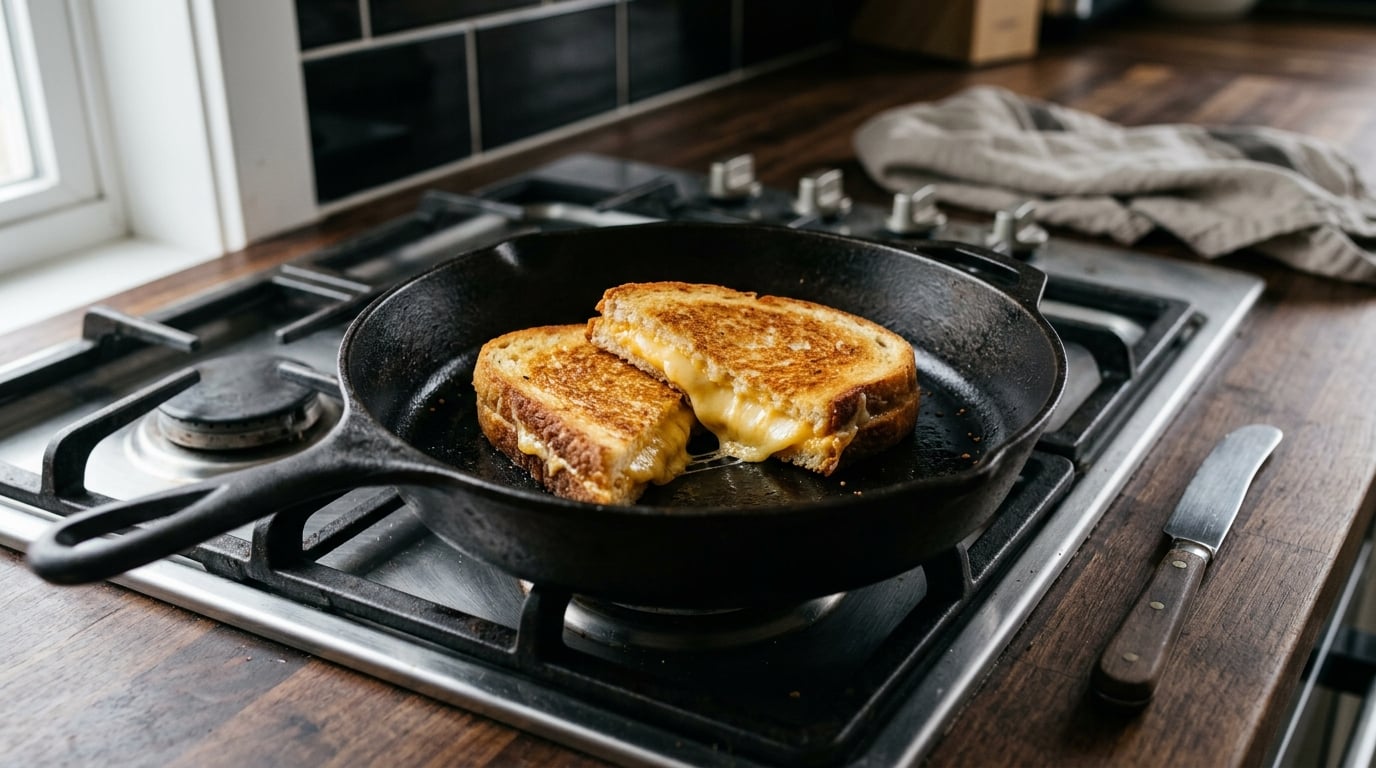
Why your grilled cheese burns before the cheese melts comes down to one thing: the crust is being cooked by direct contact with a very hot pan, while the cheese in the middle only warms by slow conduction through the bread. High heat wins the race for the browning and loses the race for the center. Drop to medium-low, put a lid on, and thin the cheese, and the problem usually disappears.
That is the short answer. The longer answer is that a grilled cheese is four different heat behaviors happening at once, and only one of them responds to how hard you turn the knob.
Table of Contents
- Why Your Grilled Cheese Burns Before the Cheese Melts
- Heat, Bread, and Cheese Melt at Different Rates
- What Actually Causes the Burnt-Bread, Cold-Center Problem
- How to Melt the Cheese Without Burning the Bread
- What Heat Should You Use for a Grilled Cheese?
- Does the Cheese Type or Thickness Matter?
- Should You Use Butter, Oil, a Lid, or a Double-Pan Method?
- How to Tell When the Cheese Is Fully Melted
- How to Fix a Sandwich That Is Already Browning Unevenly
- Frequently Asked Questions
- Conclusion
Why Your Grilled Cheese Burns Before the Cheese Melts
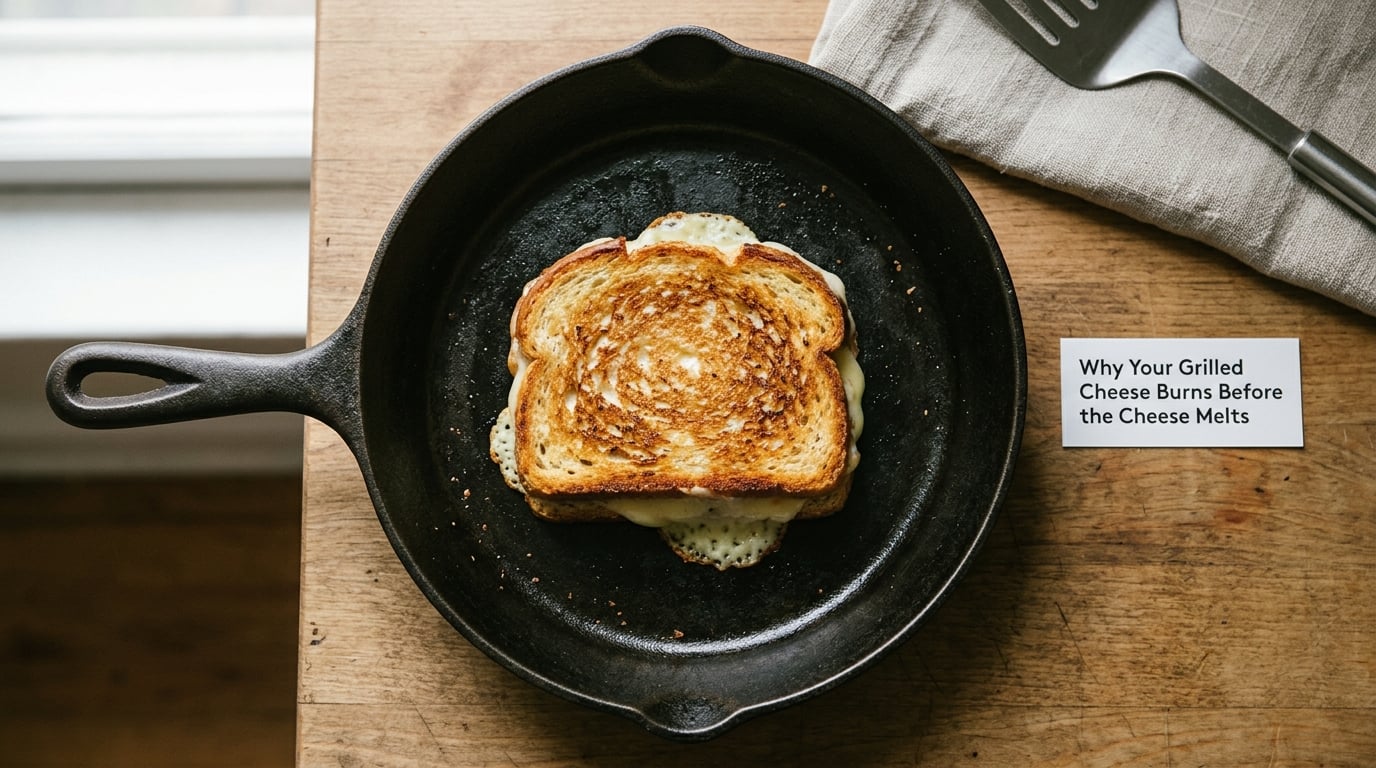
The crust darkens because the surface of the bread touches metal hot enough to trigger browning, a reaction that starts somewhere around 300F and runs fast. The cheese does not move at that pace. It sits sandwiched between two bread slices, insulated on both sides, and it only softens when enough heat has conducted all the way through to the middle.
So you are running two processes with opposite needs. The outside wants a hot pan and short exposure. The inside wants time and gentle heat. Set the pan for the outside and the inside loses.
Heat, Bread, and Cheese Melt at Different Rates
Energy moves through a sandwich in a sequence, and each layer transforms at a different speed and a different temperature.
| Layer | What it needs | How fast it changes | What goes wrong |
|---|---|---|---|
| Burner | Steady input, not maximum | Instant | High flame hits the pan edge first |
| Pan surface | Even, moderate heat | Seconds | Hot spots scorch the crust before the middle heats |
| Bread slice | Contact heat plus a few minutes | 1 to 3 minutes per side | Toasts on the outside while staying chewy inside |
| Cheese layer | Heat conducted through the bread | Slowest step, often 4 or more minutes | Rigid cold seam in the middle of a dark sandwich |
Below roughly 300F the bread surface stays pale and a bit flabby. Around 375F and above, the outer face colors in under two minutes while the center of the sandwich is still near room temperature. That gap is the whole problem.
What Actually Causes the Burnt-Bread, Cold-Center Problem
Most burnt grilled cheese comes down to a small number of repeating mistakes. I see the same four or five over and over.
- The pan is too hot. A skillet left on medium-high for a minute before the sandwich goes in has a surface well past the browning window. That is the single biggest cause.
- The bread is thin or already dry. A single thin slice has almost no thermal mass, so it goes from pale to scorched in seconds. Sourdough, challah, and pull-apart bread give you a longer window.
- The cheese is straight from the fridge. Cold cheese needs more energy before it softens, and that extra demand always comes out of the crust’s time budget.
- The filling sits on one side. Cheese slid to a single corner leaves a bare bread face that burns fast and a packed seam that never melts.
- <strongYou flip early, or fight the pan. Shovelling and scraping drags the sandwich, and flipping before the first side has set means the filling falls out and the bread tears.
A crowded pan is the quiet version of the same mistake. Two sandwiches in a skillet means the burner setting is now driving four bread faces, and the heat per face drops unevenly.
How to Melt the Cheese Without Burning the Bread
The corrected method is unremarkable once you see it as two phases: a slow melt phase and a short crisp phase.
- Pick bread with some body. Sandwich-thick white bread, sourdough, or challah. If your slices are thinner than about a quarter inch, double them.
- Butter the outside lightly. A thin coat on the faces only. Heavy butter is what blackens first.
- Start the skillet cool or barely warm. Put the sandwich in, then bring the heat up. This slow ramp gives the center time to catch up.
- Settle at medium-low. You want steady bubbling butter, not sizzling.
- Put the lid on for the first part of the cook. Trapped steam softens the cheese and the bread together, and it slows crust browning at the same time.
- Lift the lid, press the sandwich once with a spatula, and let the crust color. This is the crisp phase, and it should be brief.
- Flip once and repeat, lid off. Most sandwiches finish in five to ten minutes total.
What Heat Should You Use for a Grilled Cheese?
Medium-low is the right default on almost every stovetop. The setting matters less than the cues, so use your hand and the sound of the butter rather than the dial.
| Cooktop or pan | Start at | Sign you are right |
|---|---|---|
| Gas, thin nonstick skillet | Medium-low, flame kept under the base | Butter foams gently and the bread darkens slowly |
| Gas, cast iron or heavy skillet | Medium for the first minute, then medium-low | Even bubbling across the whole base, no dark ring at the edge |
| Electric coil or radiant | Medium-low, expect slightly longer | Slower, more forgiving browning with no flare-up |
| Thick sourdough or two-cheese sandwich | Low-medium with the lid on early | Cheese softens before the crust shows much color |
| Thin deli-style bread | Low, or add a second slice layer | Any higher and the crust scorches in seconds |
Cast iron is more forgiving than thin nonstick because of thermal mass: the pan holds and spreads heat instead of dumping it all into one spot. That is why the same burner setting produces a different sandwich in a heavy skillet.
Does the Cheese Type or Thickness Matter?
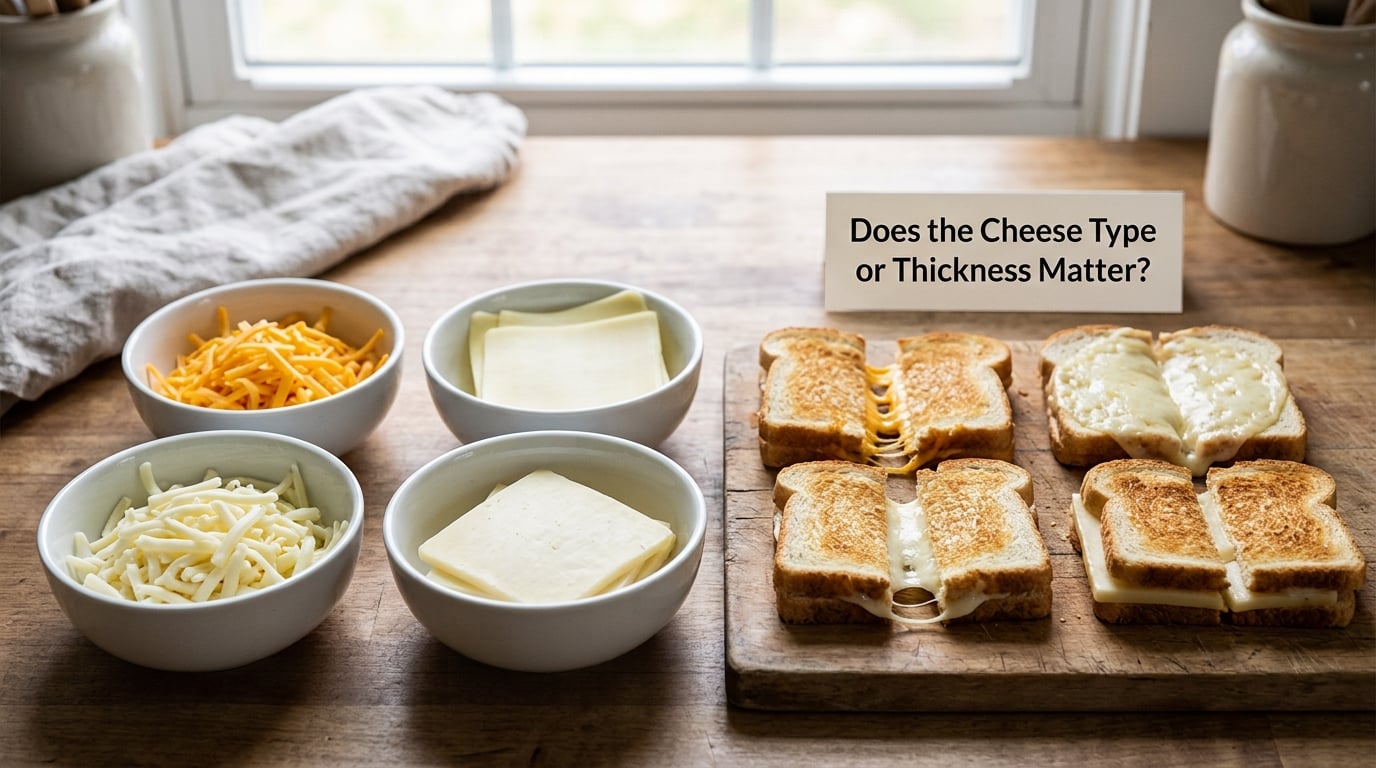
Yes, and thickness usually matters more than variety. A chunk of cheese one centimeter thick in the middle of a sandwich is a thermal mass problem before it is a flavor problem.
- Easy-melt slices such as American, Monterey Jack, or mild cheddar soften quickly and spread, which is exactly what you want under a time limit.
- Natural aged cheese such as Gruyere or aged cheddar melts later and can turn oily and stringy if pushed too far. Shred it and mix in an easy-melt slice as a binder.
- Two thin layers beat one thick slice. Lay each piece so it reaches the bread edges.
- Grated cheese melts fastest of all because there is no solid core to hold out.
- Room-temperature cheese softens more evenly and shortens the race. Thirty minutes out of the fridge is plenty.
Even distribution is the real trick. If the cheese reaches every edge of the bread, the heat has a path into it and the melt spreads instead of pooling in one seam.
Should You Use Butter, Oil, a Lid, or a Double-Pan Method?
These solve different parts of the problem, and combining a fat with a lid is usually better than either alone.
| Method | What it does | Helps most when |
|---|---|---|
| Butter | Adds fat and browning color, but milk solids scorch quickly | You want a golden crust and control the heat |
| Oil | Higher smoke point, slower browning, paler crust | You are cooking high and fast, or on a grill |
| Mayonnaise | Mostly oil with a high smoke point, browns like butter | Butter keeps catching and you want crunch without scorch |
| Lid | Traps steam so the interior cooks without extra surface heat | The center is lagging behind the crust |
| Second pan on top | A gentle top weight that improves contact and even browning | Your pan has no lid, or the sandwich is domed |
Butter burns quickly because of its milk solids and low smoke point, which is why it scorches before the inside finishes. Mayonnaise is mostly oil and tolerates heat far better. I use butter on medium-low with the lid on, and reach for mayonnaise when I am cooking a thicker sandwich at a slightly higher setting.
How to Tell When the Cheese Is Fully Melted
Brown crust tells you nothing about the center. Three cues do.
- The cheese has softened across the full width of the filling, not just at the cut edge.
- Lifting the sandwich on a spatula, the cheese runs slowly and evenly rather than sitting as a firm block.
- There is no rigid seam left in the middle when you press the top slice gently.
A sandwich that is dark on the outside and still solid in the center has simply been toasted on one side of the equation.
How to Fix a Sandwich That Is Already Browning Unevenly
You can rescue most of these mid-cook. Lower the heat first, and give it fifteen to twenty seconds to settle.
Slide the sandwich to a cooler part of the pan or onto a warm zone away from the flame. Put the lid on and leave it for a minute so trapped steam finishes the cheese without adding to the crust. Press once with a spatula to even out the filling, then finish that side until the color matches the other.
If one side is already dark enough, lift the sandwich out, set the cooked side face-up on a board, and start the pale side in a second lightly buttered pan. Two pans beat trying to rescue a scorched face.
One warning: never pour cold water into a hot skillet. The steam spatters and it can damage the seasoning on cast iron.
Frequently Asked Questions
Why does my grilled cheese burn before the cheese melts?
The crust browns by direct contact with a very hot pan surface, while the cheese only warms by conduction through two bread slices. High heat colors the outside in under two minutes but leaves the center near room temperature. Medium-low heat, a lid, and thinner cheese close that gap.
Should I use low heat or medium heat for grilled cheese?
Medium-low is the best default on gas, electric, cast iron, and nonstick alike. Low alone tends to give you a pale, soft crust. If your pan is cast iron or your sandwich is thick, start a shade higher for the first minute, then drop to medium-low so the center can catch up.
What cheese melts best without making grilled cheese soggy?
Easy-melt varieties such as American, Monterey Jack, and mild cheddar soften fast and spread to the bread edges without releasing a lot of water. Aged natural cheese like Gruyere melts later and can turn oily. Use a modest amount, layer it thin and even, and take the sandwich off the heat as soon as it flows.
Is butter or oil better for grilled cheese?
Butter browns faster and gives a richer color, but its milk solids scorch quickly at high heat. Oil has a higher smoke point and browns more slowly. Mayonnaise sits in between, tasting mild but browning like butter. On medium-low, butter is hard to beat. Above that, use oil or mayonnaise.
Does covering grilled cheese with a lid help the cheese melt?
Yes. A lid traps steam and finishes the interior without adding heat to the crust, which slows browning exactly when you need it to slow down. Put it on for the first part of each side, then take it off for a final crisp phase. Press the sandwich once before flipping.
Conclusion
Change one thing next time: medium-low heat, bread that is not paper thin, and enough cheese spread evenly to the edges. Let the cheese soften under a lid before you chase the crisp crust.
That is why your grilled cheese burns before the cheese melts, and it is why waiting for the melt instead of watching the toast fixes it. Home cooks on r/grilledcheese and r/Cooking keep landing on the same combination, and the physics backs them up.