
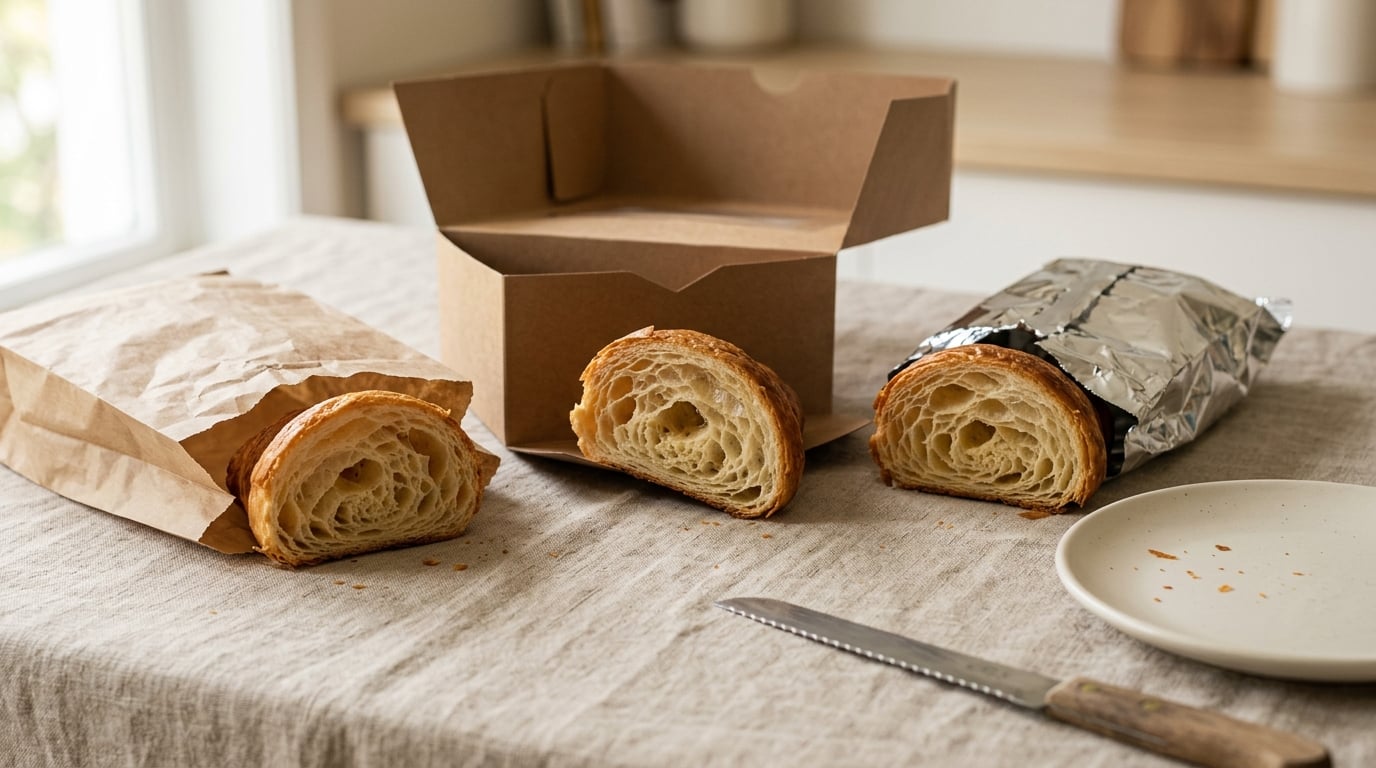
A day-old croissant from your favorite bakery will beat any store-bought version on flavor, but it is a poor sandwich bun: it shatters when you slice it, soaks through in ten minutes, and costs the most per serving. The best croissants for sandwiches come down to how you’ll use them. Buy a bakery croissant for a plated lunch where taste is the point. Buy a warehouse club case for volume service and short shelf life tolerance. Buy unbaked frozen croissants when you want bakery results with zero waste.
One rule matters more than the source: warm the croissant first, fill it second. Heat drives moisture out of the crumb and re-crisps the crust, so the base resists sogginess for the ten minutes it sits under a filling. Skip that step and even a great croissant turns into a disappointment.
Updated for October 2026
Table of Contents
- Best Croissants for Sandwiches at a Glance
- Flavor and Texture: Which Croissant Tastes Best?
- Structure: Which Croissant Holds a Sandwich Best?
- Cost and Value: Bakery, Costco, or Frozen?
- Convenience and Storage
- Best Uses for Each Type
- How We Compared Them for Sandwiches
- Which Should You Choose?
- Frequently Asked Questions
- Are frozen croissants as good as bakery croissants for sandwiches?
- Are Costco croissants better than a bakery croissant for sandwiches?
- Which croissant is best for an egg salad sandwich?
- Why does my croissant sandwich get soggy?
- Can you freeze croissants and reheat them?
- How long do Costco croissants last without preservatives?
- Conclusion
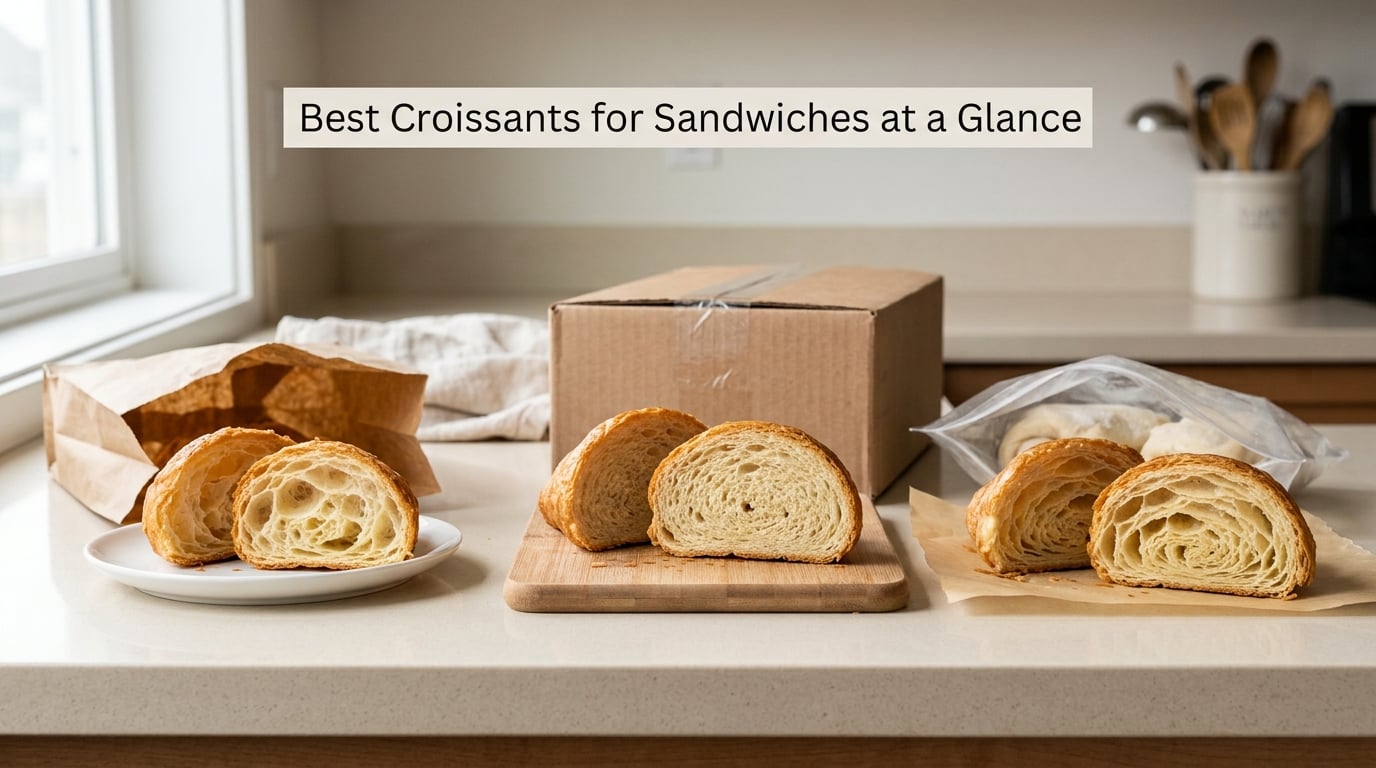
Best Croissants for Sandwiches at a Glance
| Criterion | Bakery | Warehouse club | Unbaked frozen |
|---|---|---|---|
| Butter flavor | Highest, with yeast complexity | Good, all-butter formulas available | High once baked; you control the browning |
| Flake and layers | Fine, delicate, easily crushed | Bolder, more visible layers | Fine, consistent from batch to batch |
| Holds a wet filling | Weakest, soaks fastest | Best of the ready-to-eat options | Strongest, since a hot crust firms the crumb |
| Relative cost per croissant | Highest | Lowest | Low to mid, with no waste |
| Freshness window | Same day to two days | Short, no preservatives | Months in the freezer |
| Prep before service | Warm 5 to 7 minutes | Warm 5 to 7 minutes | Bake 18 to 25 minutes, then warm |
| Suits | Plated, premium menus | Cafeteria and deli volume | Meal prep, catering, freezing ahead |
One line summary: bakery wins flavor, warehouse club wins volume, frozen wins waste control. For most sandwich kitchens the club croissant is the workhorse and unbaked frozen is the backup plan for demand you can’t predict.
Flavor and Texture: Which Croissant Tastes Best?
Butter flavor and yeast depth
The bakery croissant has a longer proof, more butter, and a hotter oven, so it tastes yeasty and layered rather than merely rich. That extra fermentation is also what makes it fragile. The crumb is light and dry, which is delicious on its own and terrible at holding egg salad.
Warehouse club croissants vary more than the packaging suggests. Costco’s Signature Butter line has been reformulated over time, and long-time buyers on r/Costco describe the arc clearly: earlier versions were “light and flakey, the good bakery quality kind,” then the style softened into something more “soft and a bit spongy, a little greasy, but tasted good.” One regular buyer put it plainly: “I dislike how they are so soft. There’s no flake or texture like a traditional croissant.” The formula has also gone back and forth between all-butter and a mix that includes soybean or canola oil, so read the ingredient list on the day you buy rather than trusting last year’s impression.
Unbaked frozen croissants have the least flavor out of the box because they are dough, not pastry. What you get is control. A hot oven browns the butter in the layers properly, and a fresh bake has more aroma than a ready-to-eat croissant that has been sitting in a bakery case since morning.
What warming does to each tier
Warming is not a nicety here. It is the difference between a sandwich that holds and one that collapses in the bag. Give any croissant five to seven minutes at 300F in an oven or toaster oven, or the same in an air fryer, and the crumb firms, the crust re-crisps, and the shell pushes back against moisture.
Frozen unbaked croissants need the full bake first, usually 18 to 25 minutes depending on size, then the same short warm before assembly. Skipping that two-stage process is the most common reason people decide frozen croissants are “not as good” as bakery ones. They are comparing dough to a finished pastry.
Structure: Which Croissant Holds a Sandwich Best?
The warehouse club croissant wins the structural test. It is denser, the layers are bonded by a little more fat and sugar, and the shell has enough snap to resist a wet filling. That density is exactly what pastry lovers dislike, and it is exactly what a sandwich needs.
Bakery croissants tear along the layers when you run a knife through them. The fix is to slice with a serrated knife using a gentle sawing motion, not to press down. Rest the croissant on a board with a damp towel under it so it stops sliding, and cut the bottom third off first, then remove the top cap only if the filling is tall enough to need the room.
Deli meat and cheese are forgiving on any tier. Egg salad, tuna, and chicken salad are the real test, because mayonnaise and chopped egg push water into the crumb. Build those sandwiches in this order: warm the base, spread a thin layer of something with fat and salt, such as butter, pâté, or a swipe of the filling’s own dressing, add the lettuce or a salt-cured layer such as ham or bacon, then the filling, then the cap last. The fat barrier is doing the same work a lettuce leaf does on a sub roll.
Turkey and cranberry works best on the club or frozen tier. The tartness of the cranberry against buttery dough is a good match, and a firmer crumb keeps the sandwich from turning to mush after twenty minutes. Roast beef with horseradish cream behaves the same way. Skip the delicate bakery croissant for anything wet or sharp.
Skewers matter more than most people expect. A single wooden pick through the middle of a filled croissant holds the stack together through a lunch bag, and for catering trays it is the difference between a tidy tray and a pile of collapsed bottoms.
Cost and Value: Bakery, Costco, or Frozen?
Bakery croissants sit at the top of the range and the exact number depends on your region and the shop. A neighborhood boulangerie will charge more than a supermarket bakery counter for the same shape, and the price rarely drops even when you buy six at once.
Warehouse club cases give the lowest cost per croissant of any ready-to-eat option, largely because they are sold in bulk and rotate through a high-volume bakery. That lowest headline number comes with a hidden line item: waste. Without preservatives, a case that doesn’t move goes past its sell-by date, and repeat buyers on r/Costco point this out as the main drawback of buying for volume. Costco also changes vendors and formulas, so per-croissant value can shift between visits.
Unbaked frozen croissants land between the two on cost per croissant, and they are the only tier where you buy exactly what you will use. Nothing expires, nothing gets donated, and the unit cost drops every time you bake a full tray instead of a single pastry. For a shop doing six dozen breakfast sandwiches a day, that predictability is usually worth more than the per-piece savings from a club case.
Cost per finished sandwich tells a different story than cost per croissant. Add filling, labor, and waste, and the gap between a premium bakery croissant and a cheaper club croissant narrows fast. If your menu price is driven by ingredients rather than by the croissant, frozen usually wins outright. The one rule I’d hold to: never quote a sandwich price built on a bakery croissant unless you have a same-day delivery agreement in writing.
Convenience and Storage
Bakery croissants are a planning-day purchase. Buy them in the morning, use them that day, and treat anything from yesterday as a baking ingredient rather than a sandwich base. Refrigeration makes them stale faster, which is counterintuitive but true; leave them at room temperature in a paper bag, never plastic.
Warehouse club croissants are the easiest of the three for a set lunch. The case is right there, the size is predictable, and nobody has to think about it. The catch is shelf life, and buyers regularly repurpose day-old club croissants for bread pudding or stuffed cookies rather than waste them, which is a good habit for anyone buying in volume.
Frozen is the opposite: more planning upfront, zero planning later. Bake a dozen, cool them fully, and freeze. Thaw at room temperature wrapped in a towel, never in the open where the crust goes soft, or reheat from frozen at 300F for a few minutes longer. For a last-minute weekday lunch, the club case still wins because there’s no baking step between you and the sandwich.
Storage detail worth knowing: croissants are hygroscopic, meaning they pull moisture out of the air. That is why a croissant left on a plate in a humid kitchen goes soft within hours, and why an airtight container is the single worst place to store one.
Best Uses for Each Type
Ham and egg or bacon breakfast sandwiches: club or frozen. This filling is wet, hot, and eaten fast, and a hot crust plus a skewer is what keeps it together through the morning rush.
Turkey and cranberry on a platter for hosting: bakery. The filling is dry enough to be kind, and this is the occasion where the yeast flavor and flakiness actually get noticed. Slice it just before serving.
Egg salad or tuna salad for a catered tray: club or frozen, and prep in advance. Cut the base, fill, cover, and refrigerate no more than a couple of hours before service. A chilled croissant is firmer than a room-temperature one, so a cold tray is actually on your side.
Roast beef and horseradish for a deli counter: club. Volume, consistency, and a predictable crumb beat flavor nuance at a lunch counter.
Meal prep for the week: frozen. Bake once on Sunday, cool, freeze in single portions, and reheat in the toaster oven. The difference in texture is small after a proper warm.
The middle tier deserves a mention, since it’s what most people actually find on the way home from work. Trader Joe’s croissants are soft and pillowy with a good butter note, which makes them a decent egg salad base at a moderate per-piece cost. Member’s Mark sandwich croissants are built for the job, though a bakery employee quoted in a published chain comparison described a newer version as “doughy, dry, not buttery, and tough,” so sample before committing to a case. Marketside, ALDI Bake Shop, Publix, and Target Favorite Day all sit in the same general band, and the same test applies to all of them: press the side of the croissant and see whether it springs back or stays dented.
How We Compared Them for Sandwiches
Most croissant rankings judge a pastry. We judged a bread, using the same criteria a sandwich kitchen would apply.
Flavor: butter intensity and yeast depth, tasted plain before any filling was added.
Flakiness: visible layers and whether they survive a serrated knife instead of shattering into flakes.
Structure: crumb density and shell strength under a wet, mayonnaise-based filling, scored after twenty minutes in a closed container.
Warming method: how the croissant responds to 300F for five to seven minutes, in an oven, a toaster oven, or an air fryer.
Serving cost: cost per finished sandwich including filling, labor, and unsold waste.
Availability and storage: where it’s sold, how long it stays usable, and whether it freezes without losing the property that matters.
One deliberate exclusion: calorie counts and nutrition panels. They’re easy to find on the box and say nothing about whether a croissant survives being filled.
Which Should You Choose?
Best overall for a single great sandwich: bakery. If you’re making two sandwiches for a Tuesday lunch, taste wins and the fragility doesn’t matter because you eat it in twenty minutes. Buy the croissant the same morning you need it.
Best value for daily service: warehouse club. The lowest cost per sandwich of any ready-to-eat option, a consistent size, and a crumb that holds filling. Plan for waste, buy in quantities you’ll sell within the sell-by window, and read the ingredient list since formulas change.
Best for freezing and quick weekday lunches: unbaked frozen. Bake to order, portion control is exact, and nothing expires in the back of the freezer. Budget the extra bake time.
Best for catering trays: frozen, assembled ahead. You control the batch size, the crumb is firmest, and you can build the whole tray the morning of the event.
If you can only buy one thing first, buy the club case. It’s the most forgiving option across every filling type, and it’s the one that teaches you fastest what your kitchen actually likes.
Frequently Asked Questions
Are frozen croissants as good as bakery croissants for sandwiches?
For sandwiches, unbaked frozen croissants are arguably better, because baking them at high heat produces a firmer crumb and a crisper shell than a ready-to-eat croissant that has been sitting in a case. They taste less complex than a day-old bakery croissant, since most are made without the long proof a boulangerie uses. If you bake one fresh and warm it before filling, the flavor gap nearly closes.
Are Costco croissants better than a bakery croissant for sandwiches?
Not for flavor, yes for structure. A bakery croissant wins on butter depth, yeast complexity, and delicate flakiness, but it tears when sliced and soaks through quickly. Club croissants are denser with more bonded layers, which is why they hold egg salad and tuna without collapsing. Long-time buyers on r/Costco also report the style drifting softer over time, so judge the batch in front of you.
Which croissant is best for an egg salad sandwich?
A dense, unbaked frozen or warehouse club croissant works best, because egg salad is wet and pushes moisture into an airy crumb. Warm the croissant first, spread a thin layer of butter or the filling’s own dressing on the base to create a fat barrier, then add the filling and a skewer. A bakery croissant is the wrong tool here no matter how good it tastes on its own.
Why does my croissant sandwich get soggy?
Three usual causes: you filled the croissant before warming it, you used an airy bakery crumb with a wet filling, or you stored the sandwich uncovered so the steam had nowhere to go. Warm the base at 300F for five to seven minutes first, add a thin fat layer such as butter or pâté, and let the sandwich sit for a few minutes before wrapping. Chilling the assembled sandwich also firms the crumb.
Can you freeze croissants and reheat them?
Yes, and a ready-to-eat croissant freezes better than most people expect. Cool it completely, wrap it in foil or a freezer bag so it does not pick up odors, and freeze up to a month for good results. Reheat from frozen at 300F for five to eight minutes, adding a couple of minutes if it goes straight from freezer to oven. Skip the microwave, which softens the crust.
How long do Costco croissants last without preservatives?
Treat the printed sell-by date as real, since club bakery croissants carry no preservatives to slow staling or mold. Cool them at room temperature in the bag rather than refrigerating them, which dries the crumb faster. If you buy a case you cannot sell in time, freeze what you will use and repurpose the rest into bread pudding, which is what repeat buyers commonly do with day-old ones.
Conclusion
Pick the croissant for the job rather than for the pastry. A bakery croissant is the best croissants for sandwiches choice when the sandwich is plated, eaten right away, and the flavor is the whole point. A warehouse club case is the best when you are building sandwiches by the dozen and need a crumb that survives egg salad.
Unbaked frozen croissants are the answer when waste and planning are the problem you actually have, because they are the only tier that keeps for months and bakes to order. Buy the club case first, warm the croissant before you fill it, and the rest of the decision takes about ten seconds.