
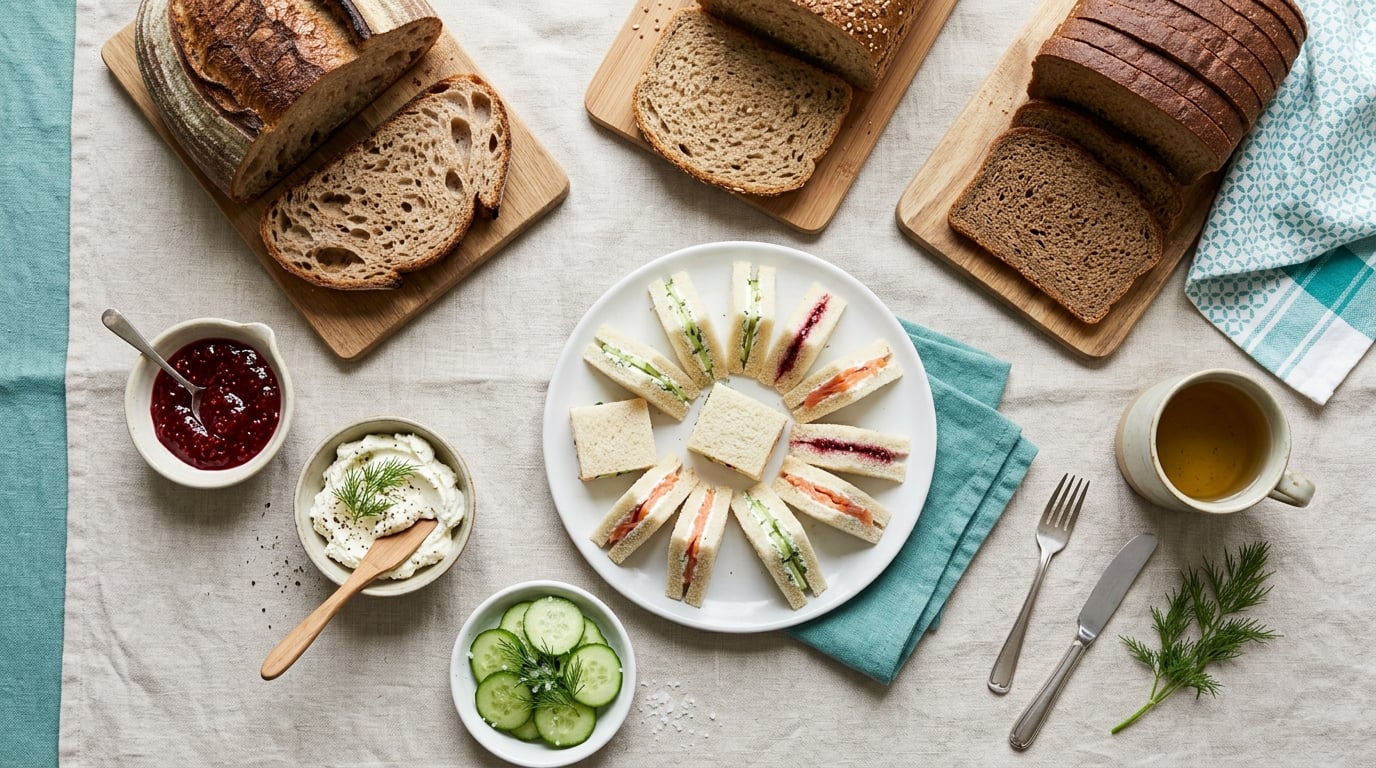
The best bread for tea sandwiches is a firm, fine-grained, thin-sliced white sandwich bread. Its neutral flavor lets cucumber and cream cheese, egg salad, or smoked salmon speak for themselves, and its even crumb stays flat when you cut it into small squares. Bread that is too soft squashes, too chewy fights the filling, and too flavorful turns a two-bite sandwich into a mouthful of toast. A tea sandwich is two of the three bites on that little triangle, so which loaf you pick decides whether the tray looks neat or looks like a pile.
I have assembled these sandwiches for enough afternoon teas, baby showers, and wedding-adjacent brunches to be opinionated about the details. The differences between loaves are small on paper and obvious on the platter. What follows is a bread-by-bread breakdown, what each one wants to be filled with, and how to pick a loaf at the store so your squares come out uniform.
A quick note on scope: this is a selection guide, not a recipe. Fillings get the brief attention they deserve, but the loaf comes first, because once the bread is wrong, no amount of clever filling rescues the tray.
Table of Contents
- Best Bread for Tea Sandwiches and Finger Sandwiches at a Glance
- 1. White Sandwich Bread
- 2. Sourdough Bread
- 3. Wheat Bread
- 4. Rye Bread
- 5. Whole-Grain Bread
- 6. Brioche
- 7. Ciabatta
- 8. Multigrain Bread
- 9. Pumpernickel
- 10. Gluten-Free Sandwich Bread
- Frequently Asked Questions
- What is the best bread for tea sandwiches that will not fall apart?
- Should I use the same bread for tea sandwiches and finger sandwiches?
- Is toasted bread better for finger sandwiches?
- What bread works best for cucumber and cream cheese sandwiches?
- How do I keep finger sandwiches from drying out?
- Can I make tea sandwiches ahead of time?
- Conclusion
Best Bread for Tea Sandwiches and Finger Sandwiches at a Glance
The table below is the short version. Ten loaf types, what each tastes like, what it holds well, how it cuts, and how much trouble it gives you at the two-hour mark on the buffet table.
If you want the one-line version, it goes like this. White sandwich bread for anything delicate, very thin and rectangular. Sourdough or pumpernickel when the filling is fish or cured meat. Rye for the boldest savory spreads. Brioche when the tray is half dessert. Ciabatta, toasted, for crostini. And a soft gluten-free loaf for anyone eating that way, chosen by bending the slice rather than by reading the front of the bag.
| Bread | Flavor profile | Best fillings | Best cut shape | Sogginess risk |
|---|---|---|---|---|
| White sandwich bread | Neutral, faintly sweet | Cucumber and cream cheese, jam and clotted cream, egg salad | Square, finger | Low with a spread barrier |
| Sourdough | Tangy, lightly sour | Salmon and dill, roast beef and horseradish, aged cheddar | Square, open-faced round | Medium, tang reads stronger when damp |
| Wheat bread | Mild, soft nuttiness | Ham and mustard, chicken salad, cucumber and ricotta | Square, triangle | Low to medium |
| Rye | Bold, earthy, malty | Smoked salmon, herring, cream cheese and capers | Finger, rectangle | Low, dense crumb resists it |
| Whole-grain | Hearty, nutty, bran flecks | Roast beef and horseradish, chicken and avocado, herbed cheese | Square, larger finger | Higher, dries and soaks quickly |
| Brioche | Buttery, rich, sweet | Chicken salad, butter and jam, cream cheese and fruit | Round, small square | Low, but goes stale fast |
| Ciabatta | Mild, floury, crisp crust | Tomato and mozzarella, chicken and pesto, olive tapenade | Crostini, bruschetta-style rectangle | Low once toasted |
| Multigrain | Nutty, varied texture | Turkey and cranberry, hummus and veg, egg and cress | Finger, larger square | Medium |
| Pumpernickel | Dark, earthy, faintly sweet | Smoked salmon, cream cheese and red currant, pastrami | Small circle, small square | Very low |
| Gluten-free sandwich bread | Neutral, soft if fresh | Same delicate pairings as white: cucumber, egg, cream cheese | Square, circle | Low, but crumbles if dry |
1. White Sandwich Bread
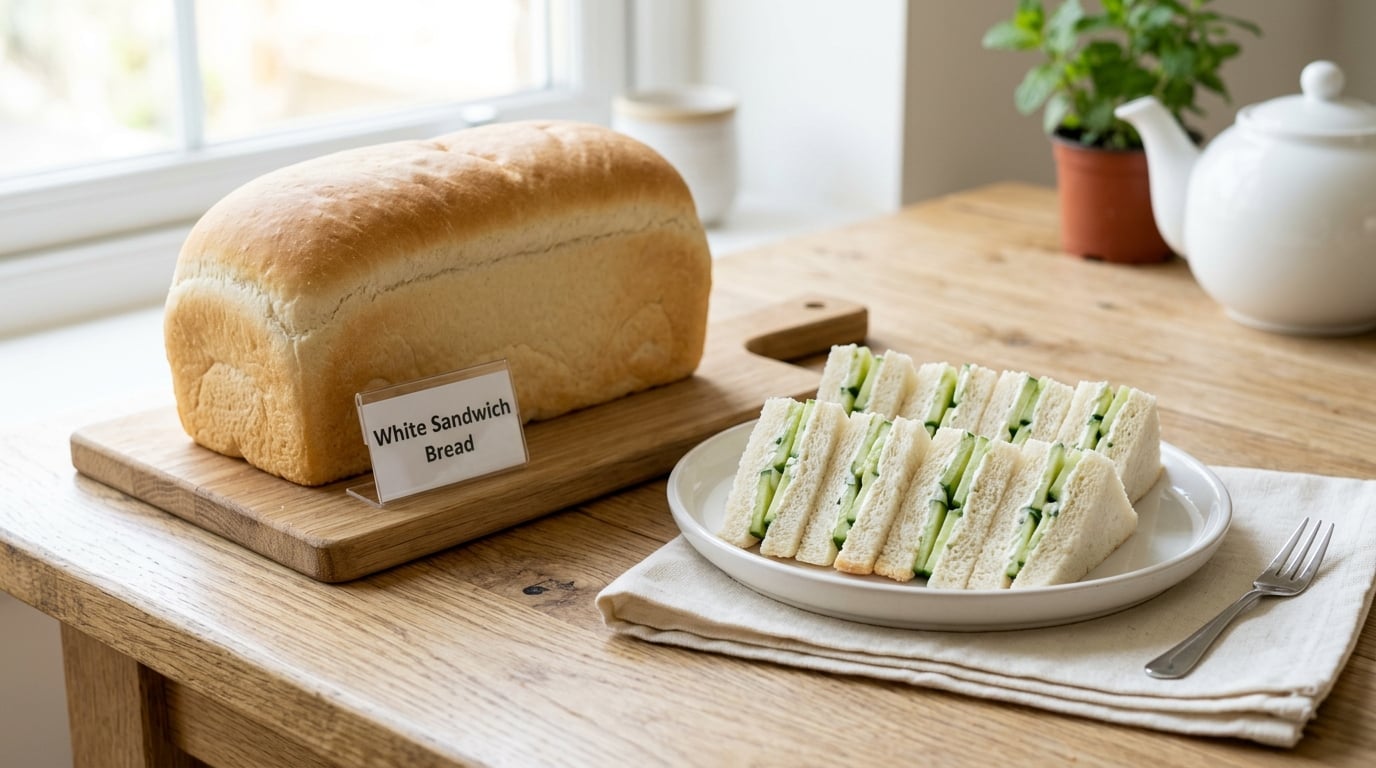
White sandwich bread is the safe answer, and for most tea tables it is the right one. The crumb is fine and even, the flavor is close to neutral, and the slices are already cut to a thickness that gives you two bites instead of one mouthful.
Look for a loaf that is actually rectangular, not one with a domed top from oven spring. Cooks have pointed this out on food forums for years: a squared-off loaf has no wasted hump slices, and every piece cuts into the same size. A very thin white loaf, the kind sold specifically for sandwiches, is the version most people mean when they say the classic tea sandwich base.
White bread handles creamy fillings better than anything else on this list. Cream cheese, butter, and soft cheese spread to the edges and create a barrier that keeps the filling from soaking in. Cut off the crusts, spread edge to edge, and a cucumber sandwich will still be holding its shape an hour into the service.
Here is the store checklist, in order. Pick up the loaf and look at the top from the side: a squared-off profile beats a domed one. Check the slice count and aim for 20 or more, since the end pieces are wasted once you trim crusts. Read the label for a thin or very thin designation, and check the ingredient list for seeds or grains in the crumb, which you do not want unless you have chosen multigrain on purpose. Finally, buy it the day before, never the morning of, so the slices are flexible rather than brittle.
Cutting shapes follow the same logic as the bread. Squares at 2 to 2.5 cm are the most forgiving and the easiest to portion evenly, so they are my default for a large tray. Triangles read as more formal, and one square slice cut corner to corner gives you two pieces with almost no waste. Circles need a small round cutter and a steady hand, but on a soft crumb they work well. Finger shapes are the longest to cut, so chill the loaf first or the corners drag and the ends compress under the knife.
Skip it when the bread is the point, or when the filling is wet. Fresh tomato, pickles straight from the jar, and a ripe avocado all overwhelm a slice that thin, and the result is a damp square that folds in half as you pick it up.
2. Sourdough Bread
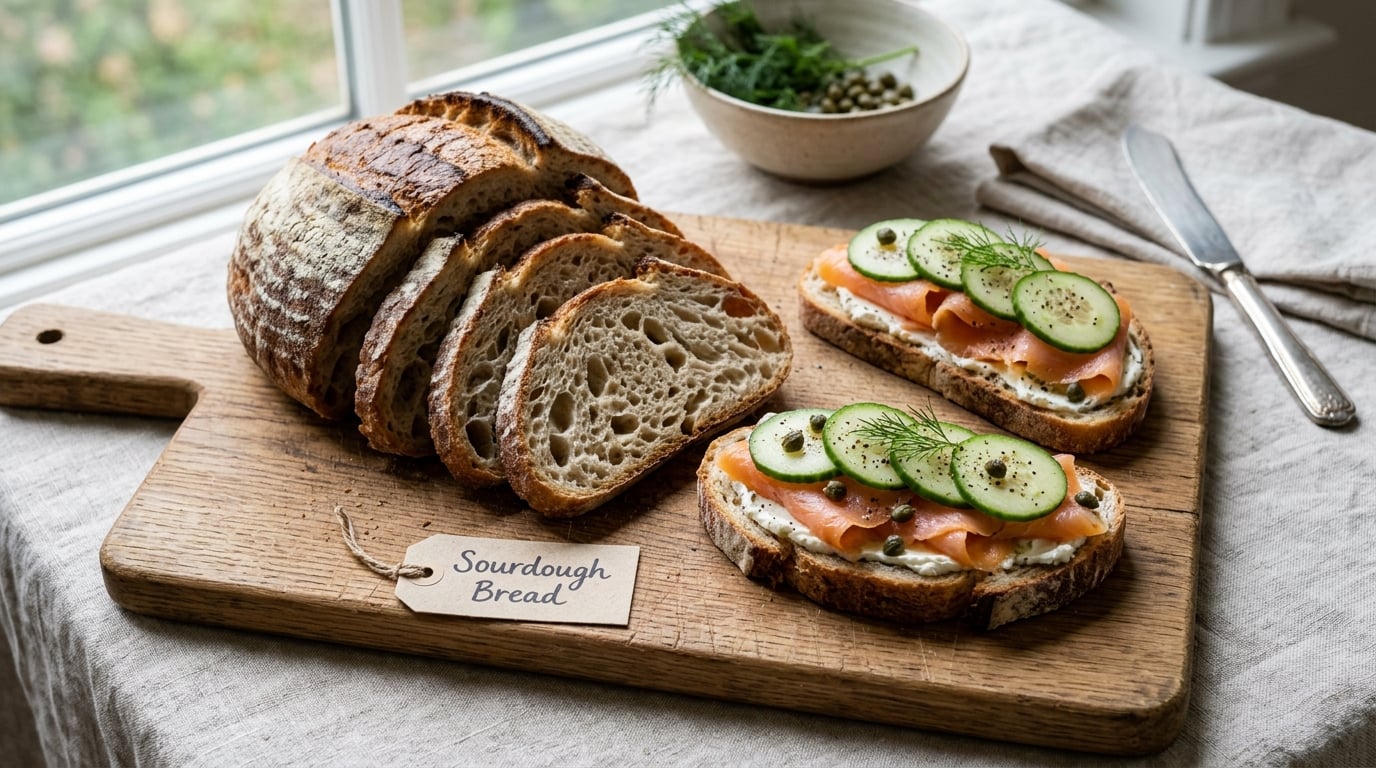
Sourdough brings tang and a crisp crust, which is genuinely lovely with fish and cured meats. What it does not bring is a neutral background, so the filling has to be strong enough to hold its own conversation with the crumb.
Use the center slices and leave the heel and the crust-heavy end at home. The middle of a sourdough loaf is the tender part, and the outer inch is where the chew lives. Two slices of leftover sourdough, crusts trimmed, cut into neat squares, and you have a sandwich that tastes like a decision rather than an accident.
Fillings that work well: smoked salmon with dill, roast beef with horseradish, aged cheddar with apple chutney. The acid in the bread balances the richness of salmon and cream cheese, and the horseradish cuts straight through the tang.
Where to find a better loaf is worth a mention. Supermarket sandwich bread is fine for this, but a bakery section loaf or a soft white milk bread from an Asian bakery has a noticeably finer crumb and a more even slice, which is exactly what the job needs. Home bakers get the same effect from a no-knead white loaf, which has the even open crumb and a thin, flexible slice once fully cool.
One thing to know: tang gets louder as the bread gets damp. If your service runs long, a sourdough square at hour three tastes more sour than it did at hour one. Assemble these closer to serving time than you would white bread, and keep the filling from touching the slice directly.
Sourdough is also the loaf to reach for when you want a small open-faced round. A slice toasted lightly, spread with cream cheese, and topped with flaked salmon and a dill sprig gives you a two-bite canapé with none of the squaring required.
3. Wheat Bread
Wheat bread, the plain wholemeal kind with no seeds and no added grains, is the middle path between white and whole-grain. It is soft enough for a light spread and sturdy enough to hold a layer of chicken salad without collapsing.
The flavor is a mild nuttiness that most people read as bread rather than as grain. That makes it a good background for ham and English mustard, and it works for the classics too if you want the tray to look a little less stark than an all-white spread.
Cut it into squares or triangles. The crumb is even enough that a triangle cut corner-to-corner comes out symmetrical, and the color gives you a visual break on a tray where every square is the same shade of cream.
The one thing to check is density. Some wheat loaves are dense enough to feel heavy in a two-bite portion. Squeeze a slice gently: if it springs back and feels like a normal piece of bread, it is right. If it feels like a brick, move to a lighter whole wheat or go back to white.
Wheat also gives you an easy answer when guests ask about the brown option. It is the compromise that rarely offends anyone, which makes it a useful second tray alongside a white one.
4. Rye Bread
Rye is a bold choice, and bold is right when the filling is bold. Smoked salmon, cured herring, cream cheese with capers, or a thick layer of egg salad all sit naturally against rye’s malty, earthy flavor.
Structurally, rye is a good match for finger sandwiches. The crumb is firm and slightly sticky in a way that actually helps: it grips the filling instead of sliding it off. A rye finger sandwich is far less likely to collapse in a guest’s hand than a white one.
Rye also travels well. It does not bruise, it does not wilt, and it holds a shape through a car ride in a way that white never manages, so it is a sensible pick when the tray is being assembled somewhere other than your kitchen.
Buy a denser rye rather than a light one, and cut it slightly thicker than you would cut white. A thicker slice gives you more structural support for a heavy filling, and it stays tender in the middle rather than turning to cardboard at the edge.
Caraway seeds are the one wildcard. If the loaf is heavily seeded, the visible seeds look messy when you cut small squares, and a couple of seeds poking out of a finger sandwich reads as a defect on a formal tray. Seedless rye keeps the look clean.
5. Whole-Grain Bread
Whole-grain bread is where texture becomes the deciding factor. The bran flecks and the slightly tighter crumb mean a heartier bite, and a heartier bite is not always what a two-bite sandwich wants. It works, though, when the filling is generous and moist enough to keep the crumb from drying out.
The dryness problem is fixable. Spread butter or cream cheese edge to edge, choose fillings with fat or moisture built in, and cover the finished tray until service. A whole-grain square that has been sitting uncovered in a dry room for two hours tastes like a cracker.
Good pairings: roast beef and horseradish, chicken and avocado, herbed cream cheese with cucumber. These are fillings that arrive with their own moisture, which is exactly what whole-grain needs to stay pleasant.
A note on the nutritional side, since it comes up a lot: whole-grain bread delivers more fiber and more of the grain than refined white, which is genuinely useful for anyone planning a large spread of small sandwiches. It is not a health claim I would hang an entire party on. It is simply a different bread, and some guests will appreciate the choice if you offer both.
For a baby-led weaning spread, whole-grain is often the easier introduction because the coarse texture gives a soft palate something to grip. Just watch the size, and cut bigger pieces for smaller hands.
6. Brioche
Brioche is the indulgent option, and it makes a two-bite sandwich taste like a small pastry. The crumb is soft, enriched with butter and egg, and slightly sweet, which means it can carry savory fillings and still feel like a treat.
It is a natural match for chicken salad, which is rich enough to sit next to the buttery crumb without either one overwhelming the other. Butter with jam and a little zest is the other direction entirely, and it makes a lovely small round for a dessert table. Cream cheese with sliced fruit works the same way.
Brioche compresses easily, so treat it gently. Chill the loaf for 20 to 30 minutes before cutting, use a sharp serrated knife with a light hand, and cut away from yourself. Warm brioche squashes into a flat, sad square no matter how careful your knife work.
The other issue is time. Brioche is at its best on the day it is baked, and by day two the crumb firms up and the richness turns slightly heavy. If you are buying ahead, buy a day at most, and rewrap in a clean towel rather than plastic if you can.
Brioche also freezes better than most enriched breads. Slice it, lay the slices flat on a tray to freeze individually, then move them to a bag. Thaw at room temperature and they soften back to usable within about an hour, which is faster than you would expect and a lot better than serving day-old brioche straight from the bag.
7. Ciabatta
Ciabatta is not really a sandwich bread in the classic sense. It is a bread to repurpose, and it does that job well. The airy, holey crumb takes dressings and melted toppings, and the crisp exterior gives you a pleasant contrast with something soft inside.
The best use is the crostini format. Slice it about a centimeter thick, brush with olive oil, toast until the edges crunch, and top with a spread. Tomato and mozzarella, chicken and pesto, or olive tapenade all work. Cut to about 2.5 cm and you have a small open-faced bite that is really a finger sandwich with the top slice turned into a cracker.
For a true sandwich, flatten the slices first. Put them under a clean baking sheet with a second tray on top and a little weight, or toast them briefly so the interior compresses. That step removes the chewy middle that makes a two-bite ciabatta sandwich a mouthful instead of a bite.
One loaf can do three jobs at a single event, which is useful when you are catering for a large group. Buy two ciabatta loaves: toast one for crostini with tomato and mozzarella, toast the second for chicken and pesto, and save any unsliced remainder for a side of bruschetta. The same logic works with sourdough, where the crisp slices become crostini and the tender center slices become the squares.
The air pockets are the thing to plan around. Large holes mean fillings fall out or slide down, so spread the base generously and keep wet ingredients to a minimum. A thick slice with a small topping beats a thin slice with too much on it.
8. Multigrain Bread
Multigrain brings variety into the crumb: seeds, oats, cracked grains, sometimes flax. The flavor is nutty and the texture is uneven, which makes it a good choice for casual spreads and a poor one for formal service.
That unevenness is the whole story. When you cut a multigrain loaf into 2 cm squares, the seeds are what you see first from across the table. A few flecks look appetizing; a square with a sunflower seed half-buried in it looks like a mistake to most hosts I have watched.
If you want multigrain for a mixed crowd, it works best as a second option rather than the main tray. Offer it alongside a plain loaf, and guests who like the texture will help themselves to it. Set the multigrain out for rustic gatherings, baby-led weaning spreads, and casual brunches where visual uniformity matters less.
Structurally it is fine, sometimes even helpful. The grains and seeds add body, so a chicken or turkey filling sits well. Just keep the portion a touch larger than a white square, because the chew is more noticeable when the pieces are small.
If seeds are the only problem, trim less aggressively and turn the cut so the visible face is the smoother side. Guests rarely object to multigrain on a casual table; they object to a sandwich that looks broken.
9. Pumpernickel
Pumpernickel is the densest bread on this list, and that density is exactly why it works so well for small portions. The crumb is moist, dark, faintly sweet, and strong enough that a thin slice does not buckle under anything you put on it.
It is a classic match for smoked salmon and cream cheese, and for the red currant jelly and cream cheese combination that shows up on a lot of formal tea menus. The slight sweetness of the loaf plays against the tartness of the jelly, and the crumb holds the cream cheese without absorbing it.
Cutting is where pumpernickel asks for care. A serrated knife is essential because the dense crumb will crush a straight blade. Take off the crusts first, then cut small, about 2 cm, and use a light sawing motion rather than pressing down. A small round or square cut from a slice yields four clean pieces.
Because the crumb is so firm, pumpernickel rewards a thinner spread than you would use on white. A heavy layer of cream cheese or salmon on a small dark square tips more easily than the same layer on a wider white piece, and the visual weight reads heavy. Spread a thin, even layer and leave a small border.
Moisture is a non-issue here, and that is part of the appeal. Pumpernickel can sit out longer than almost anything else on this list, which makes it a good pick for a spread you assemble early or a tray that travels.
10. Gluten-Free Sandwich Bread
Gluten-free sandwich bread has improved enormously, and there are now soft sandwich-style loaves made specifically for this rather than the dense, crumbly baking loaves of a few years ago. That matters for tea sandwiches, where a square that crumbles on the plate is a failure on presentation alone.
What to look for: a soft crumb, a shape close to rectangular, and slices that stay flexible when you bend them. Test one slice by bending it gently. If it folds without cracking, it will take a cream cheese spread and hold a cut edge. If it snaps, find a different loaf.
Preparation is where you win or lose. Do not skip toasting lightly if the loaf is at all crumbly, because a warmed, slightly set surface is far more resistant to crumbling than a cold soft one. And spread the cream cheese or butter all the way to the edges so the crumb never has a dry border to break away from.
Fillings that work: the same delicate pairings you would use on white bread. Cucumber and cream cheese, egg salad and cress, jam and clotted cream, smoked salmon and dill. Avoid wet fillings like fresh tomato or pickle brine, which these loaves absorb faster than wheat bread does.
Storage is the last piece. Gluten-free bread goes stale faster because it lacks the gluten structure that slows it down, so keep it sealed at room temperature for the day you need it, and slice it only when you are ready to cut sandwiches. A sliced loaf exposed to air dries out noticeably faster than a whole one.
For guests who eat gluten-free but not dairy-free, check the label for butter or milk, since many of these loaves are enriched. If you need a fully dairy-free base, a slice of firm tofu with the filling is a reasonable substitute for a small party tray, and it holds moisture better than any GF slice does.
How to Choose Bread for Your Sandwich Style
Once you have a shortlist, five variables narrow it down fast. Work through them in this order.
Slice thickness. You are making a two-bite sandwich, so aim for slices around 3 to 4 mm. Thinner than that and a filling-heavy square collapses; thicker and the bread is the majority of the bite. Very thin white is the classic answer, and a slightly thicker slice is better for smoked salmon, roast beef, or pumpernickel.
Firmness. You want a slice that springs back, not one that compresses permanently under your thumb. Day-old white bread is a legitimate choice here, and a fresh artisan loaf is often too soft. Firmness is a feature for this job.
Moisture in the filling. Wet fillings need a barrier. Butter or cream cheese spread edge to edge, on both slices, will block almost all seepage. Dry, crumbly fillings such as grated cheese or chopped nuts need the opposite, a crumb with enough fat and egg in it to bind them, which points you back to white bread or brioche.
Flavor intensity. Match the bread to the loudest ingredient. Delicate fillings such as cucumber, cream cheese, jam, and clotted cream want white, wheat, or brioche. Smoked salmon, cured fish, pastrami, and strongly seasoned salads want rye, pumpernickel, or sourdough, which can stand up to the flavor instead of getting lost.
How it will be served. Cold and chilled sandwiches want a soft, moist crumb because nothing is re-baking the surface. Toasted sandwiches, crostini, and canapés want a drier, crunchier base such as ciabatta or a toasted slice of sourdough. If the tray is a dessert table, brioche and slightly sweet loaves are worth the extra cost of better ingredients.
Once the bread is chosen, the order of work matters more than most recipes admit. The day before, buy the loaves and leave them sealed at room temperature. The morning of, cut the crusts off every slice you plan to use and chill the trimmed slices flat on a tray. Two hours before guests arrive, make the sturdy fillings first, since they keep better, then the mayonnaise-based ones last. Cut the white bread sandwiches just before you carry the trays out, and cover everything until service.
Party math is simpler than most hosts expect. One standard sandwich loaf gives about 20 usable slices once you discard the end pieces, and each slice makes two sandwiches, so a single loaf covers roughly 40 pieces. Plan on three to four small sandwiches per guest for an afternoon tea, and five if the spread is the main event. That means a group of 20 is about 70 to 80 sandwiches, or two loaves of white plus one of whatever bolder bread you are serving alongside.
Cut the delicate, dairy-heavy sandwiches last, and put them out last too. Egg salad, chicken salad, and anything with mayonnaise should be kept on ice and plated in smaller batches you can top up through the event, rather than laid out all at once.
Two food-safety notes while you are planning quantities. Fillings like egg salad, chicken salad, and tuna salad are perishable and belong in a cooler or on ice, and they should not sit at room temperature for more than two hours. If you are cooking chicken for a filling, cook it to an internal temperature of 165 F (74 C), and hard-boiled eggs used in egg salad should reach 160 F (71 C). Cut sandwiches with those fillings later than you cut the cucumber ones, and put the delicate tray out last.
Frequently Asked Questions
What is the best bread for tea sandwiches that will not fall apart?
A firm, fine-grained white sandwich bread, sliced thin, is the most reliable base. Its even crumb holds a square together and its mild flavor stays out of the way of delicate fillings. Spread butter or cream cheese edge to edge to create a moisture barrier, trim the crusts, and chill the loaf briefly before cutting with a sharp serrated knife.
Should I use the same bread for tea sandwiches and finger sandwiches?
You can, and most hosts do. White sandwich bread works well for both. The two formats overlap more than most recipes admit, though finger sandwiches tend to be a little longer and are often built for sturdier fillings such as smoked salmon or egg salad, where a firmer crumb like rye or pumpernickel holds up better than very soft white.
Is toasted bread better for finger sandwiches?
Not for most fillings. Toasting dries the surface slightly and makes a soft loaf hold its shape, but it also firms the crumb and dulls the mild flavor that makes white bread work as a background. Toast only when you want crunch, such as with cheese, or to firm up a loaf that is too soft to cut cleanly.
What bread works best for cucumber and cream cheese sandwiches?
Thin-sliced white sandwich bread, the firmer and more rectangular kind, is the classic answer. The fine crumb takes the cream cheese without absorbing it, and the neutral flavor leaves the cucumber and the dairy in charge. Spread the cream cheese all the way to the edges, salt the cucumber lightly, and drain it on a paper towel first.
How do I keep finger sandwiches from drying out?
Cover the tray until the moment you serve it, and cut sandwiches as late as you reasonably can. A damp, clean towel laid loosely over the top of the tray works well. For longer storage, put a layer of parchment between the rows, refrigerate them, and take them out about 20 minutes before serving so they are not served ice cold.
Can I make tea sandwiches ahead of time?
Yes, up to a few hours. Keep the slices and fillings separate as long as you can, then assemble close to service. Fully assembled sandwiches hold about two hours at room temperature, and refrigerated they soften and dry within a few hours, so they are best eaten the same day. Delicate fillings such as egg salad or chicken salad must be kept chilled.
Conclusion
Start with a rectangular, thin-sliced white sandwich loaf for anything delicate, and it will carry cucumber, egg, jam and clotted cream, or a simple herbed cheese without complaint. Reach for rye or pumpernickel when the filling is fish or cured meat, and for brioche when you want the sandwich to read as dessert-adjacent. Ciabatta, toasted, becomes your crostini base, and multigrain or whole-grain suit casual tables where texture matters more than a uniform look.
Whichever loaf you pick, buy it a day ahead rather than the morning of, keep it sealed, and do the actual cutting two hours before guests arrive. The best bread for tea sandwiches is simply the one that stays flat, stays quiet, and still tastes good at room temperature. Updated for 2026.